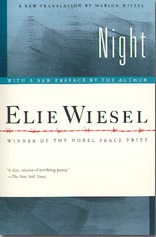
Night (book review)

Night by Elie Wiesel is not an easy read. But it is a vital read. In order to ensure that the evil perpetrated on the Jewish people by the Nazi regime never, ever happens to any other people group again, we must read what is not easy for us to read.

This book is the heart-wrenching account of the atrocities committed by the Nazis during the Holocaust. But it’s not simply a factual retelling of these horrendous events. Night takes you right into the utter despair felt by people who were completely dehumanized. People who were treated less humanely than animals. People who lived in the midst of pure Evil.

Elie Wiesel tells his firsthand account as a teenage boy forcibly removed from his home, separated from his mother and sisters, stripped of his dignity, treated in despicable ways, struggled with his anger toward God, and watched his father die right before his eyes. No one should have had to endure such things.

Elie Wiesel survived to tell his story, so that he could become the voice for the voiceless oppressed. What a great lesson for all of us to learn! We, too, should speak up for those who cannot. As Elie said in his Nobel Peace Prize acceptance speech:

We must take sides. Neutrality helps the oppressor, never the victim. Silence encourages the tormentor, never the tormented. Sometimes we must interfere. … Human suffering anywhere concerns men and women everywhere. … And action is the only remedy to indifference, the most insidious danger of all. … One person of integrity can make a difference, a difference of life and death.

Please read this book, and then be one person of integrity who makes a difference.

Thursdays With Oswald—Bad Theology

This is a weekly series with things I’m reading and pondering from Oswald Chambers. You can read the original seed thought here, or type “Thursdays With Oswald” in the search box to read more entries.

Bad Theology

Job’s friends came slowly to the conclusion that their view of God was right, therefore Job must be wrong. They had the ban of finality [the limitation or “curse” of having one’s mind made up] about their views, which is always the result of theology being put before God.

From Baffled To Fight Better

Putting theology before God makes a god out of my mind—and a very weak god at that. Or as G.K. Chesterton put it, “A weak mind is like a microscope, which magnifies trifling things but cannot receive great ones.”

Or maybe God said it best of all“As the heavens are higher than the earth, so are My ways higher than your ways and My thoughts higher than your thoughts.”

Job got it right. He continued to believe that God was doing something bigger than he could think or imagine. He didn’t close off his mind, or put his theology before God, or make a god out of his own ideas.

I pray that when the pressure is on, I can continue to trust God and not give in to the ban of finality.

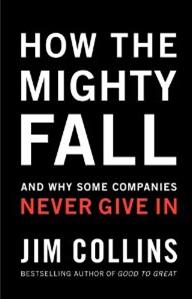
How The Mighty Fall (book review)

This is the third in the series of books from Dr. Jim Collins: Built To Last, Good To Great, and now How The Mighty Fall. This is a book that Dr. Collins wished he didn’t have to write, as he uncovers the markers that contributed to the failure of once-great companies.

If you are a frequent reader of my blog, you’re probably wondering why I’m reading/reviewing a business book. The answer is simple: the principles Jim Collins uncovers in his books are rock-solid principles of success and failure, regardless of the organization in which they are practiced or ignored. In all three of his books, I have mined so many great truths to apply to my personal life, as well as the organizations I lead.

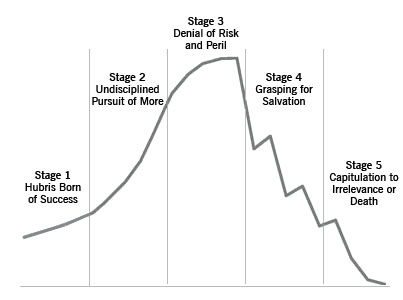
In How The Mighty Fall we learn about the five stages of decline for once-great organizations. Working backward from his evidence, Dr. Collins then gives us “markers” to look for in our own organizations that would tip us off to the stages of decline.

Why study this? Because I want to lead a great church! This quote from the book especially resonates with me:

“The point of struggle is not just to survive, but to build an enterprise that makes such a distinctive impact on the world it touches, and does so with such superior performance, that it would leave a gaping hole — a hole that could not be easily filled by any other institution—if it ceased to exist.” (emphasis added)

If you are involved in the leadership of any organization (whether for-profit or non-profit), I would encourage you to devour all three of Jim Collins’ books.

If Jesus Came To Your House

Listen to the podcast of this post by clicking on the player below, and you can also subscribe on AppleSpotify, or Audible.

If Jesus came to your house to spend a day or two—
If He came unexpectedly, I wonder what you’d do.
Oh, I know you’d give your nicest room to such an honored Guest,
And all the food you’d serve to Him would be the very best,
And you would keep assuring Him you’re glad to have Him there—
That serving Him in your own home is joy beyond compare.

But when you saw Him coming, would you meet Him at the door
With arms outstretched in welcome to your heavenly Lord?
Or would you have to change your clothes before you let Him in?
Or hide some magazines and put the Bible where they’d been?
Would you turn off the radio and hope He hadn’t heard?
And wish you hadn’t uttered that last, loud, hasty word?

Would you hide your worldly music and put some hymn books out?
Could you let Jesus walk right in, or would you rush about?
And I wonder—if the Savior spent a day or two with you,
Would you go right on doing the things you always do?
Would you go right on saying the things you always say?
Would life for you continue as it does from day to day?

Would your family conversation keep up its usual pace?
And would you find it hard each meal to say a table grace?
Would you sing the songs you always sing, and read the books you read,
And let Him know the things on which your mind and spirit feed?
Would you take Jesus with you everywhere you’d planned to go?
Or would you, maybe, change your plans for just a day or so?

Would you be glad to have Him meet your very closest friends?
Or would you hope they’d stay away until His visit ends?
Would you be glad to have Him stay forever on and on?
Or would you sigh with great relief when He at last was gone?
It might be interesting to know the things that you would do
If Jesus Christ in person came to spend some time with you. —Lois Blanchard Eades

(I added the emphasis to the things that made me pause to think…)

►► Would you please prayerfully consider supporting this ministry? ◀︎◀︎

Sharp Enough?

Long before Stephen Covey wrote about Habit 7: Sharpening The Saw, Solomon saw the value of taking time to sharpen the saw.

Using a dull ax requires great strength, so sharpen the blade. That’s the value of wisdom; it helps you succeed. (Ecclesiastes 10:10)

What are you doing TODAY to gain wisdom?

J. Wilbur Chapman asked F.B. Meyer, “What is the matter with me? So many times I fail, so many times I am powerless.”

Dr. Meyer responded, “Have you ever tried breathing out three times without breathing in once?”

What are you doing TODAY to breathe in?

Look at the mower in the summer’s day, with so much to cut down ere the sun sets. He pauses in his labor—is he a sluggard? He looks for his stone, and begins to draw it up and down his scythe, with rink-atink, rink-atink, rink-atink. Is that idle music—is he wasting precious moments? How much he might have mowed while he has been ringing out those notes on his scythe! But he is sharpening his tool. And he will do far more when once again he gives his strength to those long sweeps which lay the grass prostrate in rows before him. —Charles Spurgeon

What are you doing TODAY to sharpen yourself?

Sun Stand Still (book review)

Sun Stand Still by Steven Furtick is an amazing book!

The title and content of this book is based on an audacious, faith-filled prayer that Joshua offered in the Bible, where God actually allowed the sun to stand still so the Israelites could complete their battle before it got dark. What an amazing prayer: “God, please let the sun stand still”!

Steven leads us through the steps of getting a clear vision of what God wants to accomplish, and then activating that vision through audacious faith. He talks about the hindrances most of us will face in praying a Sun Stand Still prayer, about hanging on to faith during the waiting process, and even how to think about the times the sun goes down.

Through reading this book, I was so convicted that far too many of my prayers are puny, safe prayers; certainly not like the audacious Sun Stand Still prayer that Joshua prayed. But I was also encouraged and energized to begin to change the way I pray.

This book is easy to read and process, but it’s going to be a challenge for me to change my paradigms about praying sun-stand-still prayers.

For anyone who wants to see God do supernatural things in response to audaciously faith-filled prayers, I highly recommend this book as a valuable guide.

I am a Multnomah book reviewer.

1>2 & 2>1

Listen to the podcast of this post by clicking on the player below, and you can also subscribe on AppleSpotify, or Audible.

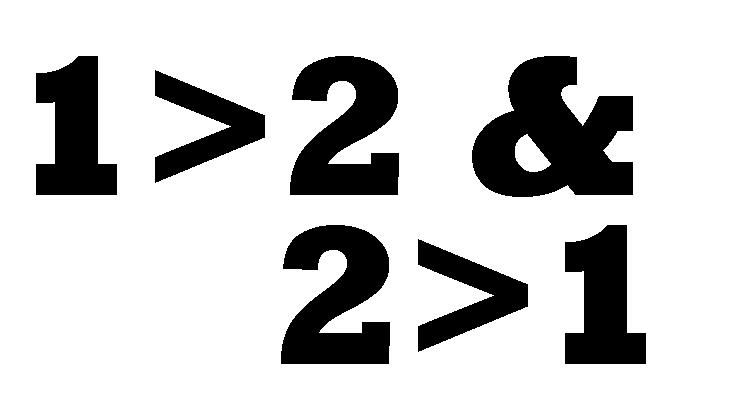
I know this sounds like confusing—maybe even illogical—math, and it probably sounds a bit like a contradiction, too. But hang with me.

Two verses from the sometimes-confusing book of Ecclesiastes say just this: 1 is greater than two, and two is greater than one.

Check them out for yourself:

1>2One handful of peaceful repose is better than two fistfuls of worried work.

2>1Two people are better off than one, for they can help each other succeed. If one person falls, the other can reach out and help. But someone who falls alone is in real trouble.

When it comes to working hard to get stuff: 1>2. It’s far better to have less and enjoy it more.

When it comes to meaningful relationships: 2>1. It’s far better to have the time to invest in more intimate relationships.

Never, ever, EVER let the pursuit of stuff get in the way of your important relationships.

To have more satisfying relationships, always keep this in mind: 1>2 [stuff] so that 2>1 [relationships].

►► Would you please prayerfully consider supporting this ministry? ◀︎◀︎

We ♥ Cedar Springs

Winning 2011 Earth Day Artwork, Hunter George, 8th Grade, CTA

I believe that our church should be a pacesetting organization for our community. When we are actively involved in our community, it gives us more opportunities to season and illuminate Cedar Springs (hey, we’re talking about this on Sunday too!).

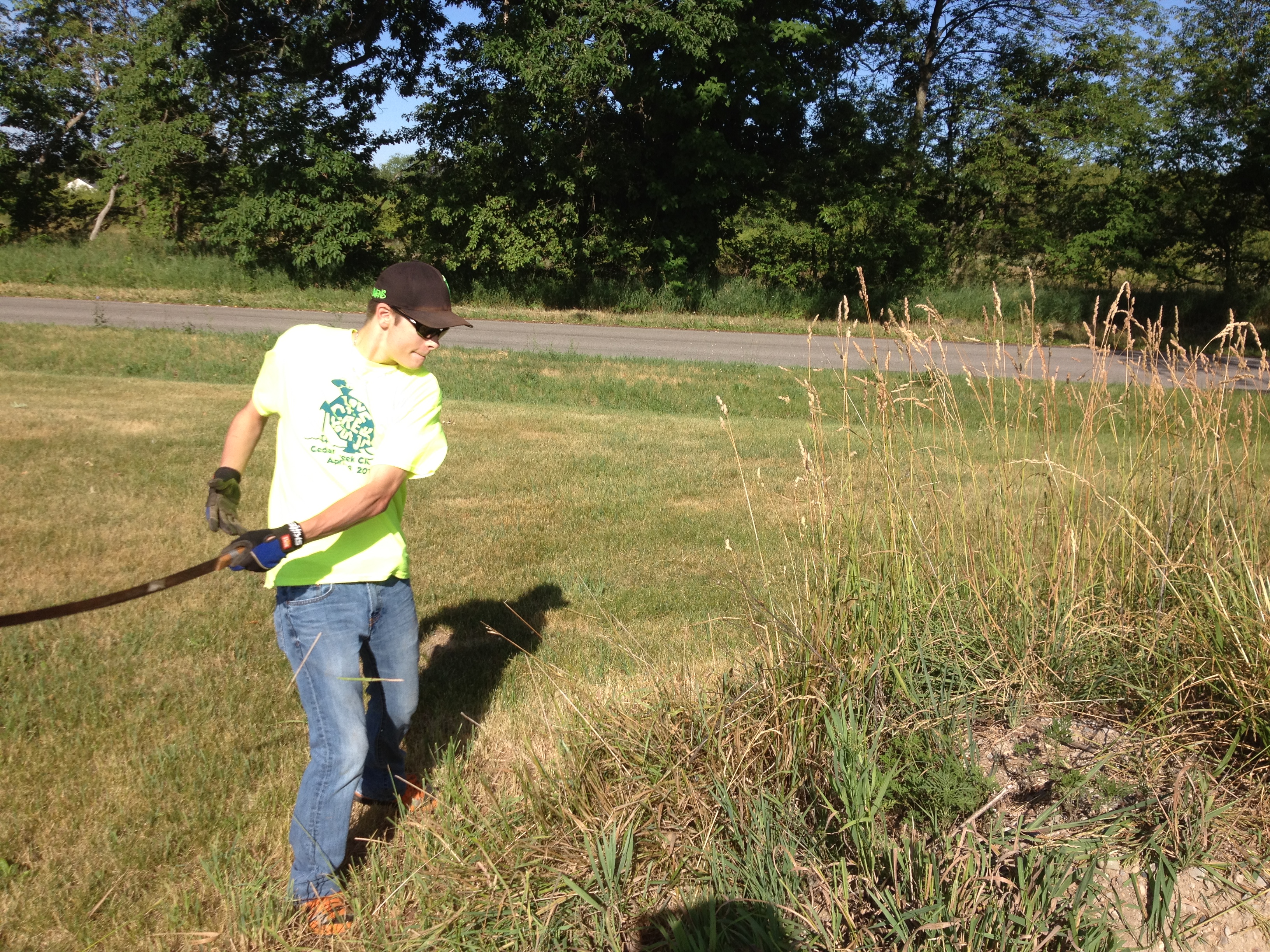
So we are planning to have a whole lot of our folks out to help with some spring cleaning for Earth Day 2011.

When we show how much We Cedar Springs, more people will get to experience firsthand what others already know about Calvary Assembly of God: We Our Church!

If you are close by, please consider joining us.

If you live in another community, what are you doing to season and illuminate your city?

Watch Your Mouth

I was reading Proverbs 10 the other day, and a recurring theme seemed to show up in this chapter. Since you’re reading this blog, I know you are highly intelligent, so I’m sure you can spot the theme as well as I can…

If you have good sense, you will listen and obey; if all you do is talk, you will destroy yourself.

If you have good sense, it will show when you speak….

If you have good sense, you will learn all you can, but foolish talk will soon destroy you.

You will say the wrong thing if you talk too much—so be sensible and watch what you say.

Honest people speak sensibly, but deceitful liars will be silenced.

If you obey the Lord, you will always know the right thing to say….

I’d say the theme was pretty obvious, wouldn’t you?

But one question still remains: What are YOU going to do with this?

Fasting (book review)

It’s one of the age-old practices for nearly every religion, but there is still so much mystery surrounding fasting. But Scot McKnight’s book simply entitled Fasting is a simple, straightforward explanation of how to apply this ancient discipline.

I appreciated Scot’s blending of passages from the Bible, the writings of the church fathers, and examples and excerpts from modern writers to present a well-rounded look at fasting. Scot lays the groundwork in the opening pages by giving this working definition: “The Bible presents a responsive view of fasting. Fasting is a response to a grievous sacred moment.”

Throughout Fasting, Scot reiterates that we don’t fast to try to get God’s attention, but we fast because we are heartbroken over our condition or the condition of others, and we’re so desperate to see God move. In the process of fasting, our body, soul, and spirit become fully engaged and lead us into a place where we are the ones who are changed. We begin to see those “grievous sacred moments” through God’s eyes, and we begin to feel the same pain He feels.

“Those who yearn for God the most often realize the superficiality of their intimacy with God, fast in response to that superficiality, and then (on the other side) find themselves entranced in the presence of the angels and God.”

If you yearn for greater intimacy with God, I would encourage you to check out Fasting.

I am a Thomas Nelson book reviewer.