Attaboy!

October has been designated as Clergy Appreciation Month. Some pastors live from “Attaboy!” to “Attaboy!” from their congregation, so October is like a feast for them!

But the apostle Paul has a slightly different perspective on this. More than getting an “Attaboy!” from a church congregation, he is joyful over the “Attaboy!” he hears from God.

For what is our hope, our joy, or the crown in which we will glory in the presence of our Lord Jesus when He comes? Is it not you? Indeed, you are our glory and joy.

For now we really live, since you are standing firm in the Lord. How can we thank God enough for you in return for all the joy we have in the presence of our God because of you? (1 Thessalonians 2:19-20; 3:8-9)

Paul’s goal is seeing people who have been changed because of their relationship with Jesus. And these changed lives are all the reward he desires!

YOU ARE OUR GLORY AND JOY! 

Pastor, it’s nice when you get the “Attaboys!” from your congregation. But what’s even better is to help your congregation enter into a deeper relationship with Christ, and then hear the “Attaboy!” from God Himself!

What an amazing joy that we get to play a small role in helping people stand firm in the Lord!
Worthy Of Imitation

I pray that my life is worthy of imitation. And, pastor, I pray yours is too!

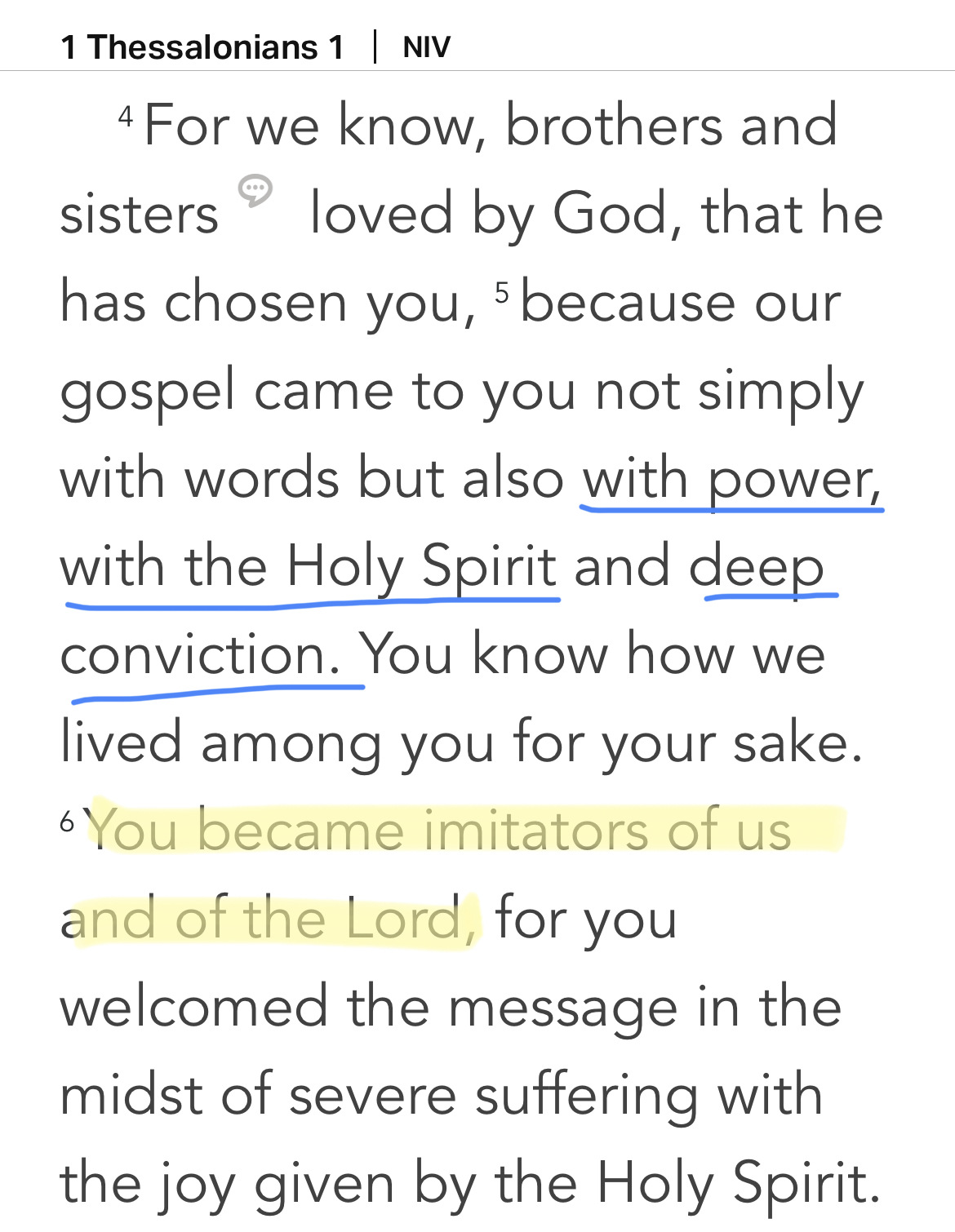
Here’s how to make sure it is an imitable life: I can’t just talk a good life. Paul wrote, Our gospel came to you not simply with words.” Words are important, but they shouldn’t be a replacement for a life that backs up those words. Paul continues his thought:

Our gospel came to you not simply with words, but also with power, with the Holy Spirit and with deep conviction…. (1 Thessalonians 1:5)

Their sermons were backed up by the help of the Holy Spirit, and the deep conviction that Paul, Silas, and Timothy lived by. This was all outwardly focused toward others. Look how Paul concludes this verse, …you know how we lived among you for your sake.

They never attempted to use the gospel or their calling to benefit themselves, but always for the benefit of others and for the glory of God.

The result (v. 6):

You became imitators of us and of the Lord. 

I pray that all of us can say this about our congregations!

Why I Didn’t Participate In Pulpit Freedom Sunday

In order to challenge the IRS regulation that non-profit 501(c)3 organizations (such as a church) not endorse a political candidate, a group called Pulpit Freedom encouraged pastors to publicly endorse a candidate in their Sunday sermons.

This is what I shared with my congregation this morning. We are not participating in the “pulpit freedom Sunday” for the following reasons—

  1. The IRS 501(c)3 regulations are not immoral. The Bill of Rights states that “Congress shall make no law respecting an establishment of religion, or prohibiting the free exercise thereof.” I don’t believe this is happening.
  2. The church should be apolitical. We don’t see any biblical writers endorsing candidates. Individuals serve in political office, and Paul often greets them. He never tells those individuals to leave their political posts, but neither does he instruct Christians on who they should support/endorse for an office.
  3. If I did what this group is asking, I feel I would doing it to make a statement, but not necessarily a statement that pleases or honors God. “For we speak as messengers approved by God to be entrusted with the Good News. Our purpose is to please God, not people. He alone examines the motives of our hearts” (1 Thessalonians 2:4). My statements must please God and not violate my conscience.
  4. I trust your intelligence. My role as a pastor is to equip people to know and apply biblical principles to every aspect of their lives; including how they make decisions to vote. My role as your pastor is not to tell you who to vote for.

Neglect Of Our Gift

Pastors, I’m challenged by these words from Charles Bridges—

It is indeed a ‘neglect of the gift of God that is in us,’ to trifle either in the study or in the pulpit. God will bless our endeavors—not our idleness. Our Master, and our people for our Master’s sake, have a just claim to our best time and talents, our most matured thoughts, and most careful studies. To venture upon this infinite work of God with slender furniture, proves a guilty unconcern to our high responsibility.

Idleness is not just laziness (although it can be that too). Think of your car when it’s idling: perhaps it’s not in gear, or maybe your foot is still on the brake. In either case, the car is not moving along to its full potential.

It’s the same for us. If we’re not moving along to our full potential as pastors, we’re idling. And that, in the words of Charles Bridges, is a neglect of the gift of God that is in us.

How might you and I be idling?

  • Not spending enough time in prayer? If we’re not praying, we’re operating in our own strength, not in God’s strength.
  • Hunting for a text to share, instead of seeking the mind of the Lord and letting Him reveal the text we should share?
  • Taking on too many projects?
  • Not delegating?
  • Not organizing or planning ahead?
  • Not taking care of our physical health, so we’re battling staying alert or staying healthy?
  • Not spending enough time in personal devotions, so our “tank” is nearly dry?

Those are just a few thoughts that came to my mind. The Holy Spirit can reveal where you may be idling and possibly neglecting such a precious gift, if you will ask Him.

Let’s always be men and women who live up to the full potential of what God has called us to. I’m praying for you!

Commissioned = Struggling

As I like to do on Fridays, this post is especially for my fellow pastors.

I have become [the church’s] servant by the commission God gave me to present to you the Word of God in its fullness. (Colossians 1:25)

Let’s be honest: What pastor wouldn’t say he/she wants to “serve” the church?

But look at Paul’s definition of a servant of the church (Colossians 1:24-2:5):

  • Suffering
  • Rejoicing in that suffering
  • Proclaiming the gospel
  • Admonishing the saints
  • Teaching with all wisdom
  • Maintaining a passion for everyone’s perfection
  • Laboring
  • Struggling

That’s quite a list!

Paul also says, “I want you to know how much I am struggling for you” (2:1). The word here and in 1:29 come from the same root word meaning: A contest (whether sports or a courtroom trial) in which there is a large audience, and in which one contestant is representing a larger group.

It’s like an Olympic athlete competing for his country, or an attorney speaking on behalf of her clients.

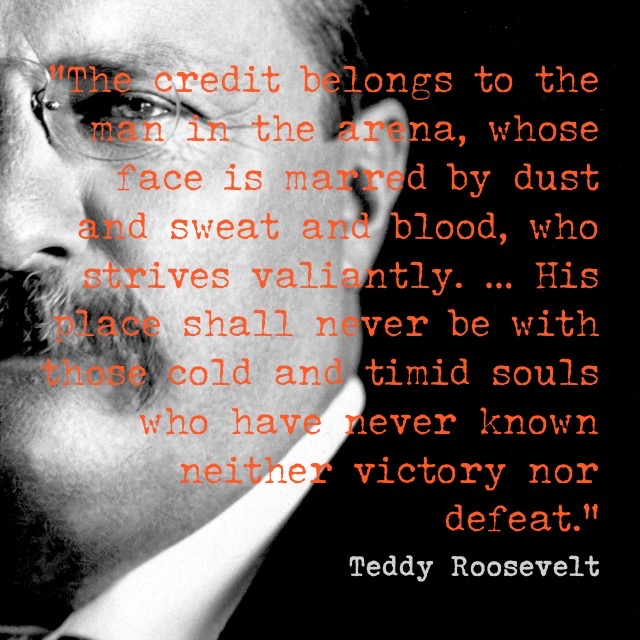
Then Paul adds, “I tell you this so that no one may deceive you by fine-sounding arguments” (2:4). In other words, actions speak louder than words. As Teddy Roosevelt famously said—

“It is not the critic who counts; nor the many who point out how the strong man stumbles, or where the doer of deeds could have done them better. The credit belongs to the man in the arena, whose face is marred by dust and sweat and blood, who strives valiantly…who knows the great enthusiasms, the great devotions, who spends himself in a worthy cause, who at the best knows in the end the triumph of high achievement, and who at the worst, if he fails, at least fails while daring greatly, so that his place shall never be with those cold and timid souls who have never known neither victory nor defeat.”

Pastor, stay in the arena!

Don’t walk away from the struggles!

Persevere through the difficulties!

People are watching you. What people? Specifically those sheep whom God has commissioned you to shepherd in His pasture. So stay in the fight!

I’m praying for you!

Spiritual Sword Play

Pastor, consider these words from Charles Spurgeon—

“We pastors depend entirely upon the Spirit of God to produce actual effect from the gospel, and at this effect we must always aim. We do not stand up in our pulpits to display our skill in spiritual sword play, but we come to actual fighting: our object is to drive the sword of the Spirit through men’s hearts.”

In order to effectively drive the sword of the Spirit through men’s hearts we must be well-trained in spiritual warfare. That training takes place in the secret chamber alone with God. Eugene Peterson gives this warning to pastors—

“Three pastoral acts—praying, reading Scripture and giving spiritual direction—are so basic, so critical, that they determine the shape of everything else in ministry. Besides being basic, these three acts are quiet and done mostly out of the spotlight of public ministry. Because they do not call attention to themselves, they are so often neglected. …Because almost never does anyone notice whether we do these things or not, and only occasionally does someone ask if we do them, these real acts of ministry suffer widespread neglect.”

You cannot give to others what you do not possess yourself!

Pastor, get alone with God. Everyday. Sharpen your sword through private prayer and personal devotion. Everyday!

Pastor And People Interceding

Prayer is the lifeblood of any church.

Look in the New Testament letters and notice how often the apostles wrote out their prayers for their congregations. Such loving, heartfelt prayers! And notice as well how many times the apostles thanked the churches for their prayers, and even requested more prayers from them.

Robert Murray McCheyne wrote to a friend who was just being ordained as a pastor—

“Give yourself to prayer and the ministry of the Word. If you do not pray, God will probably lay you aside from your ministry, as He did me, to teach you to pray. Remember Luther’s maxim, ‘To have prayed well is to have studied well.’ Get your texts from God, your thoughts, your words. Carry the names of the little flock upon your breast like the High Priest. Wrestle for the unconverted.

And to the congregation which would be shepherded by this newly ordained pastor, McCheyne wrote—

“Pray for your pastor. Pray for his body, that he may be kept strong and spared for many years. Pray for his soul, that he may be kept humble and holy, a burning and shining light. Pray for his ministry, that it may be abundantly blessed, that he may be anointed to preach good tidings.”

Pastor, learn to pray for your congregation, and for your ministry to your flock. And then teach your congregation to pray for you. For the whole church will be strengthened when both pastor and people are interceding for each other.

Prayer Before Words, Prayer After Words

Pastor, as you are putting the finishing touches on your message for Sunday, even as you are getting ready to begin the service, consider this counsel from Augustine of Hippo—

“He should be in no doubt that any ability he has and however much he has derives more from his devotion to prayer than his dedication to oratory; and so, by praying for himself and for those he is about to address, he must become a man of prayer before becoming a man of words. As the hour of his address approaches, before he opens his thrusting lips he should lift his thirsting soul to God so that he may utter what he has drunk in and pour out what has filled him.”

Pray for yourself—that you would be a living example of what you preach.

Pray for your vocabulary—that the Holy Spirit would direct your words.

Pray for your ego—that you would not be puffed up nor brought down by the people’s response.

Pray for your congregation—that they would receive and apply the Word of God.

Pray for your community—that they would desire the life of Christ that is evident in you and your congregation.

And on Monday morning perhaps you will pray this prayer of commitment from Augustine—

Breathe in me, O Holy Spirit, that my thoughts may all be holy. 

Act in me, O Holy Spirit, that my work, too, may be holy. 

Draw my heart, O Holy Spirit, that I love but what is holy. 

Strengthen me, O Holy Spirit, to defend all that is holy. 

Guard me, then, O Holy Spirit, that I always may be holy. 

Amen.

I’m praying for you this weekend!

Disciples Indeed (book review)

If you’ve been keeping track of my reading habits, you will know how much I appreciate the wisdom of Oswald Chambers. If you are not as familiar with his works, a great book for pastors and ministry leaders to get initiated into his wisdom is Disciples Indeed.

One reason that My Utmost For His Highest has been so popular (I believe) is the singular thought that Chambers presents each day. In Disciples Indeed you are taken into Chambers’ classroom at the Bible Training College in London, where he is instructing those preparing themselves for full-time vocational ministry. His teaching style was not to weigh his students down with lengthy lectures, but to give these students a place to think more deeply about the things of God.

Disciples Indeed is made up of nearly two dozen lectures. Each lecture presents a single thought in a series of small paragraphs, some of them only a single sentence in length. Chambers’ style of teaching in bullet-point fashion was intended to present profound truths upon which the student could meditate at length. Each chapter appears short on the pages of the book, but there is so much in each lecture for us to ponder.

I highly recommend Disciples Indeed to all “Christian workers” (as Oswald Chambers called his students) who have answered God’s call on their lives to step into a role of teacher, pastor, evangelist, youth leader, or the like. I am confident that your biblical thinking will be greatly enhanced by “sitting in” on these lectures.

Counsel From Billy Graham

There are very few people who bring to mind such a picture of ministry success, passion for lost souls, and total integrity like Billy Graham.

So for my pastor friends, here are a few quotes from this renowned preacher about study habits, sermon preparation, and message delivery.

“The sword of the Spirit—the Bible—is the weapon God has provided for us to use in this battle between truth and deception. Make it a priority to wield that sword skillfully.”

“If I stick to the Bible and preach the principles and the teachings of the Bible, and quote the Bible, it has an impact of its own.”

“The fact that God is infinite makes the study of His Word a lifetime occupation.”

“A seminary professor I once knew told his students, ‘Never preach about hell without tears in your eyes.’”

“Our preaching emerges out of what we are.”

“Sometimes I’m asked to list the most important steps in preparing for an evangelistic mission, and my reply is always the same: prayer . . . prayer . . . prayer.”

“Preach with authority. The authority for us is the Word of God. Preach with simplicity . . . Preach with urgency . . . Heaven and Hell are at stake. Preach for a decision.”

“Proclaiming ‘the whole will of God’ should be the goal—and the joy— of every church and every preacher.”

“When we preach or teach the Scripture, we open the door for the Holy Spirit to do His work. God has not promised to bless oratory or clever preaching. He has promised to bless His Word.”

“It is vitally important for local church leaders to keep in touch with the spiritual state of their members, to discuss their level of biblical knowledge, and to teach them how to study God’s Word and pray.”