Stopping More Than Enough

There’s a well-known line from the movie Wall Street in which the up-and-coming Bud Fox asks his rich mentor Gordon Gekko, “How much is enough?” By his words and actions, Gordon answers, “It’s never enough, pal!”

The pursuit of More Than Enough is beyond greed. It’s what both the Bible and the Greeks called Mammon: the relentless pursuit of More. It’s an easy trap in which anyone—young or old, rich or poor—can get caught. But God gave us a way out:

When you reap the harvest of your land, do not reap to the very edges of your field or gather the gleanings of your harvest. Leave them for the poor and the alien. I am the LORD your God.

God wants us to acknowledge that He is Provider by deliberately leaving something behind.

Let me state that another way: God provides our daily bread, if I have anything that is More Than Enough, it’s not for me—it’s for others.

This is yet another work-in-progress for my life: I am thinking about how I can deliberately leave the More Than Enough behind for someone else? I have a couple of thoughts, but would love you to expand on this list:

  • Leave a larger tip for my server at the restaurant.
  • Pay for the people in the car behind me in line at the drive-thru.
  • Continue to be a proud member of the Junky Car Club, so I can use my car payment money to help others.
  • Find out what one day of work really earns me, and then give up just one day a month to help others (see One Day’s Wages).
  • Order less food at McDonald’s and giving a donation to The Ronald McDonald House.
  • When I have a buy-one-get-one-free coupon, give the free one away to someone in need.

That’s just the start of my list.

I want to honor God and I want to defeat the More Than Enough monster. I can do both by deliberately leaving something behind. Will you join me?

(And feel free to continue to add to the list of ways we can all deliberately leave something behind.)

Get A Better Story

My friend Chuck and I run through a silly routine to make a point about the superficial conversations that many people have. It goes something like this—

Chuck: Hi! How are you?

Craig: I’m good. And you?

Chuck: Good. I’m good.

Craig: How’s work going?

Chuck: It’s good. How about for you?

Craig: Good.

Chuck: How’s your family?

Craig: They’re good. And yours?

Chuck: Good.

You get the idea. At the end of this conversation have I learned anything new about Chuck? Of course not. Has he learned anything new about me? Nope. Do you think either one of us is telling the truth? No, because we don’t want to really open up what’s going on inside us.

(In case you haven’t figured this out, this is just a silly thing Chuck and I do on purpose. After joking around, we do get down to the more “real life” conversation!) 

Last week I had several great sit-down meetings with some people that I already knew, but I wanted to get to know better.

In order to get to know them better, I have to get them to tell me a better story!

A better story about who they really are and what they’re really feeling.

This requires two things:

  1. I have to ask better questions. Not questions that can just be answered with a simple “good” or “fine” or “yes” or “no.”
  2. I have to be willing to tell the other person a real story about me, one that reveals who I really am and how I’m really feeling.

Sometimes asking these questions or telling these stories may seem awkward. But you have to pass through the awkward if you truly want to get to know someone better. Don’t just settle for “good,” but take a risk to go deeper.

Helping

A friend once told me that the greatest thing a church can do is find a need in the community and then help address it. I agree wholeheartedly.

Our church is helping address two needs in our community. We are hosting a benefit show called Rockin’ For Smiles to raise money for neuroblastoma cancer research. We became involved in this through our participation in PROJECT:Smile! (I wrote about this earlier, and you can read more here and here). I’m so proud of all of the people at Calvary who have rolled up their sleeves to help with this one. And it’s been amazing to see all of these bands that are willing to waive their appearance fee to help us.

We’re also collecting donations of diapers for our Bottom Blessing day on Mother’s Day. Alpha Family Center is a crisis pregnancy resource center. Much of the state aid that single Moms receive doesn’t cover the purchase of diapers, so we want to help Alpha help these young Moms.

Learning To Distinguish

In Moses’ instructions to the priests, he said, “You must distinguish between the holy and common, between the unclean and the clean.”

Why? Because these men were to be leaders. He went on to say, “You must teach the Israelites all the decrees.”

If I’m going to be a leader, I must be able to distinguish.

Here’s where the Holy Spirit is challenging me. I am working on distinguishing between…

Good and Best

Acceptable and Excellent

Common and Holy

Ordinary and Extraordinary

Want and Need

Present and Participant

Quantity and Quality

I am certain that this list is just a start, and that it’s going to be a lifetime pursuit.

Apathy Is Not An Option

The old joke goes like this—

Q: What’s the difference between ignorance and apathy?

A: I don’t know and I don’t care.

Corny, I know, but it does make a point.

For followers of Jesus Christ, sometimes ignorance of a situation is acceptable, but apathy is never an option. In other words, you may not know what’s happening around you, but once you know, you’re on the hook. You cannot do nothing. Especially when people need help.

Nowhere in Scripture will you ever see something like this:

  • “If you feel like helping the poor, go for it. If you don’t feel like it, that’s okay.”
  • “It’s okay to look away from the hurting.”
  • “If you’re too busy to get involved, God will understand.”
  • “If it makes you uncomfortable to see that, just pretend you didn’t see it.”

Nope. I cannot do that and call myself a follower of Jesus.

Anyone, then, who knows the good he ought to do and doesn’t do it, sins. (James 4:17)

The consistently righteous man knows and cares for the rights of the poor…. (Proverbs 29:7 AMP)

The godly care about the rights of the poor; the wicked don’t care at all. (Proverbs 29:7 CEV)

Get informed and then get involved.

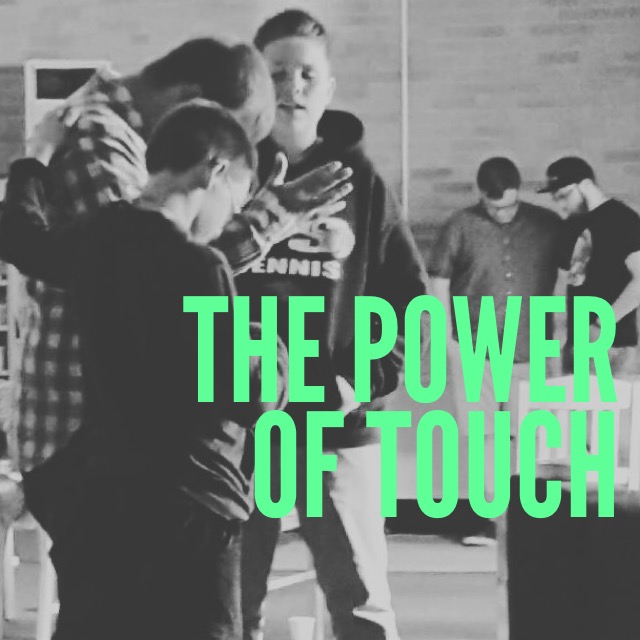
The Power Of Touch

I grew up in a church that believed in the literal “laying on of hands” while praying for someone. I still like to pray that way because I believe there is a power in the human touch.

Science has proven that human-to-human touch helps people feel better faster, lowers blood pressure, and stimulates cognitive development in newborns.

We shake hands with people when we meet them as a sign of acceptance.

We lay our hand on a friend’s arm or shoulder to show we empathize with their pain.

We embrace or kiss a loved one to show affection.

Dr. Paul Brand, a renowned surgeon who worked with leprosy patients in India, said that his hands were his most delicate and most accurate diagnostic tool.

How devastating when we withhold our touch! How crushing when the only time we touch is when we are angry!

  • Think about how much more meaningful our prayers with someone would be if we would just lay our hands on them.
  • Think about how much warmer the greeting would be if we gave someone the two-handed handshake.
  • Think about how much greater our bond with a hurting friend if we simply put our arm around their slumping shoulders.
  • Think about how much deeper the connection with your spouse and children if you held hands more often.

Touch someone today. When you do, you’ll be touching much more than their hand; you’ll be touching their heart. Your touch could make a world of difference to someone today.

A Century Turns (book review)

Some people may turn away from William Bennett’s book A Century Turns because they claim not to like history. But I have two reasons why this book is definitely worth your time: (1) Those who don’t learn the lessons of history are doomed to repeat them, and (2) This book doesn’t read like a history book.

Bill Bennett has a great talent to give us lessons from history in almost novel-like form. This narrative traces the changing tides of the United States and her relationship with her allies from the election of President George H. W. Bush through the election of President Barak Obama.

Mr. Bennett was in a unique position to see these unfolding events from the front row. In fact, in reading his book I could help but think about how Forrest Gump seemed to always show up at such pivotal and momentous times of history. So too does Bill Bennett. He has served in a variety of positions in Washington, D.C. that placed him in the right place at the right time to give his readers the “inside scoop.”

But beyond a retelling of history, Mr. Bennett captures the mood of the country through these times. He shows us just how quickly public opinion can turn. But most importantly he shows us that this great country is still made up of a government of the people, by the people, and for the people. And that is the most important history lesson of all.

I am a Thomas Nelson book reviewer.

Two Helpful Questions

Some people tell me that they don’t read the Bible for themselves because they don’t understand parts of what they read, or they don’t know what to do with the parts they do understand.

To which I reply, “That’s understandable.”

The Bible is filled with timeless principles given to us by an Eternal God. The principles may be timeless, but their application is not universal. For example, God’s timeless principle of, say, honoring your parents may be applied one way by someone living in the 12th century B.C. and applied completely differently by someone living today.

Same principle. Different application.

This is easy to say, but much harder to put into action. But I believe it is imperative that we continue to read God’s timeless principles in His Word and find daily application for our lives. So I’d like to suggest two questions to help you in this pursuit. They are the same two questions that people asked the day of Peter’s first sermon after the birth of the Christian church. Try these the next time you read your Bible:

  • What does this mean? (Acts 2:12)
  • What should I do? (Acts 2:37)

Don’t avoid reading the Bible. And don’t approach the Bible the way Søren Kierkegaard said some people do: “Many read the Bible the way a mouse tries to remove the cheese from a trap: trying not to get caught.”

I’m still learning too. Two things that help me immensely: (1) Pray before I read my Bible, asking the Holy Spirit to illuminate His inspired Word, and (2) Talk with other wise friends about the application questions I have.

If you have some strategies that are working for you, please share them in the comments below.

Mmmm, You Smell Good

Smell is one of the most potent of our five senses. It is strongly tied to memory and emotion. Maybe that’s why a “smelly phrase” appears so often in God’s requirements for the sacrifices the Israelites would offer Him:

An offering made by fire, an aroma pleasing to the Lord….

As a New Testament follower of Christ, instead of bulls or sheep or goats or birds, I have something more valuable to sacrifice to God: myself.

When I offer myself to God, it’s a powerful aroma that is pleasing to the Lord. Check this out:

Therefore, I urge you, brothers, in view of God’s mercy, to offer your bodies as living sacrifices, holy and pleasing to God—this is your spiritual act of worship. (Romans 12:1)

But thanks be to God, who always leads us in triumphal procession in Christ and through us spreads everywhere the fragrance of the knowledge of Him. For we are to God the aroma of Christ…. (2 Corinthians 2:14-15)

Offer your entire self to God and you’ll smell really good to Him.

WARNING: In order for a sacrifice to release its full fragrance it has to go through the fire. It’s especially true in the tough times that you can release the best aroma of Christ. So don’t run away from the challenging times—stay in them and release your God-pleasing aroma.

You are the pleasing aroma, so go smell good today!

You Can’t Lose

I was really challenged by the message Andy Lapins brought to our youth group.

Andy opened with a simple question, “Have you ever been afraid to tell someone about your relationship with Jesus.” My hand went up, along with just about every other hand in the room.

Andy followed up: “Why? Why are you afraid to share this good news?” The number one answer: Fear of rejection.

Andy then asked us, “If you share the good news of Jesus with someone and they accept what you have to say, is that a good thing or a bad thing?” We all answered, “Good!”

Then he asked, “If you share the good news of Jesus with someone and they neither accept it nor reject it, but you know you have planted or watered a seed, is that a good thing or bad thing?” Again, we all answered, “Good!”

Then he asked, “If you share the good news of Jesus with someone and they completely reject it—they curse you out or tell you you’re a weirdo—is that a good thing or a bad thing?” We all answered, “Bad!”

To which Andy said, “Really?!?” Then he dropped these two Bible passages on us:

  • So be happy when you are insulted for being a Christian, for then the glorious Spirit of God rests upon you. (1 Peter 4:14)
  • Blessed are you when men hate you, when they exclude you and insult you and reject your name as evil, because of the Son of Man. Rejoice in that day and leap for joy, because great is your reward in heaven. (Luke 6:22-23).

Andy followed up, “So what do you think now? If someone rejects you for sharing Jesus with them, is it a good thing or a bad thing?” Now we all answered, “Good!”

You can’t lose when you share Jesus with others!

There are only three possible outcomes:

  1. They accept Jesus = good thing
  2. You plant or water a seed = good thing
  3. You earn rewards in heaven = good thing (cha-ching!!)

I challenged our youth group to write “Cha-ching!” on their status line on Facebook whenever they shared the good news of Jesus with a friend.

Regardless of the outcome, you can’t lose! So go tell more people about Jesus today!