
6 Ways To Make Sure Everything You Do Is Sacred

It's all sacredAround 1300 AD, the Church began propagating a myth. It showed up in two words that were created around that time: clergy and laity.

Simply stated, clergy is from a root word that means “the learned men … the ones enlighten for ministry.” And laity is anyone not in that inner circle.

Insecure leaders did this to maintain control. They continued to read the Scriptures in Latin, which few could read, so they made sure that the clergy alone had a Bible, and they alone became the expounders of how the Bible told us to live.

In the clergy-laity divide, they also created a sacred-secular divide.

When Paul addresses the Colossians he does so with anything but a clergy-laity divide in mind. He calls them the holy and faithful brothers in Christ (Colossians 1:2). The KJV translates holy as saints, for that’s how Paul indeed sees them. And he sees them as his very own faith-filled brothers.

Paul also has anything but a sacred-secular divide in mind as he instructs then—whatever you do, whether in word or deed.

He makes it clear that everything we do as faith-filled, holy saints is to be sacred and God-honoring.

How do we do whatever we do in a sacred, God-honoring way? We ask these six questions:

[1] Can it be done with a clear conscience? (Acts 23:1; 24:16)

  • “It is not WHAT a man does that determines whether his work is sacred or secular, it is WHY he does it.” —A.W. Tozer

[2] Will it promote the Gospel? (Philippians 1:27)

[3] Is it a good deed? (Acts 10:38; James 3:13)

[4] Does it point people to God? (1 Peter 2:12; 1 Corinthians 10:31)

[5] Can I do it in the name of Jesus? (Colossians 3:17do it ALL in the name of Jesus)

[6] Does it cause others to be thank-full? (Colossians 3:17giving THANKS to God the Father).

Live according to your high calling, for all you do is sacred!

(To check out more thoughts on Colossians 3:15-17, click here and here.)
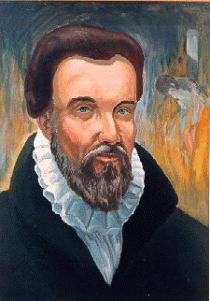
William Tyndale & Charles Spurgeon On Sacred Words And Deeds

William TyndaleThis morning in my message, we looked at the example of William Tyndale.

William Tyndale believed the Bible should be read by all (not just by the “enlightened” clergy), and he undertook the process of translating the Hebrew and Greek into English. In the preface to the first five books of the Old Testament, he wrote, “I had perceived by experience, how that it was impossible to stablish the lay people in any truth, except the Scripture were plainly laid before their eyes in their mother tongue, that they might see the process, order, and meaning of the text.”

  • The clergy tried to intimidate Tyndale into stopping his work, but he said, “I defy the Pope and all his laws. If God spare my life, ere many years I will cause a boy that driveth the plough to know more of the Scripture, than he doust.”
  • Eventually he was put on trial for heresy, where he was also accused of trying to profit from his work. He replied, “I call God to record against the day we shall appear before our Lord Jesus, that I never altered one syllable of God’s Word against my conscience, nor would do this day, if all that is in earth, whether it be honor, pleasure, or riches, might be given me.”
  • Ultimately Tyndale was strangled to death, and then burned at the stake. But his dying words were, “Lord, open the eyes of the king.”

William Tyndale was notable in his struggle to break down the unbiblical clergy/laity (or sacred/secular) divide. Another great man who addressed this topic over 300 years after the death of Tyndale was Charles Spurgeon—

C.H. Spurgeon“To a man who lives unto God nothing is secular, everything is sacred. He puts on his workday garment and it is a vestment to Him. He sits down to his meal and it is a sacrament. He goes forth to his labor, and therein exercises the office of the priesthood. His breath is incense and his life a sacrifice. He sleeps on the bosom of God, and lives and moves in the divine presence. …The Lord hath cleansed your houses, He has cleansed your bed chambers, your tables, your shops, He has made the bells upon your horses holiness to the Lord, He has made the common pots and pans of your kitchens to be as the bowls before the altar, if you know what you are and live according to your high calling. You housemaids, you cooks, you nurses, you ploughmen, you housewives, you traders, you sailors, your labor is holy if you serve the Lord Christ in it, by living unto Him as you ought to live. The sacred has absorbed the secular.”

The Holiest Moment

The holiest momentThe holiest moment of my week shouldn’t be singing songs.

It shouldn’t be listening to a profound sermon.

Not even partaking of Communion.

My holiest moment should be my going out to show Christ’s love to a hurting world.

“The holiest moment of the church service is the moment when God’s people—strengthened by preaching and sacrament—go out of the church door into the world to be the Church.” —Ernest Southcott 

To a man who lives unto God nothing is secular, everything is sacred. He puts on his workday garment and it is a vestment to Him. He sits down to his meal and it is a sacrament. He goes forth to his labor, and therein exercises the office of the priesthood. His breath is incense and his life a sacrifice. He sleeps on the bosom of God, and lives and moves in the divine presence. …  You housemaids, you cooks, you nurses, you ploughmen, you housewives, you traders, you sailors, your labor is holy if you serve the Lord Christ in it, by living unto Him as you ought to live. The sacred has absorbed the secular.” —Charles Spurgeon

Thursdays With Oswald—Integrated Life

This is a weekly series with things I’m reading and pondering from Oswald Chambers. You can read the original seed thought here, or type “Thursdays With Oswald” in the search box to read more entries.

Integrated Life

     God will never allow us to divide our lives into sacred and secular, into study and activity. We generally think of a student as one who shuts himself up and studies in a reflective way, but that is never revealed in God’s book. A Christian’s thinking ought to be done in activities, not in reflection, because we only come to right discernment in activities. Some incline to study naturally in the reflective sense, others incline more to steady active work; the Bible combines both in one life. We are apt to look on workers for God as a special class, but that is foreign to the New Testament. Our Lord was a carpenter; Paul was a weaver. If you try and live in compartments, God will tumble up the time.

From Approved Unto God

You and I don’t have sacred and secular lives. If you are a follower of God, your whole life is holy: it’s all set apart for God. Don’t slack off in areas that you think are secular; treat everything as holy.
