The Scriptures Foresaw

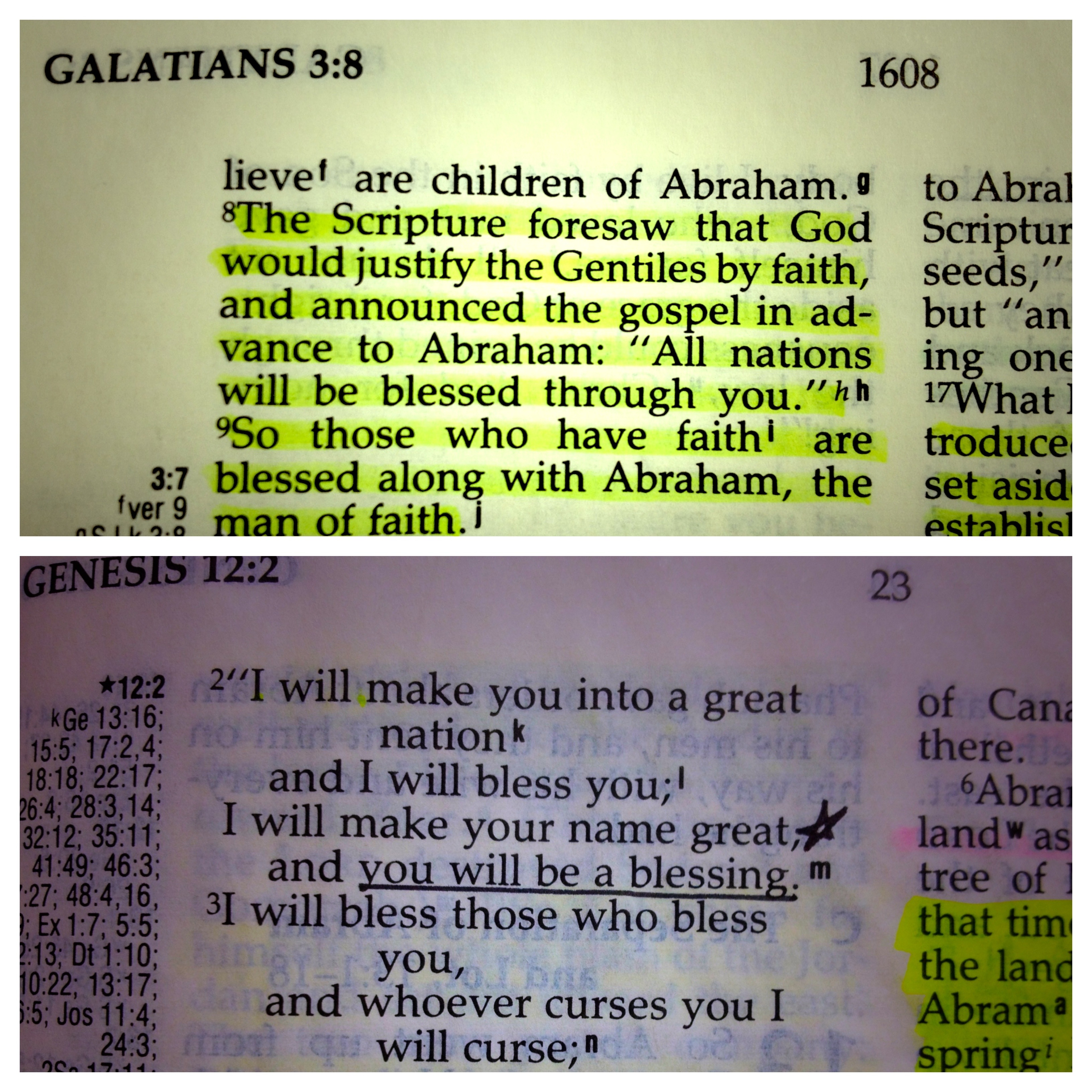
Check out this passage from Galatians 3:8-9—

The Scripture foresaw that God would justify the Gentiles by faith, and announced the gospel in advance to Abraham: “All nations will be blessed through you.” So those who have faith are blessed along with Abraham, the man of faith.

God’s Word is a living Word. They are not merely ink on a page. They are the very words of God.

God’s Word never stops working. God made a promise to Abraham 3000 years before Paul saw it being fulfilled in the Galatian believers. And now, another 2000 years after that, it’s still being fulfilled in ALL who come into a relationship with God through Jesus Christ!

These words are not past tensethose who have faith ARE blessed. They apply to me, today, now, just as much as the day they were spoken by God 5000 years ago! And they apply to you too.

Let this soak in…

Not one promise in the Bible will expire. 

Not one command will become irrelevant. 

Not one precept will ever be out-of-date.

Living. Active. Personal. Real. Present tense. Now!

Do you believe it?

Do you live like you believe it?

Growing Up

Yesterday was an historic day at Calvary Assembly of God, and I’m still buzzing about it!

The Assembly of God fellowship has several classifications for churches, the highest one being “general council status.” Yesterday our membership voted unanimously to move into this category!

Here are some of the miracles of the day:

  • My predecessor, Joel Baxter and his wife Kristina, were in attendance. They live and minister in Wisconsin now, so I didn’t think they would be able to attend, but they showed up and surprised us all. Pastor Joel laid the foundation on which we can now build, and I am so grateful for him. I’m also grateful for the prayer of blessing he prayed over us.
  • Pastor Joel shared a couple of prophesies that had been spoken over this church. One is that we would be a light to northern Kent County, and the other was that ministry would flow from this church to the cities and communities surrounding us. Amen!
  • Two precious ladies in our church have been at Calvary since its beginning decades ago, and they got to be the first two signers of our general council resolution.
  • We had several people visiting for the first time that stuck around to watch this historic vote. I love the testimony that this was for them.
  • Every vote we have taken among our membership has been unanimous. Truly this is a group of people who are one in spirit and purpose.

Notice that I said that we are growing up—not grown up. I’m thrilled with where we are, but we still have a long way to go to…

…prepare God’s people for works of service, so that the body of Christ may be built up until we all reach unity in the faith and in the knowledge of the Son of God and become mature, attaining to the whole measure of the fullness of Christ. (Ephesians 4:12-13)

And in case you haven’t heard me say it lately:

I My Church!

If you live in West Michigan and don’t have a church home, I would love for you to join us next Sunday!

Backcasting

Psalm 22 is a prayer of raw desperation. I love how transparent David is with his emotions. Many people would hide this sort of thing: never daring to admit that they had doubts. But David freely admits that he’s frustrated by what is happening—or actually not happening—in his life.

I see three points of David’s desperation:

  1. God, why don’t You answer me (vv. 1-2).
  2. God, why don’t You defend my honor (vv. 6-8).
  3. God, why don’t You rescue me (vv. 11-18).

Do you think David had a right to say these things against God? Remember Jesus said them too!

Do you think David was over-reacting when he said these things? Remember Jesus said them too!

David truly, deeply, felt these things. He truly believed that God wasn’t answering him, or defending him, or rescuing him. At least, AS HE THOUGHT GOD SHOULD!

But David says something VITAL after each of his points of desperation. It’s summed up in one conjunction each time…

  • Yet (vv. 3-5).
  • Yet (vv. 9-10).
  • But (vv. 19-21).

In all of these David recalls past history. David looks to the past to help him look to the future.

He BACKCASTS so that he can have a better FORECAST!

Looking back gives David assurance of God’s faithfulness. This assurance gives David hope for the future. So now look how he responds in his present desperate situation:

  • I will declare Your name (v. 22a)
  • I will praise You (v. 22b)
  • He calls others to join him in praise (v. 23)
  • He realizes that God has not hidden His face… but He has listened to his cry for help (v. 24)
  • He decides to praise God in spite of the temporary disappointments, giving all glory to God (vv. 25-31)

This is what is called a typio-prophetic Messianic psalm: what David experienced, Jesus would both experience and fulfill. So although Jesus cried out, “My God, My God, why have You forsaken Me,” He too could backcast to forecast and get the strength He needed to persevere

Let us fix our eyes on Jesus, the Author and Perfecter of our faith, Who for the joy set before Him endured the Cross, scorning its shame, and sat down at the right hand of the throne of God. (Hebrews 12:2)

This is why I’m a big believer in journals: writing things down now will give you ammunition for future trials. Then when you are in those trials, you can backcast to get a better forecast of the hope for God’s deliverance. That will give you joy in the present, just like David. And just like Jesus!

Old And Valuable

During my freshman year of college, I was placed as a roommate with another freshman who was a theology major. Just so we’re all clear about this: theology is the study of God. And just so we’re all crystal clear about this: the study of God is typically based on the Bible.

I can hear some of you now, “Duh! Great insight!” But hang with me for a moment.

Near the start of our first semester together my roommate came into our dorm room very upset, slammed the door shut, and threw down his backpack. When I asked what was the matter he told me he had just come from a meeting with his academic advisor and was furious at his list of required classes. When I inquired what class he wasn’t allowed to take, he said, “No, it’s not what class I can’t take; it’s what classes I have to take!”

“So what classes are you upset that you have to take?” I asked, thinking maybe something like science or phys ed.

“Old Testament,” he responded. I was speechless, but he continued, “I mean, Old Testament! C’mon, that was stuff from a long time ago. We live under the new covenant now, so the old covenant has no purpose for us anymore!”

Although this is somewhat shocking to hear from a theology major, I’m afraid a lot of people feel this way.

Did you know…

  • The Old Testament (OT) is directly quoted by the New Testament (NT) writers nearly 700 times.
  • There are thousands of references to OT people, events, or principles in the NT.
  • Of the 27 books in the NT, only six don’t have direct OT quotations. But four of those six books refer back to OT people or passages.
  • Of the 39 books in the OT, all but nine of them are quoted in the NT.
  • Jesus Himself quoted from the five books of Moses (Genesis, Exodus, Leviticus, Numbers, Deuteronomy) nearly 60 times.

I love the Old Testament! There I read some great stories and meet some very colorful personalities. But I especially love reading the OT to see what was going to happen and then reading the NT to see both what did happen and what’s still going to happen.

Those 39 books of the Old Testament may be old, but they’re so rich, and so valuable, and so enlightening to the New Testament. If you haven’t made the OT a part of your Bible reading time, I encourage you to do so.

The Old Testament is not old, as in worn out, archaic, useless. It’s old, as in priceless, valuable, foundational.

What Jesus Didn’t Say

All throughout the first four books of the New Testament—Matthew, Mark, Luke, and John—there are lots of “red letters” (words spoken by Jesus). But as each of these gospel writers begins to recount the arrest and sham trial of Jesus, I’m struck by how many “black letters” there are. This fulfilled an Old Testament prophesy—

He was oppressed and treated harshly, yet He never said a word. He was led like a lamb to the slaughter. And as a sheep is silent before the shearers, He did not open His mouth (Isaiah 53:7).

The chief priests and the Sanhedrin brought out a string of witnesses to falsely accuse Jesus, but even then these witnesses couldn’t get their stories to jive, so Jesus remained silent. In exasperation the chief priest Caiaphas lashed out at Jesus, “Aren’t You going to answer these charges? Don’t You hear what they’re saying about You? Why won’t You defend Yourself?”

So here’s how Jesus responded to His accusers: But Jesus remained silent (Matthew 26:63). His silence resonated louder than any words could have!

How could Jesus do this? How could He stand silently when all of these nasty things were being said about Him?

He looked back—”…He had done no violence, nor was any deceit in His mouth…” (Isaiah 53:9). All four Gospels record Jesus saying, “You heard Me speaking in public all the time. My life has been on display for You. If I had said or done anything wrong, you could have arrested Me earlier, but the facts are: I haven’t said or done anything sinful.”

He looked forward—”…Because of the joy awaiting Him, He endured the Cross, disregarding its shame…” (Hebrews 12:2). He knew that one wrong word could undo all of the good words which He previously spoke, so He looked forward to the joy that would come after this was over.

I just went through a period of my life where people threw incredibly hurtful lies at me, but what was that compared to the horrific abuse heaped upon Jesus? If He could remain silent, how much more should I?

While I was in the midst of this difficult time, a prayerful friend handed me a notecard which I have kept close to me. Perhaps these words will be helpful to you, too—

May kindness be the response in you
where such a response is not expected.
May gentleness have the power
to overrule an offense and the power to heal. (David Teems)

May this Good Friday be a time of reflection in what Jesus didn’t say. And may I, along with you, learn this power of silence when falsely accused.

The One Who Is To Come

the-one-who-is-to-come

We just started a new Bible study on Wednesday nights, and it’s revolutionizing my thinking about Jesus the Messiah.

In this series we’re looking at prophesies given in the Old Testament book of Isaiah, and then looking at the New Testament to see how Jesus Christ fulfilled those prophesies 700 years later when He came to earth. Then we’re also looking even further ahead at the prophesies that Jesus will fulfill when He comes back to earth again.

The more I study the life of Jesus, the more deeply I fall in love with Him!