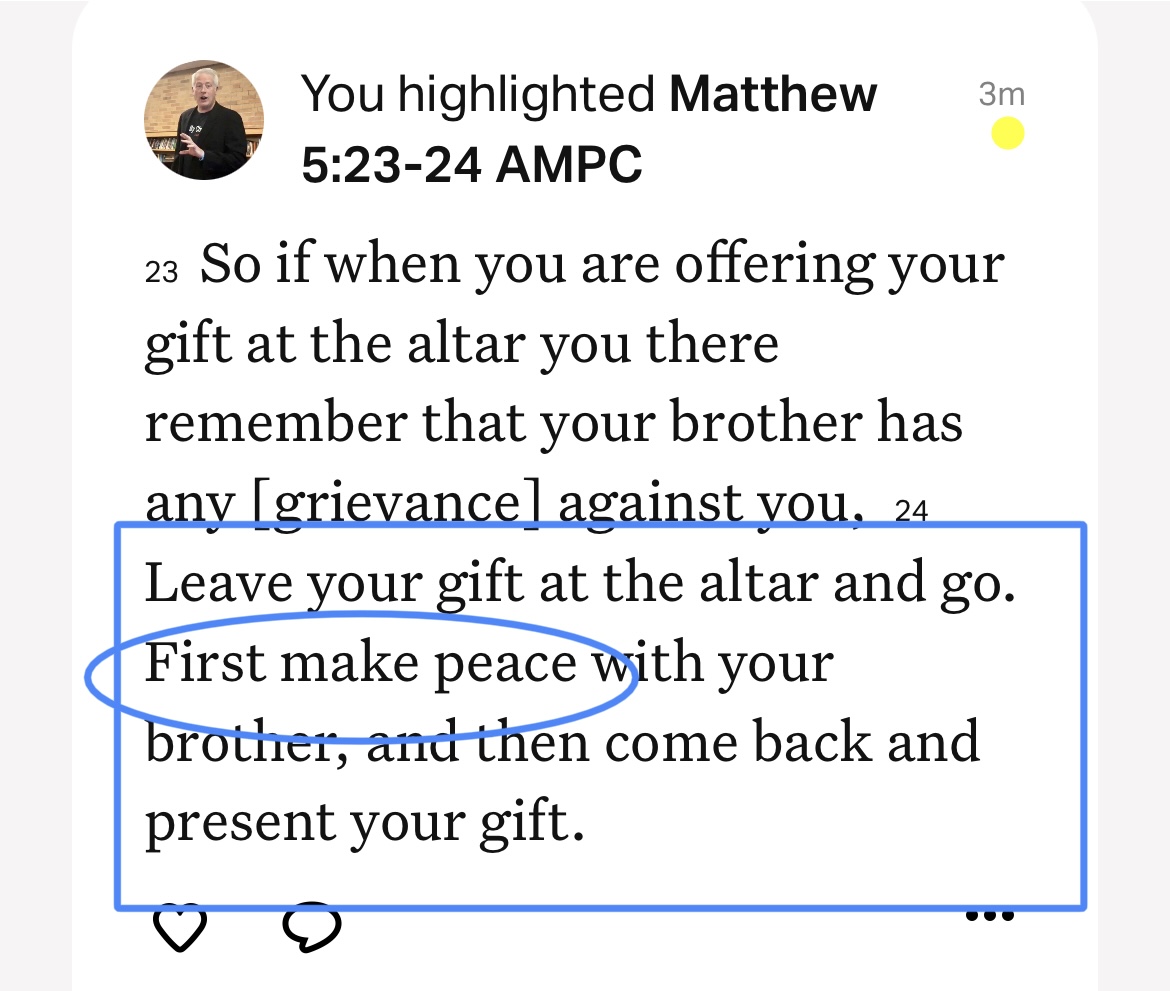
So if when you are offering your gift at the altar you there remember that your brother has any [grievance] against you, leave your gift at the altar and go. First make peace with your brother, and then come back and present your gift. (Matthew 5:23-24 AMPC)
If someone has something against you, you must take the initiative to make it right. We cannot brush it off with, “I didn’t do anything wrong” or “That’s their problem,” but we must be proactive peacemakers.
It could be that our restorative action will allow the other person to enter into worship in a way they were unable to before you reached out to them.
Listen to the podcast of this post by clicking on the player below, and you can also subscribe on Apple, Spotify, or Audible.
Last week we saw the dark times in which Micah lived as he prophesied the advent of the Messiah. Israel was both surrounded by enemies as well as lots of practices within their borders that were heartbreaking to God. Many times, our lives can feel the same way: enemies of God all around us and our own turmoil and doubts inside our hearts and minds.
In this dark, hopeless time, the Messiah came as our Great Shepherd. Take a look at what this Shepherd brings us:
He will stand and shepherd His flock in the strength of the Lord, in the majesty of the name of the Lord His God. And they will live securely, for then His greatness will reach to the ends of the Earth. And He will be their peace. (Micah 5:4-5)
We see this idea of Jesus our Great Shepherd bringing peace to our hearts in the New Testament as well:
May the God of peace, who through the blood of the eternal covenant brought back from the dead our Lord Jesus, that Great Shepherd of the sheep, equip you with everything good for doing His will, and may He work in us what is pleasing to Him, through Jesus Christ, to Whom be glory for ever and ever. Amen. (Hebrews 13:20-21)
This peace is also implied in Psalm 23:1 when David wrote, “The Lord is my Shepherd, I shall not be in want.” That phrase “I shall not be in want” really captures the definition of peace.
The Hebrew word for peace is shalom. An easy-to-remember definition of shalom is “nothing lost, nothing missing.” Our Great Shepherd makes sure nothing is lost or missing that would cause us anxiety or doubt, so we can have total peace—we can have shalom!
Jesus said the devil’s agenda was for everything to be lost or missing—“the thief comes only to steal and kill and destroy”—but our Great Shepherd’s agenda is for there to be nothing lost or missing—“I have come that they may have life, and have it to the full” (John 10:10).
Isaiah, who was prophesying at the same time as Micah, sounded a similar note:
Therefore the Lord Himself will give you a sign: The virgin will conceive and give birth to a Son, and will call Him Immanuel. … And He will be called Wonderful Counselor, Mighty God, Everlasting Father, Prince of Peace. (Isaiah 7:14, 9:6)
When this Great Shepherd was born in Bethlehem, the shepherds in the field were the first to hear the good news. Notice what the angels announced: “Glory to God in the highest heaven, and on earth peace to those on whom His favor rests” (Luke 2:14).
Who has God’s favor? Those with faith in Him: “Without faith it is impossible to please God” (Hebrews 11:6). So those with faith in God have God’s favor.
Faith in what? In all that Jesus purchased for us by His blood shed on the Cross: “Therefore, since we have been justified through faith, we have peace with God through our Lord Jesus Christ” (Romans 5:1).
Faith comes from believing that God has made the promise of peace, that God has fulfilled the promise of peace through Jesus, and that God is bringing us to His eternal peace. So now our lives of peace in a world of turmoil can serve as a testimony to others.
Jesus called His followers to be peacemakers (Matthew 5:9) but we cannot do this while we are experiencing anxiety or doubts. To be peacemakers we must be full of peace because of our relationship with the Prince of Peace, who has ensured that nothing is lost and nothing is missing!
If you feel anxious, remember that Bethlehem is your proof that the Prince of Peace has come to remove doubts, anxiety, fear, and inner turmoil. Let every pang of anxiety be immediately a call to run to the Prince of Peace. He has paid an incalculable price to purchase your peace, so don’t leave this gift unopened and unused. A dark, anxious world is looking for peace. Know the author of shalom so that you can introduce others to this Prince of Peace.
Listen to the podcast of this post by clicking on the player below, and you can also subscribe on Apple, Spotify, or Audible.
When God spoke to the “princes of Israel,” He was speaking to those in leadership positions. They were men who had wealth, position, and a high level of influence. God called them to live up to their title as “prince” because leadership is a high and holy calling given by God.
They are to be peacemakers, never men of violence nor oppression (45:9).
They are to be fair, consistent, and impartial in their interactions with others (45:10).
They are to generously provide for the people under their care (45:15-17, 22; 46:13-14).
They are to have a “get to do it” attitude toward their duties, not a “have to do it” attitude” (46:5, 7, 11).
They are to be among their people, not aloof nor isolated from them (46:10).
They are to provide for their family without impoverishing the people under their care (46:18).
Since God calls leaders, He will also call them to account. Jesus made it clear that there are only one-of-two assessments that leaders will hear from God:
Well done, good and faithful servant
You wicked, lazy servant
Let me say it again: Leadership is a high and holy calling. So…
A mark of a godly leader is one who joyfully and faithfully fulfills God’s leadership call.
This is part 67 in my series on godly leadership. You can check out all of my posts in this series by clicking here.



 So if when you are offering your gift at the altar you there remember that your brother has any [grievance] against you, leave your gift at the altar and go. First make peace with your brother, and then come back and present your gift. (Matthew 5:23-24 AMPC)




 Craig T. Owens