Come To God As A Father

Listen to the podcast of this post by clicking on the player below, and you can also subscribe on AppleSpotify, or Audible. 

Jesus told us numerous times that we can come to God as our Father. 

Have you ever played a word association game? For instance, if I said “winter” you might say “shoveling” (or kids might say “sledding”). If I said “summer” you might say “vacation.” But I think the word “father” may bring up a lot of very different feelings or images. Some may have fond memories of the word “father” while others may think:

  • playful but not a good provider 
  • disciplinarian 
  • hard to please 
  • absent
  • unavailable 

Even if our human fathers were good, they were still flawed. Jesus said this about us, “If you parents, that even know how to give good things to your kids are evil, how much more amazing is the goodness and love of God” (Matthew 7:11). But Jesus had something entirely different in mind for us when He told us we could come to God as our Father. And, sadly, it’s a level of intimacy that many have never known. 

All of us could only experience limited intimacy with our earthly fathers, but with our Heavenly Father we can have unlimited and unimaginable intimacy! 

When Jesus was teaching us to pray in Matthew 6:6-9, there are two thoughts that stand out to me about coming to God as our Father. First, Jesus tells us that we don’t have to use any special language. When He said some people babble in prayer, Jesus was saying they were using a language that was unnatural to them—they weren’t being themselves. 

Our Heavenly Father wants us to come to Him as children: full of innocence, and wonder, and expectation, and imagination!

Second, I notice that three times Jesus calls God “your Father,” but when He begins His model prayer He says, “Our Father.” Think of that: Jesus is saying we can approach God the same way He approached His Father! 

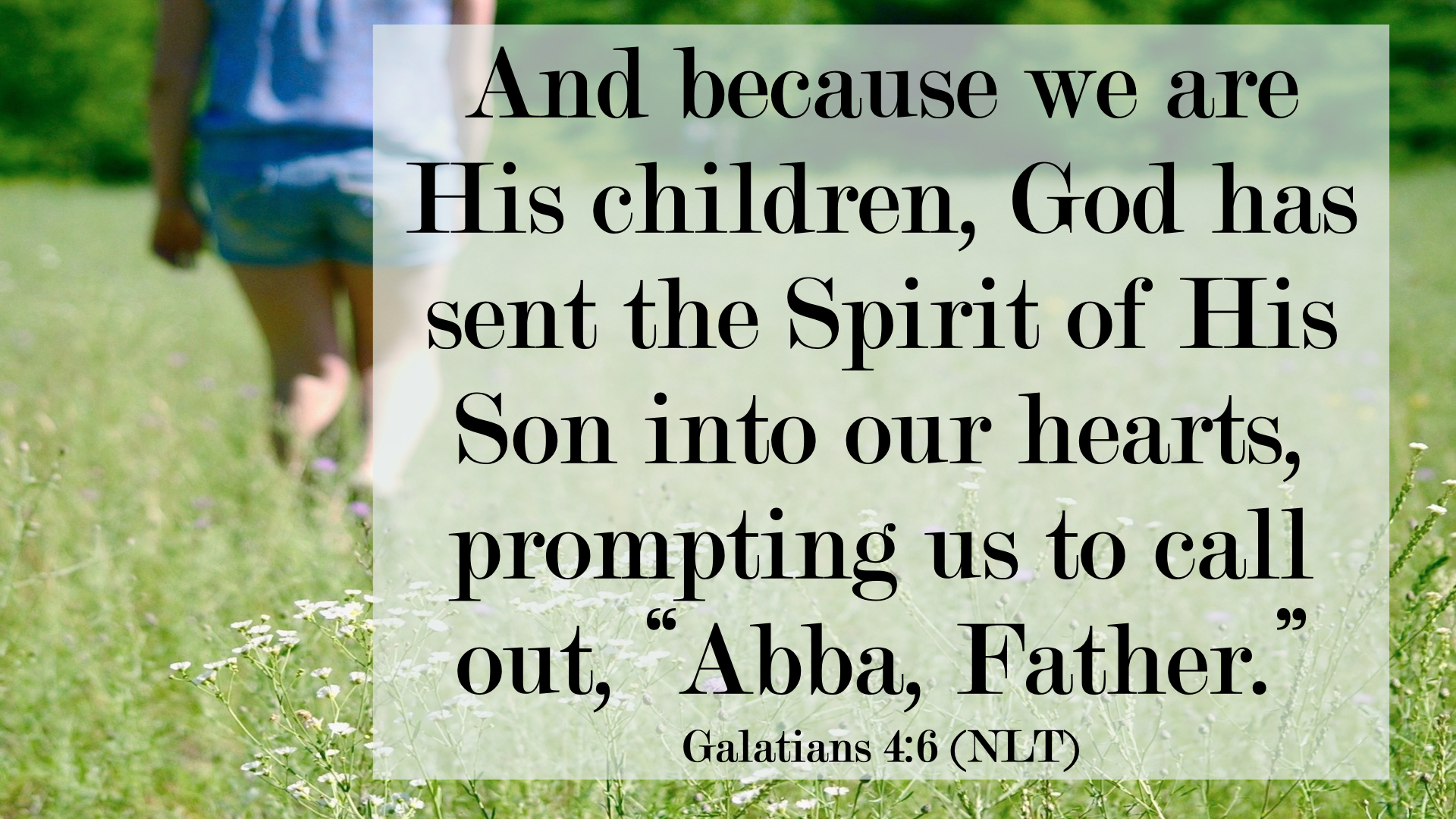
In His intense prayer time just before His crucifixion, Jesus used the phrase “Abba Father” to express His intimacy. This phrase is used two other times in the New Testament. Both of these times it’s telling us that we can approach our Heavenly Father the same way Jesus did (see Mark 14:36; Galatians 4:6; Romans 8:15). 

The Romans understood the weight that was associated with the practice of adoption. They knew that a father chose that child to be a part of his family, giving that child full acceptance into the family. Marvin Vincent noted,

“We have but a faint conception of the force with which such an illustration would speak to one familiar with the Roman practice; how it would serve to impress upon him the assurance that the adopted son of God becomes, in a peculiar and intimate sense, one with the heavenly Father.”

In writing to the Romans, Paul reminds them that for those who are in Christ Jesus, there is no condemnation—nothing holding them back from God’s presence. He also said that God has fully adopted us into His family, and that the Holy Spirit was now in us, encouraging us to call God “Abba Father” just as Jesus did (Romans 8:1, 14-16). 

Check out these two final thoughts from Jesus: He encourages us to approach God as innocent children, and He praises Our Father for then intimately confiding in His children—

“Truly I tell you, unless you change and become like little children, you will never enter the kingdom of heaven. … I praise You, Father, Lord of heaven and earth, because You have hidden these things from the wise and learned, and revealed them to little children.” (Matthew 18:3, 11:25) 

No matter what your relationship was with your earthly father, Jesus encourages us to approach our Heavenly Father in innocence, wonder, expectation, imagination, and intimacy. This is what God desires in His relationship with you! 

If you’ve missed any of the messages in our series Intimate Conversation, you can find them all by clicking here. 

►► Would you please prayerfully consider supporting this ministry? My Patreon supporters get behind-the-scenes access to exclusive materials. ◀︎◀︎
What Is Church?

All across the world on Sunday morning, people met for church? But what exactly is church? Is it a place we go to? Is it something that only happens on Sundays? 

The Greek word for church is ekklesia. It meant an assembly of citizens. Luke used the term when he recorded a government official saying, “If there is anything further you want to bring up, it must be settled in a legal assembly” (Acts 19:39). But in the New Testament, it came to mean “a community based on a special religious idea and established in a special way” (Dr. Marvin Vincent). It can also mean either a local group of Christians or “the whole body of Christians scattered throughout the earth” (Dr. James Strong). 

Church never means a building. Nowhere does the phrase “go to church” appear in the New Testament. Instead, church carried the idea of a living, growing organism because church was wherever a follower of Jesus was. Sometimes the church met collectively in one location, and sometimes individual believers were out in the community. But wherever the Spirit of God went, church was happening. 

If church is not something we go to, it’s also not something that takes place only one day per week. Look at what Jesus did on the Sabbath day: 

But we also see Jesus doing all of these things EVERY day of the week. 

For Jesus, neither the day of the week nor the location determined the way He lived. Peter summed it up this way, “God anointed Jesus of Nazareth with the Holy Spirit and with power. Then Jesus went around doing good and healing all who were oppressed by the devil, for God was with Him” (Acts 10:38). 

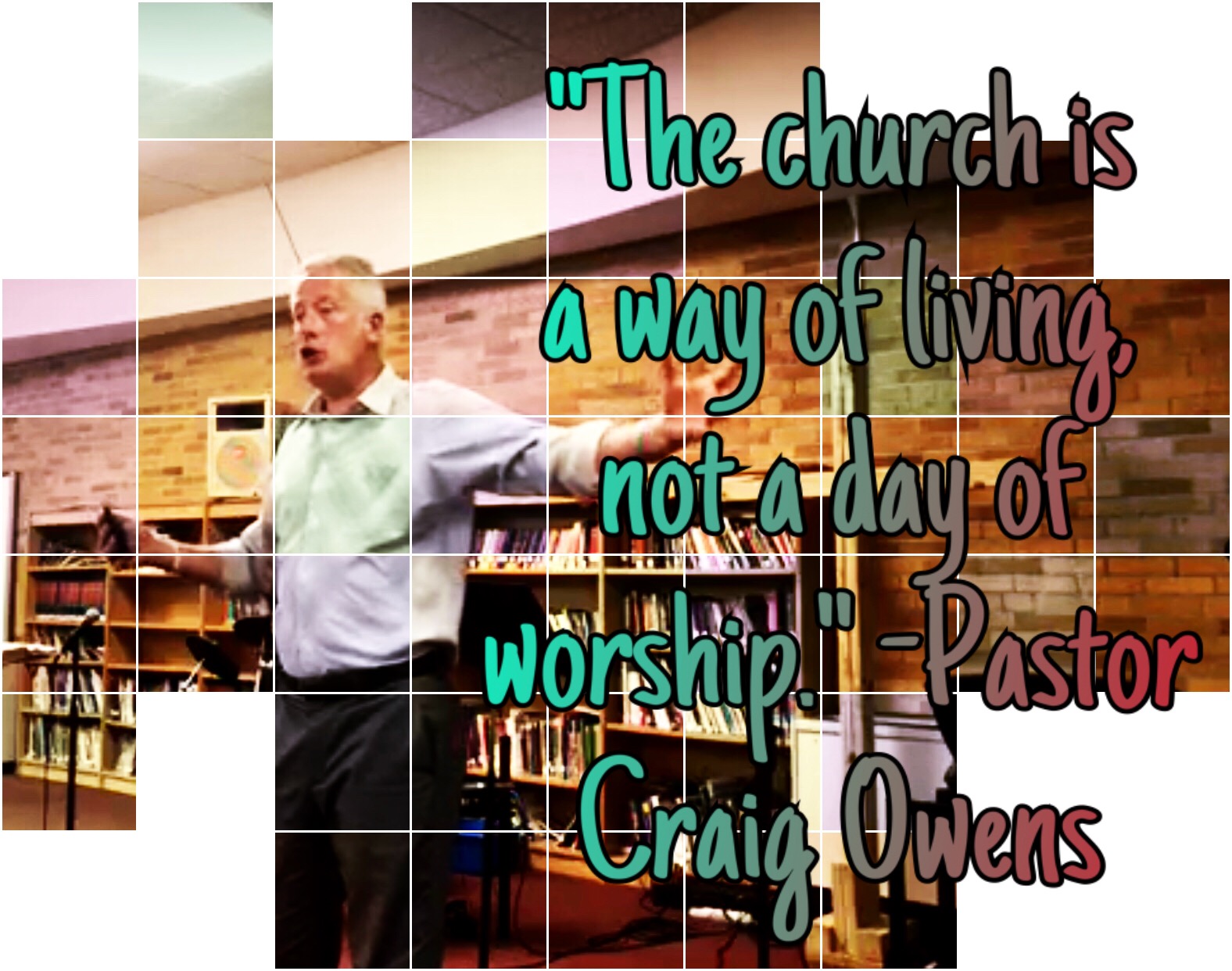
In fact, before they were called Christians the church was simply called “the Way” letting us know that the church was a way of life, not a day of the week. 

Based on how Jesus lived and how the Apostle taught, I think we can see the Church Way like this: 

In other words, EVERY day and in EVERY place the followers of Jesus were being enriched in their own lives so that they could reach out to the hurting so that they could come to know Jesus personally so that their lives could be enriched so that they too could reach out to others, and on, and on, and on it goes! 

Limiting “church” to a specific location or to a specific day of the week is way too small-minded. Church as Jesus intended it was a powerful force that would set people free EVERY day and in EVERY place from the power of the devil and introduce them to God’s eternal life! 

Gentle Restoration

I’m struggling with this one. I have a dear friend who is perplexed by an ongoing drug addiction. He appeared to have it under control until things in his life started spiraling out of his control, and he gave in to his old habit again.

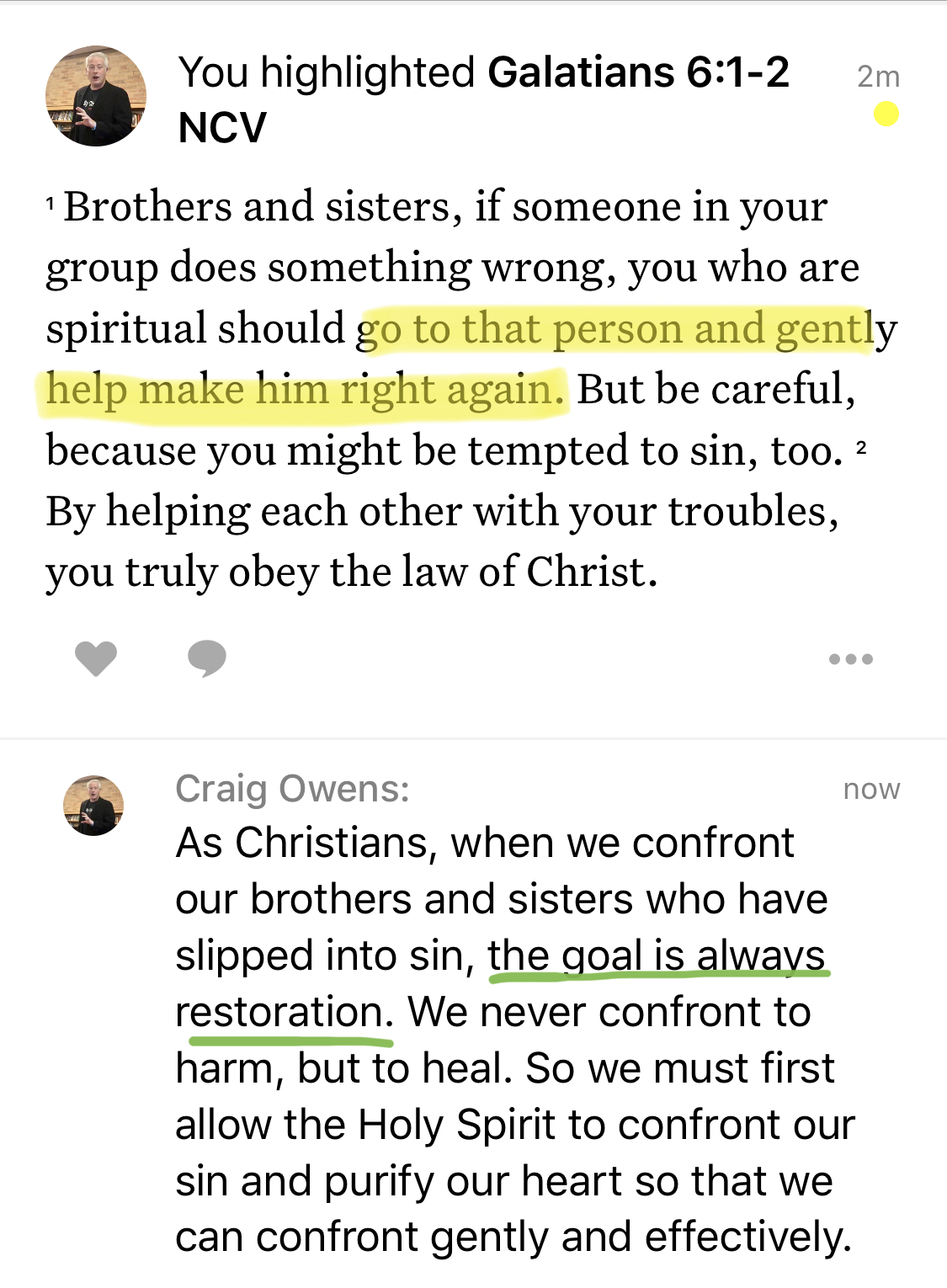
So the Bible says that if one of my brothers slips up I’m supposed to restore him gently. How exactly does one do that? I bounced between so many emotions during the last 48 hours: anger at this addiction, sorrow for what my friend is going through, heaviness at what he’s doing to himself and his family, hatred at the devil for his evil tricks, and a passion to see him whole and healthy and free again. Then my own thoughts have baffled me: “How do I gently restore my brother? What does restoration look like?”

Restoration is an interesting Greek word. It can mean setting a broken bone; mending torn fishing nets; manning a fleet of ships; or supplying an army with its provisions.

Restoration is NOT canceling a debt or removing the consequence for someone’s actions. I like what Dave Anderson wrote, “One of the best lessons you can teach your people is that when they choose a behavior they choose the consequences for that behavior.”

Restoration is feeling the pain of what’s been broken or defeated, learning the lesson from that, and then repairing the break or deficiency in such a way that it won’t break or be defeated again. I have the responsibility and the privilege of doing some mending for my friend.

What about gentle? Over time this word has come to mean something like wishy-washy, no backbone, no guts. Gentle originates from the Latin word gentilis which means belonging to the same family or clan. To be gentle is to be strong enough to respond in a controlled manner to someone who is just like me. Gentleness is strength under control.

I hope I’m gentle enough to restore my friend, to mend what is broken in him so he never has to be defeated by this addiction again. He has some consequences to face. But I am committed to helping him carry this heavy load all the way to the finish line.

Check it out—

Brothers, if someone is caught in a sin, you who are spiritual should restore him gently. But watch yourself, or you also may be tempted. Carry each other’s burdens, and in this way you will fulfill the law of Christ. (Galatians 6:1-2)

Gentle restoration is hard work. But it’s so worth the effort!

If you have any thoughts on how to gently restore a friend, I’d love to have you share them with me in the comments section.