Coasting

When I was in the 6th grade my school was at the end of a dead-end street, which was at the top of a not-too-steep hill. Coming home from school we would try to see how far we could coast on our bikes before we had to start pedaling. We’d pedal really hard across the parking lot, and then start coasting as we hit the top of the hill. I think my record was nearly four blocks!

Coasting is so much fun! It’s easy and exciting, and involves no work at all. Your legs are never tired at the end of a long coasting spree.

But you can only coast downhill. (Well, okay, I guess you might be able to coast for a short distance on level ground, but not nearly as far.)

Downhill might be fun on a bike, but it’s a lousy way to live. Solomon wrote:

The path of life leads upward for the wise to keep him from going down to the grave. (Proverbs 15:24)

Coasting is easy, but it’s taking you in the wrong direction.

Coasting doesn’t cause any muscle pain, but it doesn’t build any muscle strength either.

Coasting is fun for awhile, but the longer you coast, the harder the journey back.

Save coasting for your bike rides, but in your life be very cautious of coasting too long.

Instead…

  • Keep learning new things
  • Keep reading challenging things
  • Keep growing in new areas
  • Keep setting stretching goals
  • Keep forgiving
  • Keep strengthening relationships
  • Keep climbing higher and higher

It may be work to climb to the top, but the view is incredible!

Thursdays With Oswald—Obstinacy Or Determination?

This is a weekly series with things I’m reading and pondering from Oswald Chambers. You can read the original seed thought here, or type “Thursdays With Oswald” in the search box to read more entries.

Obstinacy Or Determination?

     It is easy to be determined, and the curious thing is that the more small-minded a man is the more easily he makes up his mind. If he cannot see the various sides of a question, he decides by the ox-like quality of obstinacy. Obstinacy simply means “I will not allow any discernment in this matter; I refuse to be enlightened.” We wrongly call this strong-mindedness. Strength of mind is the whole man active, not discernment merely from an individual standpoint. The determination in a disciple is a comprehending one, “For I determined not to know any thing among you, save Jesus Christ, and Him crucified,” says Paul.

From Facing Reality

     The difference between an obstinate man and a strong-minded man lies just here: an obstinate man refuses to use his intelligence when a matter is in dispute, while a strong-minded man makes his decision after having deliberately looked at it from all standpoints, and when opposed, he is willing to give reasons for his decision.

From Baffled To Fight Better

“The difference between perseverance and obstinacy is, that one often comes from a strong will, and the other from a strong won’t.” —Henry Ward Beecher

So in hanging onto (and defending) what I believe, am I being obstinate or justly determined? 

Hmmm? What do you think?

Devotions For Lent

Today is Ash Wednesday: the start of the season of Lent. For the next 46 days, people all around the world will be preparing themselves to celebrate Good Friday, Holy Saturday, and Resurrection Sunday.

Whether you have celebrated Lent for years, or you aren’t quite sure what Lent even is, I’d like to suggest a great tool. I love how YouVersion has made the Bible so accessible. Not only in multiple languages and a variety of translations, but via smart phones and the web, it’s so easy to read the Word.

There is a daily devotional plan now available for the Lent season. You can access it by clicking here. This is a 46-day Bible and devotional reading plan. I started it today, and I encourage you to read along with me.

Let’s keep learning more and more about the amazing work Christ did for us on Calvary, and what our response to His atoning work should be. As I tweeted this morning:

Do You Read The Bible Or Does The Bible Read You?

I’ve been studying the lives of the kings of Judah. The last God-fearing king before the fall of Jerusalem was a man named Josiah. He became king as an 8-year-old and really began looking for God as a teenager. Apparently, during all of this time, the book of the Law (the first five books of our current Bible) was hidden away and forgotten. As Josiah started seeking God, he gave orders that the temple in Jerusalem be repaired. During the clean-up work, the workers rediscovered the book of the Law and brought it to the palace. They began to read the Law to Josiah

When the king heard the words of the Law, he tore his robes.

Tearing of the robes is a sign of deep mourning. The words of Scripture cut Josiah like a dagger to the heart because he knew he and his people weren’t living according to God’s standards. He started telling everyone the Scriptural standards that they needed to honor, and had the words of the Law read aloud for everyone to hear. Then in the presence of everyone, Josiah reaffirmed his commitment to be a man who lived by the words of God’s Word.

This got me thinking:

  • Do I have an emotional response when I read the Bible? Or is it just a mental exercise? Or worse yet, just a meaningless daily habit?
  • Am I truly sorry when I read in the Bible where I’ve fallen short of what God desires? Or do I make excuses?
  • Do I ask the Holy Spirit to help me live out what I’ve read in the Word? Or do I convince myself that those parts don’t pertain to me?
  • Do I share with others what’s been revealed to me? Or do I keep it to myself?
  • Am I willing to be accountable to others about the changes I need to make? Or am I trying to be a lone ranger saint?

Do I just read the Bible? Or do I allow the Bible to read me?

Thursdays With Oswald—The Preacher And The Word

This is a weekly series with things I’m reading and pondering from Oswald Chambers. You can read the original seed thought here, or type “Thursdays With Oswald” in the search box to read more entries.

The Preacher And The Word

     Keep yourself full to the brim in reading; but remember that the first great Resource is the Holy Spirit Who lays at your disposal the Word of God. The thing to prepare is not the sermon, but the preacher. …

     It is easy to tell men they must be saved and filled with the Holy Spirit; but we have to live amongst men and show them what a life filled with the Holy Spirit ought to be.

From Approved Unto God

My takeaways: (a) My other reading is fine, but it should never take the place of the reading of the Bible; and (b) People would rather see a sermon in me than hear a sermon from me any day.

Lots Of Learning Opportunities

I love learning new things, listening to innovative ideas, and talking with other learners too. This weekend I’ll get to do a whole lot of this.

I’m heading to The Genius Of And Conference at Granger Community Church this morning. I love thinking about both-and when others are stuck on either-or. As an added bonus, I’m traveling and rooming with some innovative young leaders who are campus missionaries at Western Michigan University. I know we’ll have some great discussions around the topics we cover at the conference.

(By the way… for those of you who follow me on Twitter, I’ll be tweeting and blogging during the conference. The hashtag for the conference is #and10.)

Then our youth group is going to the Assembly of God Michigan District’s annual Youth Convention on Friday and Saturday. I love how fired up our youth get when they are worshipping, learning, and praying with their peers. Can’t wait to debrief with them when they return and let some of their passion rub off on me.

On Sunday we have a special guest speaker at Calvary A/G. Brad Leach is a dynamic young church planter. He planted a church in the metro-Detroit area, and just as it was really hitting its stride, he felt God calling him to leave Detroit and plant a new church in Philadelphia. I love that sensitivity to the Holy Spirit’s prompting, so I can’t wait to hear what word God has laid on Brad’s heart for our community. If you can, please come and join us this Sunday, November 7, at 10:30am.

I hope you are intentionally looking for opportunities to expand your horizons. As George Washington Carver noted, “How much of God are we missing because we don’t stop to listen to the many voices God uses to speak to us?”

Am I Learning?

Listen to the podcast of this post by clicking on the player below, and you can also subscribe on AppleSpotify, or Audible. 

In the Old Testament, there’s a phrase that repeats at the end of the historical record of almost every king of Israel and Judah:

As for all the other events of his reign, and all he did, are they not written down in the annals of the kings of Israel [or] Judah?

This phrase is repeated again and again (almost 40 times!). To me, the question mark at the end of this key phrase is really more like this: These stories are all here for your benefit—are you reading them? are you learning from them?

“Those who do not learn from history are doomed to repeat it.” —George Santayana

But maybe we think, “Those things don’t pertain to me.” Or even, “C’mon, that’s as plain as the nose on your face! I don’t need to study that because everyone knows you shouldn’t act that way!” How about this…

These things happened to them as examples and were written down as warnings for us, on whom the fulfillment of the ages has come. So, if you think you are standing firm [if you think you know it all], be careful that you don’t fall! (1 Corinthians 10:11-12, my paraphrase)

In light of that, here are some questions that would serve us well:

  • Am I reading these examples?
  • Am I learning from them?
  • Am I reviewing my own personal history?
  • Am I learning from that?
  • Am I writing down my experiences (both failures and successes) so that others can learn from me?

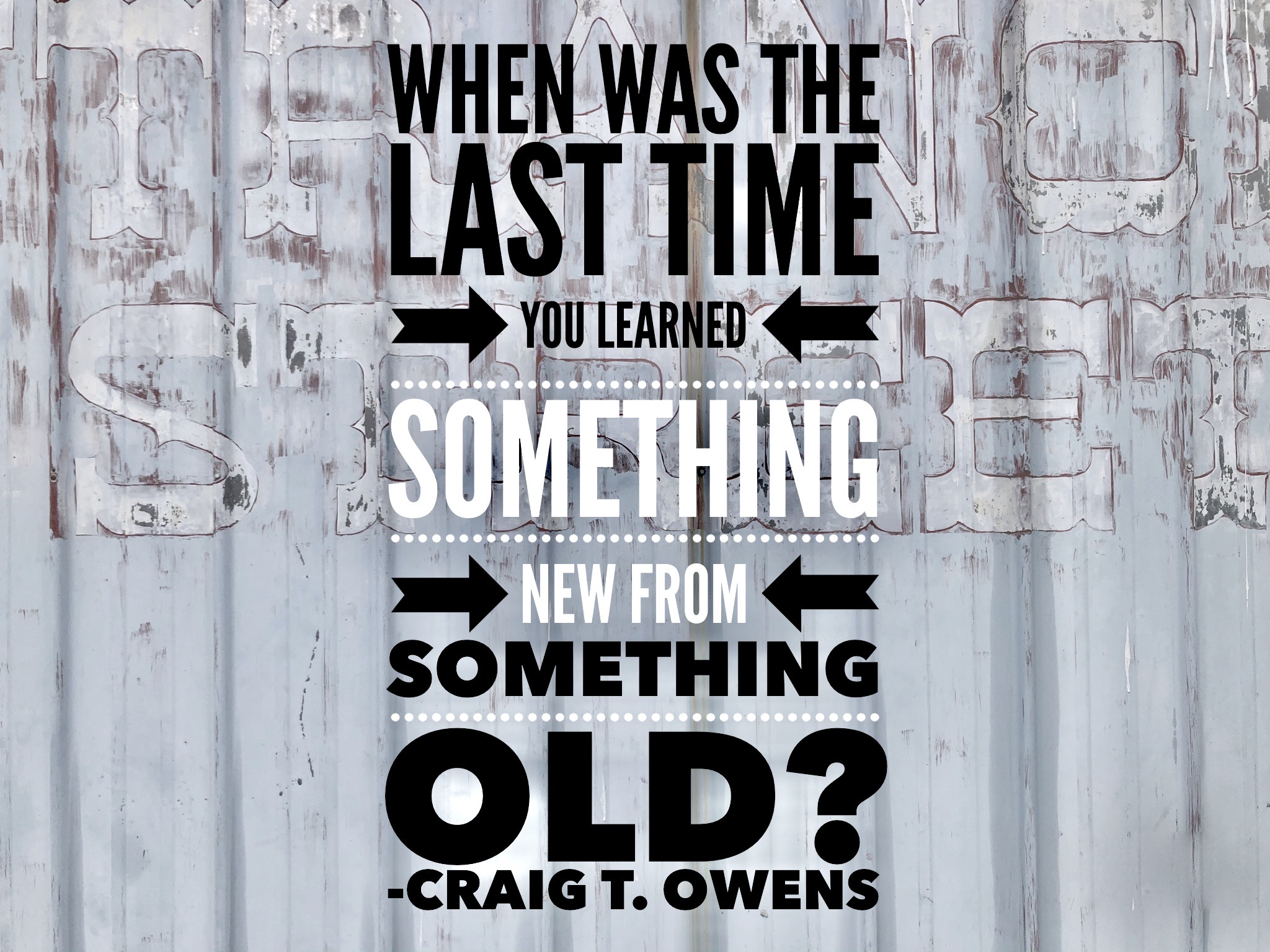
And maybe the most important introspective question of all: When was the last time I learned something new from something old?

►► Would you please prayerfully consider supporting this ministry? My Patreon supporters get behind-the-scenes access to exclusive materials. ◀︎◀︎

Borrowed Brains

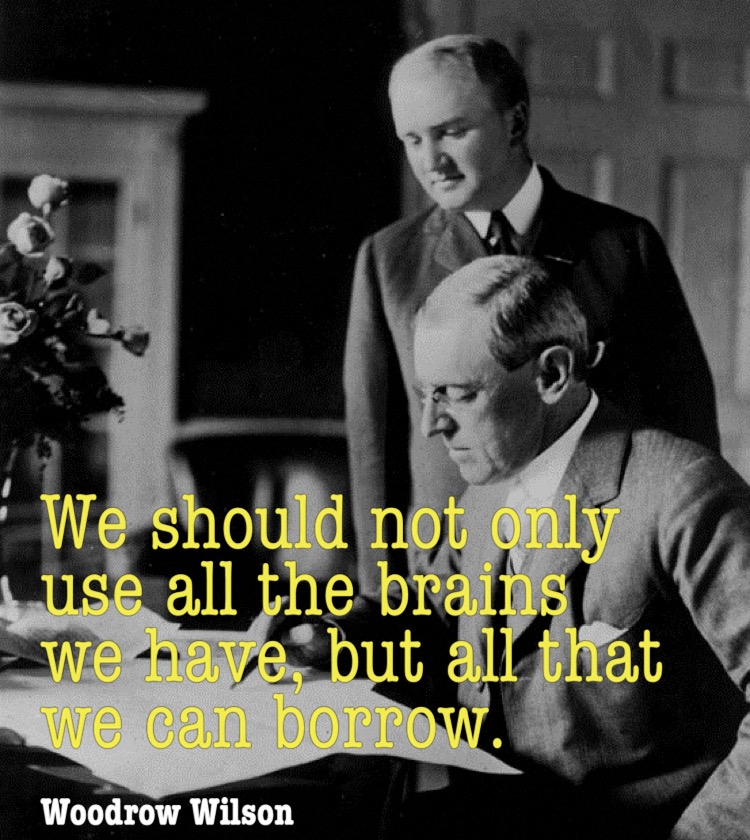
“We should not only use all the brains we have, but all that we can borrow.” —Woodrow Wilson

It’s so important to learn from others—to borrow their brains. I try to take something from other people’s brains every day.

  • Every morning I begin my day by studying the timeless truths found in the Bible.
  • Then I pray to ask God to give me the mind of Christ for my day.
  • Throughout my day I learn from the brains of other business and ministry leaders. People who have been-there-done-that and are willing to share are an invaluable source of wisdom.
  • I also consume a regular diet of biographies and autobiographies of past and present leaders. I try to put myself in their shoes to see why they made the decisions they made.
  • And I have some close friends that can give me their honest insight and critique.

One of the saddest things is to hear someone say, “I’m a self-made man” or “I’m a self-made woman.” Really?! That’s rather limited, isn’t it?

So whose brains are you borrowing? 

I Don’t Have To Be A Know-It-All

I’m still reading through Craig Groeschel’s book The Christian Atheist. This morning I read a statement that Craig quotes from Andy Stanley:

“You don’t have to understand everything to believe in something.”

I don’t know about you, but this gives me such freedom! Especially in my role as a pastor where sometimes I feel like I’m supposed to understand it all.

I don’t have to have an answer to every question to point people to God.

I don’t have to be able to unravel every theological mystery to tell people Jesus loves them.

I don’t have to know how He does it to lead people to the empowerment of the Holy Spirit.

I don’t have to know why everything happened the way it did to care for hurting or confused people.

The bottom line is I can only know the part—the infinitesimal part—that the Holy Spirit has made alive to me. But that part is more than enough for me to keep on loving my God and my Savior!

Learning To Distinguish

In Moses’ instructions to the priests, he said, “You must distinguish between the holy and common, between the unclean and the clean.”

Why? Because these men were to be leaders. He went on to say, “You must teach the Israelites all the decrees.”

If I’m going to be a leader, I must be able to distinguish.

Here’s where the Holy Spirit is challenging me. I am working on distinguishing between…

Good and Best

Acceptable and Excellent

Common and Holy

Ordinary and Extraordinary

Want and Need

Present and Participant

Quantity and Quality

I am certain that this list is just a start, and that it’s going to be a lifetime pursuit.