Listen to the podcast of this post by clicking on the player below, and you can also subscribe on Apple, Spotify, or Audible.
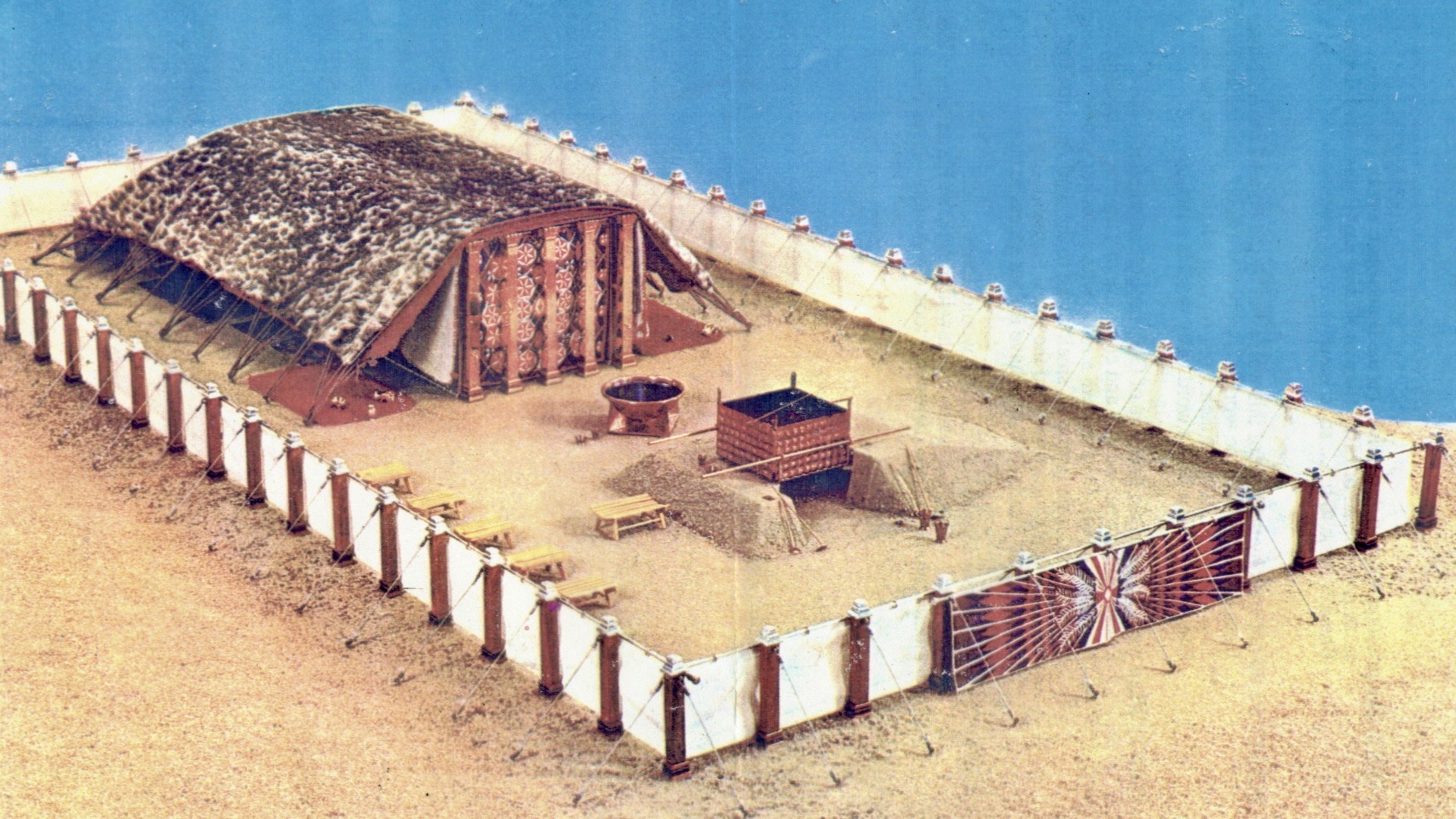
I was absolutely fascinated by a Messianic Jew’s insights on the Old Testament Tabernacle, and how every aspect of it pointed to Jesus the Messiah.
The overview of the construction of the Tabernacle starts in Exodus 25 and covers the next fifteen chapters in that book. Here are a few of my main takeaways from my friend’s teaching.
The materials for the Tabernacle are brought as a freewill offering given by freed slaves (Exodus 25:1-2). This gold, silver, bronze, linens, and other materials were gifts from the Egyptians when the Israelites left on the night of the Passover.
The Tabernacle is at the center of the Israelite camp (Numbers 2:1-34), signifying God’s presence in the center of our lives. When the Israelite community moved out, the tribe of Judah went first. Judah means “praise.” What a great reminder to let praise to God be at the forefront of all we do!
In Exodus 27:16, the materials to be used for the curtains compromising the entrance to the Tabernacle are blue, purple, and scarlet. The blue is for sky (Heaven), the purple designates royalty, and the scarlet signifies the blood of the sacrifices. Jesus came to earth as royalty from Heaven, and by His shed blood He opens the way for all of us to be with Him in Heaven forever! Jesus said He was the only way to Heaven (Hebrews 2:14-15; John 14:6).
The bronze altar for cleansing was just inside the entrance (Exodus 27:1-8). The worshiper offered this sacrifice in place of their sin. The priests would then move to the laver to wash off the dirt of the world. It’s important to note that the priests wash at the laver, not in the laver. Jesus is the One who washes us and cleanses us (Ephesians 5:26).
There are four different coverings over the Holy Place. As the priest progresses farther into the Holy Place, the coverings become thicker, so less outside light is visible.
First covering (Exodus 26:1) was blue, purple, and scarlet yarns (like the colors at the entrance) with cherubim woven into the fabric. The priests looking up would see these angels.
Second covering (v. 7) was goat’s hair. Goats were used for sin offerings, reminding the priests that there was a sacrifice to cleanse them so they could approach the presence of God.
Third covering (v. 14) was a red-dyed ram skin, showing the blood that covers us.
Fourth covering (v. 14) was the durable leather of a badger. Now there would have been very little light from outside, but the angels would still be seen for those inside the Holy Place.
In the Holy Place was the showbread (sometimes called the bread of presence) pointing to Jesus as our Bread of Life (Exodus 25:23-30; John 6:35). Also in the Holy Place was the lampstand filled oil (vv. 31-37). Only one stick holds the oil and supplies the other six branches. The priests could only work by the light of God. Jesus is our light (John 8:12). And we also find the altar of incense here (30:1-7). This was a unique perfume that wasn’t used anywhere else. The prayers of the saints that arise before the throne in Heaven as said to rise as incense (Psalm 141:2; Revelation 5:8). Worshipers in God’s presence are saturated with the aroma of Jesus (2 Corinthians 2:14-15).
In the Holy of Holies is the ark of the covenant of the Lord (25:10-22). Inside the ark were the stone tablets that contained the Ten Commandments. On top of the ark, overshadowed by the wings of two huge cherubim angels, was the mercyseat or atonement cover. Notice that mercy is over the Law, and that the blood of the sacrifice of Jesus covers my disobedience and makes me at one with God (the literal definition of atonement).
How beautifully all of these aspects of the earthly Tabernacle point to Jesus (Hebrews 8:5, 10:1)! And even more amazingly, Jesus fulfilled every requirement in this Tabernacle to make it possible for all who put their faith in Him to enter the Heavenly Tabernacle and remain in His presence for ever and ever!
Let’s follow this thread from the Old Testament into the New Testament—
“When Aaron trims the lamps at twilight, he shall burn incense. There shall be perpetual incense before the LORD throughout your generations.” (Exodus 30:8)
“Therefore I urge you, brethren, by the mercies of God, to present your bodies a living and holy sacrifice, acceptable to God, which is your spiritual service of worship.” (Romans 12:1)
“For we are a fragrance of Christ to God among those who are being saved and among those who are perishing.” (2 Corinthians 2:15)
“The incense which you shall make, you shall not make in the same proportions for yourselves; it shall be holy to you for the LORD.” (Exodus 30:37)
“Our lives are not to be about us, lived out in private and for self-glory. Our lives are to be about God, lived out in full view of the nations and for His name’s sake.” —Dick Brogden
What incense is your life—your witness, your testimony—sharing with those around you?
“This incense was to be ‘offered with’ or ‘laid upon’ so as to cover or envelope the ‘prayers of all saints’—yes, all saints, from Able downwards; for this seems to be the gathering into one of all prayers from the beginning, that at length they may be answered (Luke 18:3, 7). Upon the golden altar in front of the throne the prayers of the saints of all ages have been laid; there they have accumulated; the unanswered ‘How longs?’ not forgotten.
“Not one petition, even the poorest or feeblest, has dropped from that altar, or been swept away, or lost in the process of time. All, all are there. In themselves the are poor, having no fragrance; but their intrinsic imperfection cannot change the nature of that altar on which they are laid. There they are preserved— each sigh, each tear, each cry, from child or aged man, from the chief of sinners, from the thief upon the cross, from the chamber of weakness and sorrow, from the crushed spirit and the broken heart—there they are: the groanings that cannot be uttered; the ‘God be merciful to me, a sinner;’ the ‘How long?’ of the tortured martyrs; the moan of the suffering saint upon his tossing sick-bed—there they are: the father’s prayer, ‘Lord, save my child;’ the child’s prayer, ‘Lord, save my father’— there they are: the pleadings for the church of God, for the overthrow of Antichrist, for the binding of satan, for the deliverance of earth, for the consummation of the eternal purpose! Not one cry lost; not one petition gone astray. All there!
“There is no such thing as unanswered prayer. Delay will only add to the fullness of the answer, and increase our joy when it comes. And it will come. He is faithful that promised. He cannot deny Himself.” —Horatius Bonar, in Light & Truth: Revelation(emphasis mine)
E.M. Bounds has challenged and inspired my prayer life probably more than any other author. Check out these words from his book Purpose In Prayer—
“God shapes the world by prayer. Prayers are deathless. The lips that utter them may be closed in death, the heart that felt them may have ceased to beat, but the prayers live before God, and God’s heart is set on them and prayers outlive the lives of those who uttered them; outlive a generation, outlive an age, outlive a world.
“That man is the most immortal who has done the most and the best praying. They are God’s heroes, God’s saints, God’s servants, God’s deputies. A man can pray better because of the prayers of the past; a man can live holier because of the prayers of the past, the man of many and acceptable prayers has done the truest and greatest service to the incoming generation. The prayers of God’s saints strengthen the unborn generation against the desolating waves of sin and evil. Woe to the generation of sons who find their censors empty of the rich incense of prayer; whose fathers have been too busy or too unbelieving to pray, and perils inexpressible and consequences untold are their unhappy heritage. Fortunate are they whose fathers and mothers have left them a wealthy patrimony of prayer.” (emphasis added)
When God gave Moses instructions for building the tabernacle, the altar of incense was placed before the curtain that separated the Holy Place from the Holy of Holies. The Bible does not tell us how the high priest passed through or by the curtain, so many believe that as he worshiped God, his prayers mingled with the incense, and God translated him through the curtain and into His presence.
There are other verses to support this:
Let my prayer be set forth as incense before You, the lifting up of my hands as the evening sacrifice. (Psalm 141:2)
The book of Revelation gives us a glimpse into Heaven, and twice we see the prayers of the saints being linked with the incense of worship (see Revelation 5:8 and 8:3-4).
Notice what E.M. Bounds says … our prayers TODAY are providing the incense the NEXT GENERATION will need! If we fail to pray now, we’re not only hurting ourselves, but we’re putting our children and grandchildren on a path toward “perils inexpressible and consequences untold.”
Instead, let’s leave them “a wealthy patrimony of prayer”! Will you pray? Today?






 Craig T. Owens