12 Quotes From “12 Huge Mistakes Parents Can Avoid”

12 Huge MistakesI highlighted a lot in Tim Elmore’s newest book 12 Huge Mistakes Parents Can Avoid … a lot! This is book that every parent (or grandparent) should read because it’s never too late to invest the best in our (grand)children. You can read my full book review of this must-read book by clicking here. Below are just a few of the quotes I highlighted in this book.

“I believe we have under-challenged kids with meaningful work to accomplish. We have overwhelmed them with tests, recitals, and practices, and kids report being stressed-out by these activities. But they are essentially virtual activities. Adults often don’t give significant work to students—work that is relevant to life and could actually improve the world if the kids rose to the challenge. We just don’t have many expectations of our kids today.” 

“Every parent and teacher wants to see their kids succeed in school, in sports, and in life, but making it impossible to fail isn’t the answer. Removing failure, in fact, is a terrific way to stunt maturity. … As parents, we’ve given them lots of possessions but not much perspective. As educators, we’ve given them plenty of schools but not plenty of skills. As coaches, we’ve taught them how to win games but not how to win in life. As youth workers, we provide lots of explanations but not enough experiences. As employers, we’ve mentored them in profit and loss but haven’t shown them how to profit from loss.”

“Truth be told, when kids have heard they are excellent without working hard or truly adding value to a team, the praise rings hollow to them. Our affirmation must match their performance.”  

“When people—especially young people—know they are free to try something and fail, their performance usually improves. It brings out the best in them. But if they are preoccupied with trying not to fail, they become paralyzed:

  • Failure can create resilience.
  • Failure can force us to evaluate.
  • Failure can motivate us to better performance.
  • Failure prompts creativity and discovery.
  • Failure can develop maturity.”

“Our constant caving begins to foster a constant craving in them. They want clarity. With boundaries unclear, they need more direct attention from Mom or Dad. Unwittingly, we actually breed insecurity and instability in our kids. This may sound strange, but consistency may be your best friend as a parent because it aids in your authority and in your child’s development.” 

“Removing the consequences takes one of two roads. We either excuse their behavior and remove negative outcomes, or we actually step in and pay the consequence for them. When we do this, we frequently relieve the stress. We bring immediate peace to the situation, so we get addicted to this pattern. Unfortunately, we don’t see the long-term problems we are causing. Removing the consequences from our children’s lives brings short-term tranquility but long-term trouble.”

“‘You can do anything you want.’ I recognize why we say this, but as our kids grow older, we must help them to see what we really meant. … We really meant, if they set their mind to do something, they’ll be amazed at what they can pull off. The catch is, it needs to be something with in their gift area. They cannot simply make up a dream or copy a friend’s dream and call it theirs. Dreams should be attached to strengths.” 

“We have created a world of conveniences, filled with smart phones, microwaves, Internet shopping, and online banking. The subtle message is that struggles are to be avoided. We want as much convenience as possible. In fact, we feel entitled to it. But we failed to see that when we remove the struggles from our children’s lives, we begin to render them helpless. They don’t have the opportunity to develop the life skills they’ll need later on. Further, when we step in to control their levels of struggle, they don’t learn how to be in control or under control themselves. In fact, all they learn is how to be controlled.”

“Ironically, the things young people want to avoid are necessary for them to mature authentically. Slow, hard, boring, risky, laborious… these are the very challenges that prepare me to become a good man, a good husband, a good father, a good employee, a good employer. Many life skills that once naturally developed in us now atrophy in today’s culture. So we must be far more intentional about leading our kids into opportunities to build these skills.” 

“When we affirm looks or clothing—external matters instead of internal virtues—kids values become skewed. Remember, what gets rewarded gets repeated. Without realizing it, we are reinforcing cosmetic features—usually features that are not in their control. … We should be doing just the opposite. We must affirm effort and behavior, which are in their control, instead of characteristics that are out of their control. If we do this, we begin to foster a growth mindset instead of a fixed mindset.”

“We mistake hurtful with harmful. Many times, hurting helps us. In fact, removing the hurt may be harmful. … When we hurt, we can learn important truths about ourselves and about others, truth that will be beneficial later in our lives. … We confuse disturbance with damage. We hate being disturbed. Our days are so full, we often hope and pray we won’t face any unexpected disturbances as we pursue our goals. The fact is, however, that on our way to those goals, we fall into unhealthy ruts. Interruptions force us out of those ruts. Interruptions are not damaging at all. They are the very items that save us from our tunnel vision. We need to be disturbed from time to time. Interruptions are wake-up calls that rouse us from our apathy or complacency.” 

“I know you think kids are tired of you talking about the good old days. But I’ve found most kids love hearing stories of how we adults struggled to learn the same life skills when we were young. It’s all part of growing up.”

12 Quotes From “Create”

CreateCreate by Stephen Altrogge is a quick motivating read to help you: (1) realize that God created you to be creative, (2) remove the excuses for not exercising your creativity, and (3) encourage you to get something started! You can read my full book review by clicking here. Below are some quotes I highlighted in Create.

“Everyone was created to create. It’s hardwired into us by our Maker. … We are created in the image of God we all have an irresistible impulse to create and to establish order. When a painter brings forth beauty from the chaos of his paint palette, he is reflecting the image of God. When an accountant massages an unruly mass of data into an intelligent sales report, she is reflecting the image of God. When a writer assembles letters into words and words into sentences and sentences into paragraphs and paragraphs into pages and pages into a book, he is reflecting the image of God. When a wife tastefully decorates her house with paint colors and throw pillows, she is reflecting the image of God. When a chef mixes flower and sugar and eggs to create a cake, she is reflecting the image of God.”

“If we’re constantly dependent on the approval of other people we’ll always be afraid of failure. If we’re constantly needing the affirmation and praise of those around us then we’ll never take any creative risks. … Our identity is not rooted in what we create it’s rooted in Christ. Our identity is wrapped up in the One who created us, not the things that we create. Our acceptance doesn’t come from our friends or coworkers or fellow artists, it comes from Christ.”

“Be at peace with being lousy for a while. Chesterton once said that anything worth doing was worth doing badly. He was right. Only an insufferable egoist expects to be brilliant first time out.” —Douglas Wilson

“Trying to be perfect all the time takes the fun out of creativity.”

“When you start a creative project don’t look at the end, look at the next step in front of you.”

“A journey of a thousand miles is begun with a step.  Beware of despising small beginnings.  Some men never arrive at usefulness because they are not satisfied to begin in a small way, and proceed by a step at a time.” —Charles Spurgeon

“Most creative works are the result of faithful effort, not massive creative outbursts.”

“I believe in plodding. Productivity is more a matter of diligent, long-distance hiking than it is one-hundred-yard dashing. Doing a little bit now is far better than hoping to do a lot on the morrow. So redeem the fifteen minute spaces.” —Douglas Wilson

“Being a successful creator requires making a habit out of creativity. The most consistently creative people are the ones who have made creativity a habit. They sit down at their desk every single day and do the work. They may not work for long periods of time, but they do work consistently. They don’t wait for the creative muse to descend upon them. They sit down, grab the muse by the ear, and start putting words on paper or numbers in a spreadsheet or paint on a canvas. The muse does not descend upon those who wait. The creative muse descends upon those who grab hold of it, put it in a headlock, and force it into submission.” 

“If our creative work truly is for the honor of God, we should be willing to see it through to the end. … If we give up easily on a project that we believe will honor the Lord, we’re not being faithful. We’re being lazy, and we’re actually being selfish. We’re not allowing others to benefit from the creative gifts that God has given us.”

“If we’re truly seeking to glorify God through creativity, then we should be open to all manner of advice, suggestions, and even criticisms. God created us to be dependent on other people, and this is true in the creative field as well. … If we don’t pursue feedback there’s a pretty good chance that our creative work isn’t going to be very good.” 

“Psalm 24:1 says, ‘The earth is the Lord’s and the fullness thereof, the world and those who dwell therein….’ God created the world. Everything in the world belongs to Him and everything in the world is infused with His creativity. The world is literally busting at the seams with the creativity of God. There are ideas lurking around every corner! Creativity is everywhere. We just need to be on the lookout for it.”

Poetry Saturday—Failure

Edmund Vance CookeWhat is a failure? It’s only a spur
   To a man who receives it right,
And it makes the spirit within him stir
   To go in once more and fight.
If you never have failed, it’s an even guess
You never have won a high success.

What is a miss? It’s a practice shot
   Which a man must make to enter
The list of those who can hit the spot
   Of the bull’s-eye in the centre.
If you never have sent your bullet wide,
You never have put a mark inside.

What is a knock-down? A count of ten
   Which a man may take for a rest.
It will give him a chance to come up again
   And do his particular best.
If you never have more than met your match,
I guess you never have toed the scratch. —Edmund Vance Cooke


Poetry Saturday—A Psalm Of Life

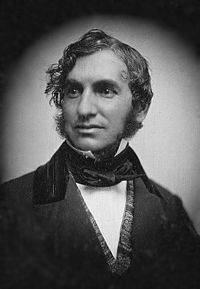
LongfellowTell me not, in mournful numbers,
   Life is but an empty dream!
For the soul is dead that slumbers,
   And things are not what they seem.

Life is real! Life is earnest!
   And the grave is not its goal;
Dust thou art, to dust returnest,
   Was not spoken of the soul.

Not enjoyment, and not sorrow,
   Is our destined end or way;
But to act, that each to-morrow
   Find us farther than to-day.

Art is long, and Time is fleeting,
   And our hearts, though stout and brave,
Still, like muffled drums, are beating
   Funeral marches to the grave.

In the world’s broad field of battle,
   In the bivouac of Life,
Be not like dumb, driven cattle!
   Be a hero in the strife!

Trust no Future, howe’er pleasant!
   Let the dead Past bury its dead!
Act,— act in the living Present!
   Heart within, and God o’erhead!

Lives of great men all remind us
   We can make our lives sublime,
And, departing, leave behind us
   Footprints on the sands of time;

Footprints, that perhaps another,
   Sailing o’er life’s solemn main,
A forlorn and shipwrecked brother,
   Seeing, shall take heart again.

Let us, then, be up and doing,
   With a heart for any fate;
Still achieving, still pursuing,
   Learn to labor and to wait. —Henry Wadsworth Longfellow

No Self-Made Men

I get so tired of people calling themselves “a self-made man.” There is no such thing! It is equally as distasteful when pastors pat themselves on the back talking about “the ministry I have built.”

Dick Brogden

Dick Brogden

Here are important words to remember—

“Wherever we go in ministry and mission, we either benefit from the labor of others or we contribute to the future benefit of those that will follow. If we see fruit, we can be assured that it is not solely due to our dedication or vision but because others went ahead of us and did the hard work. Often prayer accomplishes this hard work. Regularly those on the ground preceding us did this hard work.” (Dick Brogden)

And this—

What, after all, is Apollos? And what is Paul? Only servants, through whom you came to believe—as the Lord has assigned to each his task. I planted the seed, Apollos watered it, but God has been making it grow. So neither the one who plants nor the one who waters is anything, but only God, who makes things grow. The one who plants and the one who waters have one purpose, and they will each be rewarded according to their own labor. For we are co-workers in God’s service; you are God’s field, God’s building. (1 Corinthians 3:5-9)

What do you think?

Keep Your Love Up-To-Date

Busyness Can Kill LoveIt’s possible to be so busy doing good things that we forget why we are doing those good things. Worse than that: our busyness can actually kill what’s most important.

When Jesus addressed the church at Ephesus (Revelation 2:1-7), He addressed a problem we in the West face today as well. Jesus said, “You are hard workers. You keep pressing on despite the obstacles. You are ministering to others, you’re making sure no wolves in sheep’s clothing infiltrate the church, and you even stand strong under persecution for your faith.”

But then Jesus drops a hard word on them: “Yet I have this against you: You have forsaken your first love.

The Ephesians were fighting the good fight. Yet this intense work and ministry detracted from what is most important: Love for God. The New Living Translation says verse four this way: You don’t love Me or each other as you did at first.

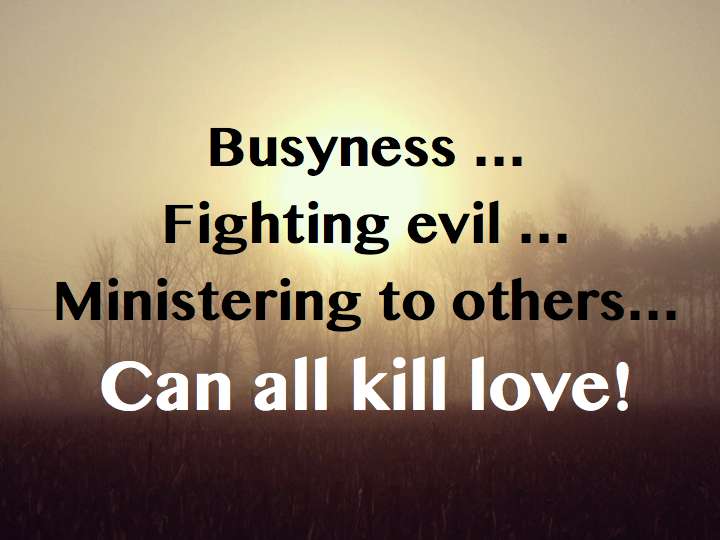
  • Busyness can kill love.
  • Fighting evil can kill love.
  • Standing for truth can kill love.
  • Ministering to others can kill love.

Ministering to others is not love. It can only come from the overflow of love. But if the love is not kept full, there’s nothing there to overflow, and we’re only “doing our duty.”

So Jesus challenges the Ephesians (and us) with these two steps: Remember and Repent.

The verb tense for remember is the present tense. That means it’s something we need to do now. I cannot tell my wife “I love you” nine times on Monday morning and expect that I’m covered for the next 10 days. In the same way, we cannot tell Jesus we love Him on Sunday morning, and then go off to do our own thing for the rest of the week. That choice will not allow us to overflow with love; in fact, it will be just the opposite: we’ll be running on empty, just doing our duty.

We must keep our love up-to-date. Remember often how much God loves you, and express your love to Him. And if you find something in your life that is more of a focus that Christ, repent. Turn from that and turn back to your first love.

Thursdays With Oswald—Are You A Saint?

This is a weekly series with things I’m reading and pondering from Oswald Chambers. You can read the original seed thought here, or type “Thursdays With Oswald” in the search box to read more entries.

Oswald Chambers

Are You A Saint? 

     The New Testament idea of a saint is not a cloistered sentiment gathering around the head of an individual like a halo of glory, but a holy character reacting on life in deeds of holiness. 

From Christian Disciplines

Artists usually depict saints the same way they depicted Jesus: Someone with an angelic face, a heavenly glow around the top of their head, looking longingly up into heaven.

In reality, saints aren’t solitary but are constantly involved with other people. If there’s a glow on their face, it’s probably a glow of glistening sweat. There are callouses on their hands, and dirt under their fingernails from helping others. And if they are looking up to heaven, it’s in a moment of prayer trying to discern what God wants them to do next.

A saint is busy trying to live more and more like Jesus, Who came to feed the hungry, heal the sick, encourage the brokenhearted, bring hope to the hopeless, and show the love of God in touchable ways.

Are you a saint?

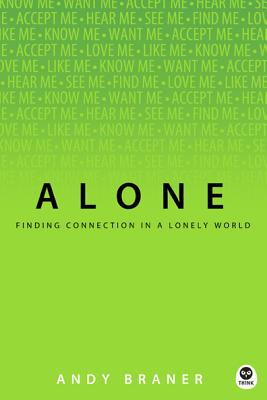
11 Quotes From “Alone”

AloneAlone should be read and discussed by parents and teens to help find the right balance of technology usage in our lives. You can read my book review by clicking here. Below are some of the quotes that stood out to me from Alone.

“Maybe God created Adam to be needy. … Maybe Adam’s relationship with God was not built in fullness but contained a hole God created inside of humanity so we might recognize the importance of each other. It was (and is) brilliant.”

“Friendship has to be accompanied by experience. … The illusion of friendship is making everyone in the world think we’re perfect. … Instead of time spent experiencing life together, we’ve turned our world into a self-shaped, self-regulated, self-indulgent, me-centered life.”

“We are now a culture that wants to deal with relationships on our time. … Relationships are work. They’re inconvenient. They’re exciting and spontaneous. You can’t apply some formula for relationships and expect to walk out of the room with a load of friends.” 

“When you realize what role you have to play here on the planet, the most beautiful sense of belonging begins to awaken inside your soul. The world begins making sense. No matter what you’re doing, if God has gifted you in it, you’re going to have a high level of functioning.”

“Don’t get me wrong: Hard work and dedication are important factors as we help people understand significance, but in the end, our short lives are shaped by the relationships we make along our own journey. And if those relationships are filled with people who believe in us, the lonely factor fades away and we are recognized for the abilities we do have rather than the ones we don’t. Paul said it clearly: ‘I remind you to fan into flame the gift of God, which is in you through the laying on of my hands’ (2 Timothy 1:6). What can you do to fan someone else’s flame? Who in your life fans yours?”

“Maybe it’s because we’ve replaced the idea of risk and adventure with the idea of wealth and comfort. Loneliness begins to creep into a man’s life when adventure and risk are taken out of the equation, when men have to replace their God-given desires with something ‘more responsible.’ … Men need to sense that what they are doing in the world is courageous. They need to feel the sense of responsibility and freedom. They need to have opportunities to express their manhood.”

“There is no perfect girlfriend. There is no perfect employee. There is no perfect friend. There is no perfect body type or student or athlete. There’s no such thing as a perfect woman who finds the perfect role for her perfect situation. Those who continue to assign a high value to that mythical person who has it all together are driving themselves mad with the idea that they can achieve her. It’s from this feeling of failure, of never measuring up, that the loneliness sets in.” 

“The first step in understanding true joy is defining what joy actually is. It’s a feeling. It’s an emotion. It’s a state of mind. It’s the ability to know that the desires of your heart are being fulfilled. It’s not happiness. It’s not the constant state of euphoria. It’s not everything lining up perfectly. … In modern times, joy happens when we interact with each other. When we see a friend’s smile giving us validation that he or she is interested in being with us: joy. When we hear the words ‘How are you?’ in an honest tone, with honest body language behind it: joy. When we have an opportunity to rest in the fact that someone else wants us to be the person God created us to be: ultimate joy.”

“The quickest way to initiate friendship is to give people freedom to be themselves.”

“‘Oh, you did sooo well in your game,’ she said, walking past, rolling her eyes. Versus … ‘I can’t believe you! You’re the most awesome basketball player I’ve ever seen,’ she said, putting her arm around her friend in celebration. See the difference? Authentic versus agenda-driven. Caring for someone versus using someone. When a tribe is built … When experience glues relationships together … When you can rest in the joy that certain relationship gives you … Loneliness starts to fade away. But you can’t do that on Facebook.”

“If we can take the value of the social networking scene and combine it with real-time relationships, we might see this trend of loneliness take a positive direction. What would life look like if we could really experience life together? Community is important. To be able to contribute to the life of the community is even more fulfilling.” 

Careless Words

Listen to the podcast of this post by clicking on the player below, and you can also subscribe on AppleSpotify, or Audible. 

“But I tell you that men will have to give account on the day of judgment for every careless word they have spoken.” —Jesus Christ, in Matthew 12:36

The King James Version uses the phrase idle words, which is a rather apt description. The root Greek word is the picture of a worker, but the prefix “a” with it means that the worker is either lazy or unemployed. Not only that but he couldn’t care less (“careless”) about his unemployed, unproductive state.

It’s lazy to use whatever word comes to mind, especially if it’s not the right word. 

It takes hard work to say the right word at the right time. 

It requires great care to leave the wrong word unspoken.

Just prior to the above quote from Jesus, His critics had just thrown out the line, “He casts out demons through the power of the devil.” They didn’t think about what they were saying, so Jesus said, “If you had thought that through before you said it, you would have realized that it makes no sense. That was an idle, unproductive, lazy thing to say.” In the meantime, who knows how many people heard that throw-away line and then turned away from Jesus (see Matthew 12:22-37).

Words have consequences. Idle, careless words may have eternal consequences. I’ll have to stand before God to explain my careless words some day.

And so will you.

►► Would you please prayerfully consider supporting this ministry? My Patreon supporters get behind-the-scenes access to exclusive materials. ◀︎◀︎