No Toleration

We need to elevate our vocabulary when it comes to God and the things about His nature and His Kingdom.

I was convicted of this a few years ago. I came home from church and was watching an NFL game on a Sunday afternoon, when a receiver made an amazingly acrobatic catch for a touchdown. I jumped off the couch and shouted, “That. Was. Awesome!!

Immediately the Holy Spirit brought something to my mind. “When you were worshiping at church this morning,” He gently reminded me, “didn’t you say how awesome God was? Is He as awesome as that catch?”

Right then and there I decided that I needed to be more careful of my vocabulary. I want to reserve words for God that I used nowhere else. Theologians do it all the time: creating new words to try to capture the majesty, omnipotence, and mind-blowing-vocabulary-defying greatness of Almighty God.

I’m certainly not perfect at this, but I’m working on it.

I was reminded of this again when I read these words from Charles Spurgeon:

“My Master has riches

beyond the count of arithmetic,

the measurement of reason,

the dream of imagination,

or the eloquence of words.

They are unsearchable!

You may look,

and study,

and weigh,

but Jesus is a greater Savior

than you think Him to be

when your thoughts are at the greatest.

My Lord is more ready to pardon

than you to sin,

more able to forgive

than you to transgress.

My Master is more willing to supply your wants

than you are to confess them.

Never tolerate low thoughts of my Lord Jesus.”

Who’s Your Promoter?

Check out this verse where God speaks to Joshua:

Today I will begin to exalt you in the eyes of all Israel, so they may know I am with you as I was with Moses.

Self-promoted leadership requires that I know what the current whims of the people are, and then I cater to those special-interest whims. But people are fickle, so I have to be constantly reinventing myself. I have to wear the right mask for the right group. I have to become a slick politician, giving the right speech to the right special interest group, promising them what they want to hear. I have to pander for votes to stay in leadership.

God-promoted leadership requires that I have faith in God alone. No focus groups to find out what people want. No advisors whispering in my ear. No masks, no special interest speeches, no pandering for votes. God knows the hearts of the people, and if He has called me to be a leader, He will equip me to be His leader.

Joshua was a God-promoted leader. When he was on the eve of his first major campaign as the new leader of Israel, he gave just one speech: “Let’s get ready to go.” A self-promoting leader would have given one motivational speech to the priests, one pep talk to the generals, one persuasive speech to the troops, an encouraging speech to the stay-at-home moms, and possibly one more convincing speech to those who wanted to pursue an alternative strategy.

The results of God-promoted leadership?

  1. So the Israelites did just as Joshua commanded them (Joshua 4:8).
  2. That day the Lord exalted Joshua in the sight of all Israel; and they revered him all the days of his life (Joshua 4:14).

Who’s your promoter?

My prayer is that I always allow God to be my promoter and that the Holy Spirit will convict me anytime I try to promote myself.

Everything I Need Is Right Here

God wants to bless people. He wants it so much, that He puts everything we need to receive His blessing right in front of us.

It’s not elusive. It’s not obscure.

I don’t need a Master’s in Divinity to figure this out:

Now what I am commanding you today is not too difficult for you or beyond your reach. … No, the word is very near you; it is in your mouth and in your heart so you may obey it.

The New Testament amplifies this:

  • God’s laws are written on my heart, and my conscience tells me if I’m obeying them or not (Romans 2:15).
  • The Holy Spirit teaches and reminds me of everything I need (John 14:26; 16:8; 13).

You don’t need a spiritual pilgrimage to find God. He’s already written on your heart what you need to call out to Him. Don’t delay another day!

Relearning To Pray

I’ve been sharing a series about prayer with my congregation. It’s called Total Access. The premise of the series is that we have total access to the treasure trove of God’s blessings, and prayer is the key which unlocks the door.

One of the things I love about preparing a message for my congregation…

how much more I learn.

One of the things that challenges me about preparing a message for my congregation…

how much the Holy Spirit convicts me.

I feel like I’m having to relearn how to pray.

It’s so simple, yet it is so deep.

I love the words to Kari Jobe’s song The More I Seek You

The more I seek You
The more I find You
The more I find You
The more I love You 
 
I wanna sit at Your feet
Drink from the cup in Your hand
Lay back against You and breath
Hear Your heart beat
This love is so deep
It’s more than I can stand.
I melt in Your peace
It’s overwhelming

It is overwhelming. And at the same time so comforting. I love relearning to pray… again and again and again.

Cheap Trade-Off

During the reign of King Rehoboam in Judah, God’s judgment fell on the land. Because of their sin against Him, God allowed Shishak, the king of Egypt, to plunder Jerusalem. Shishak carried off all of the valuable furnishings of the temple in Jerusalem.

To replace what had been plundered Rehoboam commissioned the casting of shields made of bronze (1 Kings 14:27). Whenever the king went to the temple, all the guards would carry these shiny shields with them, but then immediately after the king left the temple the guards returned their shields to the armory.

It looked good, but it was all a cheat … an imitation … a cheap trade-off.

Looking back a few chapters we read that not only did Rehoboam’s father, King Solomon, make the original shields out of gold, but he made almost everything out of gold. In fact, the Bible says, “Nothing was made of silver, because silver was considered of little value in Solomon’s days.” If silver was of little value, can you imagine how cheap bronze was?!

The temple is plundered. The gold shields—along with anything else of value—are gone, but there is no outcry from Rehoboam or the people, no repentance for their crimes against God, no anger at their sin that allowed Shishak’s raid.

Instead, Rehoboam wanted to try to keep up appearances.

He made bronze shields to look like the stolen gold shields.
He made his trip to the temple a spectacle of pomp and circumstance.
He hid the bronze shields away after he left the temple.

Isn’t this how many people deal with the plundering of their lives? I know I have at times. It seemed so much easier to try to cover up what was lost because of my sin, than to simply admit I sinned, repent of that sin, and ask for God’s merciful forgiveness.

Sure, Rehoboam still looked like he had his act together. But he knew—every time he was on this way to the temple and saw those bronze shields—that he was living a lie. He accepted a cheap trade-off for the real deal.

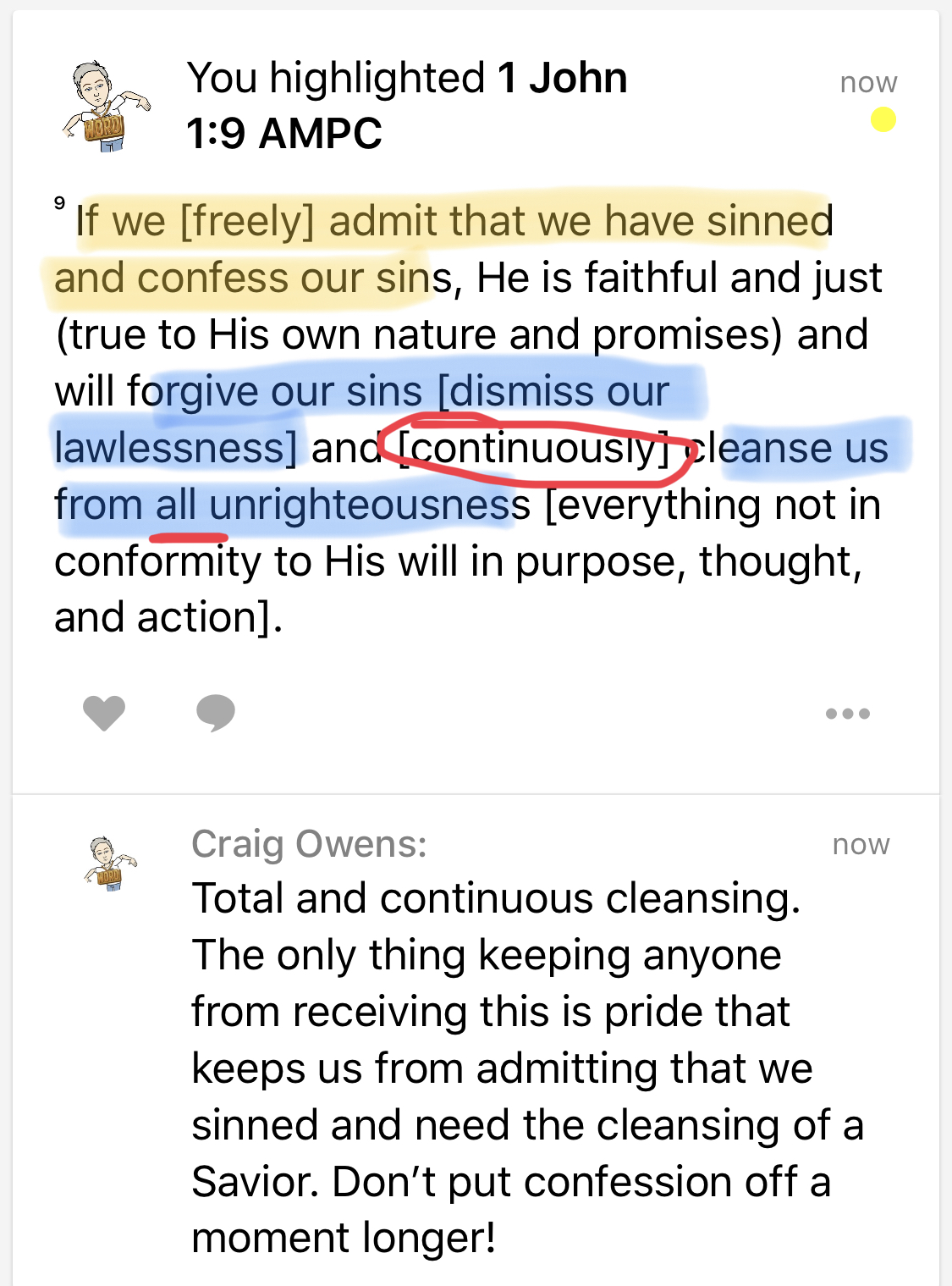
I am so grateful that, “If we confess our sins, He is faithful and just and will forgive us our sins and purify us from all unrighteousness” (1 John 1:9).

I’m not going to settle for cheap trade-offs anymore. How about you?

Justifying Myself

One of my favorite prayers is recorded in Psalm 139. It is such an intimate prayer of how well God knows us. I‘m frequently struck by the two thoughts that seem to contradict themselves in the opening and closing verses.

David begins his prayer, “O Lord, You have searched me and You know me. … You perceive my thoughts from afar.” But then he ends his prayer with these words, “Search me, O God, and know my heart; test me and know my anxious thoughts. See if there is any offensive way in me, and lead me in the way everlasting.”

Now why would David ask God to search his heart and his thoughts after he said God had already searched him? I think it‘s because our natural tendency is to justify ourselves. It goes like this: God searches us → He shows us things that need to be changed → We justify why we don‘t need to change those things → We try to forget what God had pointed out to us and move on.

When the Holy Spirit points out an anxious thought or an offensive way, our natural response is to quickly say, “Yes, but…

  • …I know I shouldn‘t have said that to her, but you don‘t know how she pushes my buttons!”
  • …I know it‘s wrong of me to desire that, but having it won‘t really hurt anything.”
  • …I know I should make that change in my behavior, but it‘s just not realistic in my current situation.”
  • …I know I should have talked to him about Christ, but it wasn‘t the right time.”
  • …I know my I‘ve been battling anxiety over this, but I‘m scared to make any changes because things might get worse!”

I echo Augustine‘s prayer: “O Lord, deliver me from this lust of always vindicating myself.”

David sets an example for me that I‘m trying to make a consistent practice in my life: Regularly allowing the Holy Spirit to search me for any anxious thoughts or offensive ways, and then addressing those without trying to justify or vindicate myself (no “yes-but‘s”). Because if I justify myself, I‘m really saying I know better than God what’s best for my life.

And all the while, God is simply trying to lead me in the way everlasting. He‘s trying to occupy more of my life with His presence.

If thou couldst empty all thyself of self.
Like to a shell dishabited,
Then might He find thee on the Ocean shelf,
And say, “This is not dead,”
And fill thee with Himself instead.
But thou art all replete with very thou,
And hast such shrewd activity,
That, when He comes, He says, “This is enow
Unto itself—‘Twere better let it be:
It is so small and full, there is no room for Me.“ —T.E. Brown

Are you making room for Him today? Or are you justifying the anxious thoughts and offensive ways the Holy Spirit is trying to reveal to you?