Prayer Changes My Maturity

Listen to the podcast of this post by clicking on the player below, and you can also subscribe on AppleSpotify, or Audible. 

Prayer can unleash God’s miracles. Sometimes the most visible miracles are the changes that are seen in us—our attitude, our expectation, our focus, and our maturity.  

Maturity is not stuffy and stodgy. Those folks actually become quite childish when others around them don’t “act right,” according to their standards. The most mature people are the most childlike. 

Do you want proof for that last statement? The most mature Person to ever live on earth was Jesus, and He loved being around kids and having children around Him (Mark 10:13-14). 

(Check out all of the Scriptures in this post by clicking here.) 

His teaching examples were frequently quite simple—farmers, birds, flowers, trees, and even going to the bathroom!. He knew their songs (Luke 7:31-32), and many of His interactions with the overly-mature religious leaders were quite playful and childlike (Mark 11:27-33). 

Jesus wants us to come to our Father like children (Mark 10:15-16). “Like a little child” means childlike, which is the exact opposite of childish. Those who think they are too mature for such simplistic things are actually the ones who are childish. 

Jesus uses the Father-child relationship over and over to teach us about praying to a Father who is desirous of giving us the best things (Matthew 6:7-9; Luke 12:32). 

One of the Psalms of Ascent written by David strikes this childlike note (Psalm 131). Verse 1 describes the childishness he’s giving up, and verse 2 describes the childlikeness he is taking on: 

  • “my heart is not proud”—not focused on me (v. 1a) 
  • “my eyes are not haughty”—overly grown up (v. 1b) 
  • “I don’t concern myself with matters too great or too awesome for me to grasp” (v. 1c NLT) 
  • instead I am stilled, quieted, trustingly at peace (v. 2) 
  • and then David calls all of us to this same childlikeness (v. 3) 

Jesus taught about persistent prayer in Luke 18:1-8 and then used a scenario from the temple to illustrate His point (Luke 18:9-17), contrasting the childish pseudo-maturity of the overly-religious man and the childlike maturity the childlike man. And then, as directed by the Holy Spirit, Luke includes the same exchange Mark used about Jesus taking up children in His arms to bless them.  
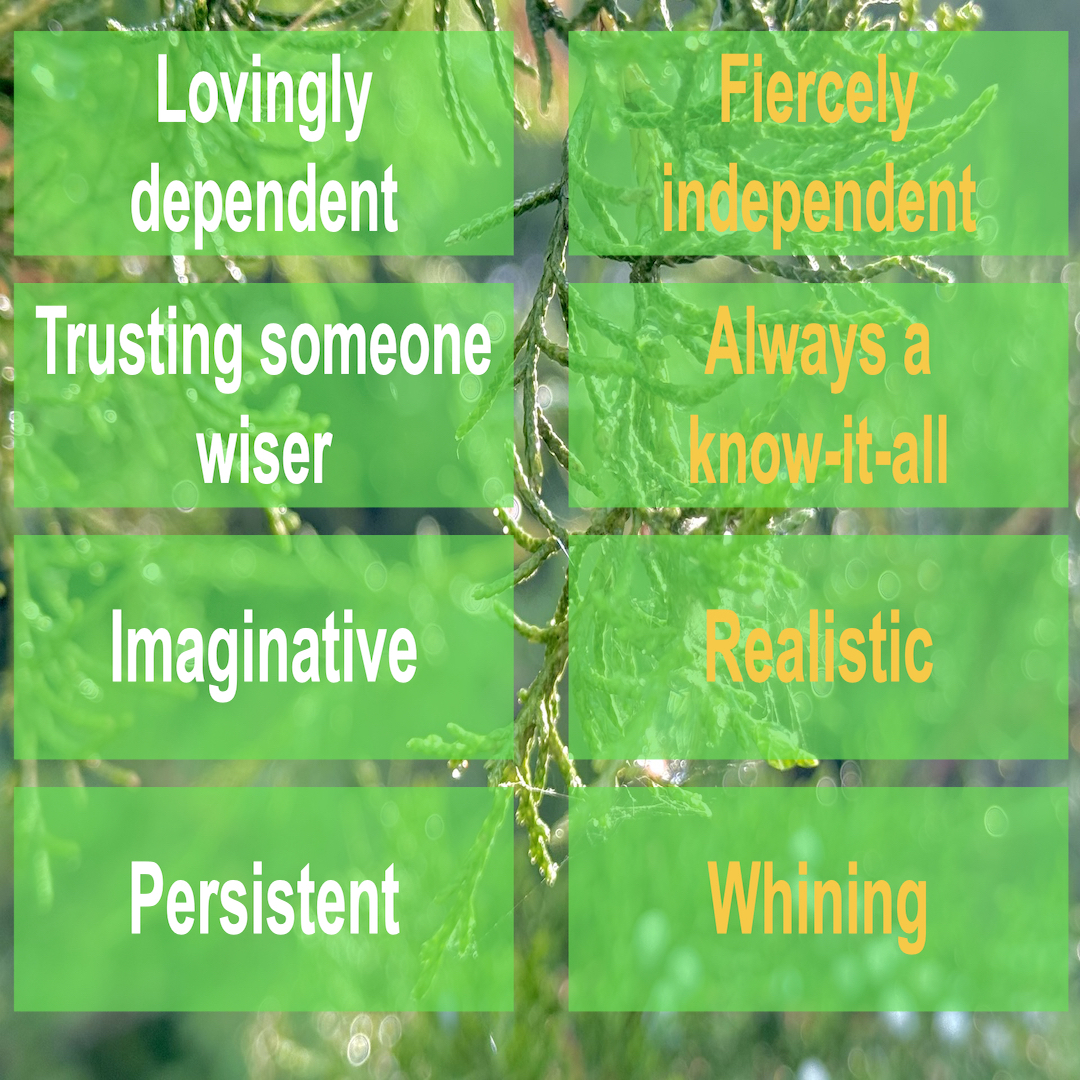
Childlike is loving dependent; childish is fiercely independent. 

Childlike is trusting someone wise; childish always knows best. 

Childlike is imaginative; childish is realistic. 

Childlike is persistent; childish is whining. 

I love the Henry Wadsworth Longfellow poem called The Children’s Hour. As you read through this, imagine our Heavenly Father as Longfellow and yourself as his three daughters. 

Between the dark and the daylight,
When the night is beginning to lower,
Comes a pause in the day’s occupations,
That is known as the Children’s Hour.

I hear in the chamber above me
The patter of little feet,
The sound of a door that is opened,
And voices soft and sweet.

From my study I see in the lamplight,
Descending the broad hall stair,
Grave Alice, and laughing Allegra,
And Edith with golden hair.

A whisper, and then a silence:
Yet I know by their merry eyes
They are plotting and planning together
To take me by surprise.

A sudden rush from the stairway,
A sudden raid from the hall!
By three doors left unguarded
They enter my castle wall!

They climb up into my turret
O’er the arms and back of my chair;
If I try to escape, they surround me;
They seem to be everywhere.

They almost devour me with kisses,
Their arms about me entwine,
Till I think of the Bishop of Bingen
In his Mouse-Tower on the Rhine!

Do you think, O blue-eyed banditti,
Because you have scaled the wall,
Such an old mustache as I am
Is not a match for you all!

I have you fast in my fortress,
And will not let you depart,
But put you down into the dungeon
In the round-tower of my heart.

And there will I keep you forever,
Yes, forever and a day,
Till the walls shall crumble to ruin,
And moulder in dust away! —Henry Wadsworth Longfellow

We mature by trading childishness for childlikeness. We mature best by coming to God our Father in prayer as a child comes to his father. 

Let prayer change your maturity! 

If you’ve missed any of the other messages in this series on how prayer changes us, you can find them all here. 

►► Would you please prayerfully consider supporting this ministry? My Patreon supporters get behind-the-scenes access to exclusive materials. ◀︎◀︎

Don’t Undo The Good

Just one moment of indulgence…

Just one small compromise in values…

Just a little bit of childish folly…

…and you undo all that you had done so well. 

Dead flies cause the ointment of the perfumer to putrefy and send forth a vile odor; so does a little folly in him who is valued for wisdom outweigh wisdom and honor. (Ecclesiastes 10:1 AMPC) 

You can go a bit deeper on this in my posts Don’t Putrefy Your Leadership

Becoming Childlike

Listen to the podcast of this post by clicking on the player below, and you can also subscribe on AppleSpotify, or Audible. 

I hope you’ve noticed so far that the parts of Christ’s model prayer that we’ve looked at so far are both an acknowledgement of the holiness of God and the greatness of His Kingdom, and also a request for us to be empowered to live in a way that makes those things known to Earthlings. 

One of the ways we live to make these things seen is found in the next phrase: Your will be done on earth as it is in Heaven (Matthew 6:10). 

In A Christmas Carol, Charles Dickens shows us a scene where the Ghost of Christmas Present has taken Scrooge to his nephew’s home. After dinner, these young adults begin playing games. Dickens says, “For it is good to be children sometimes, and never better than at Christmas, when its mighty Founder was a child Himself.” 

Jesus loved children! Being around “the littles” lately at on our school campus, I have a whole new appreciation for this. Because Jesus loved children, their parents wanted them around Him, and He wanted them around too (see Matthew 19:13-15; Mark 10:14-16; Luke 18:15-17).

Children are loud, busy, adventurous, and easily distracted. But they are also loving, trusting, curious, innocent, and easily comforted. And Jesus loved to bless them!   

What does this have to do with “Your will be done on earth as it is in Heaven”? Jesus taught us to address our praying to “Our Father.” That means we are to interact with Him as His children.  

Jesus wants us to be childlike not childish. 

  • trusting not posturing—Matthew 6:7-8 
  • honest not hypocritical—Luke 18:9-14 
  • persistent not whining—Luke 11:9-13 
  • humbly dependent not scheming—Matthew 18:1-4 

[Check out these passages here] 

Children love to do the will of their parents. They’re not trying to earn their approval, but joyfully obeying out of innocence. When we obey God as loving children, we are doing His will on earth as it is done in Heaven! 

So once again, this is both an acknowledgement and a request. 

In Psalm 131, David uses this same picture of a contented child for us. 

Childlike is lovingly dependent. Childish is selfishly independent. Childlike is trusting someone wiser. Childish is believing I know best. 

Our prayer request should always be, “Father, may I trust You and obey You as an innocent child.” 

This is part 4 of our series on prayer called Kingdom Praying. You can check out all of the other messages in this series here. 

►► Would you please prayerfully consider supporting this ministry? My Patreon supporters get behind-the-scenes access to exclusive materials. Like some exclusive quotes from a book I just reviewed. ◀︎◀︎

The Approachable Jesus

Listen to the podcast of this post by clicking on the player below, and you can also subscribe on AppleSpotify, or Audible. 

A friend of mine who was in a position of leadership in the Assemblies of God used to joke with people, “Since you’re bowing and walking backwards out of my office, would you like to kiss my ring too?” There are some people that we feel are in a special class so that we have to approach them differently. 

If we feel that way about certain people, what might we be thinking when we consider approaching the supreme, awesome, preeminent, incomparable Jesus?! It’s very likely that we could feel Him to be unapproachable, as though we aren’t worthy of His attention. 

But when Jesus Himself told us, “When [not ‘if’] you pray,” He is assuming that we will pray. And then He adds this amazing thought: “And I will do whatever you ask in My name, so that the Father may be glorified in the Son” (John 14:13)! 

Jesus loves to help us. He died a cruel death on the Cross so that He could help us! Jesus ties our trusting prayer with His willingness to serve us (Luke 12:22-37). Note this last line from our approachable Savior: 

It will be good for those servants whose Master finds them watching when He comes. Truly I tell you, He will dress Himself to serve, will have them recline at the table and will come and wait on them. (v. 37) 

Jesus serves us?! What an amazing thought! But does this make Jesus somehow less majestic? I like what John Piper has to say about this: “Does this belittle the risen Christ—to say that He was and is and will ever be the servant of His people? It would, if ‘servant’ meant ‘one who takes orders,’ or if we thought we were His masters. Yes, that would dishonor Him. But it does not dishonor Him to say that we are weak and need His help.” 

How do we not treat Jesus as an order-taking servant? First, we have to remember that approachable doesn’t mean something we do casually. I think this is discovered in our attitude—it’s the difference between being childlike and being childish. 

The childlike attitude is one of wonder and trust. One that calls God, “Daddy.” One that is lovingly dependent on Him. One that says, “I don’t understand what I’m going through right now, but I trust Your wisdom.” 

The childish attitude is one who treats majestic things flippantly. Perhaps the childish one talks about God as “the Big Guy upstairs.” Or one who remains selfishly independent, or who says, “Do it my way—now!”

The childlike attitude glorifies Jesus as our approachable Servant Savior. 

The childlike attitude also recognizes that there are more dimensions of the majesty of God to be discovered in an abiding relationship with Jesus. Our approachable Savior wants us to come to Him, to call to Him for help, and to know Him more intimately (Jeremiah 29:13-14; Matthew 11:28-30; Hebrews 4:16; 10:19, 22). 

Prayer not only unlocks deeper, proper intimacy with Jesus, but it conforms our heart more and more to His heart. As we are conformed to Him, we reflect His approachable glory to others (2 Corinthians 4:6, 3:18). 

We approach the awesome Jesus reverently in childlike faith. It’s in God’s presence that the Holy Spirit matures our faith so that we become glory-reflectors that point others to Jesus. 

If you’ve missed any of the eight messages in our series Awesome: Learning to pray in the awesome name of Jesus, you can find the list of all of the messages by clicking here. 

►► Would you please prayerfully consider supporting this ministry? My Patreon supporters get behind-the-scenes access to exclusive materials. ◀︎◀︎

Saturday In The Psalms—Childlike Not Childish

Lord, my heart is not haughty… (Psalm 131:1).

This psalm is only three verses long, but they are three verses of immense trust in God. Truly these verses reveal extraordinary childlike dependence on God.

My heart is not haughty—I am subduing my pride.

My eyes are not lofty—I’m not looking for great things for myself.

I do not concern myself with great matters—I stay away from burdens I don’t need to carry.

I have no interest in things too profound for me—I don’t spend time on the “what ifs,” but I quietly trust God to provide for me.

I have calmed and quieted my soul—if my emotions start running too far ahead, I remind myself that God knows best what I need.

Childlike not childish!

Childlike is lovingly dependent. Childish is selfishly independent.

Childlike is trusting someone wiser. Childish is believing I know best.

John Maxwell said, “The Christian leader is mature enough to not act childish, yet remains trusting enough to stay childlike.”

Think of it this way: a “weaned child” (v. 2) is able to eat more grown-up food than an infant, but it is still dependent on a loving parent to provide that food—food that is best. It’s not necessarily food I want, but it is food I need.

David implores us to adopt this childlike dependence on God, and give up our childish independence apart from God. This attitude, David says, starts in a humbled heart.

Holy Spirit, work in my heart today. Drive out any childish selfishness for what I want, and create in me a childlike trust in my God Who gives me all that I need. Amen.

The Counselor Makes Us Childlike

ChildlikeJesus loved being around kids! In fact, it still is the childlike nature that Jesus wants to see in all of us, and that’s one of the roles of the Holy Spirit as our Counselor.

There is a huge difference between being childish and childlike. Childish is being aware that what you’re doing is foolish; childlike is being innocently unaware.

Jesus was childlike.

  • He knew the kid’s songs in the street—Luke 7:32.
  • He wanted to have lot of kids around Him—Mark 10:14.
  • Most of His teaching examples were basic—farmers, birds, flowers, wedding parties.
  • Some were downright obvious—Matthew 15:16-17.
  • Some of His interactions with His adversaries were playful—Mark 11:27-33.

And when He described the way to Heaven—

He called a little child to Him, and placed the child among them. And He said: “Truly I tell you, unless you change and become like little children, you will never enter the kingdom of heaven. Therefore, whoever takes the lowly position of this child is the greatest in the kingdom of heaven. (Matthew 18:2-4)

Humbly loving God and innocently serving others. Isn’t that the essence of what Jesus taught us the Kingdom of Heaven was? Loving God and loving others in a childlike way.

Here’s how The Counselor trains us to be childlike:

  • Think of everyone as your friendMatthew 5:9, 44.
  • Laugh more often because you have no burdens weighing you downMatthew 11:28-30.
  • Don’t use double entendrés—…be innocent (harmless, guileless, and without falsity)… (Matthew 10:16, AMP).
  • Be fascinated by natureLuke 12:27.
  • Exercise your imaginationMatthew 18:10; Acts 6:15; 7:55-60.

The Counselor will teach us Christ-like childlikeness; He will reprove us when we are too “adult” in our thinking; He will continually correct us when we cross the line into childishness; and He will train us to love God and love others in a childlike way.