Links & Quotes

link quote

“We know that God’s being is perfect, His essence infinite, His dominion absolute, His power unlimited, and His glory transcendent.” —Charles Spurgeon

“A great empire, like a great cake, is most easily diminished from its edges.” —Benjamin Franklin

“We will do most good for this world by keeping a steadfast freedom from its beguiling attractions. We will serve our city best by getting our values from the ‘city which is to come’ (Hebrews 13:14). We will do our city most good by calling as many of its citizens as we can to be citizens of the ‘Jerusalem above’ (Galatians 4:26). Let’s live so that the natives will want to meet our King.” —John Piper

Anyone who works with kids (parents, teachers, coaches) should check out Mark Merrill’s list of 9 things not to say to children.

Matt Chandler says, “sex can be about the Gospel, if we’re mindful enough to make it so.” Read more of his post The ‘Good News’ About Sex.

Eric Metaxas shares an alarming statistic: An astonishing 70,000 children are kidnapped by gangs every year in China! Check out the worldview that contributes to this.

Some amazing pro-life news: doctors have discovered how to counteract the effects of RU-486 (the abortion-inducing drug) and save the lives of unborn babies!

[VIDEO] John Piper’s Look At The Book series is a great in-depth Bible study. Here is part 1 in this series about anxiety—

Links & Quotes

link quote

Some great reading from today…

“The reason fraudulent religious leaders are such a sensation is because the religion they profess has taught millions of people not to steal or kill or commit adultery or lie or covet, but to love others as they love themselves. They make news because they don’t make sense. Ten thousand honest, self-sacrificing, care-giving pastors are not news, precisely because it is simply expected that they will be that way. Why? Because we take for granted that their faith produces good behavior. The justified media outrage is an indirect testimony to long patterns of uprightness that Christianity has produced.” —John Piper

The Hobby Lobby case that the Supreme Court ruled on continues to have positive outcomes for other businesses as well. “A religious person should not be forced to choose between their faith and their ability to participate in the private sector. Operating a business does not mean that someone’s religious beliefs cease to matter, and thankfully, the Supreme Court is acknowledging that truth as well.” Read more in Supreme Court rules in favor of another corporation challenging the HHS mandate just one day after the Hobby Lobby ruling.

This post—Planets In Chaos—is a fascinating piece of astronomy. But the overall conclusion is even a more amazing admission from scientists: “The discovery of thousands of star systems wildly different from our own has demolished ideas about how planets form. Astronomers are searching for a whole new theory.” Perhaps a theory they might consider is one that has a Creator at the center.

The California Institute for Regenerative Medicine (CIRM) has already spent $3 billion (yes, billion) trying to find medical benefits for embryonic stem cells. Now they are poised to ask for another $5 billion in funding. For this expenditure, how many medical processes are now in place using embryonic stem cells: None! The CEO of CIRM made this astounding claim, “We have to protect science’s access to the full range of cellular types now. And in doing that, we will protect the freedom of science to ethically pursue knowledge in this country outside of religious ideology” (emphasis mine). Meanwhile, research facilities using adult stem cells (which do not destroy life) have actual life-saving procedures in place for far less money. So I guess there’s something to be said for those religious ideologies guiding scientific research.

The Overview Bible Project has a cool [INFOGRAPHIC] on all the songs in the Bible.

“Income tax has made more liars out of the American people than golf.” —Will Rogers
“Beware of the young doctor and the old barber.” —Benjamin Franklin


Helpers

HelpersI was at the University of Michigan with a friend who is on the list waiting for a liver transplant. We spent a half-day listening to doctors, nurses, dietitians and others tell us what to expect through this process.

One social worker really emphasized the care of the patient’s body prior to the transplant as a way to help with recovery from the surgery. He said, Pre-habilitation helps rehabilitation.” 

I like that!

It’s sort of a variation on Benjamin Franklin’s maxims, “An ounce of prevention is worth a pound of cure,” and “A stitch in time saves nine.” Even wise King Solomon wrote, “A prudent person sees trouble coming and ducks; a simpleton walks in blindly and is clobbered” (Proverbs 22:3, The Message).

To help things go better later, we need to start working sooner. Later things go better with helpers that begin sooner. 

Here are a few helpers I thought of:

Pre-habilitation helps rehabilitation. 

Preparing helps repairing. 

Exercise helps recovery. 

Proaction helps better reaction. 

Accepting responsibility helps apologizing. 

Praying helps working. 

Daily study helps studying the night before a test. 

What other helpers would you add to the list? (Add them in the comments below….)

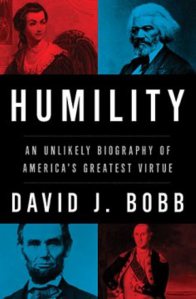
Humility (book review)

HumilityDavid J. Bobb has a title/subtitle combination that almost sounds paradoxical—Humility: An Unlikely Biography Of America’s Greatest Virtue. After all, when many think of America they are more likely to use the terms “confidant” or even “brash,” but not usually “humble.” But in this seeming paradox is a great truth.

The Greek philosophers often described a virtue as the golden mean between two extremes. Indeed, David Bobb uses such philosophers as Socrates and Aristotle, alongside Augustine and even more modern thinkers like Benjamin Franklin, to explore how America could be virtuous because of its humility.

Or more precisely, how America could be virtuous because of humble Americans. Dr. Bobb explores the biographies of notable Americans like George Washington, James Madison, Abigail Adams, Abraham Lincoln and Frederick Douglass to give us an intriguing description of what true humility looks like. Although in their time many thought of these people as proud or even glory-seekers, Dr. Bobb shows us how it was their profound, often hard-won humility that made them examples worth emulating.

And we do need these examples. In the epilogue, Dr. Bobb quotes Oliver Wendell Holmes, “Humility is the first of the virtues for other people.” How true! The question is: Will Americans re-learn the virtuous power and strength of humility, or will humility continue to erode, mistaken by many as a weakness?

For both history enthusiasts, leaders, leaders-in-training, and those who love a good biography, Humility is a very enjoyable and educational book.

I am a Thomas Nelson book reviewer.

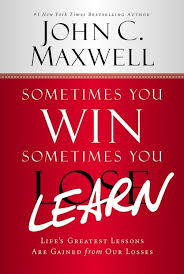
21 Quotes From “Sometimes You Win, Sometimes You Learn”

Sometimes You WinAs I mentioned in my book review (which you can read by clicking here), John Maxwell always expands my horizons with his writings. I appreciate his ability to use his own life experiences as well as historical and contemporary examples and writings. So some of my favorite quotes from Sometimes You Win, Sometimes You Learn are from Dr. Maxwell, and some are from others that he quotes. Enjoy!

“I sometimes react to making a mistake as if I have betrayed myself. My fear of making a mistake seems to be based on the hidden assumption that I am potentially perfect and that if I can just be very careful, I will not fall from heaven. But a mistake is a declaration of the way I am, a jolt to the way I intend, a reminder that I am not dealing with facts. When I have listened to my mistakes, I have grown.” —Hugh Prather

“Those who profit from adversity possess a spirit of humility and are therefore inclined to make the necessary changes needed to learn from their mistakes, failures, and losses. … When we are focused too much on ourselves, we lose perspective. Humility allows us to regain perspective and see the big picture. … Humility allows us to let go of perfection and keep trying.” —John Maxwell

“Most people spend their entire lives in a fantasy Island called ‘Someday I’ll.’” —Denis Waitley 

“An idealist believes the short-run doesn’t count. A cynic believes the long run doesn’t matter. A realist believes that what is done or left undone in the short-run determines the long run.” —Sydney J. Harris

“Those things that hurt, instruct.” —Benjamin Franklin

“You can’t grow and learn if your focus is on finding someone else to blame instead of looking at your own shortcomings.” —John Maxwell

“The highest reward for our toil is not what we get for it but what we become by it. … Mistakes are not failures. They are proof that we are making an effort. When we understand that, we can more easily move out of our comfort zone, try something new, and improve. … Improvement demands a commitment to grow long after the mood in which it was made has passed.” —John Maxwell 

“Success in most things comes not from some gigantic stroke of fate, but from simple, incremental progress.” —Andrew Wood

“The main trouble with despair is that it is self-fulfilling. People who fear the worst tend to invite it. Heads that are down can’t scan the horizon for new openings. Bursts of energy do not spring from a spirit of defeat. Ultimately, helplessness leads to hopelessness.” —Norman Cousins

“Positive thinking must be followed by positive doing.” —John Maxwell

“When you are influential and highly respected, people tend to tell you what you want to hear, not what you need to hear. They are seeking your approval, or they flatter you. Unfortunately, this creates a gap between what you hear and reality. If you find yourself in that situation, you will need to work extra hard to get the people close to you to speak honestly into your life. And you will have to become highly intentional in observing and listening.” —John Maxwell 

“Wisdom is the reward you get for a lifetime of listening when you would have preferred to talk.” —Doug Larson

“Circumstances are the rulers of the weak; but they are the instruments of the wise.” —Samuel Lover 

“Mistakes are painful when they happen, but years later a collection of mistakes is what is called experience.” —Denis Waitley

“Ninety percent of those who fail are not actually defeated; they simply quit. … As you face bad experiences, it’s important for you to remember that you can rarely see the benefits while you’re in the midst of them. You usually gain perspective on the other side of it.” —John Maxwell 

“Most people would rather change their circumstances to improve their lives when instead they need to change themselves to improve their circumstances. They put in just enough effort to distance themselves from their problems without ever trying to go after the root, which can often be found in themselves. Because they don’t try to change the source of their problems, their problems keep coming back at them.” —John Maxwell

“To grow, you must be willing to let your present and future be totally unlike your past. Your history is not your destiny.” —Alan Cohen

“If I had my life to live over again, I’d make the same mistakes, only sooner.” —Tallulah Bankhead

“Maturity is doing what you are supposed to be doing, when you’re supposed to be doing it, no matter how you feel.” —Dom Capers 

“Have you not succeeded? Continue! Have you succeeded? Continue!” —Fridtjof Nansen, Nobel Peace Prize winner

“How we think when we lose determines how long it will be until we win.” —G.K. Chesterton

An Unabashed Appeal To Join Religion And Government

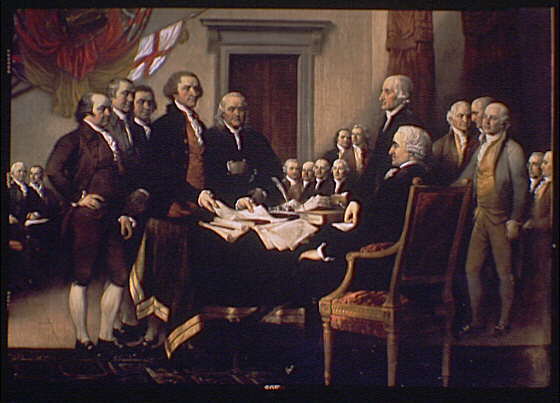
Talk about taking a passing remark out of context! In a personal letter, Thomas Jefferson mentions how church and state should be separate. But I’m convinced where we’ve ended up is no where close to what he intended! I’m so tired of historical revisionists trying to convince us that biblical values and Judeo-Christian ethics had no place in the founding of our nation. Or—worse yet—that they have no place now. Consider these founding remarks…

“…Having undertaken, for the Glory of God, and advancements of the Christian faith and honor of our King and Country, a voyage to plant the first colony in the Northern parts of Virginia….” —Mayflower Compact

“And for the support of this Declaration, with a firm reliance on the protection of Divine Providence….” —Declaration Of Independence

“I have lived, Sir, a long time; and the longer I live the more convincing Proofs I see of this Truth, That God governs in the Affairs of Men!—And if a Sparrow cannot fall to the Ground without His Notice, is it probable than an Empire can rise without His Aid? — We have been assured, Sir, in the Sacred Writings, that ‘except the Lord build the House, they labor in vain that build it.’ I firmly believe this; and I also believe that without His concurring Aid we shall succeed in this political Building no better than the Builders of Babel…. I therefore beg leave to move, That henceforth Prayers, imploring the Assistance of Heaven, and its Blessing on our Deliberations, be held in this Assembly every Morning before we proceed to Business.” —Benjamin Franklin, Constitutional Convention

It is impossible to rightly govern a nation without God and the Bible.” —George Washington

“Suppose a nation in some distant Region should take the Bible for their only law Book and every member should regulate his conduct by the precepts there exhibited! What a Utopia, what aParadise would this region be.” —John Adams

And, of course, the quotes could go on and on and on. But one of my favorites:

“Yes, if our religion had more to do with our politics; if, in the pride of our citizenship, we had not forgotten our Christianity; if we had prayed more and wrangled less about the affairs of our country, it would have been infinitely better for us at this day.” —John Mitchell Mason (1770-1829), in his book published in 1800

Happy Birthday, America! May GOD bless you!

What’s Your Excuse?

It’s so easy to make excuses, isn’t it?

  • I wasn’t feeling well
  • I don’t have enough training
  • The sun was in my eye
  • The other guy was supposed to….
  • I don’t have the right tools
  • If only….
  • I can’t because….

John Maxwell has started a new teaching series where he presents a one-minute lesson on one word every day. Today’s lesson was on excuses. Watch the clip here.

Here are some other quotes on excuses:

“Ninety-nine percent of failures come from people who have the habit of making excuses.” —George Washington Carver

“There’s a difference between interest and commitment. When you are interested in doing something, you do it only when it is convenient. When you are committed to something, you accept no excuses only results.” —Kenneth Blanchard

“Obstacles are not excuses for failure, they are opportunities for growth.” —Craig T. Owens

“People who are good at making excuses are seldom good at anything else.” —Benjamin Franklin

Let’s stop making excuses and start taking responsibility! 

Celebrating Freedom

Yesterday at Calvary Assembly of God we celebrated our country’s birthday with an outdoor service and picnic. I talked about the biblical roots and godly heritage of our great nation. In telling this story, I used quite a few quotes from key historical people. Several people have asked me to make these quotes available, and I’m happy to do so. (Any text in bold was added by me.)

“It was the Lord who put into my mind (I could feel His hand upon me) the fact that it would be possible to sail from here to the Indies. All who heard of my project rejected it with laughter, ridiculing me. There is no question that the inspiration was from the Holy Spirit, because He comforted me with rays of marvelous inspiration from the Holy Scriptures.” —Christopher Columbus writing about the motivation for his journey

“In the name of God, amen. We whose names are under-written, the loyal subjects of our dread Sovereign, King James…. Having undertaken, for the glory of God and advancement of the Christian Faith and honor of our King and country, a voyage to plant the first colony in the northern parts of Virginia, do by these presents solemnly and mutually in the presence of God and one another, covenant and combine ourselves together in a civil body politic ….” —The Mayflower Compact

“When, in the course of human events, it becomes necessary for one people to dissolve the political bands which have connected them with another, and to assume among the powers of the earth, the separate and equal station to which the laws of nature and of nature’s God entitle them….

“We hold these truths to be self-evident, that all men are created equal, that they are endowed by their Creator with certain unalienable rights, that among these are life, liberty and the pursuit of happiness. That to secure these rights, governments are instituted among men, deriving their just powers from the consent of the governed. …

“…And for the support of this declaration, with a firm reliance on the protection of Divine Providence, we mutually pledge to each other our lives, our fortunes and our sacred honor.” —Preamble and closing sentence of the Declaration of Independence

“I have lived, Sir, a long time; and the longer I live the more convincing Proofs I see of this Truth, That God governs in the Affairs of Men! And if a Sparrow cannot fall to the Ground without His Notice, is it probable than an Empire can rise without His Aid? We have been assured, Sir, in the Sacred Writings, that ‘except the Lord build the House, they labor in vain that build it.’ I firmly believe this; and I also believe that without His concurring Aid we shall succeed in this political Building no better than the Builders of Babel…. I therefore beg leave to move, That henceforth Prayers, imploring the Assistance of Heaven, and its Blessing on our Deliberations, be held in this Assembly every Morning before we proceed to Business.” —Benjamin Franklin, at Constitutional Convention, June 28, 1787

“Whereas, the Senate of the United States, devoutly recognizing the Supreme Authority and just Government of Almighty God, in all the affairs of men and of nations, has, by a resolution, requested the President to designate and set apart a day for National prayer and humiliation.” —Proclamation of a nation day of prayer and fasting, March 30, 1863

“The year that is drawing towards its close, has been filled with the blessings of fruitful fields and healthful skies.  To these bounties, which are so constantly enjoyed that we are prone to forget the source from which they come, others have been added, which are of so extraordinary a nature, that they cannot fail to penetrate and soften even the heart which is habitually insensible to the ever watchful providence of Almighty God. … No human counsel hath devised nor hath any mortal hand worked out these great things.  They are the gracious gifts of the Most High God….” —Abraham Lincoln’s proclamation of a day of thanksgiving in October 1863

“I recognize we must be cautious in claiming God is on our side. But I think it’s all right to keep asking if we’re on His side. —Ronald Reagan

I believe God will continue to bless America IF we make sure we are on His side.

Tell Your Story

People often ask me why I read so much, or even why I read the things I read. I like to read widely: classics to contemporary, history to biographies, and even a little poetry.

Tim Sanders wrote a book called Love Is The Killer App. In this wonderful book, he says that reading and studying should be motivated by love. We read and learn so that we can be informed enough to help others who are in need. Not reading just to read, but reading with a purpose. Reading to help tell someone a story. I haven’t found a book that does this better than the Bible.

The world’s greatest storyteller (ever!) was Jesus of Nazareth. Check this out:

With many stories like these, He presented His message to them, fitting the stories to their experience and maturity. He was never without a story when He spoke (Mark 4:33-34, The Message paraphrase).

Jesus could tell a story to anyone at any time. He learned, He studied, He observed, so He would always be ready. He frequently used whatever was at hand to tell His stories—a child, a farmer, fish, bread made with yeast, a coin, a bridal party—but He had to know something about each of those things in order for His stories to be effective for each person’s “experience and maturity.”

Once Jesus encountered a man so demonized that he spent his life naked and living in the graveyard (my friend Jim Wiegand calls him “the naked, cat-eating guy”!). Jesus set this man free from his demons. When this newly-freed man wanted to accompany Jesus, He told him, “Go home to your own people. Tell them your story” (Mark 5:19, The Message).

Tell them YOUR story.

The best story you can tell is your story.

It’s wonderful to read to be informed—I highly encourage this. I love to be able to say, “Benjamin Franklin said…” or “I love the Longfellow poem about…” or “Stephen Covey wrote that we should….” But it’s so much more effective to say, “Here’s what I have learned from my personal encounter with Jesus. Here’s MY story of what Jesus did for me!”

What about you? Do you have a story to tell? If you’re in a relationship with Jesus, you always have a story to tell. Keep walking with Jesus. Keep reading His love letter to you written on every page of the Bible. Then tell YOUR story—the best story of all!