What Are Rules For?

Listen to the podcast of this post by clicking on the player below, and you can also subscribe on AppleSpotify, or Audible. 

David is on the run from Saul. He leaves town so quickly that he didn’t have time to kiss his wife goodbye. He didn’t even have enough time to grab a weapon, a change of clothes, companions, or food. So he stops by Ahimelech’s house to see if this priest has any food.

Remember this old nursery rhyme?

Old Mother Hubbard
Went to the cupboard,
To give the poor dog a bone:
When she came there,
The cupboard was bare,
And so the poor dog had none.

That’s just about what happened here. Ahimelech said, “The only bread I have is the holy showbread.” This consecrated bread was 12 loaves laid out each Sabbath in God’s presence. When this bread was replaced each week, it became food for the priests. Ahimelech recognized he had a moral obligation to save David’s life which superseded the ceremonial rules.

Jesus used this incident as an example when the Pharisees accused Him of breaking the law concerning the Sabbath day. Jesus and His followers had been walking through a wheat field, plucking some pieces of grain on which they could munch. The rule-keeping Pharisees said this amounted to work, and a violation of Sabbath rules.

I think sometimes we get so caught up in keeping the rules (or following tradition, or preserving decorum) that we forget the meaning behind the rule. Or, more accurately, we forget God’s design behind the rule.

Every rule God gives is to keep us in a place where we can experience His presence. Rules are not life, but they are boundaries that keep us on the path to life.

Ahimelech kept David alive with showbread. Jesus and His disciples sustained themselves with wheat kernels. Jesus healed the sick on the Sabbath to bring life and wholeness.

Following rules just to follow rules misses the point. What is the point? Following God’s rules to find God’s heart is THE point.

So let me ask you: Do you get the point?

You may also want to check out series on God’s rules called The Love In The Law, or the post called Rules Are Overbearing—Love Never Is.

►► Would you please prayerfully consider supporting this ministry? My Patreon supporters get behind-the-scenes access to exclusive materials. ◀︎◀︎
Your Part In The Battle

The story about David defeating the giant Goliath in battle is familiar to just about everyone. (If it’s not a familiar story to you, you can read it here.) I was struck by how David saw his part in this fight. Look what he said:

All those gathered here will know that it is not by sword or spear that the Lord saves; for the battle is the Lord’s.

After the fight was over, and Goliath lay dead at David’s feet, the biblical writer said the same thing:

So David triumphed over the Philistine with a sling and a stone; without a sword in his hand he struck down the Philistine and killed him.

If you are a God-follower, then your battles are really God’s battles. David recognized that it was God’s battle, but David also knew that he played a part in this too.

1.  He had to train. David had to know how to use a sling with deadly accuracy.

2.  He had to reject “good” advice. Saul advised David, “Here, wear my armor.” That sounded like good advice, but it didn’t fit for David. He had to be true to what the Spirit of God spoke to his heart, even as he rejected what seemed like good advice.

3.  He had to have faith. David truly believed that God was going to do something big—something no one else could even imagine.

4.  He had to show up. Sometimes God fights battles for His people, and sometimes He fights with His people. David didn’t know what God was going to do in this instance until he showed up on the battlefield.

God wants you to win big battles. And if you’re following God, He will bring the victory. But you still have a very important part to play. Train hard, reject advice that is contrary to what God has told you, have faith, and then show up for the battle. These are the keys to victory.

A Maze Of Grace (book review)

I’m not one for “chick flicks,” and I’m usually not one for “chick books” either. But every once in a while a movie or a book comes along in these categories that grabs my attention. Trish Ryan’s A Maze Of Grace did just that.

This book is part II of Trish’s memoirs. At first, I thought I would be missing out on something by not having read part I, but that wasn’t the case. Right from the opening words where Trish confesses that her husband Steve has just lied to her, I was hooked.

I love the concept of God’s grace. I try to remember grace by using the acrostic: God’s Riches At Christ’s Expense. In other words, God lavishes us with more than we deserve. Trish’s memoir of her walk through grace is a constant reminder to not settle, to not give up or give in. Instead, Trish tells how she came right to the point of just accepting, “This is all there is,” and then daring to hope and trust in God’s grace again. Sometimes we read how God showed His grace to Trish and brought her into something bigger and better. And sometimes we’re left without a resolution, still hanging on in faith to God’s grace.

All in all, this is a delightful memoir. I told my wife that I think there are some emotions and insights that she would probably relate to more than I did, but I would still recommend this book to anyone who is still on the journey. Anyone who has ever come to the point where they thought, “This is it: I’ll just have to settle for this,” will be encouraged by reading this memoir to trust God for one more day.

As Trish says in her closing words:

“Not just for me, but any of us. A maze of grace. Amazing Grace. Amen.”

I am a Faith Words book reviewer.

Brave Enough

If God asks me to give $1, I can quickly and easily say, “Yes!”

If God asks me to give $10, I say, “Okay!”

If God asks me to give $100, I say, “Um, well, if You say so.”

If God asks me to give $1000, I say, “I need to pray about this ‘faith promise.’”

If God asks me to give $10,000, I say, “As soon as You bless me, I’ll be able to do this.”

This same principle holds true for anything else:

  • Used clothing? Sure. Brand new stuff? I’m not so sure.
  • Volunteer an hour? Okay! Make a commitment for an hour every week? Let me pray about it.
  • Pray for someone? No problem. Add them to my daily prayer list? Whoa!
  • Support missionaries? Yes! Become a missionary? Well….

It’s easy to obey when we think the stakes are low. But the more “zeroes” that get added to the amount, the higher the stakes seem. Am I brave enough to obey then?

This is what tripped up Saul, Israel’s first king. He was supposed to devote everything from the defeated Amalekites to God. “Devote” means a complete and irrevocable giving to God. When the stakes were low, he obeyed, but when he perceived the stakes being too high, he lost the courage to follow through:

Saul and his men spared Agag’s life and kept the best of the sheep and goats, the cattle, the fat calves, and the lambs—everything, in fact, that appealed to them. They destroyed only what was worthless or of poor quality. (1 Samuel 15:9 NLT)

He captured Agag, king of Amalek, alive. Everyone else was killed under the terms of the holy ban. Saul and the army made an exception for Agag, and for the choice sheep and cattle. They didn’t include them under the terms of the holy ban. But all the rest, which nobody wanted anyway, they destroyed as decreed by the holy ban. (1 Samuel 15:9, The Message)

Ironically, because Saul held on to what he thought was valuable, he lost something invaluable: a close relationship with God. His cowardice led to disobedience, and his disobedience led to his ultimate collapse.

I pray that I’m brave enough to obey just as quickly when the stakes are higher as I do when the stakes are lower.

What about you? Are you brave enough?

How A Leader Should Bring Correction

Listen to the podcast of this post by clicking on the player below, and you can also subscribe on AppleSpotify, or Audible.

Bringing correction is one of the toughest jobs for those in leadership, but it’s a responsibility that cannot be delegated or ignored. In order for correction to be effective, it must not be too light or too heavy. Unfortunately, many of us have experienced far too many ineffective forms of leadership correction.

I read a great example of how to properly correct in the life of Samuel. In 1 Samuel 12, the people had gotten off track, and Samuel lovingly and effectively brought them back into line. Here’s what his example teaches us on how to correct followers:

1.  Shared history (v. 2). Samuel reminded them of what had happened in their history, and even what they had experienced together. “Newbie” leaders need to be cautious about bringing correction that violates an organization’s established culture.

2. Integrity (v. 3). Samuel’s words and lifestyle lined up. That doesn’t mean he never made a mistake, but it does mean that he was willing to acknowledge and repair his mistakes. Nothing is worse than a leader who says, “Do as I say, not as I do!”

3. Common ground (vv. 6-11). A leader needs to get everyone on the same page. Find something somewhere on which everyone can agree, and then move forward from there.

4. Just say it (vv. 12-13). Don’t beat around the bush; don’t try to bring correction through a parable; don’t soften the blow. Just say it: “This is where I believe you made a mistake.” Far too many leaders talk too much and leave their followers saying, “Huh?” If you are going to bring correction, make sure your followers know exactly what it is you are correcting.

5. Give the remedy (vv. 14-15, 20-21). Samuel pointed out the error, and he just as clearly told them how to get back on track. The remedy should be as clear and simple as possible.

6. Remove the fear (vv. 20, 22). Don’t let the corrected follower be afraid of you! Fear will never re-establish trust. Samuel couldn’t have been more clear on this. He literally said to the Israelites, “Do not be afraid.”

7. Demonstrate servant leadership (v. 23). At the close of the meeting, Samuel said he would do two things: “I will continue to pray for you, and I will continue to teach you.” In telling them this, Samuel was really saying, “Let’s walk through this together.”

If you lead your family, your church, your company, or your team, you are going to have to bring correction at some point. When you need to do this, take some time to review this list and bring correction the way Samuel did: lovingly and effectively.

P.S. You can also check out this post where the apostle Paul gives us another example of how to handle correction properly.

►► Would you please prayerfully consider supporting this ministry? My Patreon supporters get behind-the-scenes access to exclusive materials. ◀︎◀︎

Patton: The Pursuit Of Destiny (book review)

Disclaimer: I am a huge admirer of General George Smith Patton, Jr. So it should come as no surprise that I thoroughly enjoyed Agostino Von Hassell and Ed Breslin’s biography Patton: The Pursuit Of Destiny.

It’s also no surprise that I relished reading about Patton’s military genius and his relentless preparation to be a man of destiny. What did surprise me was the candor with which the authors dealt with the shortcomings of Patton. For all of his military genius, there were areas of his life that always seemed to get the best of this general. On the battlefield, he had few equals, but away from the heat of battle, his insecurities could get the best of him. I appreciated how the authors showed Patton playing to his strengths while still struggling with his weaknesses. While many biographies show great men and women overcoming their struggles, Patton shows the general living with his struggles and still achieving greatness in spite of them.

I also learned more about Patton’s family lineage in this book that helped me understand what drove this military hero. I read about a man who was a voracious learner, highly competitive, and a man who set extraordinarily high standards for himself. His biggest weakness: he couldn’t abide those who didn’t share these same lofty goals for their own lives or profession.

If you enjoy military history, a study of a larger-than-life leadership persona, or a biography with an unflinching look at a great man’s angels and demons, you will enjoy reading Patton: The Pursuit Of Destiny.

I am a Thomas Nelson book reviewer.

The Doctor & The Pastor—Part II

Friends, I recently reviewed the manuscript for a new book Living Free In An Anxious World. This is an essential book for pastors, Christian counselors, psychologists, and medical doctors which deals with a problem that is only expanding: worry, stress, anxiety. Stay tuned to this blog for a chance to win a free copy in just a couple of weeks.

In the meantime, I am absolutely thrilled that the co-authors of Living Free In An Anxious World have agreed to write to my blog readers! Today is the second installment from Dr. Lanny Hunter. (If you missed Part I from Victor Hunter, you can check it out here.)

Guest Author: Dr. R. Lanny Hunter

In my profession as a dermatologist, it’s fair to say that most of my patients come to see me because they are worried. Patients may have developed a rash that worries them. What is it? Is it contagious? Is it serious? Will it scar? What will people think? Can I get rid of it?

Patients may have developed a skin growth, a lump, a sore that won’t heal, a place that is changing color, causing pain, or bleeding. Again, they are worried. Is it cancer? Is it life-threatening? Can it be cured? If I do make a diagnosis of cancer, their anxiety escalates. Will I die? How long do I have to live? How will it be treated? What should I tell my spouse? My family?

Beyond questions of diagnosis, treatment, and questions of severity of illness, many worry about medical costs. How much will it cost? Will my insurance pay for it? They may confide that their insurance has a very high deductible, or that they have no insurance at all, or that they live only on Social Security and Medicare. Will treatment bankrupt them?

In the course of consultation, medical care, and surgery, patients reveal more than their medical worries. They confide their life disappointments—marriage problems, work conflicts, children in trouble, personal and vocational failures, criminal escapades.

Patients with worry and anxiety are my life’s work. To that end, I use all of the interpersonal skills, psychological insights, religious convictions, and medical skills that I have acquired through training and experience. I must listen compassionately and constructively, and be armed with the latest medical techniques in treating disease. I must be cognizant of my limitations in skill and time. I may need to refer a patient to a psychologist, psychiatrist, pastor, priest, social worker, or another physician. I must always remember that I’m not treating the skin. I’m treating the whole person.

With that holistic approach in mind, my brother (a pastor) and I (a physician) have authored a book, Living Free in an Anxious World, which combines the insights of our two vocations to help people manage worry and anxiety in order to free them for more productive living. 

United In Worship

I love it when people from different denominations come together for one purpose: to exalt the name of Jesus. The Cedar Springs Ministerial Association is bringing all of our churches together for an outdoor community worship service. We’ll be gathering in Morely Park at 10:30am.

Bring a lawn chair, and an attitude of worship, and let’s make Cedar Springs ring with our united praise! And following the service, stick around for the lunch that will be provided for everyone in attendance, and there will be some fun games for the kids.

Goals & Strategies

I’m in the midst of a fascinating biography about General George S. Patton. As I wrote yesterday, I love borrowing the brains of other great men and women and adding some of their finer attributes to my life.

Years after Patton had died, his son donated his father’s books to the West Point Military Academy. It was then that a notation in Patton’s own hand was discovered on the last page of his Elements Of Strategy textbook. He wrote: “End of last lesson in Engineering. Last lesson as a Cadet, thank God.” But then on the back cover, he had also written—

Qualities of a Great General

1.  Tactically aggressive (loves a fight)

2.  Strength of character

3.  Steadiness of purpose

4.  Acceptance of responsibility

5.  Energy

6.  Good health and strength

George Patton

Cadet

April 29, 1909

Here’s what I love: he wrote these down years before he was ever given the command of anything! He put his goals and strategies in writing and dedicated himself wholeheartedly to achieving them. And achieve he did!

Years ago I took some time to write down a similar challenge for myself. Reading this about Patton reminded me that I haven’t reviewed my list in a while, and it was high time for me to reacquaint myself with those goals and strategies.

What about you?

Do you know where you want to go?

Do you know what it will take to get there?

Have you written down those goals and strategies?

Borrowed Brains

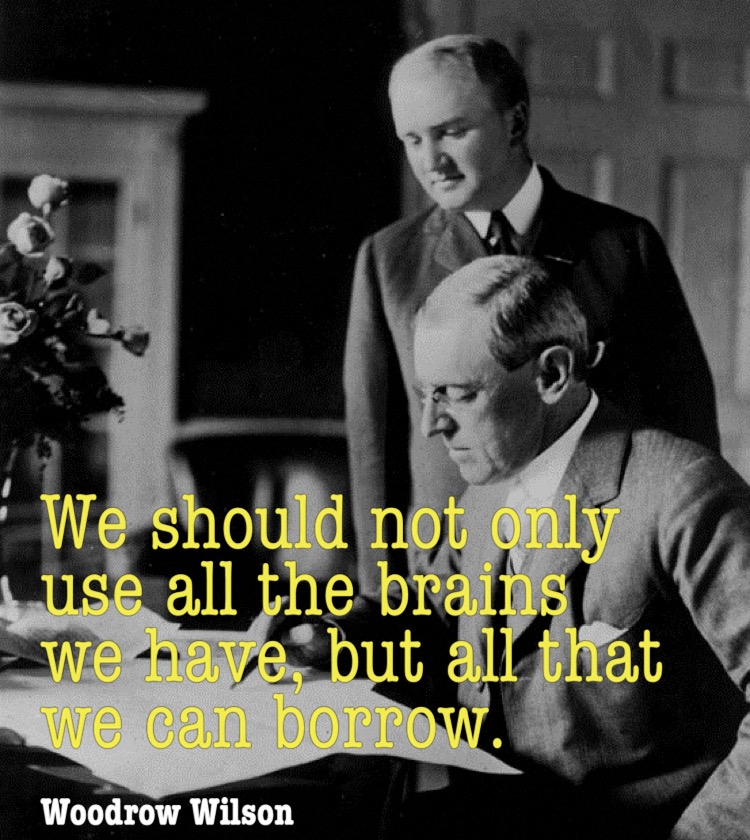
“We should not only use all the brains we have, but all that we can borrow.” —Woodrow Wilson

It’s so important to learn from others—to borrow their brains. I try to take something from other people’s brains every day.

  • Every morning I begin my day by studying the timeless truths found in the Bible.
  • Then I pray to ask God to give me the mind of Christ for my day.
  • Throughout my day I learn from the brains of other business and ministry leaders. People who have been-there-done-that and are willing to share are an invaluable source of wisdom.
  • I also consume a regular diet of biographies and autobiographies of past and present leaders. I try to put myself in their shoes to see why they made the decisions they made.
  • And I have some close friends that can give me their honest insight and critique.

One of the saddest things is to hear someone say, “I’m a self-made man” or “I’m a self-made woman.” Really?! That’s rather limited, isn’t it?

So whose brains are you borrowing?