Shining Like Stars

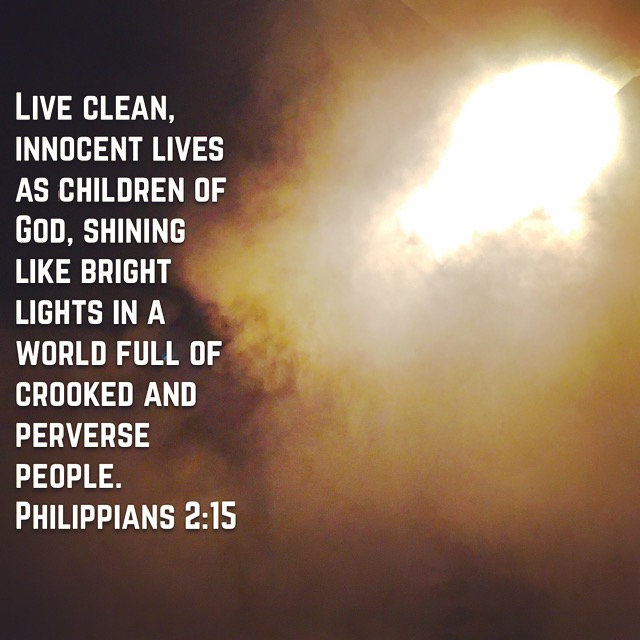
Do everything without complaining and arguing, so that no one can criticize you. Live clean, innocent lives as children of God, shining like bright stars in a world full of crooked and perverse people. (Philippians 2:14-15)

Those who follow Jesus are supposed to be different.

The word holy means different; it means “set apart from everything else for a special purpose.” But holy shouldn’t be a repelling different, but a winsome, appealing, attractive different. Instead, our holy lives should shine like bright stars.

When we first had kids, people began to talk to Betsy and me about where our kids would go to school, and their first assumption was that we would send them to a “Christian” school. But we felt differently about this. We have been called by Jesus to let our light shine before men that they may see our good deeds and praise our Father in heaven. So our desire is that our kids may let their light shine in their public schools.

While I am grateful for the A’s and B’s on all of their third-quarter report cards, there are other statements on my kids’ report cards that make me even prouder—

  • “You are a pleasure to have in class.”
  • “I am so blessed to have him in class.”
  • “You have proven yourself to be a responsible, respectful, and hard working student.”
  • “She does a fantastic job of helping out other students in class.”
  • “He is extremely respectful towards others and a pleasure to have in class!”
  • “He is always willing to lend a helping hand to others if needed.”
  • “You are a joy to be around, and I look forward to your smile every morning!”

These comments reflect lifestyles that are different—a winsome, appealing, attractive different.

This light shining out from our kids has opened the door for us to share our faith in Jesus with both teachers and students. In fact, my daughter has been able to lead one of her classmates to faith in Christ, and she and her family are now attending our church!

My kids challenge me to do everything in a way that shines. I want to be different … I want to shine … I want to live in a way that attracts others to Jesus Christ. What about you?
Cheap Trade-Off

During the reign of King Rehoboam in Judah, God’s judgment fell on the land. Because of their sin against Him, God allowed Shishak, the king of Egypt, to plunder Jerusalem. Shishak carried off all of the valuable furnishings of the temple in Jerusalem.

To replace what had been plundered Rehoboam commissioned the casting of shields made of bronze (1 Kings 14:27). Whenever the king went to the temple, all the guards would carry these shiny shields with them, but then immediately after the king left the temple the guards returned their shields to the armory.

It looked good, but it was all a cheat … an imitation … a cheap trade-off.

Looking back a few chapters we read that not only did Rehoboam’s father, King Solomon, make the original shields out of gold, but he made almost everything out of gold. In fact, the Bible says, “Nothing was made of silver, because silver was considered of little value in Solomon’s days.” If silver was of little value, can you imagine how cheap bronze was?!

The temple is plundered. The gold shields—along with anything else of value—are gone, but there is no outcry from Rehoboam or the people, no repentance for their crimes against God, no anger at their sin that allowed Shishak’s raid.

Instead, Rehoboam wanted to try to keep up appearances.

He made bronze shields to look like the stolen gold shields.
He made his trip to the temple a spectacle of pomp and circumstance.
He hid the bronze shields away after he left the temple.

Isn’t this how many people deal with the plundering of their lives? I know I have at times. It seemed so much easier to try to cover up what was lost because of my sin, than to simply admit I sinned, repent of that sin, and ask for God’s merciful forgiveness.

Sure, Rehoboam still looked like he had his act together. But he knew—every time he was on this way to the temple and saw those bronze shields—that he was living a lie. He accepted a cheap trade-off for the real deal.

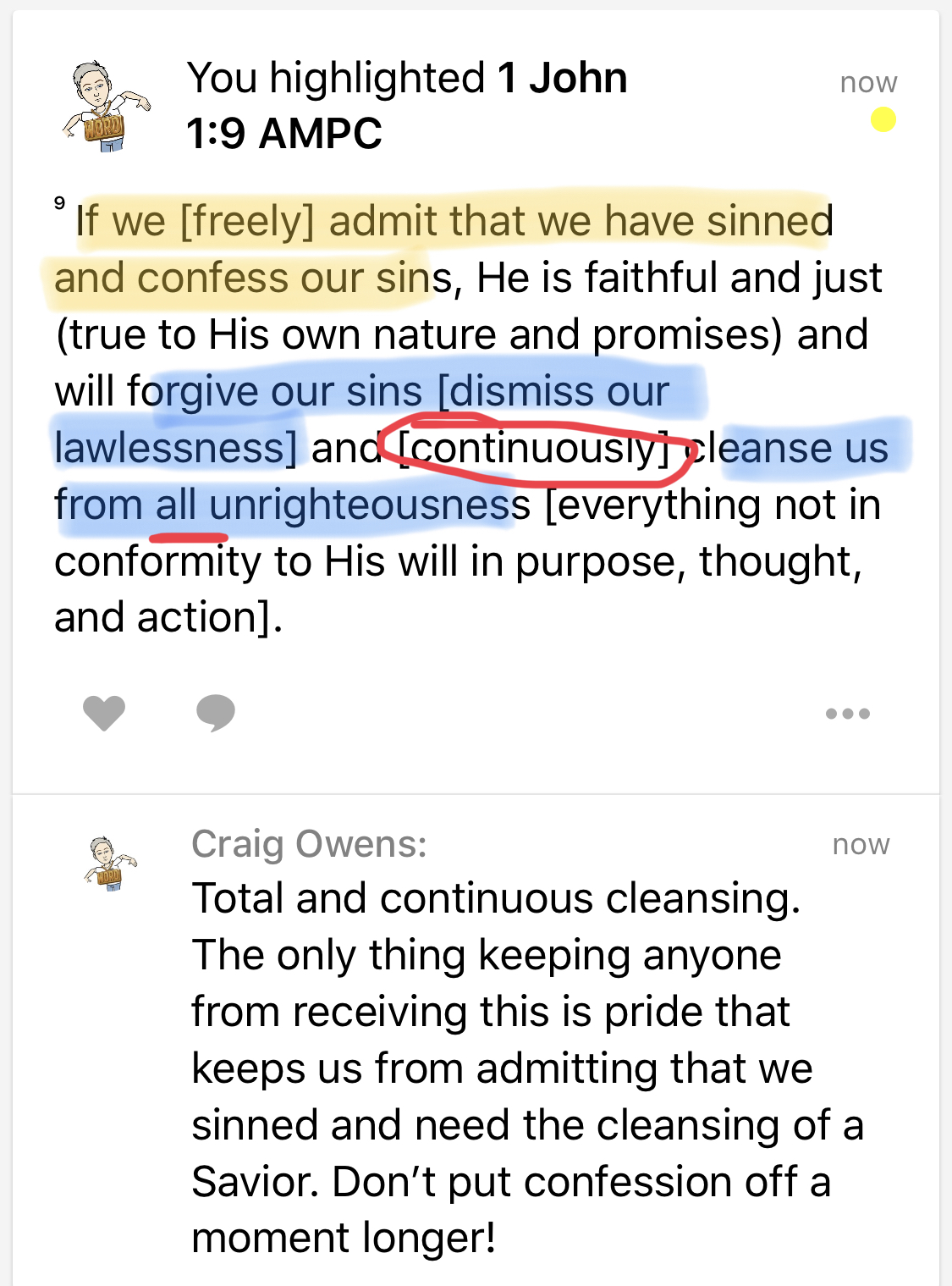
I am so grateful that, “If we confess our sins, He is faithful and just and will forgive us our sins and purify us from all unrighteousness” (1 John 1:9).

I’m not going to settle for cheap trade-offs anymore. How about you?

Choice Four-Letter Words

Listen to the podcast of this post by clicking on the player below, and you can also subscribe on AppleSpotify, or Audible.

Have you ever been “cursed out” by someone? I mean had a stream of four-letter obscenities hurled at you? What happens inside you? Isn’t your natural reaction to strike back? To begin to a counter-attack with a few choice four-letter words of your own?

It’s natural to feel this way; it’s a very human response.

On the other hand, have you ever been “blessed out” by someone? Had someone shower you with niceties and accolades and compliments? What happens inside you this time? Isn’t your natural reaction the complete opposite? Don’t you want to say, “Well, I think you’re pretty special, too”?

It’s natural to feel this way; it’s a very human response.

But Jesus commanded us to do something counter-cultural, something which requires a spiritual response: “Bless those who curse you” (Luke 6:28). Paul amplified this thought: “Bless those who persecute you; bless and do not curse” (Romans 12:14).

These words curse and bless are challenging for me. Curse means to hope for someone’s downfall; bless means to say good words to or about someone. Cursing can be done internally or verbally; blessing has to be done verbally. Eugene Peterson captures the essence of this in his paraphrase of Romans 12:14: “Bless your enemies; no cursing under your breath.”

If my natural response is to match curse for curse, obscenity for obscenity, then to respond in a Christ-like fashion is going to take a change of character. To respond with the right four-letter words, I have to do the opposite of my natural response.

In the Old Testament, the Hebrew word for bless carried the understanding that it all hinged on God—He is the focal point. All of the definitions of this word involve a close relationship with God: (a) bless God; (b) bless men in the name of God; (c) ask for divine favor for persons or things created by God; or (d) salute someone because we know God has saluted us.

In the New Testament, the Greek word for bless makes it clear that this has to be done verbally, out loud. It is impossible to bless under your breath. In the Greek, bless is the compound word eulogeo = eu- (good) + –logos (words): saying good words out loud.

Only God is good, so only a closer relationship with our good God will help us say good words to others. Especially to those who curse us.

The right four-letter words to use—the un-natural words to use—are: Good words.

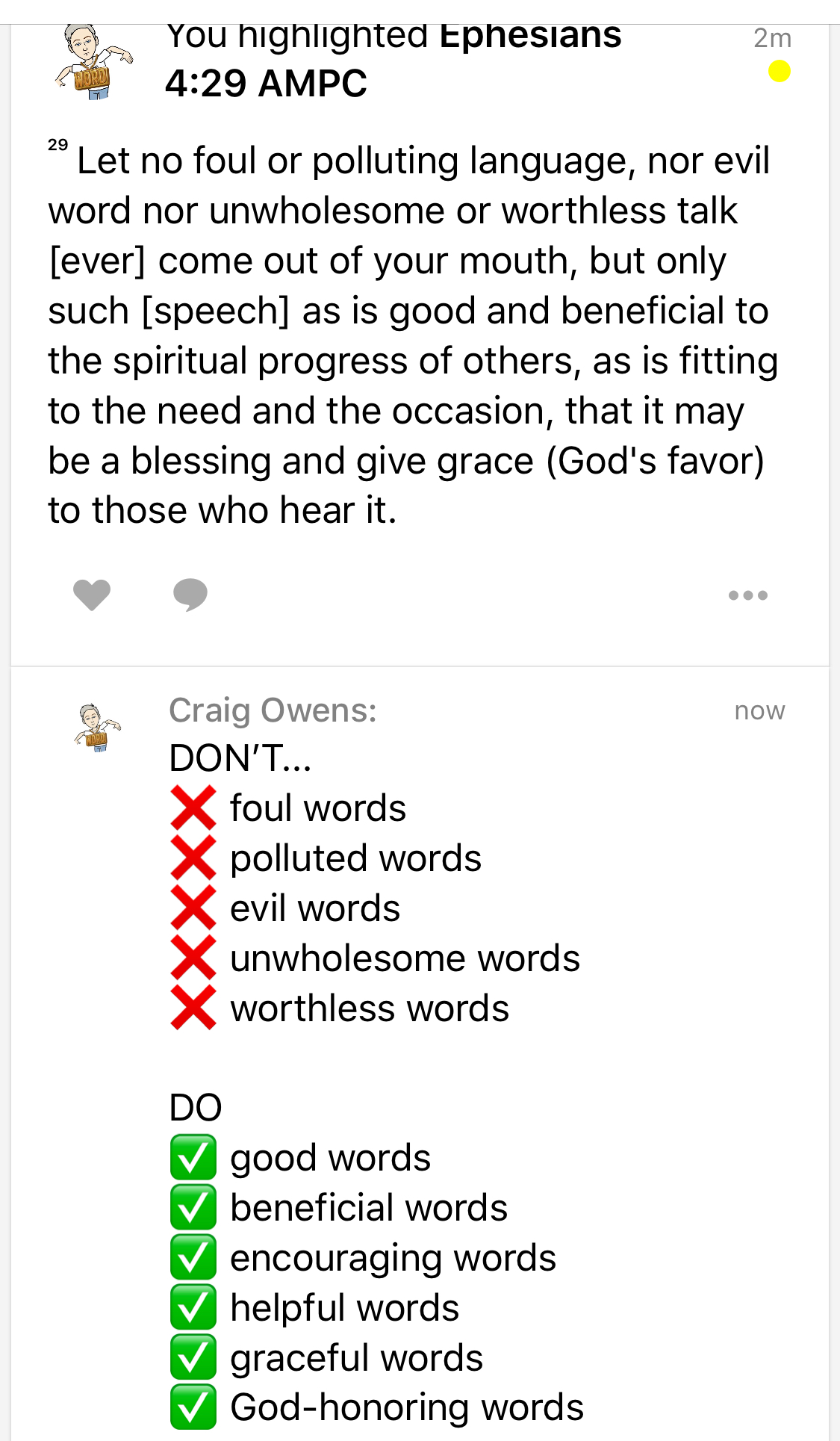
I’m challenging myself today to bless others, especially those who curse me. I only want to say good to and about others today. I’m attempting to live out Ephesians 4:29—

  • Do not let any unwholesome talk come out of your mouths, but only what is helpful for building others up (New International Version)
  • Let no foul or polluting language, nor evil word nor unwholesome or worthless talk ever come out of your mouth, but only such speech as is good and beneficial to the spiritual progress of others (Amplified Bible)
  • Watch the way you talk. Let nothing foul or dirty come out of your mouth. Say only what helps, each word a gift (The Message)
  • When you talk, do not say harmful things, but say what people need—words that will help others become stronger (New Century Version).

So let me ask you: How will you say the right four-letter words to others today?

►► Would you please prayerfully consider supporting this ministry? My Patreon supporters get behind-the-scenes access to exclusive materials. ◀︎◀︎

Moderate Back Thrusts

How would you like to have this written on your tombstone—

Appointed by God to be king
Caused all Israel to sin against God
Doomed my family line to extinction

That is exactly the epitaph of King Jeroboam (see 1 Kings 13-14). In God’s indictment of Jeroboam He says, “Because of the sins you have committed, and the sins you have caused Israel to commit, you have provoked Me to anger and thrust Me behind your back.”

I find that phrase—thrust Me behind your back—intriguing. The word thrust means to throw something away. How exactly does one go about throwing God away? Can you crumple Him up like a piece of paper and toss Him in a garbage can? Can you grab Him and shove Him behind you? Is He like a stack of old newspapers thrown in a recycling bin? Clearly not!

One only thrusts God behind one’s back little by little. Just moderate back thrusts.

John Maxwell was exactly right when he said that whatever good things a leader does in excess, those following will do in moderation. Whatever poor things the leader does in moderation, those following will do in excess. The “moderate” ways in which Jeroboam thrust God behind his back caused all of Israel to sin excessively. And that became Jeroboam’s eternal legacy!

People are watching me—my kids, my neighbors, my friends, the baristas at Starbucks—what example am I setting for them? There are only two examples I can set: (1) Pursue God with all my heart, all my soul, all my mind, and all my strength; in other words, love God to excess. Or (2) Moderately thrust God behind my back little by little by little.

Search me, O God, see if there is ANY moderate back thrusting in me and lead me in the way everlasting (see Psalm 139:23-24).