Listen to the podcast of this post by clicking on the player below, and you can also subscribe on Apple, Spotify, or Audible.
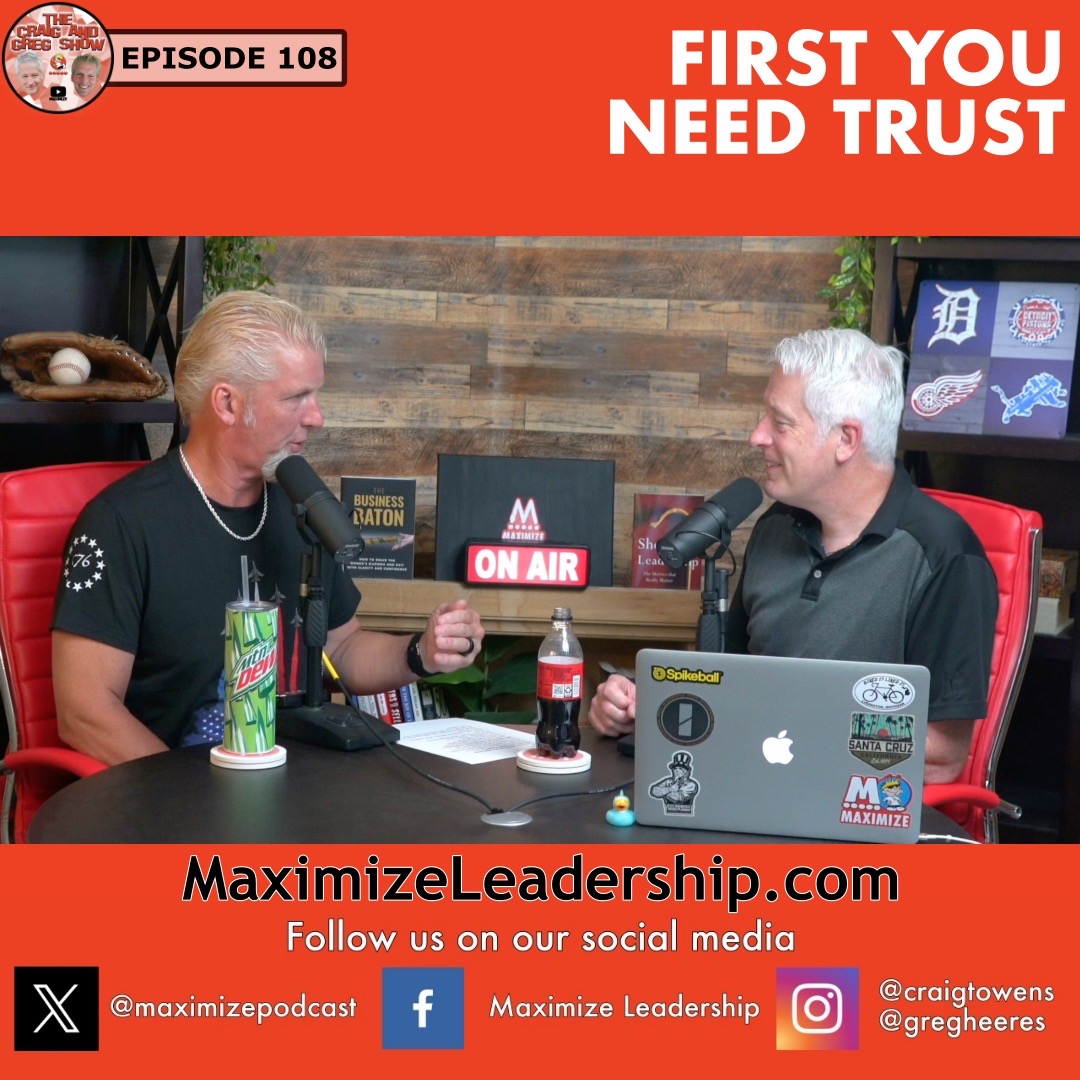
In the wise words of John C. Maxwell, “He who thinketh he leadeth and hath no one following him is only taking a walk.” As always Maxwell is right on the money. And the first step to getting others to follow you is trust. If you want to lead your team into uncharted territory they have to first trust that you’re not going to lead them off a cliff! In today’s episode Greg and I cover why trust is so vital and offer suggestions on how to build and maintain trust.
[0:42] People only listen to leaders that they can trust.
[2:03] Trust is an emotional glue between a leader and the team.
[3:03] Trust has to be built over time.
[6:07] Sometimes our teammates will test our trustworthiness.
[6:57] How leaders build trust.
[10:22] Phrases leaders should never use!
[12:07] Be careful of becoming defensive if someone questions your trustworthiness.
[13:26] Some people are unaware that they are not trustworthy.
[13:59] In building trust, be sure to extend grace to others.
[15:10] An external coach can help you spot the areas where you may be undermining your own foundation of trust.
[16:28] Trust builds culture and culture builds trust.
[18:04] Trusting cultures foster greater creativity and camaraderie.
I also discovered that the portions of the Levites had not been given to them, so the Levites and the singers who performed the service had gone away, each to his own field. So I reprimanded the officials and said, “Why has the house of God been neglected?” Then I gathered them together and stationed them at their posts. All Judah then brought the tithe of the grain, wine, and oil into the storehouses. To be in charge of the storehouses, I appointed Shelemiah the priest, Zadok the scribe, and Pedaiah from the Levites, and in addition to them was Hanan the son of Zaccur, the son of Mattaniah; for they were considered reliable, and it was their task to distribute to their kinsmen. (Nehemiah 13:10-13)
According to the Hebrew definitions:
“considered” = accountable
“reliable” = trustworthy
Both words mean someone who has passed the test and someone who is still passing the test. These men were faithful leaders before they were given this important job, and then they continued to prove themselves faithful even as their work was carefully scrutinized.
A title doesn’t make you a leader, and a title doesn’t sustain you as a leader. Your faithful, God-honoring, trustworthy accountability makes you a leader—even if you never get the title, God sees you and He will reward you.
Listen to the audio-only version of this podcast by clicking on the player below, or scroll down to watch the video.
When you are in a leadership role it is unavoidable that you will occasionally have to talk about people. Perhaps it’s gathering more information or discussing an incident with a fellow leader. However, we have to be very careful that these discussions don’t cross the line into gossip. Gossip is toxic for your organization, and left unchecked can lead to disastrous results. Check out this episode where Greg and I discuss how to make your conversations about goals instead of gossip.
[0:31] Leaders have to have lots of conversations on different levels—how do they do this without gossiping about their teammates?
[1:32] Leaders need to have a goal for each of their conversations.
[3:39] What holds leaders back from having the productive (but difficult) conversations?
[6:02] Leaders need to be careful of the diabolic nature of gossip.
[8:58] We need to try to make all of our conversations constructive for us, our teammates, and the entire organization.
[11:01] Productive, healthy conversations must become a part of your organization’s culture.
[13:09] Do your teammates totally trust that you, as their leader, have their best in mind?
[16:51] Leaders need to prioritize transparency at all levels of the organization.
[18:36] Leaders can empower their teammates to make healthy changes.
Check out this episode and subscribe on YouTube so you can watch all of the upcoming episodes. You can also listen to our podcast on Spotify and Apple.
Listen to the podcast of this post by clicking on the player below, and you can also subscribe on Apple, Spotify, or Audible.
A young man came to Jesus and asked Him, “What must I do to inherit eternal life?”
Jesus initially replied by listing some of the Ten Commandments that should be followed, and the young man quickly replied, “I have kept all of these since I was a boy!”
Then Jesus said, “There is just one more thing: sell everything you have and give to the poor, you will have treasure in Heaven. Then come, and follow Me.”
Even though this young man had received the answer that he was seeking, Luke records, “he became very sad because he was very wealthy.” (Check out this full exchange here.)
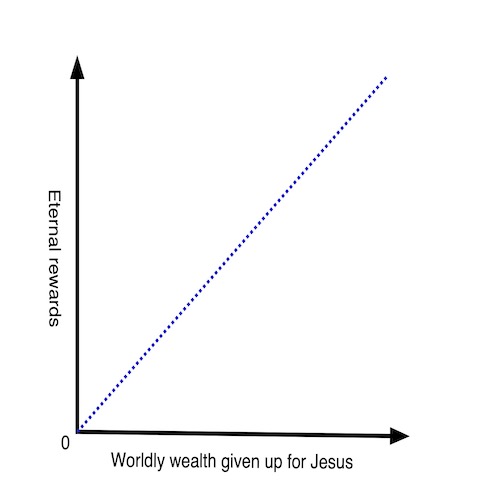
The word “very” is used twice by Luke (Luke 18:23). It speaks of a greatness or heaviness of something. It appears that when we are very wealthy, it is very hard to trust anything other than that wealth. The opposite also appears to be true: When worldly wealth is scant, our trust in God for our daily bread is high. This is what mathematicians would refer to as an inverse proportion.
On the other hand, Jesus promised eternal rewards for those who replaced trust in possessions with trust in God (also see Matthew 6:19-21; Luke 18:28-30). This is what mathematicians would referred to as proportional.
Both this proportional treasure and the inverse proportional trust in God are God’s indisputable realities.
As this young man shows us, it’s not about what we do or about what commands we have kept. In fact, it’s not about us at all! It’s all about a total trust in the only One who is eternally trustworthy!
This is a weekly series with things I’m reading and pondering from Charles Spurgeon. You can read the original seed thought here, or type “Thursdays With Spurgeon” in the search box to read more entries.
Listen to the podcast of this post by clicking on the player below, and you can also subscribe on Apple, Spotify, or Audible.
When God Seems Distant
You may possibly be in such a condition that every promise scowls at you as though it were transformed into a threat. When you turn over the pages of the Book once so full of comfort to you, it seems withered into a howling wilderness. …
Even those promises that you have been accustomed to offer to others in their time of need appear to shut their doors against you. ‘No admittance here,’ says one promise. Unbelief puts its burning finger right across another. Past sin accuses you and cries, ‘You cannot claim this word, for your transgression has forfeited it.’ So you may look through the whole Bible and find nothing upon which your souls may rest. … The fault is not in the promise but in us. …
Why does our gracious God permit this? Perhaps it is because you have been living without Him, and now He is going to take away everything upon which you have been in the habit of depending. Another reason may be that He wishes to drive you to Himself. … The prodigal was never safer than when he was driven to his father’s bosom, because he could find sustenance nowhere else. And, brothers and sisters, I think our Lord favors us with a famine in the land that it may make us seek after the Savior more. …
When everything goes well with us, we frequently run a long way from God, but as soon as we are overtaken by trouble or see a lion in the way, we fly to our heavenly Father. I bless God for the mire and for my sinking in it, when it makes me cry out, ‘Deliver me, O my God, out of the deep mire, and let me not sink.’
From The Believer Sinking In The Mire
David said, “I keep my eyes always on the Lord. With Him at my right hand, I will not be shaken” (Psalm 16:8). And in another psalm he elaborated on this by saying,
Yes, my soul, find rest in God; my hope comes from Him. Truly He is my rock and my salvation; He is my fortress, I will not be shaken. My salvation and my honor depend on God; He is my mighty rock, my refuge. Trust in Him at all times, you people; pour out your hearts to Him, for God is our refuge. (Psalm 62:6-8)
God allows shaking so that we will recognize that He is the only sure foundation. The only things that shake and prove themselves to be untrustworthy are those things not standing on God. So if God seems distant, ask the Holy Spirit to show you if there are any idols in your heart. If there are, repent from trusting those and return to God alone.
After this, the next step is to silence the voice of the enemy. Jesus said satan’s native language is lies and slander. As Spurgeon said, the enemy of your soul would love to tell you that God’s promises aren’t for you—that somehow you are disqualified from claiming them.
This is a weekly series with things I’m reading and pondering from Charles Spurgeon. You can read the original seed thought here, or type “Thursdays With Spurgeon” in the search box to read more entries.
Listen to the podcast of this post by clicking on the player below, and you can also subscribe on Apple, Spotify, or Audible.
Standing Firm
Superficial brilliance is always afraid of fire, but gold is not. The paste gem dreads to be touched by the diamond, but the true diamond fears no test. People who have a kind of confectionery godliness will wish to be preserved from temptations, for they cannot endure them. But the Christian counts it all joy when he falls into different trials, knowing that ‘tribulation produces perseverance; and perseverance, character; and character, hope. Now hope does not disappoint, because the love of God has been poured out in our hearts by the Holy Spirit who was given to us’ (Romans 5:3-5). My dear friends, if your faith is only a sunshiny faith, get rid of it! …
So our gracious God, beloved, glorifies Himself by permitting His people to be subjected to trials and by enabling them to endure the strain. We would never know the music of the harp if the strings were left untouched. We would never enjoy the juice of the grape if it were never trod in the winepress. We would never discover the sweet perfume of cinnamon if it were not pressed and beaten. And we would never know the warmth of fire if the coals were not utterly consumed. The excellence of the Christian is brought out by the fire of trouble. The wisdom of the great Workman and the glory of His skill and power are discovered by the trials through which His vessels of mercy are permitted to pass. …
Depend upon it, beloved, those who suffer as I have described are the children of God, for they show it. They show it by the way in which they bear their trials. In the worst times there is always a clear distinction that marks them as separate from other men. If they cannot shout, ‘Victory!’ they bear patiently. If they cannot sing to God with their mouth, yet their hearts bless Him. There is a degree of light even in their worst darkness…. If they get into the mire, they do not perish there. They cry for help when their woes surround them, and in the very nick of time, when everything appears to be lost, their heavenly Father hastens to their aid.
From The Believer Sinking In The Mire
I shared a series of messages called Thankful In The Night. Another psalmist wrote, “Yet the Lord will command His loving-kindness in the daytime, and in the night His song shall be with me” (Psalm 42:8).
Notice that this psalmist was praising God IN the night, not praising Him FOR the night. Many people have gone through what has been called “the dark night of the soul.” I don’t think anyone has ever given thanks because of being in a dark time, but certainly they have given thanks afterward because of the lessons learned in that dark time.
Quite simply put, there are some things God wants to teach us that we can learn in no other way than to go through a dark night. So we can learn to be thankful even IN those nights. IN those nights, we can learn to say, as Spurgeon did, “I believe in my Lord because He is a God who cannot lie. He is faithful and true to His every word and, therefore, let the whole creation go to rack and ruin, my faith will not waver or give up its confidence.”
Today you will be with Me in paradise—only in Luke
Dear women, behold your son—only in John
My God, My God, why have You forsaken Me?—only in Matthew and Mark (and this is the only dying declaration they record)
I thirst—only in John
It is finished—only in John
Father, into Your hands I commend My spirit—only in Luke
This is an excellent apologetic for the legitimacy and authenticity of the historical record.
You know that when your friends are at an important event, not everyone notices the same thing or even to the same extent as the others.
Cold-case detective J. Warner Wallace has pointed out that when he’s conducting an investigation, he separates the eyewitnesses from each other exactly so they don’t get their stories to “match.” Detective Wallace is able to get the full story precisely because of the differences in each of the accounts.
This is why the Gospel writers’ accounts ring true: they tell us the same historical event from their unique perspectives. It’s only by reading all of them that we get the full picture. If the death and resurrection of Jesus had been a conspiracy, these writers clearly would have collaborated to “get their story straight” ahead of time, and as a result, we would have four identical stories.
The historicity of Jesus as told in the Bible is spot-on and completely trustworthy!
This is a weekly series with things I’m reading and pondering from Charles Spurgeon. You can read the original seed thought here, or type “Thursdays With Spurgeon” in the search box to read more entries.
God Directs His Wind
At the present moment, I am not able to enter fully into the subject of the new birth. I am very weary, both in body and mind, and cannot attempt that great and mysterious theme. To everything there is a season and a time for every purpose under heaven, and it is not the time to preach upon regeneration when the head is aching, or to discourse upon the new nature when the mind is distracted.
From The Holy Spirit Compared To The Wind
Charles Spurgeon had a sermon in mind, but a headache and a distracted mind caused a course change. Can God use a headache to accomplish what He wants done? Of course He can! God knew exactly what that audience needed to hear that evening, and He arranged for His servant Charles Spurgeon to preach that needed message.
The apostle Paul was on his way to Rome, where God had said that Paul would speak before Caesar. But on their way, such a strong wind came up against their ship that they were blown off course. The wind ultimately caused them to shipwreck on the island of Malta. It was on Malta that Paul was able to show the power of God in a couple of miraculous ways. Can God use a storm at sea to get someone where He needs him? Of course He can!
So too with your life. You may have some plans or desires that a wind is tossing around. Don’t fight the wind and don’t curse the wind. Can God use this adversity to get you exactly where you need to be? Of course He can! He is using this wind to put you exactly where He needs you.
…all of them were leaders of the Israelites (Numbers 13:3).
Caleb and Joshua were two of the ten leaders who were sent out to explore the land of Canaan in advance of the Israelites’ crossing the Jordan River.
One of their areas of exploration was Hebron, the city where God first promised this land to Abraham and his descendants. It was here that the explorers saw the giants of Anak. Next, they went to the Valley of Eschol and took a sample of the gigantic-sized fruit. The explorers all experienced the same journey, but they did not all come to the same conclusion.
Ten of the explorer said, “The food is gigantic but so are the people. We cannot defeat them!” (13:26-29)
“Then Caleb silenced” those naysayers and said, “We can do it!” And Joshua joined Caleb in declaring, “Their protection is gone, but the Lord is with us. Do not be afraid of them” (13:30; 14:6-9).
The majority rules, right?
No! God did not send them in as a committee to vote on His plan. God had already said, “Take possession of the land”—that wasn’t up for debate or vote!
The naysayers said, “It looks like a good land, but….”
Caleb and Joshua said, “They look like giants, but….”
The majority saw the negatives and made excuses. They saw their situation as bigger than God.
The minority saw God as bigger than the giants. God by Himself is always the Majority. Always. My vote doesn’t change a thing. In fact, I don’t even get a vote! My only decision is whether or not to trust God and obey Him. Obedience—faithful, trusting obedience in God’s word—puts me on God’s side.
A mark of a godly leader is one who makes sure he is always on God’s side.
This is part 48 in my series on godly leadership. You can check out all of my posts in this series by clicking here.
When God made His promise to Abraham, since there was no one greater for Him to swear by, He swore by Himself, saying, “I will surely bless you and give you many descendants.”And so after waiting patiently, Abraham received what was promised. (Hebrews 6:13-15)
After waiting patiently…
God’s promise did come, but Abraham had to wait a long, long time! One translation says that Abraham waited long and endured patiently. Another says, Abraham stuck it out and got everything that had been promised to him.
God’s promises DO come to those who patiently endure UNTIL the promise comes.
Hang on.
Don’t fret.
Keep focused.
Don’t lose heart.
Endure!
Endure patiently.
Stick it out.
Don’t give up.
Keep going.
Don’t stop.
Persevere until it comes.
God has determined to show us the abundance of His promises, the faithfulness of His word, the trustworthiness of His promises.
Ask Abraham. He’ll tell you that it’s so worth it to hang on until God fulfills His word.
God’s counsel is unchangeable.
His wisdom is profound.
His treasures are immeasurable.
His delights are beyond comparison.
His hope is secure
His word endures.
His promises are sure.
Don’t give up. Patiently endure another day. God’s promise IS coming!



 In the wise words of John C. Maxwell, “He who thinketh he leadeth and hath no one following him is only taking a walk.” As always Maxwell is right on the money. And the first step to getting others to follow you is trust. If you want to lead your team into uncharted territory they have to first trust that you’re not going to lead them off a cliff! In today’s episode Greg and I cover why trust is so vital and offer suggestions on how to build and maintain trust.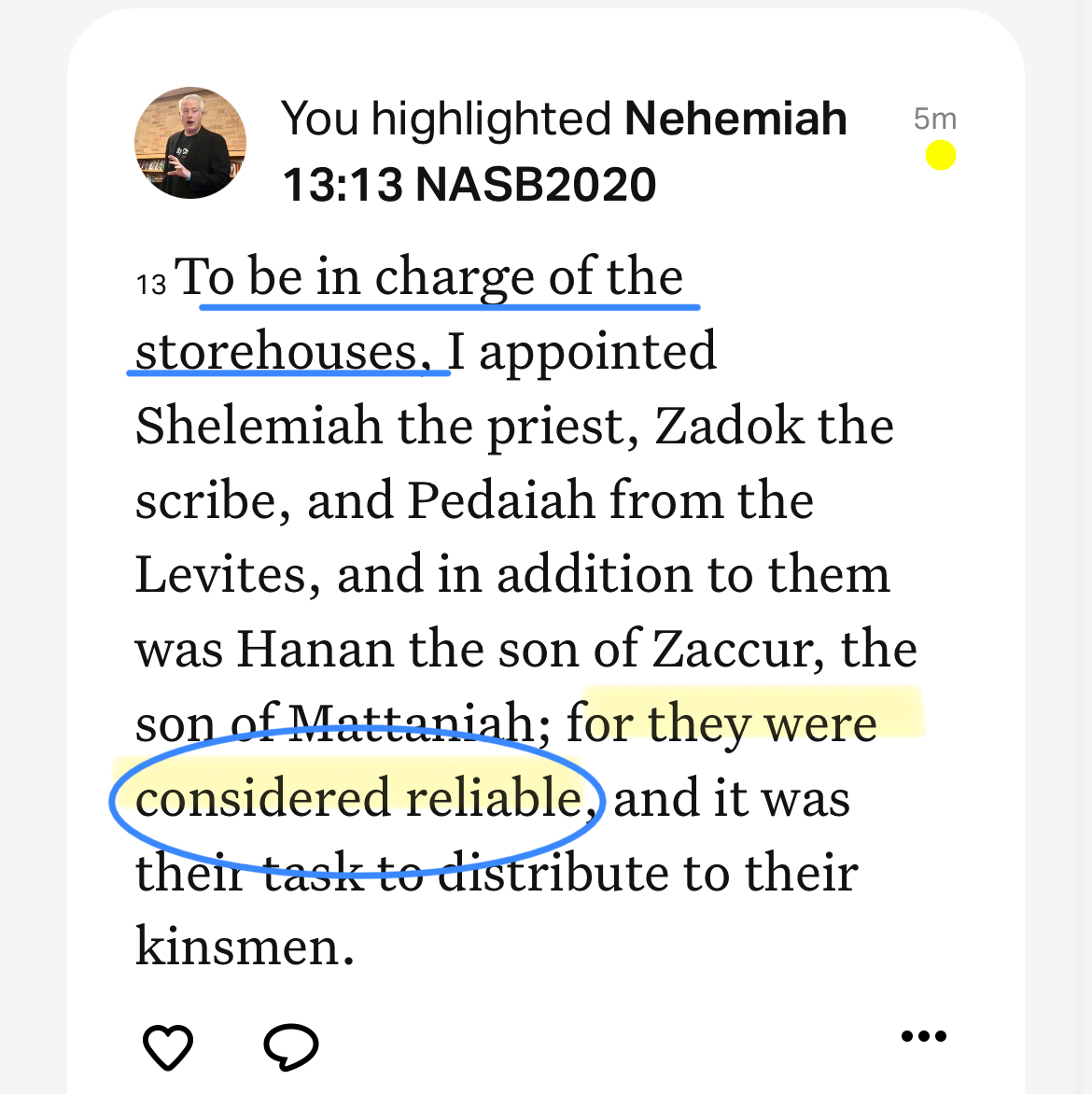









 Craig T. Owens