Use Your Spiritual Gifts Well

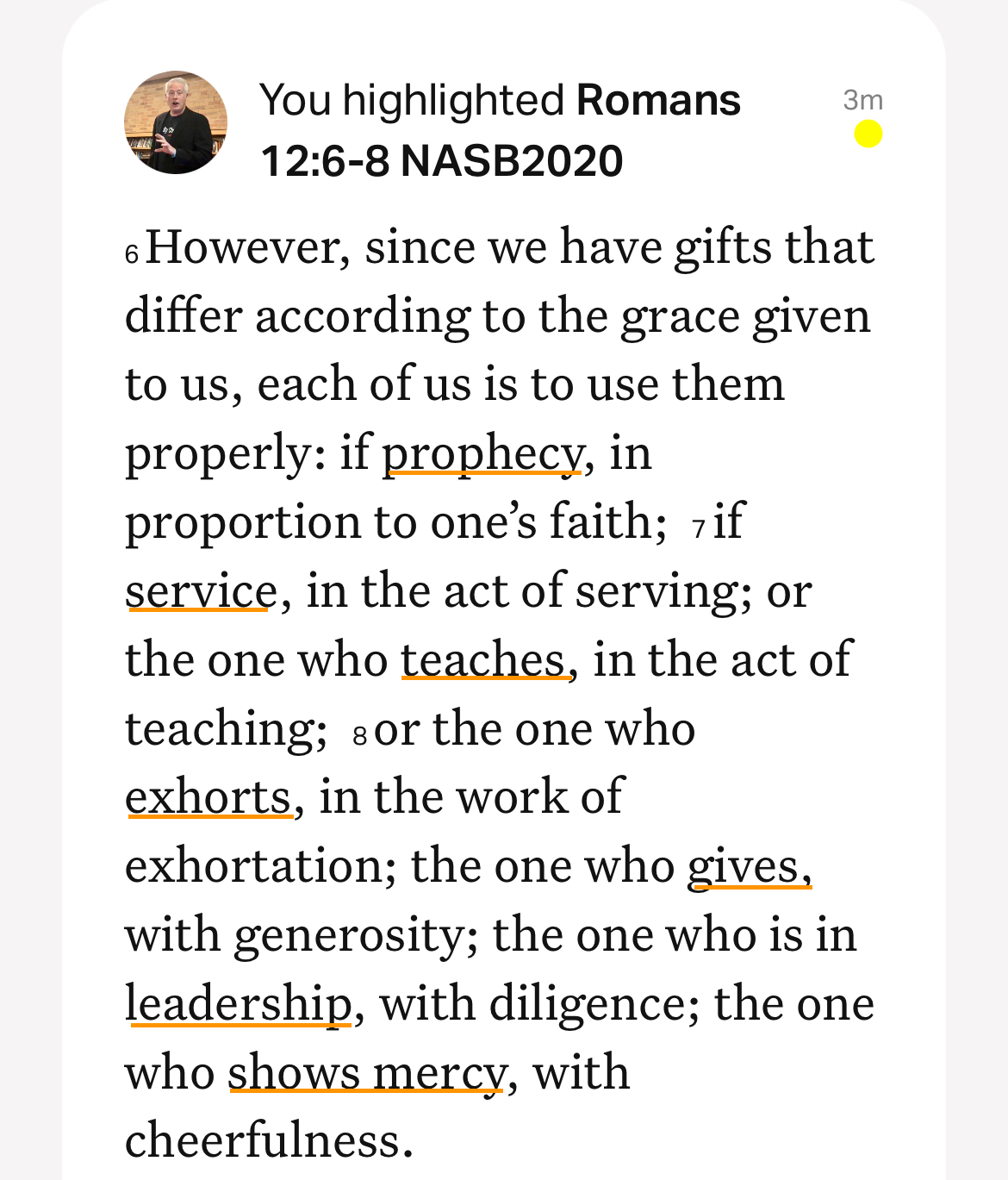
However, since we have gifts that differ according to the grace given to us, each of us is to use them properly: if prophecy, in proportion to one’s faith; if service, in the act of serving; or the one who teaches, in the act of teaching; or the one who exhorts, in the work of exhortation; the one who gives, with generosity; the one who is in leadership, with diligence; the one who shows mercy, with cheerfulness. (Romans 12:6-8)


As God has gifted you…

  • Prophesy faithfully
  • Serve wholeheartedly 
  • Teach skillfully 
  • Exhort encouragingly 
  • Give generously 
  • Lead diligently 
  • Restore cheerfully 

I taught a series of classes on these motivational gifts. Check out the videos and downloadable materials here.

Links & Quotes

Many of the examples Jesus used to tell us about the Kingdom of God seem like such small things. But those small beginnings have irresistible growth potential! Check out more thoughts in my series of posts called Kingdom Praying. I have lots of new content every week, which you can check out on my YouTube channel.

My wife is a school teacher and I also work quite a bit in our local schools. I think T.M. Moore is spot-on in his analysis of the breakdown in our current educational system: “This commitment to the Law and Word of God as foundational to the education of the young was everywhere practiced throughout the pre-revolutionary period in colonial America. It was unthinkable in the colonies that young people should be submitted to any instruction for any length of time without being taught the commandments and statutes of God, including the Gospel of Jesus Christ. Parents insisted on it, colonial and local statutes required it, and local school boards dutifully saw to it in all their schools.Since the middle of the previous century, assailed by specious invocations of ‘the separation of Church and State,’ educational policy in America has increasingly denied a place to God, His commandments, and His Word in the public-school curriculum. Generations of American children have grown up in a ‘disenchanted’ world (Charles Taylor), a world in which God, spiritual things, and the Law of God are deemed to be irrelevant if not oppressive, or at least a nuisance. The present crisis of morality, culture, and social upheaval is only the most visible consequence of that policy.”

David Mathis shared some thoughts about the healthy pace of ministry Jesus demonstrates for us. He said, “Let’s sit together at the feet of Jesus, and consider the pace and patterns of His life and ministry. He was not idle. Nor was He frenzied. From all we can tell from the Gospels, Jesus’s days were full. I think it would be fair to say He was busy, but He was not frantic. He lived to the full, and yet He did not seem to be in a hurry. In Jesus, we observe a human life with holy habits and patterns: rhythms of retreating from society and then reentering to do the work of ministry. Even as God Himself in human flesh, Jesus prioritized time away with His Father. He chose again and again, in His perfect wisdom and love, to give His first and best moments to seeking His Father’s face.“ These words resonate with me, because they are thoughts that I considered quite extensively for my book Shepherd Leadership.

I love reading stories like these that show how a relationship with Jesus utterly transforms a person’s life! “Opal W. Eubanks joined the Mississippi Highway Patrol during the race riots of 1964. A large, broad-shouldered white man, he relished the opportunity to strike fear in the hearts of African-Americans who were in trouble with the law. By his own admission, he was a foul-mouthed sinner who liked ‘rough stuff.’ A radical conversion to Christ in the early 1970s altered the course of Eubanks’ life, and his hardened heart became tender toward African-Americans in his rural community. He and his wife, Thelma, ultimately pioneered an Assemblies of God congregation consisting mostly of African-Americans, which they pastored for 21 years.”

The Greek word for “teaching” in Mark 9:31 means an ongoing dialogue. It’s an imperfect verb here because it is an activity that is never fully completed. Jesus wants us to abide with Him—to dialogue with Him—to continually learn from Him. The New Living Translation says it this way, ”For He wanted to spend more time with His disciples and teach them.” This is just as true for us today! 

J. Warner Wallace addresses the claims that the Old Testament prophets actually foretold that Jesus would be the Messiah. I love considering the apologetics for the death and resurrection of Jesus Christ, and this video will become an added resource for me in the future.

Rewards And Consequences

Rewards and ConsequencesThe Bible consistently gives us—right up front—the rewards for right living, and the consequences for wrong living. No one ever has to be surprised. 

For example, take this message from Jesus in Luke 6.

  1. If you don’t want others to judge you, don’t be judgmental (v. 37).
  2. If you don’t want to be condemned by others, don’t condemn others (v. 37).
  3. If you want to be forgiven, forgive others first (v. 37).
  4. If you want to receive, be the first to give to others (v. 38).
  5. If you want to teach, find a good teacher and then be a good learner first (vv. 39-40).
  6. If you want to help others with their problems, first look in the mirror at yourself (vv. 41-42).
  7. If you want to speak good words, put good words inside yourself (vv. 43-45).
  8. If you want to stand strong through adversity, build on the right foundation (vv. 46-49).

God doesn’t miss a thing! He told us how to stay in the place where He can bless us, and how we can avoid life’s negative consequences.

We would all do well to hear these words and put them into practice (v. 47)!

Poetry Saturday―I Will Do More

William Arthur WardI will do more than belong―I will participate.
I will do more than care―I will help.
I will do more than believe―I will practice.
I will do more than be fair―I will be kind.
I will do more than forgive―I will forget.
I will do more than dream―I will work.
I will do more than teach―I will inspire.
I will do more than earn―I will enrich.
I will do more than give―I will serve.
I will do more than live―I will grow.
I will do more than suffer―I will triumph. ―William Arthur Ward

3 Steps To Better Bible Studies

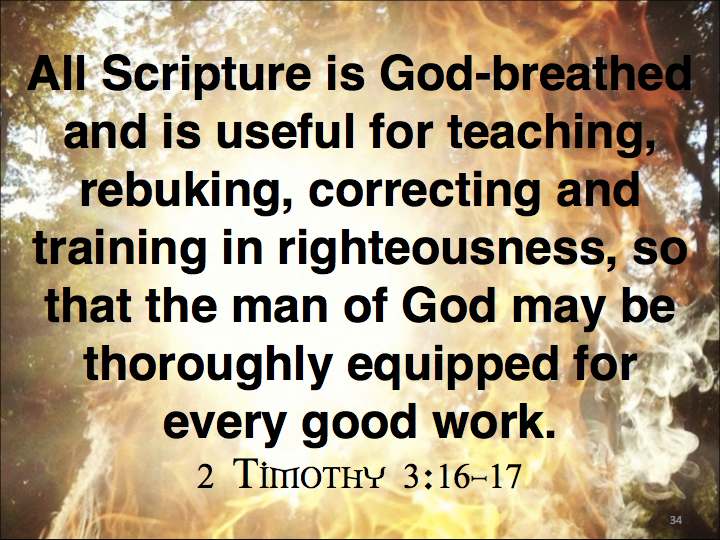
Inspired WordThe Bible is God’s inspired Word—literally, that means it is “God-breathed” (2 Timothy 3:16-17). If the Holy Spirit inspired the Word to the biblical writers, He can best illuminate the same Word to you as you read and study it.

This is how Jesus said the Holy Spirit would help us handle God’s Word:

Teach (John 14:26a). This word means to teach by holding a discourse with someone (or in this case, with Someone). Reading the Bible is meant to be a dialogue, not a monologue.

Remind (John 14:26b). The Holy Spirit is actively involved in us recalling and applying the Word to the situations in which we find ourselves. The Bible tells us to study to be prepared (1 Peter 3:15) and to handle God’s Word like a good worker (2 Timothy 2:15). We are also told not to pre-plan what to say if we are put on the spot, but that words would be given us (Matthew 10:19) as the Holy Spirit recalls to our memory which we have studied.

Convict (John 16:8). This word means both to refute and to confute. Confute simply means proving something is wrong. Refute means to show us we’ve reached a false or illogical conclusion, perhaps a conclusion we reached without giving it very much thought.

Guide (John 16:13). We get a good idea of the meaning of this word from the negative use of the same word—Can a blind man lead [the same word for “guide” in John 16:13] a blind man? Will they not both fall in a pit? (Luke 6:39). We can trust the Holy Spirit to lead us to the truth in the Scriptures that we can apply to our lives.

Quite simply better Bible studies come from:

  1. Praying for the Holy Spirit to illuminate Scripture to you as your read it.
  2. Reading the Bible.
  3. Obeying what the Holy Spirit illuminates to your heart and mind.

Try it and see what happens. I think you’ll like the results!

Obey─Remember─Teach

I see this pattern of instruction repeated throughout the Bible, but especially as the Israelites are getting ready to enter the Promised Land:

  • Obey God’s commands
  • Remember what He has done for you
  • Teach His commands to your children

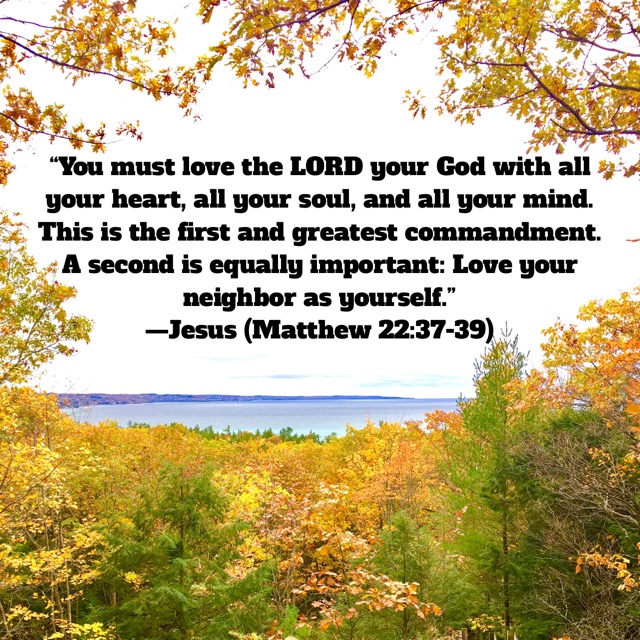
When Jesus was asked which commandment was the greatest, He quoted a passage from Deuteronomy, “Love the Lord your God with all your heart and with all your soul and with all your strength.” And He added, “And love your neighbor as yourself.” These, Jesus said, were the fulfillment of all the law.

  • Love God
  • Love yourself
  • Love your neighbor

This Great Commandment corresponds with this pattern of obey-remember-teach.

  • I obey God because I love Him.
  • When I remember what He has done for me, I can fully appreciate my own value in His eyes.
  • I teach others because I love them and want them to experience the same blessings from God that I have experienced.

This is what I need to be constantly evaluating:

  • Am I obeying God out of fear of what may happen, or out of love for Him?
  • Am I finding ways to continually be reminded of His blessings? Do I realize how valuable I am to Him?
  • Am I expressing true love to others by passing on what I am learning?

Obey [love God] … Remember [love myself] … Teach [love others].

What a great way to live!

How Far?

How far are you willing to go to make sure someone learns something from you?

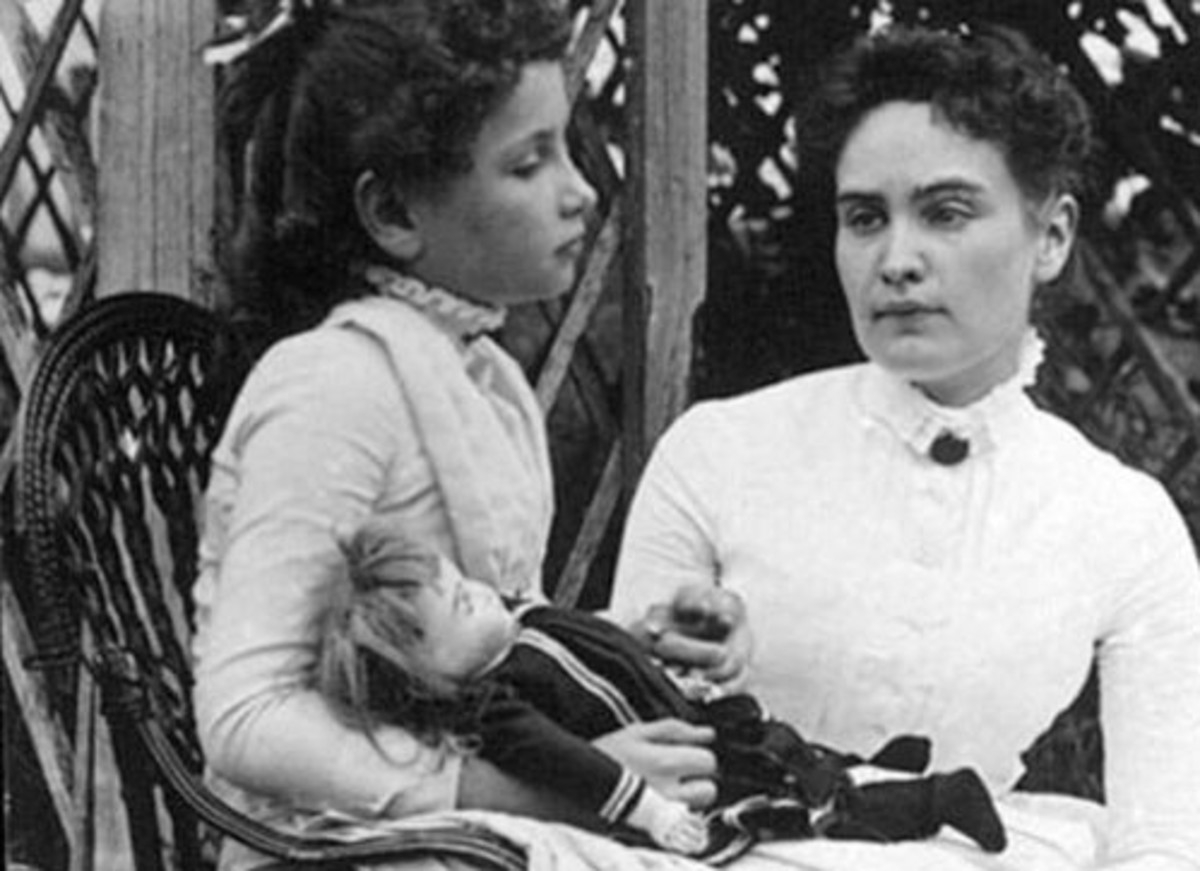
I’m reading a biography about Helen Keller and her teacher Annie Sullivan. As you may have heard before, Annie taught Helen how to communicate using her hands and fingers to spell out words. But after Helen heard about a deaf-blind student in Norway who was learning to speak audibly, Helen was determined to speak this way as well.

How do you teach someone who is deaf how consonants, vowels, blends, and words are supposed to sound? Eventually, Helen could “listen” to someone speak by placing her middle finger on the speaker’s nose, her index finger on their lips, and her thumb on their throat.

To get to this point of “listening” Helen had to know how sounds and words were formed with the lips and tongue. Initially, Annie would place Helen’s fingertips on her lips as she made sounds, but that only works so far. One of Helen’s cousins wrote, “Many times it was necessary for Helen to put her sensitive fingers in Teacher’s [Annie’s] mouth, sometimes far down her throat, until Teacher would be nauseated, but nothing was too hard, so Helen was benefited.”

Nothing was too hard.” Not even being gagged by an eager pupil! What amazing dedication!

So how far are you willing to go to help someone learn something valuable? Can you find a new way to say it? Are you willing to humble yourself to make yourself heard? Will you find a new way to communicate? A way that’s outside of your comfort zone? Can you communicate without even using words?

The Apostle Paul communicated the good news about Jesus this way: “I’ve become just about every sort of servant there is in my attempts to lead those I meet into a God-saved life. I did all this because of the Message. I didn’t just want to talk about it; I wanted to be in on it!” (1 Corinthians 9-:22-23, The Message)

How far are you willing to go to make sure someone hears the good news of Jesus from you?