Am I On My Own?

This is the only thing I want to find out from you: did you receive the Spirit by works of the Law, or by hearing with faith? Are you so foolish? Having begun by the Spirit, are you now being perfected by the flesh? (Galatians 2:2-3) 

Some people try to live as though the Bible says, “God helps those who help themselves.” This is exactly what Paul refutes.

In essence, Paul asks, “Does it make sense that after the Holy Spirit reconciled you to the Father through your faith in Jesus that then God would say, ‘You’re now on your own—figure it out yourself’?”

Of course not! 

When the Bible says that God opposes the proud, that means that He stands back from those who say, “I can do it by myself.” But the Scripture goes on to assure us that God gives more grace to the humble. That means that God is an ever-present help to those who say, “I cannot do this by myself.”

Hellbent

Listen to the podcast of this post by clicking on the player below, and you can also subscribe on AppleSpotify, or Audible. 

Here’s how God describes a wicked nation:

Woe to her who is rebellious and defiled, the oppressive city! She obeyed no voice, she accepted no discipline. She did not trust in the Lord, she did not approach her God. Her leaders within her are roaring lions, her judges are wolves at evening; they have no bones to gnaw in the morning. Her prophets are insolent, treacherous men; her priests have profaned the sanctuary. They have done violence to the Law. (Zephaniah 3:1-4)

These are people who were once so passionate for God and are hurtling toward His judgment on their sinful lifestyle—

  • thumbing their noses at their own civil laws 
  • calling their own justice system into question 
  • governed by leaders who are focused on flexing their power for themselves 
  • afflicted by judges ruling by the desires of those who give them “bones to gnaw” 
  • subject to preachers who twist and distort Scripture to suit their own desires 

These things can come from nothing but pride that says, “We know best. We don’t need some out-of-date, behind-the-times god telling us what to do!” 

These prideful people are hellbent on pursuing their sinful lifestyle—rejecting God’s warning of impending and certain judgment—because they have fooled themselves into believing there is no God! 

Our history books are filled with stories of other proud nations that thought this same way, but God both announced and carried out His righteous judgment on them. And still, we foolishly believe we are better than them, that we can avoid the inscrutable eyes of God. 

God is looking for one righteous man or woman who will hold to His righteous standard, and who will stand in the gap to intercede for rebellious, hellbent people (Ezekiel 22:30). 

Will you be that one?

►► Would you please prayerfully consider supporting this ministry? My Patreon supporters get behind-the-scenes access to exclusive materials. ◀︎◀︎

Wonder Worker

To Him who alone does great wonders, for His faithfulness is everlasting. (Psalm 136:4).

No one but our God can do the wondrous things He does because…

…no one is eternally existent like He is

…no one is self-sufficient like He is

…no one knows what He knows

…no one loves like He loves

…no one has the strength He has

…no one is as faithful as He is 

…no one gets the final word as He does

Finishing Well Is Better

Listen to the podcast of this post by clicking on the player below, and you can also subscribe on iTunes or Spotify.

The land was at peace… (2 Chronicles 14:6).

King Asa started out so well. The beginning of his reign could best be described by the word “peace”:

  • The land was at peace 
  • No one was at war with him 
  • The Lord gave him rest 
  • “[God] has given us rest on every side”  
  • The Lord his God was with him

When Cush attempted to attack the nation of Judah, Asa called on God: “Lord, there is no one like You to help the powerless against the mighty. … Do not let mere mortals prevail against You” (14:11). God gave Asa a great victory over Cush, and other God-fearing people from Israel began flocking to Judah “when they saw that the Lord his God was with [Asa]” (15:9). 

This peace lasted for 35 years!

And then came one poor decision from which Asa never recovered. 

The king of Israel began to make preparations for war against Judah. Instead of calling on God as he did when Cush was preparing to attack, Asa reverted to political maneuvering. He sent a bribe to a rival nation, enticing them to attack Israel. 

The prophet Hanani told Asa, “The eyes of the Lord range throughout the earth to strengthen those whose hearts are fully committed to Him. You have done a foolish thing, and from now on you will be at war” (16:9). 

From “the land was at peace” to “from now on you will be at war” came about because Asa…

  • …trusted his own ingenuity instead of relying on God 
  • …calculated his odds instead of calling on his God 
  • …forgot about God’s past provision 
  • …refused to confess his sin and repent from it, even when the prophet called him out
  • …utterly abandoned his God (16:2-12) 

Starting well is good, but finishing well is far better! 

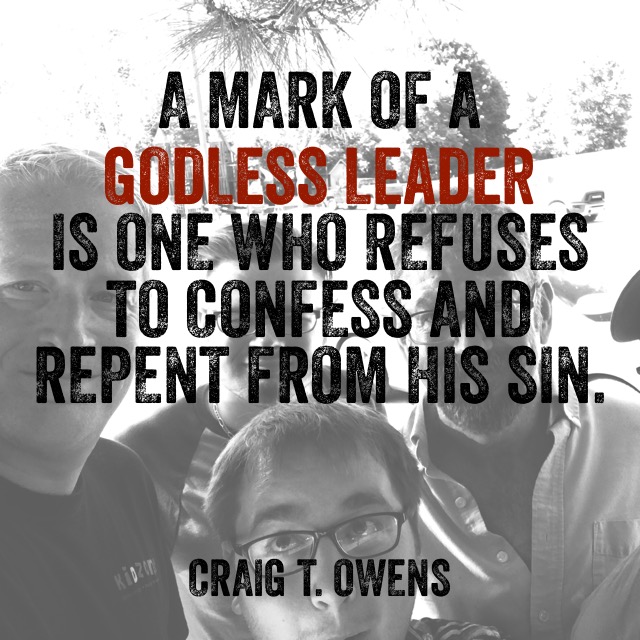
A mark of a godless leader is one who refuses to confess and repent from his sin. 

Asa’s refusal to admit his sin resulted in the end of his life being spent afflicted with disease and his country being surrounded and oppressed by enemies. 

This is part 54 in my series on godly leadership. You can check out all of my posts in this series by clicking here.

The Destructive Power Of Self-Sufficiency

…Find me a woman who is a medium, so I may go and inquire of her (1 Samuel 28:7). 
How sad for King Saul! But this is the inevitable path for one who was put into his leadership position by God and then completely turned his back on God. 

God did so much over so many years to try to get Saul to turn back to Him, but Saul persisted in his self-sufficiency. As Paul wrote in Galatians, “A man reaps what he sows.” Militarily, Saul had one shining moment: delivering the people of Jabesh Gilead. The closing words of 1 Samuel show us the valiant man from Jabesh conducting a covert nighttime mission to remove the bodies of Saul and his sons from the Philistines, and then giving them a proper burial. Just imagine how many more valiant men may have been around if Saul had continually obeyed God! 

Now, nearing the end of his life, Saul is at his wits’ end: God is not answering him by any means he tries. As a result, this final chapter of Saul’s leadership is characterized by words like:

  • afraid
  • terror filled his heart 
  • great distress 
  • filled with fear 
  • his strength was gone

Until King Saul ultimately takes his own life.

The consequences of Saul’s sinful self-sufficiency impacted more than just him. A leader’s sins have devastating effects on his followers. Throughout Saul’s reign as king we see the army fearful, hesitant, ill-equipped, slinking away, confused, set up for failure, and ultimately defeated. Saul could never get out of his own way, taking Israel down with him.

A mark of a godless leader is sinful self-sufficiency.

How sad for Saul and Israel. Especially because Saul’s demise was totally avoidable if he only would have repented of his pride and turned wholeheartedly to God.

This is a sober reminder for all leaders: if God has put you in a place of leadership, you will experience success. Don’t let that success fool you, as it did with Saul, into thinking you created that success. This is the first step toward the downward slide that ultimately destroyed Saul, and it will be your undoing as well. 

This is part 49 in my series on godly leadership. You can check out all of my posts in this series by clicking here.

The Knowledge Of The Holy (book review)

One definition of a Christian mystic is someone who engages in deep, prayerful pondering of the nature of God, as He is revealed in the Scriptures, and then emerges from those intimate encounters to share with us what he or she has learned. I would put A.W. Tozer in this category, especially in his book The Knowledge Of The Holy—The Attributes of God: Their Meaning in the Christian Life. 

Tozer himself described the Christian mystic more fully than I could in his book The Christian Book Of Mystical Verse. In that book, Tozer shared some poetic verses from some of his favorite mystical thinkers. He noted, “The hymns and poems found here are mystical in that they are God-oriented; they begin with God, embrace the worshipping soul, and return to God again.” 

In The Knowledge Of The Holy, Tozer takes us on his own personal journey into the immeasurable depths of God’s greatness. Whereas many theologians tend to focus on one attribute of God at a time, Tozer has a God-given ability to help us see all of God’s attributes operating in their infinite fullness. 

Even as Tozer plunges deep into the attributes of God’s self-existence, self-sufficiency, omniscience, omnipotence, omnipresence, love, mercy, justice, grace, and sovereignty, he reminds us, “Because God is immutable He always acts like Himself, and because He is a unity He never suspends one of His attributes in order to exercise another.” 

This is not a book you can ready lightly or casually, or even quickly. This is a book that invites you to read slowly and reverently each of the short chapters, and then to meditate long on the immenseness of an All-Powerful, All-Loving God who wants to reveal Himself to you. 

The Knowledge Of The Holy is a soul-expanding book!

Links & Quotes

link quote

“Puffery in doctrine leads to its dishonor.” —Charles Spurgeon

“In love’s service, only the wounded soldiers can serve.” —Dr. James Stewart

“Don’t bother about the idea that God ‘has known for millions of years exactly what you are about to pray.’ That isn’t what it’s like. God is hearing you now, just as simply as a mother hears a child. The difference His timelessness makes is that this now (which slips away from you even as you say the word now) is for Him infinite. If you must think of His timelessness at all, don’t think of Him having looked forward to this moment for millions of years: think that to Him you are always praying this prayer. But there’s really no need to bring it in. You have gone into the Temple (‘one day in Thy court is better than a thousand’) and found Him, as always, there. That is all you need to bother about.” ―C.S. Lewis

“The itch of self-regard craves the scratch of self-approval. That is, if we are getting our pleasure from feeling self-sufficient, we will not be satisfied without others seeing and applauding our self-sufficiency.” —John Piper

Some godly women on the front lines of the war against the sex industry.