


Listen to the podcast of this post by clicking on the player below, and you can also subscribe on Apple, Spotify, or Audible.
 Recognition of the proper chain of command is drilled into every soldier, and knowing and following that chain of command is essential to success. In fact, it’s so important that violating this hierarchy could result in court martial and a dishonorable removal from military service.
This is just as true in our service in the Lord’s army.
Pastor Dan Chastain noted how similar the US Army’s Non-commissioned Officer (NCO) creed is to the way Roman centurion’s operated: “I will know my Soldiers and always place their needs above my own. I will communicate consistently with my Soldiers and I will never leave them uniformed. I will be fair and impartial when recommending both rewards and punishment.”
The centurion we meet in Luke 7:2-10 cared for his servants and understood the chain of command. He recognized the supreme authority that Jesus had, even His authority over death and disease.
(Check out all of the Scriptures I mention in this post here.)
Pastor Dan also noted that the backing for an NCO’s authority is fear. There is an understanding of the authority that officer has to both reward and punish.
The Romans had perfected the torturous act of crucifixion. It struck fear into the hearts of their enemies. In Mark 15:15-38 we see just how well the Romans had developed this gruesome act to keep people living in fear of them.
They knew just how much to flog their victims to demoralize them for maximum effect—just enough to take the fight out of them, but not too much that they died before being crucified.
The death of Jesus, however, was probably not what the Roman kill squad expected. It was probably a bit of a letdown for them that Jesus died rather quickly because they were used to their enemies suffering for days. But they also knew they had to ensure that their victims were truly dead (see John 19:31-34).
Governor Pontius Pilate was also surprised how quickly Joseph of Arimathea showed up to ask for the body of Jesus, so Pilate summoned the centurion who had been in charge of the crucifixions to verify that He was indeed dead (Mark 15:42-45).
Did you notice that Pilate called “the centurion”? Who is this? He’s the one who oversaw the kill squad that had crucified Jesus and the two other criminals.
This centurion was a professional soldier. He had obtained his rank by his military skill, his leadership capabilities, his bravery, and his rigidly following the chain of command. His climb through up the ranks would have had him saying over and over again, “Kyrios kaiser,” which means “Caesar is lord.”
But notice that throughout the time that the Roman soldiers gambled for Jesus’ clothes, hurled insults and Him, and thrust a spear into His side that this centurion remained silent. There was something about this Man that was different.
When Jesus breathed His last breath, this soldier didn’t say, “Kyrios kaiser,” but something entirely different—“And when the centurion, who stood there in front of Jesus, saw how He died, he said, ‘Surely this Man was the Son of God!’” (Mark 15:39). He changed from “Caesar is lord” to “Jesus is Lord”!
 Just like the Romans terrified their enemies, our enemy wants to do the same thing—to steal, kill, and destroy (John 10:10); to prowl and growl like a lion (1 Peter 5:8).
We resist him not by our show or force against him, but by our show of submission to the King of kings (Philippians 2:10-11). The devil isn’t afraid of you, and you aren’t strong enough to defeat him (check out what happened in Acts 19:11-16). But satan has been defeated by our King, and when you bow to Christ’s authority, then he must flee from you (James 4:7).
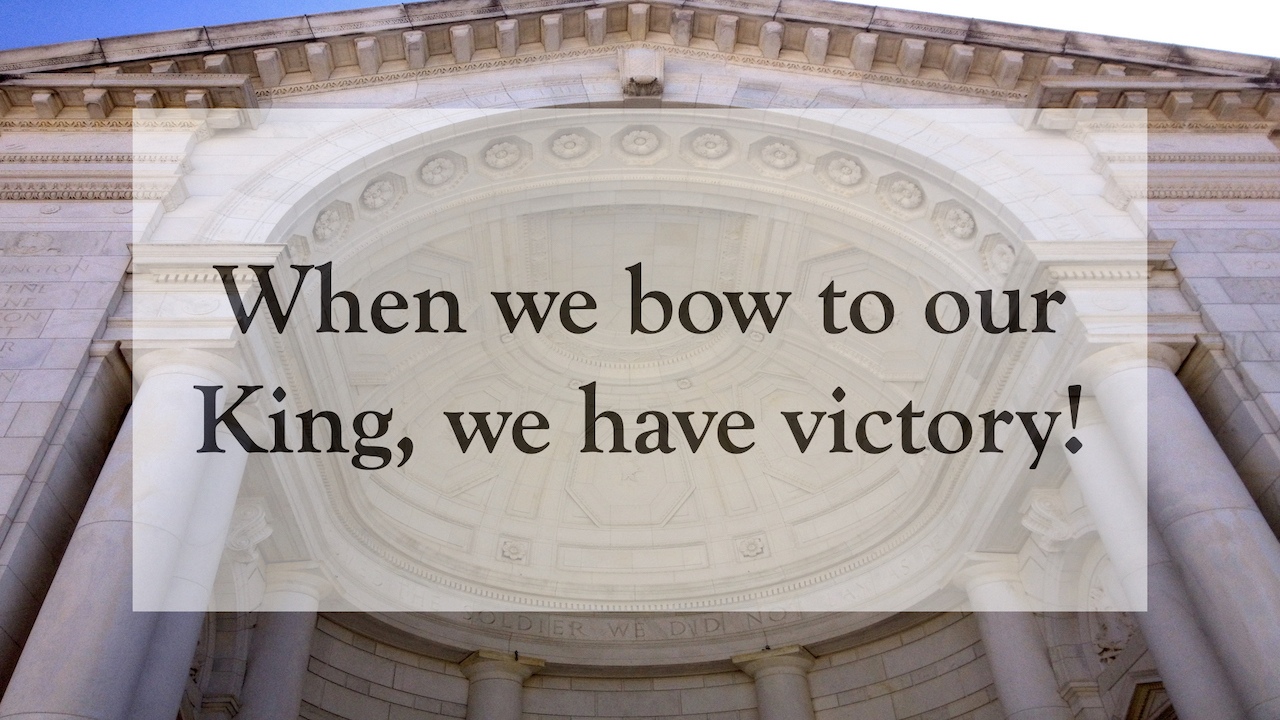
Our authority comes from bowing, from giving up our way of doing things, from not trying to figure out solutions on our own. When we bow to our King, we have victory!
If you’ve missed any of the messages in this series on spiritual warfare, check them all out here.
►► Would you please prayerfully consider supporting this ministry? My Patreon supporters get behind-the-scenes access to exclusive materials. ◀︎◀︎




 Craig T. Owens