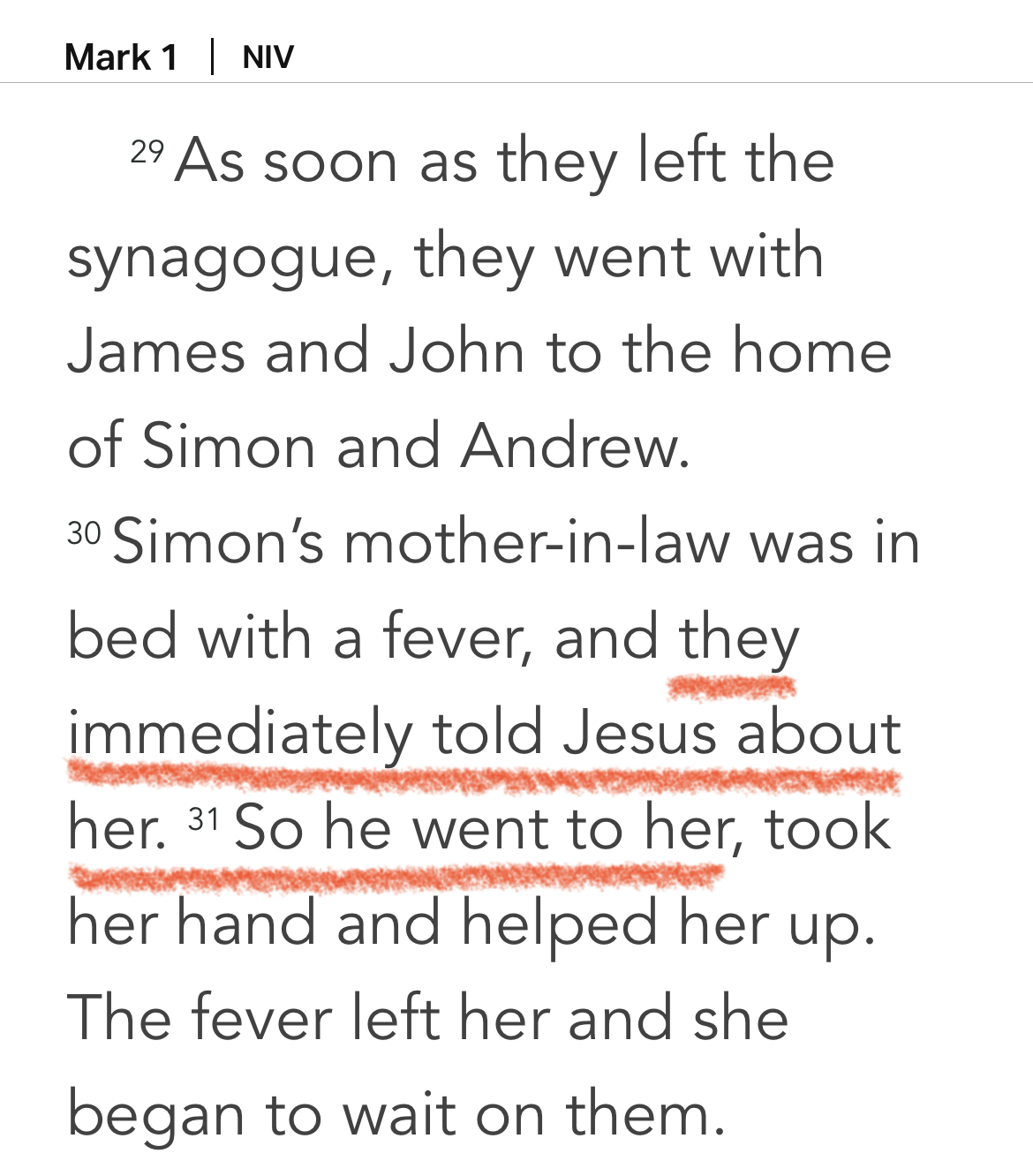
Peter’s mother-in-law was sick with a fever. “They immediately told Jesus about her. So He went to her…” (Mark 1:30-31).
They didn’t call a doctor first, or try a home remedy first, or consult a friend about how they treated a fever first. They immediately went to Jesus. And as soon as they did, Jesus went to the sick woman and healed her.
The old hymn What A Friend We Have In Jesus has a powerful reminder: “Oh, what peace we often forfeit—Oh, what needless pain we bear—all because we do not carry everything to God in prayer.”
What are we waiting for? Why do we try to help ourselves first when Jesus is standing right there waiting to help us?
Let’s respond differently. Let’s make going to Jesus our first—our immediate—response so that Jesus can come to our aid right away.
When Shechem…saw Dinah, he took her and he raped her (Genesis 34).
There is no doubt that what Shechem did to Diana was abhorrent. The text is full of reminders:
an outrageous thing
a thing that should not be done
Dinah had been defiled
their sister had been defiled
he treated our sister like a prostitute
Shechem never admits to his wrongdoing. We don’t even know if he told his father Hamor what he had done. Dinah was being kept in the city away from her family, so she didn’t tell her father Jacob. Somehow, however, Jacob found out and his response is curious: he did nothing about it (v. 5). Even as Shechem and Hamor address Jacob’s family, it’s Diana’s brothers who reply deceitfully, so either Jacob has left the meeting or he is still sitting there silently.
Levi and Simeon have the same mother as Dinah. Their reaction to their sister’s defilement is extreme—they kill every male in Shechem’s hometown!
Since Shechem hadn’t even mentioned his crime to his father, it’s possible that the rape of Dinah has been kept a secret from the rest of the citizens of his city. Perhaps if the other city leaders had found out, Shechem alone would have been punished, instead of the whole city being wiped out.
Jacob’s silence and inaction to this injustice prompted an overreaction by his sons.
When a leader’s response is inappropriate to injustice, the followers’ response is likely to become even more so. Injustices must be dealt with in a God-honoring way: quickly and appropriately.
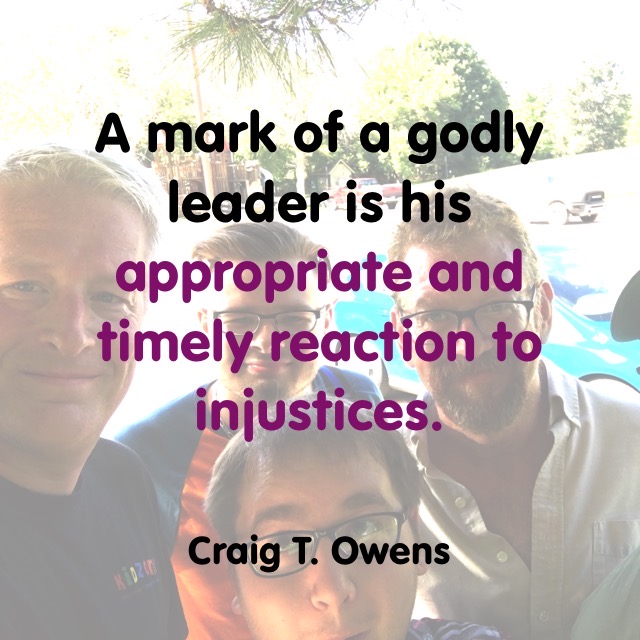
A mark of a godly leader is his appropriate and timely reaction to injustices.
This is part 50 in my series on godly leadership. You can check out all of my posts in this series by clicking here.
Oh, wait. It doesn’t really work that way, does it? At least it hasn’t for me. After I’ve been hurt, it takes quite a while to get to a place of healing. We have cliches for this sort of thing—phrases like “Once bitten, twice shy” and “Fool me once, shame on you; fool me twice, shame on me.”
We begin to react to the past instead of reflecting and responding in the present.
It’s interesting that those who compiled the Psalter placed Psalm 55 where they did. There is no introduction that gives us a background or setting, but David still seems to be looking for those “Ziphites” that betrayed him to King Saul.
Here’s an important physiological and psychological truth: Our brains cannot tell the difference between a real threat and an imagined threat. Our physical bodies react the same way in response to any threat.
It’s interesting to note that both Selahs in Psalm 55 are in the middle of a sentence, almost as if David is interrupting his own thoughts. Which, I believe, is exactly what he’s doing.
As this psalm opens David is still praying, but he’s praying about his internal threats:
my thoughts trouble me
I am distraught
I notice the conversations and the stares of potential enemies
myheart is in anguish
I feel like terrors of death, fear and trembling, and horror are closing in on me!
This leads to David’s fight/flight response (although really, it’s his flight response): “Oh, that I had the wings of a dove! I would fly away and be at rest—I would flee far away and stay in the desert.”
David has been listening to himself, and he finally at least attempts to put a halt to these distressing thoughts with his first Selah—which means “pause, and calmly think of that.”
Most of our natural reactions are driven by fear. But fear—by its very nature—is limiting. Fear keeps us tunnel-visioned on the perceived threat. Fear closes us off to accepting any new information. Fear limits our creative responses. Fear perpetuates more fear.
So David tries a second time to Selah. He is attempting to interrupt his negative thoughts—to stop listening to himself and start talking to himself. To move from a self-preserving reaction to a God-glorifying response requires a Selah pause to reflect. Reflecting on things like:
Where will these thoughts ultimately take me?
How has God responded before?
What does God’s Word say?
Could I imagine Jesus responding the way I’m responding?
What changes can I make?
I love David’s conclusion: “But as for me, I TRUST IN YOU.” He’s saying, “I’m not going to listen to those negative fears anymore. It’s time to put my trust in God.”
David had to do this “evening, morning, and noon”—again and again and again! Until finally he could say, “I will cast all my cares on the Lord and He will sustain me; He will never let me fall” (Psalm 55:22).
This is what Jesus promises us, “Come to Me, all of you who are tired and have heavy loads, and I will give you rest” (Matthew 11:28).
In Stand Strong, Nick Vujicic shares the hard-won strategies he learned to overcome bullies. You can read my full review of Stand Strong by clicking here.
I already shared some of Nick’s quotes from this book, but I wanted a separate post to highlighted a key issue in bullying. One of the biggest tolls on a person being bullied is in their emotional health. One of the chapters I highlighted the most had to do with this important area, so below are a few good reminders.
“I encourage you to keep this phrase in your mind when faced with bullying: You can say terrible things to me, but you can’t touch who I am inside. You can’t make me feel badly about myself. I know who I am, and I stand on my own.”
“We have emotions for a reason. They don’t just come over us by chance, even though it sometimes may seem that way. Asking where your emotions come from and assessing why you feel the way you feel are critical parts of creating self-awareness and asserting self-control over your actions. It’s important to know what triggers your emotions so you can better control your responses in ways that benefit you over the long term. Managing negative emotions is an important part of your bully defense system, and it is also a key to living a more successful life. People who let their negative emotions control their actions tend to feel out of control, insecure, and unhappy. Those who act based on a thoughtful process for monitoring and managing such emotions tend to be more successful, more confident, and happier.”
“Emotions are natural and you feel what you feel. But the quality of your life is greatly affected by the choices you make in responding to your feelings. You see, a space, a time interval, and an opportunity between the point at which you feel something and the point at which you act on that feeling. This space is a gift. … Psychologists say people who learn to use this space wisely are generally much more successful in life than those who either ignore it or don’t use it well. This is the space where you can take control, make smart decisions, and put yourself in a position to determine your own destiny. … When you use the space to think about your response and to decide what is best for you over the long term, you are practicing self-awareness and self-control. This is called ‘response flexibility,’ and it is a sign of emotional intelligence.”
“Here’s something to consider: your negative emotions can be like bullies inside you. They try to provoke a response from you that may not be in your best interest. So if you simply do what those bad feelings stir you to do, you are just giving in to another bully in your life.”



 Mark the Gospel writer loves the action! He uses the word immediately eleven times, and the phrase at once seven times.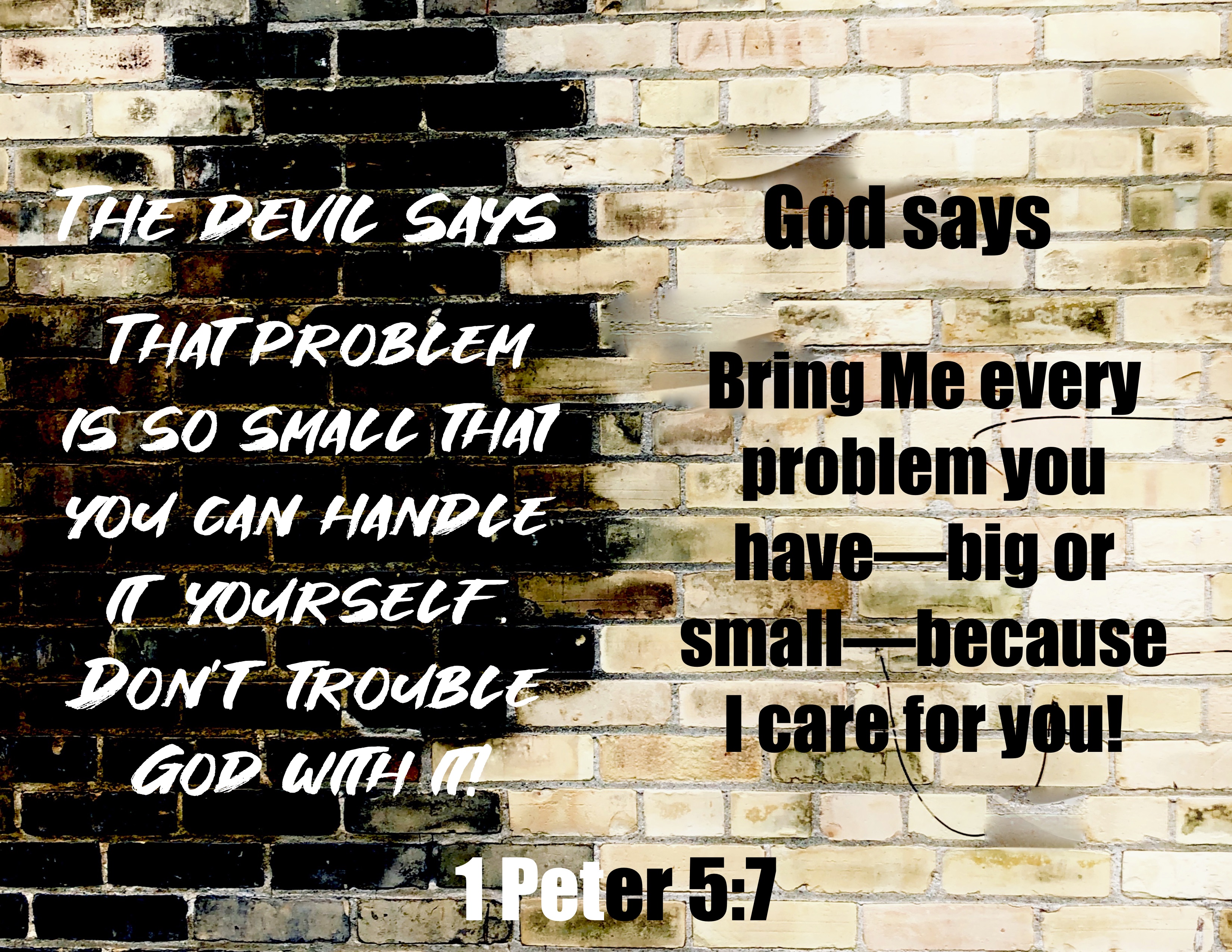


 Craig T. Owens