Links & Quotes

When Christian saints get together, there are fewer gaps and fewer blind spots. Don’t isolate yourself, but stay involved with a group of saints!

I have a lot of new video content on my YouTube channel every week. Please check it out and subscribe so you don’t miss anything.

“Tragedy is the highest expression of the infinite value of human life.” —G.K. Chesterton

Clinton Manley says, “Though we often read by ourselves, we never read alone. When you open up a book, you sit down with an author. The book is fundamentally a technology of conversation; it fosters the meeting of minds across time and space.” Referencing several classical works and the Scripture, Manley reminds us that we become what we read.

“It has always been easy to hate and destroy. To build and to cherish is much more difficult.” —Queen Elizabeth II 

“Those of us who have been true readers all our life seldom fully realise the enormous extension of our being which we owe to authors. We realise it best when we talk with an unliterary friend. He may be full of goodness and good sense but he inhabits a tiny world. In it, we should be suffocated.” —C.S. Lewis

What Are You Reading?

Listen to the podcast of this post by clicking on the player below, and you can also subscribe on AppleSpotify, or Audible. 

I would like to ask you a simple question: What are you reading? 

You may have heard the phrase, “Leaders are readers.” Is that true? Is that the best use of your time? If this phrase is true, how do we know what to read? 

Here are some related blog posts I would suggest you peruse: 

The post from Scott Hubbard that I mentioned is called “What Should I Read Next? 

If you are a pastor or ministry leader, I would humbly suggest that my books might be a good addition to your reading list:

►► Would you please prayerfully consider supporting this ministry? My Patreon supporters get behind-the-scenes access to exclusive materials. ◀︎◀︎

Links & Quotes

Some human employers may ask us to do business for them without giving us a good example or enough resources. But when Jesus told us to be about the Father’s business, He gave us an example and the full empowerment of the Holy Spirit! Check out this full sermon.

I have a lot of new video content on my YouTube channel every week. Please check it out and subscribe so you don’t miss anything.

“Compromise is a costly word; non-compromise, even more so.” —Bono 

Shane Morris said, “But as much as AI’s potential can cause harm, blaming it alone misses the point and likely makes these problems worse. Humans are the fallen ones, and that fallenness manifests in all kinds of destructive ways. Machines, strictly speaking, don’t have morals or intentions. They can only reflect ours.” Check out his podcast AI is not the problem, we are.

“I do not believe that a nation dies save by suicide. To the very last every problem is a problem of will; and if we will we can be whole. But it involves facing our failures as well as counting our successes.” —G.K. Chesterton 

I love reading and I have a long list of what I would like to read next. Scott Hubbard addresses this question: “Perhaps the question ‘What should I read or listen to?’ would come into sharper focus if we had a better sense of why we read at all. ‘Why read?’ has more than one right answer. We read to learn, to rest, to deepen friendship with fellow readers, to enjoy the craft of skilled wordsmiths. But alongside these good reasons, consider three others that put our reading into the service of greater loves.” 

“I only hope that we never lose sight of one thing—that it was all started by a mouse.” —Walt Disney 

“The scientific man does not aim at an immediate result. … His duty is to lay the foundation for those who are to come, and point the way.” —Nikola Tesla 

This week marked the 100th anniversary of a court case that was known as “the trial of the century,” perhaps you have heard it called the Scopes Monkey Trial. It was, and has been, more sensation than substance. Check out this post that puts this trial in its proper perspective.

Links & Quotes

When someone wants to “grow” an organization, what exactly does that look like? Is growth only numeric or is it something that’s perhaps a bit more difficult to count? The leader needs to have this clear in their mind, and they need to regularly communicate this metric to their team. I unpack this in greater detail in my book Shepherd LeadershipCheck out more of this message hereAnd be sure to check out all of my videos on my YouTube channel.

It appears that creativity is largely fueled by two things: proper sleep and finding your “sweet spot” each day. If you are an early bird, protect that creative time. If you are a night owl, don’t try to become an early bird to emulate someone else, but lean into your productive time. Check out this full post.

I love reading, but even I have trouble finding time to sit down with my books. But this insight from John Piper totally rejuvenated my thinking about reading. “Suppose that you can read about 250 words a minute. Now, that’s not real fast; most of us can do that—250 words a minute. And suppose that you set aside fifteen minutes a day to read a great book—a classic or some book that you’d been longing to read that would help you grow in your wisdom, your understanding. Now, fifteen minutes a day for 365 days is 5,475 minutes a year. Now, you multiply 5,475 times 250, and you get 1,368,750 words that you could read in a year at fifteen minutes a day. Now, an average book has about 300 to 400 words on a page. So we’ll take 350, which is kind of in the middle, and divide that into 1,368,750. And you know what you get? You get 3,910—almost 4,000 pages a year. An average book has about 200 pages. You see the implication of that? You could read twenty books by this time next year by setting aside fifteen minutes a day.”

An ancient Hebrew inscription consisting of 48 letters was discovered on Mt. Ebal in Israel and is centuries older than any known Hebrew inscription from ancient Israel. This is yet another archeological discovery that speaks to the historicity of the Bible.

T.M. Moore wrote one of the endorsements of my book Shepherd Leadership. His thoughts here about the role of godly shepherds is right on the mark: “The work of shepherds consists of helping the people of God to connect with Him—to know, love, fear, and serve Him in every area of their lives. This work cannot be fulfilled by one who is merely a good speaker, an effective organizer, or an inspiring motivator. This work must be done by one who truly knows the Lord. For unless we know the Lord, the Lord will not know us, and He will not honor our labors.”

You are one-of-a-kind! There has never, ever been anyone like you, and there never will be. God made you on purpose and for a purpose. And God wants to reveal the purpose He has for your life. You be you—that is how God is most glorified through you.

Thursdays With Spurgeon—Study The Right Things

This is a weekly series with things I’m reading and pondering from Charles Spurgeon. You can read the original seed thought here, or type “Thursdays With Spurgeon” in the search box to read more entries.

Study The Right Things

     It is very advantageous to the Christian mind frequently to consider the deep and unsearchable attributes of God. … If we study man and make him the only object of our research, there will be a strong tendency in our minds to exaggerate his importance. We will think too much of the creature and too little of the Creator, preferring the knowledge that is to be found out by observation and reason to the divine truth that revelation alone could make known to us. … 

     The fleeting things of human life and the fickle thoughts and showy deeds of men are as movable and as changeable as the waters of the treacherous deep. But when we mount up, as it were, with eagles’ wings to Him Who sits upon the circle of the earth, before Whom all its inhabitants are as grasshoppers (Isaiah 40:22), we nestle in the Rock of Ages that from its eternal socket never starts and in its fixed immovability can never be disturbed.

From The Infallibility Of God’s Purpose

I read a lot of books. But in the hands-down, it’s-not-even-close category, I read the Bible more than anything else. It is the Book of books because it reveals the eternal Wisdom behind the earth’s wisdom. 

Zig Ziglar used to say, “Every morning I read my Bible and I read the newspaper. That way, I know what both sides are up to.” That’s pretty good!

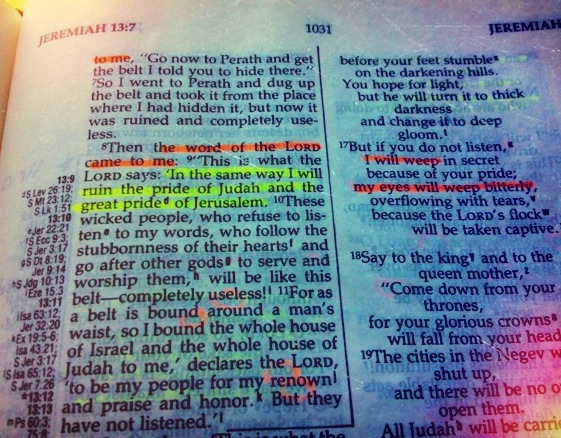
We read the Bible not just to know the Bible, but to know the One Who authored the Bible. Or, as I like to say it—

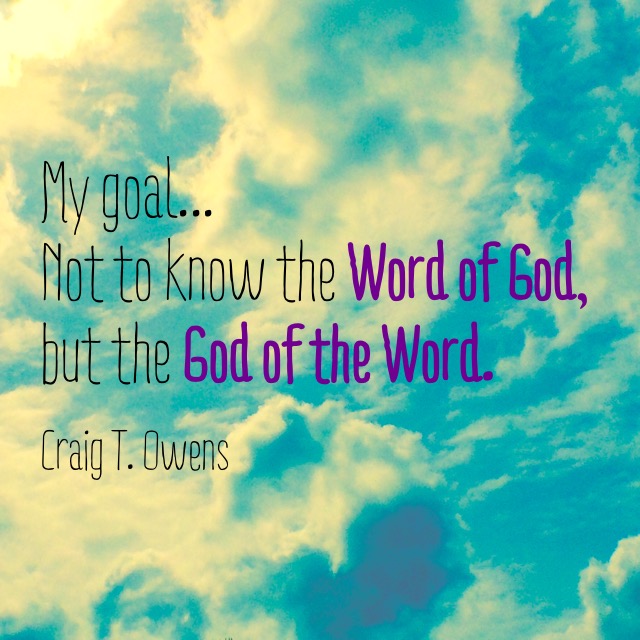
My goal in reading the Word God is to get to know the God of the Word better and better.

Charles Spurgeon would never say—nor do I—that you shouldn’t study a variety of topics. Just make sure that your priority is God’s Word. This will give you the greatest insight into other topics and will protect you from humanistic error. 

Read Your Bible More

“Read your Bible more and more every year. Read it whether you feel like reading it or not. And pray without ceasing that the joy return and pleasures increase.

“Three reasons this is not legalism:

  1. You are confessing your lack of desire as sin, and pleading as a helpless child for the desire you long to have. Legalists don’t cry like that. They strut.
  2. You are reading out of desperation for the effects of this heavenly medicine. Bible-reading is not a cure for a bad conscience; it’s chemo for your cancer. Legalists feel better because the box is checked. Saints feel better when their blindness lifts, and they see Jesus in the Word. Let’s get real. We are desperately sick with worldliness, and only the Holy Spirit, by the Word of God, can cure this terminal disease.
  3. It is not legalism because only justified people can see the preciousness and power of the Word of God. Legalists trudge with their Bibles on the path toward justification. Saints sit down in the shade of the Cross and plead for the blood-bought pleasures.

“So let’s give heed to Mr. Ryle and never grow weary of the slow, steady, growth that comes from the daily, disciplined, increasing, love affair with reading the Bible. 

‘Do not think you are getting no good from the Bible, merely because you do not see that good day by day. The greatest effects are by no means those which make the most noise, and are most easily observed. The greatest effects are often silent, quiet, and hard to detect at the time they are being produced. Think of the influence of the moon upon the earth, and of the air upon the human lungs. Remember how silently the dew falls, and how imperceptibly the grass grows. There may be far more doing than you think in your soul by your Bible-reading’ (J.C. Ryle, in Practical Religion).” —John Piper 

Thursdays With Spurgeon—A Firm Doctrine

This is a weekly series with things I’m reading and pondering from Charles Spurgeon. You can read the original seed thought here, or type “Thursdays With Spurgeon” in the search box to read more entries.

A Firm Doctrine

     If a tree has to be taken up two or three times a year, you will not need to build a very large loft in which to store the apples. When people are always shifting their doctrinal principles, they are not likely to bring forth much fruit to the glory of God. It is good for young believers to begin with a firm hold upon those great fundamental doctrines that the Lord has taught in His Word.

From The Autobiography Of Charles Spurgeon 

This is true of any endeavor—can you imagine constantly shifting the way you learn math, or biology, or cooking, or anything else? There’s always a “learning curve” in every new endeavor that brings a momentary setback before there are new gains.

Thankfully, the Bible has a consistent message from Genesis to Revelation. Getting into the Word regularly and attending a Bible-preaching church will help you immensely. 

There is no “right way” to read the Bible. In fact, Spurgeon had a great response to a man who told him that he “read my Bible on my knees.” Spurgeon said—

“I think you read the Bible in a very uncomfortable posture, and if you had read it in your easy chair, you would have been more likely to understand it. Pray, by all means, and the more, the better, but it is a piece of superstition to think there is anything in the posture in which a man puts himself for reading.”

The point is not in what posture you read the Bible, or in what translation, or at what time of day, but the point is that you are regularly reading God’s Word. Get into the Word, and let the Holy Spirit get the Word into you. 

A.W. Tozer On Reading Well

“To confine our reading to the works of a few favorite authors of today or last week is to restrict our horizons and to pinch our souls dangerously.” …

“To think without a proper amount of good reading is to limit our thinking to our own tiny plot of ground. The crop cannot be large. …

“Extensive reading without the discipline of practical observation will lead to bookishness and artificiality. Reading and observing without a great deal of meditating will fill the mind with learned lumber that will always remain alien to us. Knowledge to be our own must be digested by thinking.” …

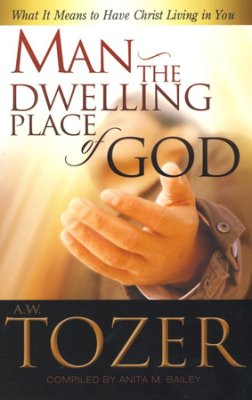
“The best book is not one that informs merely, but one that stirs the reader up to inform himself. The best writer is not one that goes with us through the world of ideas like a friendly guide who walks beside us through the forest pointing out to us a hundred natural wonders we had not noticed before.” —A.W. Tozer, in Man—The Dwelling Place Of God

5 Quotes From “How To Read A Book”

how-to-read-a-bookIf you want to get more out of your book reading time, I’d highly recommend How To Read A Book to you. Check out my review here, and then check out some of the quotes I especially appreciated.

“We do not have to know everything about something in order to understand it; too many facts are often as much of an obstacle to understanding as to few. There is a sense in which we moderns are inundated with facts to the detriment of our understanding.”

“Good books are over your head; they would not be good for you if they were not. And the books that are over your head weary you unless you can reach up to them and pull yourself up to their level. It is not the stretching that tires you, but the frustration of stretching unsuccessfully because you lack the skill to stretch effectively. To keep on reading actively, you must have not only the will to do so, but also the skill—the art that enables you to elevate yourself by mastering what at first sight seems to be beyond you.”

“Perhaps you were beginning to see how essential a part of reading it is to be perplexed and know it. Wonder is the beginning of wisdom in learning from books as well as from nature. If you never ask yourself any questions about the meaning of a passage, you cannot expect the book to give you any insight you do not already possess.”

“Many persons believe that they know how to read because they read at different speeds. But they pause and go slow over the wrong sentences. They pause over the sentences that interest them rather than the ones that puzzle them. Indeed, this is one of the greatest obstacles to reading a book that is not completely contemporary.”

“‘State in your own words!’ That suggests the best test we know for telling whether you have understood the proposition or propositions in the sentence. If, when you are asked to explain what the author means by a particular sentence, all you can do is repeat his very words, with some minor alterations in their order, you had better suspect that you do not know what he means. Ideally, you should be able to say the same thing in totally different words. The idea can, of course, be approximated in varying degrees. But if you cannot get away at all from the author’s words, it shows that only words have passed from him to you, not thought or knowledge. You know his words, not his mind. He was trying to communicate knowledge, and all you received was words.”

Links & Quotes

link quote

“Reading the Bible is a good preparative for prayer, as prayer is an excellent means to render reading effectual.” —George Whitefield

“God would have remained hidden afar off if Christ’s splendor had not beamed upon us.” —John Calvin

“In selecting men for office, let principle be your guide. Regard not the particular sect [party] of the candidate—look to his character. … It is alleged by men of loose principles or defective views of the subject that religion and morality are not necessary or important qualifications for political stations. But the Scriptures teach a different doctrine. They direct that rulers should be men ‘who rule in the fear of God, able men, such as fear God, men of truth, hating covetousness.’” —Noah Webster

“During the gold rush, the people who made the most money were the ones selling the shovels.” —Russell Brunson

Husbands, here are 8 things your wife should expect from you.

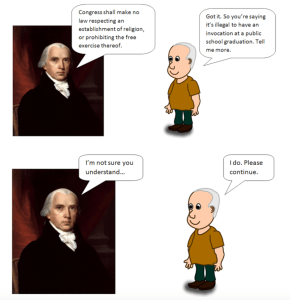
James Madison & the Bill of RightsMurray Vassar has another great cartoon. Click the picture or here to see the rest…

Seth Godin always makes me think. Like this post called Opposition

The opposite of creativity is fear.
And fear’s enemy is creativity.
The opposite of yes is maybe.
Because maybe is non-definitive, and both yes and no give us closure and the chance to move ahead.
Perfect is the enemy of good.
Us is not the enemy of them. Us is the opposite of alone.
They can become us as soon as we permit it.
Everything is the opposite of okay. Everything can never be okay. Except when we permit it.
The right is not the opposite of the left. Each side has the chance to go up, which is precisely the opposite of down.
Dreams are not the opposite of reality. Dreams inform reality.

[VIDEO] John Maxwell makes me think, too. Here he does it with a bit of humor—

https://youtu.be/n4VwCtnGbHw