
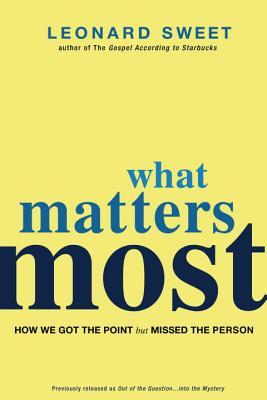
17 Quotes From “What Matters Most”

What Matters Most is sure to be a thought-provoking, conversation-starting, paradigm-challenging book. You can read my full review of Leonard Sweet’s book by clicking here. To help whet your appetite for this book (that you’re going to read very soon, right?), here are 17 quotes that especially caught my attention…

“To save the world we don’t need the courage of our convictions. We need the courage of our relationships… Especially the courage of our relationship with the Creator, the creation, and our fellow creatures. Our problem in reaching the world is that we’ve made rules more important than relationships.”

“Western Christianity is largely belief based and church focused. It is concerned with landing on the right theology and doctrine and making sure everyone else toes the line. The Jesus trimtab, in contrast, is relationship based and world focused. It is concerned not so much with what you believe as with Whom you are following.” 

“Relationship is one of the things that distinguishes Judaism and its radical Christian revision from other religions: God calls us into a relationship. Christianity is much more than a wisdom tradition or a moral system or a path leading to higher states of existence.”

“We don’t follow Jesus because we understand Him or because we know the truth about Him. We follow Jesus because He is the Truth, and He leads us into truth through our relationship with Him. …The Jesus call to discipleship is an invitation to enter a relationship with the person doing the teaching, not simply an intellectual encounter with the principles He taught.”

“The postmodern quest has been misunderstood as an abandonment of the quest for truth. It is far from an abandonment, but is rather a rerouting of the quest for truth along more relational and less rational paths.”

“If we shift our focus away from truth as right teaching and correct doctrine, and instead center our lives on truth as a Person and faith as a relationship with that Person, what does this do to evangelism? Evangelism shifts from an attempt to indoctrinate a skeptic into a new belief system and makes the gospel proclamation a process of inviting others into a relationship with God. Evangelism is as much invitation as it is proclamation. It is inviting others into a relationship with God so that the Holy Spirit can make Christ come alive in them and live in them and they can live in God’s fullness and providence. Evangelism is not leading people into right beliefs about Jesus. It is introducing people to a relationship with Jesus the Christ.” 

“Obedience, in the biblical sense, is not ‘doing what you are told.‘Obedience is living relationally, even ‘indivisibly,’ with the Holy One so that we honor, uphold, receive, and follow all that God is and all that God is calling us to become.”

“It’s time to end the theological error of talking about how to make the Scriptures ‘come alive.’ The Word of God is alive. It’s we who must ‘come alive’ to the Scriptures.

“I can either be right, or I can be in a relationship with my neighbor.”

“The Holy Spirit is not a gift to individuals. The Holy Spirit is a gift to the body of Christ.”

“Relationship, not numbers, show if growth is biblical, healthy, and truly fruitful. Perhaps it’s times to declare a moratorium on statistics in the church. What if the only thing we reported was the answer to this question: ‘Is spiritual fruit in evidence in your church? Give me the stories, not more statistics.’ My dream for the church? God’s people telling more God stories than golf stories. An authentic Great Awakening is when people can’t stop talking about what God is doing.”

“James Hillman defines deepening growth as ‘work in the dirt.’ Plants can’t grow heavenward without first growing downward. Colorful blossoms are the byproduct of bland, down-and-dirty roots. Relationships that blossom are knee-bending, hands-dirtying digs into the bedrock issues. …If our relationships are to bear fruit, they first must become rooted in the soil of the Spirit. …If you’re concerned about your dignity, think about this: Where’s the dignity in being hung naked on a tree? Where’s the dignity in kneeling down to wash the dirtiest parts of someone’s body? Where’s the dignity in being born in a manger?”

“Prayer doesn’t plunge us deeper into ourselves, but deeper into others. The early church looked at prayer as a conversation with God that brings us into greater intimacy with God and others. Prayer is not what you do to get God’s attention. Prayer is what you do to bring yourself to attend to God and to pay attention to others.”

“For Jesus it was not ‘Poor people and other outcasts, find yourself a church’; it was ‘Church people, find yourself the poor and the outcasts.’” 

“Sadly, the church is too busy connecting people with the memory of Jesus, the Jesus Who ‘once was’ or the promise of a returning Christ Who ‘is to come.’ Meanwhile, the church is neglecting the Jesus Who ‘is right now,’ the Jesus Who lives all around us in the lives of the poor, the sick, the disabled, the persecuted, and the dying.”

“Being a Christian is more about relationship with God than beliefs about God; more about the presence of God than the proofs of God; more about intimacy with truth than the tenets of truth; more about knowing God’s activities than knowing God’s attributes. It is time to move from a religion that seeks to comprehend God to a relationship that seeks to encounter and be a home for God.”

“God does not come to us offering rules; God comes offering relationship. Truth is not found in the solving of difficult theological riddles. Truth is found as we get lost in the mystery of faith. You can maintain your bearings while getting lost… if Jesus is leading the way.”
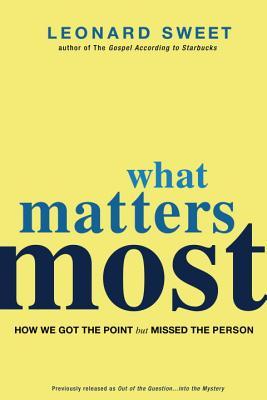
What Matters Most (book review)

The Old Testament prophet thundered out, “Thus saith the Lord!” and called the people back into a right relationship with God. The prophet’s words were not always well-received or well-liked, but they were always proved correct by God Himself. In many ways I felt like I was hearing a prophet’s voice in Leonard Sweet’s thundering words in What Matters Most, words calling us back into a right relationship with God.

The subtitle of the book is dead-on: How we got the point but missed the Person. Wow, how true that is! Christians and the Church today have so focused on getting the point of Christianity right, that we’ve missed the central point of CHRISTianity: Jesus Christ!

Leonard Sweet reminds us that we weren’t created to follow the rules of religion in isolated, solitary lives, but we were created to be in an intimate relationship with the Creator and with His creation. Sweet writes:

“What makes us human is the same thing that makes us created in the image of God. We are not isolated entities, self-contained, existing apart from God or from one another or even from God’s creation. We are made for “community” and “communion” and “ecology” …. We are judged by the world not on the basis of how “right” we’ve gotten what we believe but on how well we’re living it—on how we love God and people.”

So in What Matters Most Leonard Sweet focuses on those living relationships that should be the hallmark of Christians. Things like our relationship with…

  • our faith
  • our Creator
  • other people of faith
  • other people outside the faith
  • creation
  • arts
  • the unseen spiritual world

As I wrote earlier, often the prophet’s message was not received well initially. This is how you may feel when you first read What Matters Most. But if you will prayerfully read through this book, I think you will find (as I did) how these words resonate with the “Thus saith the Lord” tenor of Scripture and cause you to reevaluate your relationship with God and others.

I am a Waterbrook book reviewer. Check out some of the quotes I shared from this book by clicking here.

What Is Successful Church Ministry?

I like to keep asking myself and my leadership team this question: How do we know if our church is successful? 

The apostle Paul uses two words to help answer these questions: Quality and Faithfulness.

But each one’s work will be shown for what it is; the Day will disclose it, because it will be revealed by fire—the fire will test the quality of each one’s work. (1 Corinthians 3:13)

Now it is required that those who have been given a trust must prove faithful. (1 Corinthians 4:2)

So here are two important questions we need to ask ourselves:

  • Am I doing quality work?
  • Am I faithfully doing my work?

To help answer those questions, I like this thought from Leonard Sweet’s book I Am A Follower:

“The most important metrics we must rely on, the crucial ‘deliverables’ we can present, must focus on the newly formed lives of the disciples we are making, the followers who are following Christ into a place of serving Him by serving others. The most important measure of our faithfulness to Christ must be the extent of transformation into the living image of Christ Himself. …

The quantifiable fruit of our church is not found in the number of people we can gather on a weekly basis. What counts is what is happening in the lives of those who have gathered. …It is quite possible to have a ‘successful’ life—and a ‘successful’ church—without God. But it is absolutely impossible to have a truly fruitful one.”

Again, Paul’s advice here is invaluable:

My conscience is clear, but that does not make me innocent. It is the Lord who judges me. Therefore judge nothing before the appointed time; wait till the Lord comes…. (1 Corinthians 4:4, 5)

Pastor, you need to think about these questions about “success.” But they should be questions framed around your quality and faithfulness of work as revealed to you by the Holy Spirit, not by some “expert” or anyone else.

(By the way, if you’re interested in exploring this further, I framed this question a different way in this post.)

UPDATE: This post was one of the seed thoughts that went into fashioning my book Shepherd Leadership: The Metrics That Really Matter.

15 Quotes From “I Am A Follower”

I Am A Follower by Leonard Sweet turned my leadership thoughts upside down (or is that right-side up?). I would strongly encourage you to read this book, especially if you are in church “leadership.”

It wasn’t easy to do, but here are 15 great quotes from I Am A Follower —

“The Greek noun perichoresis was the early church’s favorite word to describe the interrelationship of the holy Trinity. When the prefix peri (around) is linked with the root of the verb choreuein (to dance), a compelling metaphor is formed or  ‘choreographed’ to describe the ‘one nature in three Persons’ of God the Father, Son, and Holy Spirit. Literally they ‘dance around.’ The choreia or dance of God is the choreography of the cosmos, the interrelationship of Creator, creation, and life itself, the holy creativity of the All in All.”

“Following is the most underrated form of leadership in existence.”

“The cry for leadership is deafening amid our social disintegration, our moral disorientation. We have come to believe that we have a leadership crisis while all along we have been in a drought of discipleship. The Jesus paradox is that only Christians lead by following.”

“The church has become what [Dwight] Eisenhower predicted: a place where everyone is trying to get everyone else to do what they want done but don’t want to do themselves.”

“Leadership is a function. Followership is an identity. … Leadership is a functional position of power and authority. Followership is a relational posture of love and trust. … Being a follower is less about showing how much you know than showing humble gratitude for how much there is to be known.”

“Have we made Christianity more a moment of decision than a momentum for life? Both are important, but have we spent more time on how you become a Christian than on what it means to live as a Christian? Both are important, but have we made holiness more about a destination than a direction?” 

“But to think we can capture and tame Truth is a delusional trap. In fact, the desire for command and control above our desire to please God dams up the rivers of Living Water.”

“Christ does not ask of His followers great success or great fame or great distinction. Christ expects of His followers what He expected of Himself: simply ‘to do the will of Him Who sent Me.’”

“Never in the history of humanity has knowledge been more accessible and of such quality. But when our thirst for information, expertise, and control begins to outrun our thirst for Christ, we can easily trade the waters of the Spirit for a soda-pop substitute. When we place our faith in fillers instead of allowing the Spirit to fill us, we end up selling out not only Christ but ourselves.”

“Leadership culture is strength based. Followership culture is weakness based. …We bless others naturally through our strengths. But we bless others supernaturally through our weaknesses.”

“The disciples were instructed to feed the sheep, not lead them. Christ will lead them. Jesus is the Shepherd. We are the sheep. All of us.”

“Near the end of John’s gospel we find Jesus’ poignant words: ‘As You have sent Me into the world, so I have sent them into the world.’ Did you catch that sneaky as? Jesus’ commissioning of His disciples was simply an echo of His own commissioning.”

“The relationship between leader and follower is this: leaders are over, followers are among. We are all Jesus followers.”

“The leadership paradigm creates folk heroes. Followership creates heroes who are folk.”

“Jesus told His disciples that the sheep always know the Master’s voice. To follow Jesus is not to demand road signs but to respond to the Voice of the Spirit along the way.”

I Am A Follower (book review)

About a decade ago I was moved into a position of leadership that seemed way too big for me. So to prepare myself, I began to read all of the leadership materials I could find: Bible-based leadership, marketplace leadership, anything I could find that would help me grow as a leader. I thought I was progressing as a leader, until I read I Am A Follower by Leonard Sweet.

Just a few pages into I Am A Follower I read this: “Following is the most underrated form of leadership in existence.” And thus I was confronted by a message that seemed 180-degrees out-of-phase with what I’ve been learning for the past decade.

In pointing time and time and time again to the life of Jesus, Len Sweet makes the case that Jesus is the only Leader, and the rest of us are followers. Jesus showed us perfect leadership by being a perfect Follower. In fact, He is the perfect Follower, as no one has ever followed God as He did. Some of us may follow Christ a little sooner, or a little closer, or a little more persuasively. Those, Dr. Sweet would say, are better called “first followers.”

Dr. Sweet uses phrases like the dance of life, and the transformation of viewpoint. These are not phrases that a leader uses, but they are the paradigm of followers. Check out this quote:

“The cry for leadership is deafening amid our social disintegration, our moral disorientation. We have come to believe that we have a leadership crisis while all along we have been in a drought of discipleship. The Jesus paradox is that only Christians lead by following.” (Leonard Sweet)

This book is a prophetic word: it is calling us back to true biblical-centeredness, true Christ-likeness, true discipleship. This is a book that took me a while to read, and will take me even longer to process. It’s a paradigm-busting game-changer…

…and it’s right on target.

Go get this book today!

I am a Thomas Nelson book reviewer.