What’s Your Excuse?

It’s so easy to make excuses, isn’t it?

  • I wasn’t feeling well
  • I don’t have enough training
  • The sun was in my eye
  • The other guy was supposed to….
  • I don’t have the right tools
  • If only….
  • I can’t because….

John Maxwell has started a new teaching series where he presents a one-minute lesson on one word every day. Today’s lesson was on excuses. Watch the clip here.

Here are some other quotes on excuses:

“Ninety-nine percent of failures come from people who have the habit of making excuses.” —George Washington Carver

“There’s a difference between interest and commitment. When you are interested in doing something, you do it only when it is convenient. When you are committed to something, you accept no excuses only results.” —Kenneth Blanchard

“Obstacles are not excuses for failure, they are opportunities for growth.” —Craig T. Owens

“People who are good at making excuses are seldom good at anything else.” —Benjamin Franklin

Let’s stop making excuses and start taking responsibility! 

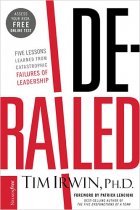
Derailed (book review)

Derailed

As I read Dr. Tim Irwin’s latest book, Derailed, I thought about a quote from John Maxwell: “A wise man learns from his mistakes. A wiser man learns from others’ mistakes. The wisest man learns from others’ successes.”

The subtitle of this book is “Five lessons learned from catastrophic failures of leadership.” In this, we learn from others’ mistakes. But then Dr. Irwin goes on to show us successes that we can learn from as well. Combining the insight from successful—or should I say “non-derailed” leaders—with his own discernment, Dr. Irwin shows us how to stay on the rails.

When I first noticed that the examples in the book were all high-profile CEOs, I thought, “What could I learn from them? After all, I’m not the CEO of a Fortune 500 company.” But Dr. Irwin does an excellent job of bringing the four qualities of character—authenticity, self-management, humility, and courage—down to a pedestrian level where even we non-CEO-types can benefit from his wisdom.

Although the principles in Derailed can benefit anyone in leadership, or aspiring to a leadership position, this book still might not be for everyone. The six case studies in the book are all derailed CEOs, and unless you have a penchant for the business world, you might not find them very enjoyable reading. However, for those of you who enjoy business history, there is much to gain from a careful reading of Derailed.

I am a Thomas Nelson book reviewer.

Big, Big World

Bigger Than Me“The smallest package in the world is a person who is all wrapped up in himself.” —Billy Graham

We have a tendency to get so wrapped up in ourselves. If we are feeling down, no one is happy. If we don’t like our job, everyone has a lousy job. If we have a toothache, the whole world is hurting. But as John Maxwell says, “The whole world—with one minor exception—is made up of other people.”

On Wednesday in our Impact youth service, we’re beginning a new series called Bigger Than Me. It’s a reminder, a wake-up call, an eye-opener to remind our students that the world is big. Bigger than them. And in need of someone who is not all wrapped up in himself.

Burn, Baby, Burn

It’s been a debate around golfing circles for years as to which PGA pro gets credit for responding to a fan who quipped, “That was a lucky shot!” The famous reply (variously attributed to either Gary Player, Arnold Palmer or Lee Trevino) is, “You know, the more I practice, the luckier I seem to get.”

Regardless of who said it, there’s so much truth in that statement. Here’s what I’ve learned about success:

NO ONE is an over-night success. “The heights of great men reached and kept // Were not attained by sudden flight // But they, while their companions slept // Were toiling upwards in the night.” —Henry Wadsworth Longfellow

NO ONE is a half-hearted success. “Success is the maximum utilization of the ability that you have.” —Zig Ziglar

NO ONE is successful on their own. “Leaders will not experience long-term success unless a lot of people want them to.” —John Maxwell

SUCCESS requires a high price. “Achievers choose what losers won’t and pay the price that others don’t.” —Anonymous

SUCCESS takes dedicated time. Malcolm Gladwell in his book Outliers quotes the 10,000 Hour Rule. He writes, “The biggest misconception about success is that we do it solely on our smarts, ambition, hustle and hard work.” Instead, he says that highly successful people have put in a minimum of 10,000 hours in a single area (think the Beatles with their music or Bill Gates with his computer programming).

SUCCESS starts with personal initiative. “Success isn’t a result of spontaneous combustion. You must set yourself on fire.” —Arnold H. Glasow

John Wesley explained how he drew such large crowds in the First Great Awakening by stating, I set myself on fire, and the people come to see me burn.” If you want to be successful, you must set yourself on fire, pay the price, and do the time.

Are you ready? If so, then burn, baby, burn!

Put Your Dream To The Test (book review)

Dream Test I’m a HUGE John Maxwell fan. He has been a mentor-from-afar for me for a number of years. So I know whenever I pick up a Maxwell book I’m going to be challenged and stretched in my thinking. Put Your Dream To The Test lived up to my expectations.

What’s your dream? Everyone has a dream, so what’s yours? I have always loved this quote from T.E. Lawrence:

“All men dream, but not equally. Those who dream by night in the dusty recesses of their minds, wake in the day to find that it was vanity: but the dreamers of the day are dangerous men, for they may act on their dreams with open eyes, to make them possible.”

If you are a “dreamer of the day” you will find great value in reading this. In this book, Dr. Maxwell guides you through ten questions to help you refine the pursuit of your dream—

  • Is my dream really my dream?
  • Do I clearly see my dream?
  • Am I depending on factors within my control to achieve my dream?
  • Does my dream compel me to follow it?
  • Do I have a strategy to reach my dream?
  • Have I included the people I need to realize my dream?
  • Am I willing to pay the price for my dream?
  • Am I moving closer to my dream?
  • Does working toward my dream bring satisfaction?
  • Does my dream benefit others?

In typical Maxwell fashion, I was challenged to think differently, I was encouraged to renew what I have already learned, and I realized some things I needed to give up. One of the aspects of Maxwell’s books that I especially appreciate is how energized I feel after reading them. I feel like the counsel he gives me has prepared me to live my life more fully.

If you have a dream that is bigger than you, good! If you have a dream that size, I would strongly recommend that you read this excellent book to help you see your dream and seize your dream.

Thinking About What You’re Thinking About

When was the last time you thought something new for the first time? Atheist Bertrand Russell said something painful, but true, “Most men would rather die than think. Many do.”

I’ve written before about the most important and most lengthy conversation all of us have every day. It’s the conversation we have with ourselves—it’s called thinking. But for many people, their thinking is stuck in a rut.

I’ve often had conversations with people bucking against a new thought where I have asked them why they believe what they believe. Far too many times they tell me, “That’s just the way I was raised.” Okay, but what do you think about it? “I don’t know. That’s just the way I was raised.”

Two books that have really helped my thinking are As A Man Thinketh (James Allen) and Thinking For A Change (John Maxwell). Allen uses the analogy of our minds as gardens where we need to constantly pull out the weeds and plant the thoughts that will bear the fruit we desire. Maxwell challenges us to look differently at the way we think our thoughts.

The Apostle Paul tells us to take captive every thought and make it obedient to Christ (2 Corinthians 10:5). And then we can begin to change the way we think: Fix your thoughts on what is true, and honorable, and right, and pure, and lovely, and admirable. Think about things that are excellent and worthy of praise (Philippians 4:8).

“Rarely do we find men who willingly engage in hard solid thinking. There is an almost universal quest for easy answers and half-baked solutions. Nothing pains some people more than having to think.” —Martin Luther King, Jr.

If your thinking is ever going to go to a higher level it has to start with this: You have to be willing to think about what you’re thinking about.

In other words, why are you thinking what you’re thinking? Start capturing the thoughts running through your mind and ask them, “Why are you here?” Are you thinking what you’re thinking because you thought it, or because someone else thought it for you?

It is only by capturing the thoughts that are already in your head that you can sort out the healthy thoughts from the unhealthy thoughts.

Managing “To Do” Lists

I’ll bet many of you have your “To Do” lists ready to go this week. I’ve got my list ready. But even as I was working on my list last night I knew that I probably wouldn’t be able to get everything done that I’m hoping to get done. Do you ever feel like that?

So how do you respond? Just doggedly press through no matter what? Let off the gas a little because you know it’s not all going to get done anyhow? Or just scrap the list and fly by the seat of your pants?

Here are 4 things I’ve learned (and I’m still learning) that might help you:

  • Begin the day with prayer. The Bible says that the steps of the righteous are directed by God. He knows what’s in store for you today and He can help guide you in your list-making time.
  • Know the difference between important and urgent. The urgent things always scream at you, while the important things usually stand by silently. Focus on what’s important. And here’s one key guideline: People are important.
  • Don’t try to get it all done today. I love John Maxwell’s reminder, “We overestimate what we can do in a day; we underestimate what we can do in a year.” If I only get time to read one chapter a day in a book, that’s still 365 chapters at the end of the year, and that’s quite a few books! It’s good to take a long-range view.
  • Look for the small time-wasters. If you just track one week’s time usage in 15-minute increments, you’ll be amazed to find out where a few minutes here and a few minutes there add up to a whole lot of time at the end of each week.

I’m still learning this stuff. If you have some tips or strategies that work for you, I’d love to hear them. Please share in the comment section.

Sharper Thinking

Yesterday I was challenged to do a lot of thinking. To think about things I’ve not considered before, and to think about things I have considered before but from a different perspective.

Yesterday a fellow pastor convened a Pastor’s Leadership Thinking Lab. The purpose was to use Warren Bullock’s book When The Spirit Speaks as a springboard to talk about the vocal gifts of the Holy Spirit in operation in our church services (see 1 Corinthians 12-14). At the outset, we all reaffirmed our unwavering commitment to our fellowship’s fundamental truths—those were non-negotiable. The challenge was to think about and discuss the practicalities of the how’s in our church services.

It was a bit intimidating being in the room with such smart people. These are guys with way more education and experience than me—guys who have had the privilege of studying and discussing this topic with some of the greatest Pentecostal thinkers of our generation. I felt a little out of place. In fact, during the lunch break, one of my friends commented, “Have you ever felt like that in a roomful of tuxedos you’re the one brown shoe?” My feelings exactly.

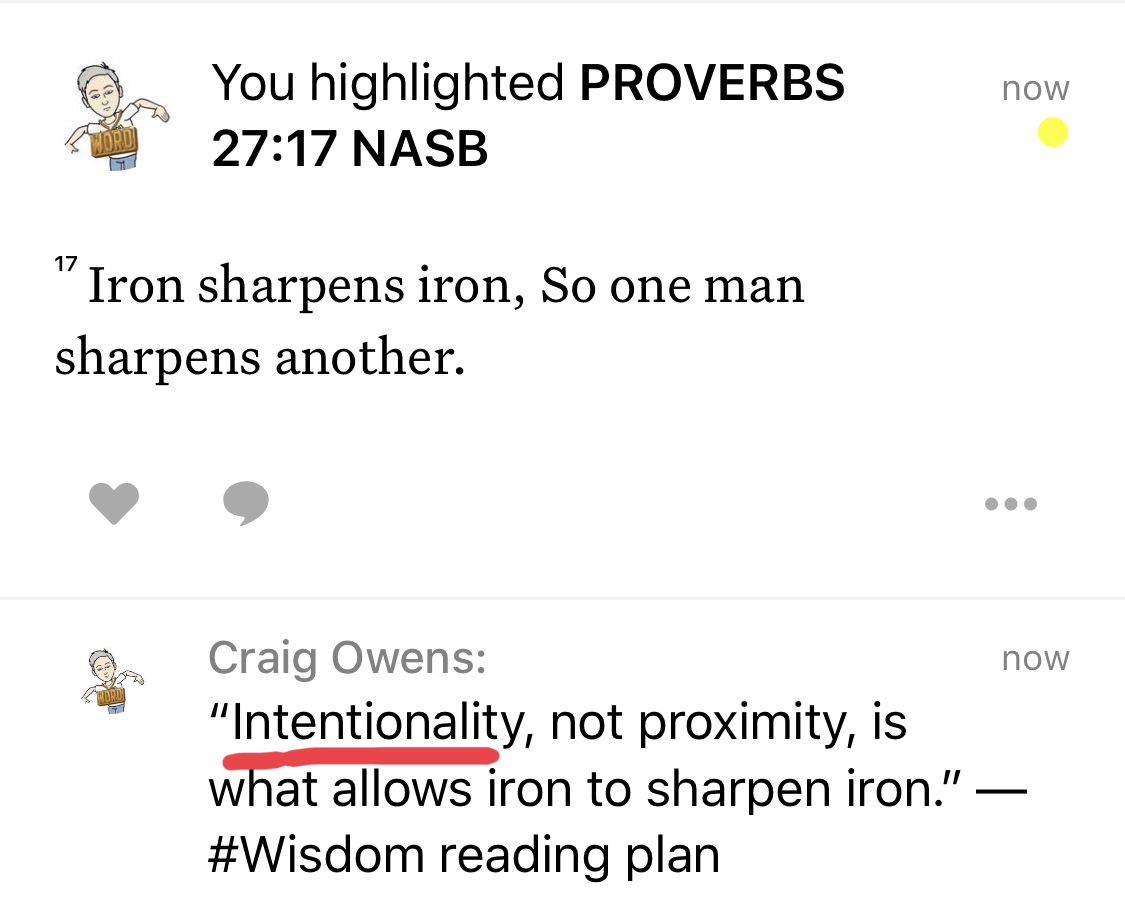
But King Solomon wrote, “As iron sharpens iron, so one man sharpens another” (Proverbs 27:17). The iron of my colleagues definitely sharpened me yesterday.

I also like what John Maxwell said, “Some of my best thinking has been done by others.” In other words, these really smart guys have thought about some things in ways I haven’t; they’ve been exposed to some great thinkers that I haven’t; they’ve experienced some things that I haven’t. But spending the day with them was like getting that education they received, having those conversations with great thinkers they had, and experiencing those things they experienced.

Did I agree with everything that was shared? No.

Was I challenged to think differently? Yes.

F. Scott Fitzgerald wrote, “The truest test of a first-rate mind is the ability to hold two contradictory ideas at the same time, and still retain the ability to function.”

If you really want to sharpen your thinking, get around some people smarter than you. Spend time with people who see things differently than you. But most of all, make sure these folks are one in purpose with you. All of the guys in this Lab shared the same passion to see God glorified and people drawn into a deeper relationship with Jesus. That’s what made yesterday so rewarding for me.

Do you have some “iron” friends in your life that are sharpening your thinking?


Moderate Back Thrusts

How would you like to have this written on your tombstone—

Appointed by God to be king
Caused all Israel to sin against God
Doomed my family line to extinction

That is exactly the epitaph of King Jeroboam (see 1 Kings 13-14). In God’s indictment of Jeroboam He says, “Because of the sins you have committed, and the sins you have caused Israel to commit, you have provoked Me to anger and thrust Me behind your back.”

I find that phrase—thrust Me behind your back—intriguing. The word thrust means to throw something away. How exactly does one go about throwing God away? Can you crumple Him up like a piece of paper and toss Him in a garbage can? Can you grab Him and shove Him behind you? Is He like a stack of old newspapers thrown in a recycling bin? Clearly not!

One only thrusts God behind one’s back little by little. Just moderate back thrusts.

John Maxwell was exactly right when he said that whatever good things a leader does in excess, those following will do in moderation. Whatever poor things the leader does in moderation, those following will do in excess. The “moderate” ways in which Jeroboam thrust God behind his back caused all of Israel to sin excessively. And that became Jeroboam’s eternal legacy!

People are watching me—my kids, my neighbors, my friends, the baristas at Starbucks—what example am I setting for them? There are only two examples I can set: (1) Pursue God with all my heart, all my soul, all my mind, and all my strength; in other words, love God to excess. Or (2) Moderately thrust God behind my back little by little by little.

Search me, O God, see if there is ANY moderate back thrusting in me and lead me in the way everlasting (see Psalm 139:23-24).