The Craig And Greg Show: What’s New, Leadercat?

On this episode of “The Craig And Greg Show” we talk about: 

  • the challenge for leaders when things are changing
  • too many leaders get comfortable with the status quo 
  • leaders need to adopt a growth mindset
  • what if we changed “what’s the worst that could happen?” to “what’s the best that could happen?”
  • I reference John Maxwell’s helpful book Sometimes You Win—Sometimes You Learn  
  • Greg cautions that either we address change or we avoid change, but if we avoid changing, our group may move on without us
  • just because we are changing doesn’t mean we are growing
  • Greg offers counsel on what leaders need to evaluate when considering changes
  • “unhealthy leaders change things to gain more control; healthy leaders change things to help the whole team get better,” Greg says
  • we don’t grow in areas of comfort: we learn most of our lessons moving forward, but we learn very few lessons sitting still
  • good leaders reassure other leaders to make thoughtful changes
  • the right way for leaders to partner with their team to effect positive changes

Check out this episode and subscribe on YouTube so you can watch all of the upcoming episodes. You can also listen to our podcast on Spotify and Apple.

Leaking Influence

Leaking influenceJim Collins has great advice for leaders: When things are going well, look out the window (at your people); when things aren’t going well, look in the mirror (at yourself). This is as true for business CEOs as it is for pastors.

Pastor, you leak.

I leak.

We all leak.

It’s impossible to just maintain where we are. There needs to be a constant refreshing, a constant refilling. We need to keep learning, keep changing, keep renewing. If we don’t, well, this is how Oswald Chambers described it—

“If you are in a position of authority and people are not obeying you, the greatest heart-searching you can have is the realization that the blame does not lie with them, but with you; there is always leakage going on spiritually. Get right with God yourself, and every other one will get in touch with God through you.” (my emphasis)

Pastor, don’t wait: Look in the mirror today, get right with God, replenish what’s leaked out of you, and then watch to see how others in your congregation will begin to move toward God themselves.

How The Mighty Fall (book review)

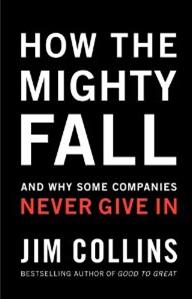
This is the third in the series of books from Dr. Jim Collins: Built To Last, Good To Great, and now How The Mighty Fall. This is a book that Dr. Collins wished he didn’t have to write, as he uncovers the markers that contributed to the failure of once-great companies.

If you are a frequent reader of my blog, you’re probably wondering why I’m reading/reviewing a business book. The answer is simple: the principles Jim Collins uncovers in his books are rock-solid principles of success and failure, regardless of the organization in which they are practiced or ignored. In all three of his books, I have mined so many great truths to apply to my personal life, as well as the organizations I lead.

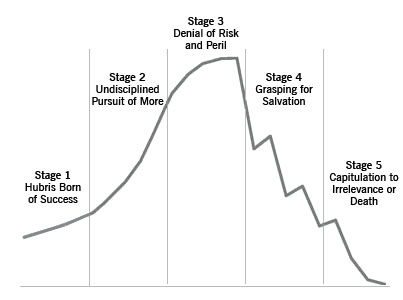
In How The Mighty Fall we learn about the five stages of decline for once-great organizations. Working backward from his evidence, Dr. Collins then gives us “markers” to look for in our own organizations that would tip us off to the stages of decline.

Why study this? Because I want to lead a great church! This quote from the book especially resonates with me:

“The point of struggle is not just to survive, but to build an enterprise that makes such a distinctive impact on the world it touches, and does so with such superior performance, that it would leave a gaping hole — a hole that could not be easily filled by any other institution—if it ceased to exist.” (emphasis added)

If you are involved in the leadership of any organization (whether for-profit or non-profit), I would encourage you to devour all three of Jim Collins’ books.

Andy Stanley & Jim Collins

Lamenting Over The Fallen

How The Mighty Have Fallen! Long before Jim Collins entitled his latest book with this phrase, David said this when King Saul and Prince Jonathan were killed in battle. In fact, he said it not once, but three times in just eight verses.

It is understandable that David would lament the death of his friend Jonathan. They were covenant brothers, they shared the same heartbeat for God and for Israel, and they stood by each other through thick and thin.

But Saul? Why would David lament the death of Saul? This is the man who was jealous of David. So jealous that he did everything he could to trip David up. Including trying to kill him. Saul chased David from his home, from his family, from his wife, even from his country.

Why would David lament Saul’s death? Wouldn’t it be more appropriate to rejoice over it?

But David still saw Saul as “the Lord’s anointed.” David recognized the good in Saul. He called him…

  • the glory of Israel
  • a successful warrior
  • gracious
  • lovable
  • strong
  • Israel’s provider

When David heard Saul had been killed, he lamented, Oh, how the mighty have fallen!

When I see the mighty, God-anointed leader fall, do I lament?

I may shake my head, I may feel vindicated, I may be disgusted, but I don’t know that I have ever lamented or grieved when one of these mighty brothers has fallen. Or if I have, my lament has been short-circuited by other less appropriate emotions.

Despite their sin, they are still God’s anointed.

Who am I to sit in judgment? Who am I to do anything but lament their fall?

Lord, forgive me! Father, help me to see Your anointed ones in the proper perspective: as Your anointed. Holy Spirit, remind me of the tragedy of even one mighty one who falls. May my response be one of lament, and mercy, and prayer.

Both-And Compassion In Action

At 10:30 this morning I picked up my cell phone to call Barney. I knew his daughter, Alysia, had gone in for a routine tonsillectomy early this morning and I wanted to check on her. Just as I was scrolling down to his number, my phone began to ring: it was Barney calling me.

“Hey, Barney, I was just getting ready to call you….”

“Pastor,” he interrupted, “we’re in trouble. Before they could do Alysia’s surgery, she stopped breathing and her heart stopped beating. It seems okay now, but my daughter almost died. They’re taking her to ICU right now. I don’t know what to do.”

I hurried over to Hurley Hospital and went right into the ICU. Alysia was doing better, but her blood pressure was still very low, and her heartbeat was racing. After spending some time talking with the nurses and praying with Alysia, I slipped out so her Mom, Maria, could stay with her, and I went back out to the waiting room to see Barney.

“Barney, I think she’s stablized now. It’s going to be okay. Is there anything else I can do for you?”

“Yes, Pastor, would you pray with these kids.” He motioned to four crying teenagers sitting together in the opposite corner of the waiting room. “Their friend, Christopher, just passed away. I’ve been talking to them, but I would really like you to pray with them.”

Pray with them?!? His daughter is laying in an ICU room, and he’s concerned about some teenagers — whom he has never met before — in the midst of their grief. Wow! I immediately thought of the Apostle Paul’s words, “Each of you should look not only to your own interests, but also to the interests of others” (Philippians 2:4). Jim Collins writes about The Genius Of And, and Barney beautifully exhibited that. He was both concerned about Alysia and Christopher’s friends too. In my trials, how often do I become completely self-focused? Thanks, Barney, for a great example of Both-And compassion in action.