The Christian Book Of Mystical Verse (book review)

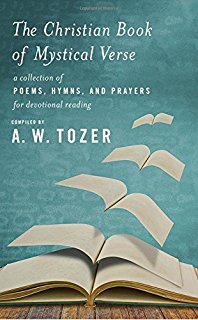
Sometimes you can judge a book by its cover. In this case, the writings A.W. Tozer collected between the covers of this book is exactly what the title says—The Christian Book Of Mystical Verse: A collection of poems, hymns, and prayers.

A.W. Tozer was a first-class scholar, but he didn’t stop with mere head knowledge. He loved plunging deep into the spiritual realms to let God touch his heart, mind and emotions. So we find among his extensive library, collections of poems and mystical writings to enliven the heart and mind.

Don’t get thrown by that word “mystical.” Tozer himself describes it this way—

The word ‘mystic’ as it occurs in the title of this book refers to that personal spiritual experience common to the saints of Bible times and well known to multitudes of persons in the post-biblical era. I refer to the evangelical mystic who has been brought by the gospel into intimate fellowship with the Godhead. His theology is no less and no more than is taught in the Christian Scriptures. … He differs from the ordinary orthodox Christian only because he experiences his faith down in the depths of his sentient being while the other does not. He exists in a world of spiritual reality. 

I have a natural bent to be more left-brained, logical, and fact-seeking. Years ago I discovered that poetry and other “mystical” writings unlocked my right-brain hemisphere with all its emotion and passion, and made the left-brained stuff so much more real. The collection of writings in this book “scratches an itch” unlike any academic book ever can.

Should you read The Christian Book Of Mystical Verse? I think so. Tozer said, “This is a book for the worshiper rather than for the student.” So if you are longing to worship God more deeply, this is a great book to dive into deeply.

I am a Moody Publisher book reviewer.

The Gift Of Fanny Crosby


Image processed by CodeCarvings Piczard ### FREE Community Edition ### on 2016-02-09 20:53:56Z | http://piczard.com | http://codecarvings.com“The hymns To God Be the Glory, Blessed Assurance, All the Way My Savior Leads Me, and He Hideth My Soul remind us that it’s never too late to begin serving Christ. Some people start as children, others as teens or young adults. But Moses was 80 when God commissioned him, and Paul was middle-aged. So was Fanny Crosby, author of the above hymns.

“Fanny was born in a cottage in South East, New York, in 1820. Six weeks later, she caught a cold in her eyes, and a visiting doctor prescribed mustard poultices, leaving her virtually blind for life. Growing into childhood, she determined to make the best of it, writing at age eight:

O what a happy soul I am!
Although I cannot see, 
I am resolved that in this world contented I will be.

“Fanny spent many years in New York’s Institution for the Blind, first as a student, then as a teacher and writer-in-residence. Her career flourished; her fame swelled. She recited her poems before Congress and became friends with the most powerful people in America, including presidents. But not until 1851 did Fanny meet her greatest friend, the Lord Jesus. While attending a revival meeting at John Street Methodist Church in New York, she later recalled, a prayer was offered, and ‘they began to sing the grand old consecration hymn, “Alas! And Did My Savior Bleed?” and when they reached the line, “Here, Lord, I give myself away,” my very soul was flooded with celestial light.’

“Fourteen years later she met the hymnist William Bradbury, who told her, ‘Fanny, I thank God we have met, for I think you can write hymns.’ Bradbury suggested an idea for a song he needed, and on February 5, 1864, Fanny Crosby, seizing his idea, wrote:

We are going, we are going
To a home beyond the skies
Where the fields are robed in beauty
And the sunlight never dies.

“It was her first hymn, and she was 44. But by the time she reached her ‘home beyond the skies’ 50 years later, she had written 8,000 more.” —From On This Day

Poetry Saturday—The Very Thought Of Thee

Bernard of ClairvauxJesus, the very thought of Thee
With sweetness fills the breast;
But sweeter far Thy face to see
And in Thy presence rest.

No voice can sing, no heart can frame,
Nor can the memory find
A sweeter sound than Thy blest Name,
O Savior of mankind!

O hope of every contrite heart,
O joy of all the meek,
To those who fall, how kind Thou art!
How good to those who seek!

But what to those who find? Ah, this
No tongue or pen can show;
The love of Jesus, what it is
None but His loved ones know.

Jesus, our only joy be Thou,
As Thou our prize wilt be;
Jesus, be Thou our glory now
And thru eternity. —Bernard of Clairvaux

Thursdays With Oswald—Contemptible Unbelief

This is a weekly series with things I’m reading and pondering from Oswald Chambers. You can read the original seed thought here, or type “Thursdays With Oswald” in the search box to read more entries.

Oswald Chambers

Contemptible Unbelief 

     “All power is given unto Me in heaven and in earth” (Matthew 28:18). All power is given—unto whom? To the Being who lived a humble, obscure life in Nazareth; the One who says, “Come unto Me, all ye that labor and are heavy laden, and I will give you rest.” If all power is given to Jesus Christ, what right have I to insult Him by worrying? If we will let these words of Jesus come into our heart, we shall soon see how contemptible our unbelief is. 

     … Will I say skeptically, “What does Jesus Christ know about my circumstances? Is His power and understanding sufficient to manage things for me?” To talk like that is the way to realize the size of our unbelief, and to see why Jesus Christ was so stern in condemning it.

From Bringing Sons Unto Glory 

I love the phrase from the old hymn—

Oh, what peace we often forfeit
Oh, what needless pain we bear
All because we do not carry
Everything to God in prayer! 

When I think how All-powerful and All-loving He is, I begin to see how utterly contemptible is my unbelief and my unwillingness to take everything to Him. If all power is given to Jesus Christ, what right have I to insult Him by worrying?

Such Wondrous Love

CrossAs I am preparing both a Good Friday message and an Easter message, I am immersed in the details of Christ’s passion for us. There are so many thoughts swirling through my head about the amazing, unequaled, undeserved, overflowing love that Jesus has for us.

See from His head, His hands, His feet / Sorrow and love flow mingled down! / Did e’er such love and sorrow meet, / Or thorns compose so rich a crown? (Isaac Watts, When I Survey The Wondrous Cross)

You see, at just the right time, when we were still powerless, Christ died for the ungodly. Very rarely will anyone die for a righteous person, though for a good person someone might possibly dare to die. But God demonstrates His own love for us in this: While we were still sinners, Christ died for us. (Romans 5:6-8)

That Christ should join so freely in the scheme / Although it meant His death on Calvary / Did ever human tongue find nobler theme / Than love divine that ransomed me?

Such love, such wondrous love / Such love, such wondrous love / That God should love a sinner such as I / How wonderful is love like this!

That for a willful outcast such as I / The Father planned, the Savior bled and died / Redemption for a worthless slave to buy / Who long had law and grace defied (C.Bishop, Such Love)

Because of the joy awaiting Him, Jesus endured the Cross, disregarding its shame. Now He is seated in the place of honor beside God’s throne. (Hebrews 12:2)

I hope this week you will reflect on God’s amazing grace, Christ’s great love, and the Holy Spirit’s persistent drawing of your heart. Jesus died for us so that we could be brought into a loving relationship with our Heavenly Father!

If you are in the Cedar Springs area, please join me in celebrating with our churches our combined Good Friday service, or our Easter morning breakfast drama called Conspiracy!