A Leadership Measurement Trap

Listen to the podcast of this post by clicking on the player below, and you can also subscribe on AppleSpotify, or Audible. 

Leaders have to be very careful of the trap of measuring the growth of their teammates by the wrong metrics. The things that matter most are often the things that are the most difficult to measure, but leaders must find a way.

Check out the full conversation we had on this topic on this episode of The Craig and Greg Show. 

In my book Shepherd Leadership, I have a chapter entitled ‘Don’t Try to Grow Your Own Ministry.’ This book is mainly written for church and non-profit leaders, but there are helpful principles here for every kind of leader. Here’s an except from this chapter—

     Businesses think in terms of quantitative gains—things they can count—but churches and nonprofits should be thinking in terms of qualitative gains—a quality improvement that isn’t as easily counted. I think we all know this, and yet we still persist in wanting to define success in a church or a nonprofit by those quantitative standards such as attendance growth, donations, and the like. When we think qualitative over quantitative, suddenly what seemed “small” is so significant and so valuable that it cannot be calculated! … 

     Don’t try to grow your ministry. First, because it’s not yours, it’s [God’s]; and second, because your measure of success is probably more slanted toward quantitative measurements than qualitative. Jesus wasn’t concerned about bigger numbers: “What do you think?” He asked, “If a man has a hundred sheep, and one of them goes astray, does he not leave the ninety-nine and go to the mountains to seek the one that is straying?” (Matthew 18:12). 

     Philip went to Samaria to tell people about Jesus. He didn’t go there because it fit his plan, but because Jesus said, “You will be My witnesses in Jerusalem, and in all Judea and Samaria, and to the ends of the earth” (Acts 1:8). Philip’s obedience brought God’s success: hundreds turned to Jesus as their Savior, demon-possessed people were delivered, the sick were healed, and the new Christians were baptized in the Holy Spirit. Yet God called Philip to leave these “ninety-nine” and go to the desert to cross paths with just one confused and wondering sheep (Acts 8). After that, Philip virtually disappears from Luke’s historical record. 

     What’s the value of one government official’s life? God says that his value is incalculable. Apparently, God knew that Philip was the perfect shepherd to lead this Ethiopian to the pasture where he would accept Jesus as his Savior. Philip was obedient, a sheep was saved, and God was pleased. But I wonder how many people today might think Philip’s ministry was unsuccessful because he left a bigger ministry in Samaria to go to a smaller ministry in the desert? 

Leaders need to be very cautious about using the right metrics to measure the growth of their teammates and the success of their organization.

►► Would you please prayerfully consider supporting this ministry? My Patreon supporters get behind-the-scenes access to exclusive materials. ◀︎◀︎
The Craig And Greg Show: Blind Spots

Listen to the podcast of this post by clicking on the player below, and you can also subscribe on AppleSpotify, or Audible.

In our last episode, Greg and I discussed how vital it is to focus on your own internal development. If you’ve been doing that, chances are you have identified a few blind spots in yourself. While it might feel more comfortable to simply hide these away and hope nobody notices, we would like to encourage you to be vulnerable: Drag your blind spots into the light, address them, and watch how your leadership improves as a result.

  • [1:30] Leaders have to get comfortable with being vulnerable if they are going to make any meaningful changes in their life.
  • [2:17] Blind spots have to be brought out into the light.
  • [5:44] Paying attention to the feedback from others requires us to slow down to process what we need to change.
  • [7:35] Leaders need to understand the speed of their team in the area of productivity.
  • [8:34] Greg shares a “blind spot” example from one of his kids.
  • [9:53] Why do leaders avoid their blind spots?
  • [11:45] Peripheral vision isn’t good just for athletes, but for leaders too.
  • [13:11] I share how asking good questions has helped my teammates with their blind spots.
  • [14:50] If leaders assume things about their teammates or work with their favorite teammates, they will never improve the morale of the team.
  • [18:17] Greg talks about the movie “Blindside” as a learning point about having the right people watching out for us.
  • [20:10] We need to be thinking about the kind of people we need around us.
  • [25:42] The one word most people are afraid to say.
  • [26:59] Sometimes a fresh set of eyes is necessary to see a blind spot. Maximize coaching would love to be a resource for you in this area.

Check out this episode and subscribe on YouTube so you can watch all of the upcoming episodes. You can also listen to our podcast on Spotify and Apple.

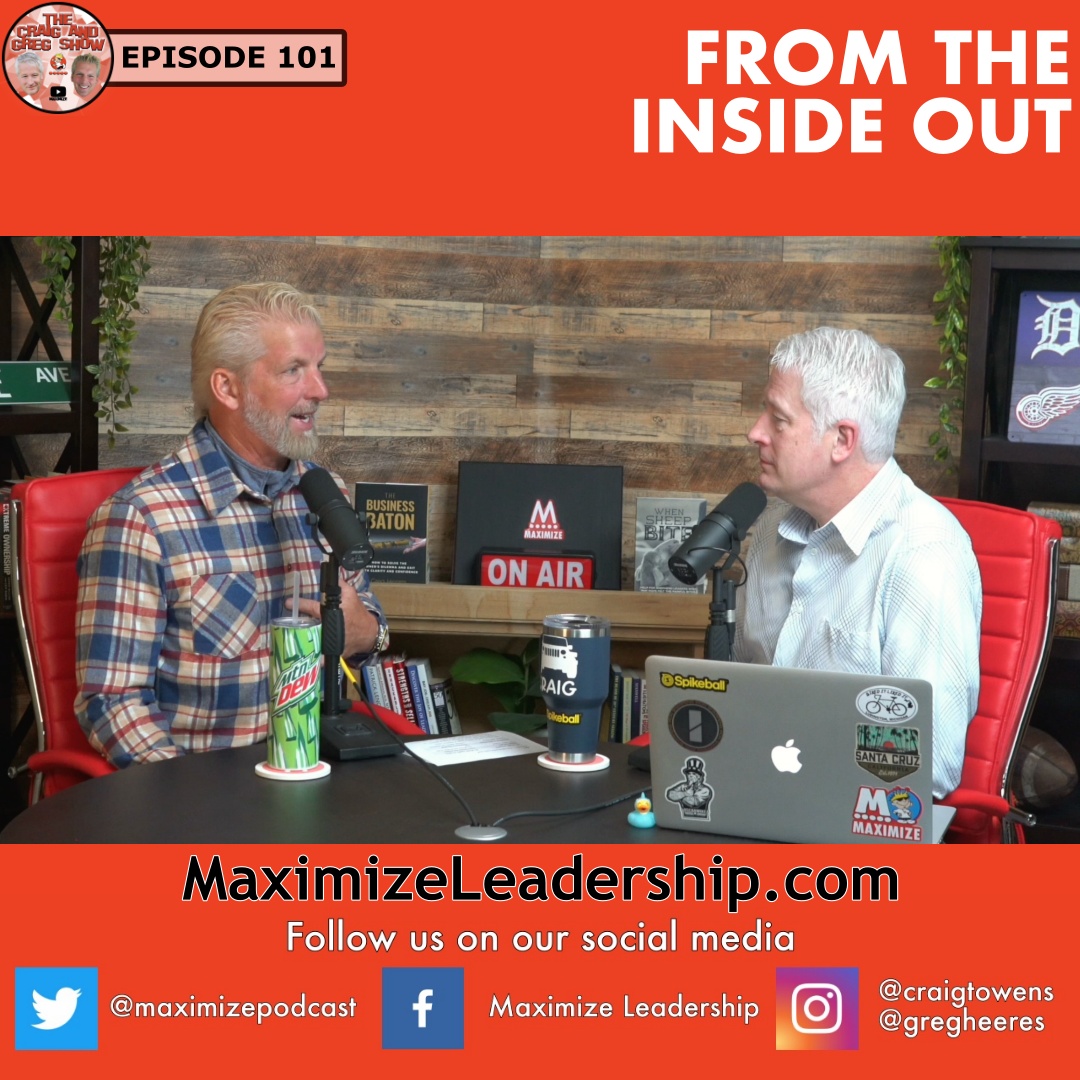
The Craig And Greg Show: From The Inside Out

Listen to the podcast of this post by clicking on the player below, and you can also subscribe on AppleSpotify, or Audible. 

Watermelon is a great summer treat. However, sometimes a nice green exterior can hide rotten fruit on the inside. When this happens we don’t say, “Well, at least the outside was nice,” but we throw the whole thing out! We can fall into a similar trap in our leadership, focusing on creating a great exterior while we let our vital interior development rot away. In this episode, Greg and I encourage you to focus first on your internal development, and through that your external image will improve as well.

  • [0:59] A lot of leaders are more interested in what’s on the outside than what’s on the inside.
  • [1:39] Why do leaders naturally gravitate to making the outside look better than the inside?
  • [4:10] Greg wonders if perhaps we enhance our exterior because we’re afraid to be vulnerable.
  • [5:25] If you have to tell people you’re a leader you’re probably not
  • [6:40] Greg and I discuss a list of things we usually recognize, alongside the things we should equally recognize
    • [6:48] 1. Talents and gifts alongside integrity and character.
    • [12:19] 2. Superb product alongside quality process.
    • [15:30] 3. Excellence performance alongside excellent discipline.
  • [19:35] If we ignore the inside stuff what’s the inevitable result?
  • [20:51] Greg likes to ask the question, “What’s new?” as a simple way to assess growth in others.
  • [21:50] I share a discovery from my Bible reading in Romans.
  • [23:03] Greg tells a cautionary tale about a former coworker who didn’t know how to engage in deeper conversation with his team.
  • [24:24] “The best mirror is in a good friend’s eye.” Greg and I would love to be this good friend for you. Reach out to us at here if you’re interested in personalized coaching.

Check out this episode and subscribe on YouTube so you can watch all of the upcoming episodes. You can also listen to our podcast on Spotify and Apple.

The Craig And Greg Show: Jargon

Listen to the podcast of this post by clicking on the player below, and you can also subscribe on AppleSpotify, or Audible.

If the expected target metrics of today’s program are met, we expect significant workflow performance advancements from team lead positioned individuals.

Does that seem a little complicated? Jargon in the workplace can very quickly cause significant problems, leading to confusion and disengagement in your team. The solution is simple—clear, concise communication. So let’s try this again without the jargon: Greg and I hope that this episode inspires you to remove the jargon from your communication, and as a result you will see your leadership influence grows.

  • [0:41] Today we are returning to Leadership Builders and Killers with a topic inspired by a series of videos I saw online about business jargon.
  • [3:21] Greg asks, “Why all the jargon?”
  • [5:34] Jargon can take away from what you want to communicate, and can cause others to disengage from the conversation.
  • [8:26] Jargon is antithetical to a commitment to clarity.
  • [9:33] I share a story of a conversation with students that highlights wisdom we can take into the workplace.
  • [12:06] One of the lowest form of communication is assumption.
  • [14:03] It’s important to circle back with people after a meeting to maker sure they understood.
  • [15:13] Jargon frequently shows up when there’s bad news to share, and when leaders are trying to cast vision.
  • [16:50] Sometimes we use jargon to hide.
  • [19:30] I share a story from the life of John Wesley about how he became a better communicator.
  • [21:14] It’s important to communicate with everyone on an even playing field, and not use jargon to avoid being pinned down.
  • [22:39] Using jargon can negatively impact your influence as a leader. Conversely, clear communication will lift your influence.
  • [24:58] Jargon can creep into your communication without you being aware of it. A coach from outside your industry can help you notice these blind spots.

Check out this episode and subscribe on YouTube so you can watch all of the upcoming episodes. You can also listen to our podcast on Spotify and Apple.

What’s Inside?

Listen to the podcast of this post by clicking on the player below, and you can also subscribe on AppleSpotify, or Audible. 

Far too many leaders spend more time making sure things look good on the outside than they do addressing whether things are good on the inside. Of course, I’m talking about issues like character, and humility, and servant-mindedness. 

Greg and I addresses this on a recent episode of our leadership podcast The Craig and Greg Show. 

Check out the full conversation Greg and I had on this episode called Healthy Leaders. 

And I dive a lot deeper into the issue of true leadership coming from the inside out in my book Shepherd Leadership. 

►► Would you please prayerfully consider supporting this ministry? My Patreon supporters get behind-the-scenes access to exclusive materials. ◀︎◀︎
The Craig And Greg Show: “The Business Baton”

Listen to the podcast of this post by clicking on the player below, and you can also subscribe on AppleSpotify, or Audible.

Every business owner needs to be prepared for an eventual transition. Whether it be retirement, moving on to a new opportunity, or an M&A offer, nobody can run their business forever. In today’s episode Greg and I sit down to discuss Greg’s new book The Business Baton.

  • [0:35] “Keep your eye on the ball” is important for more than just sports, and far too often business owners forget this advice during the transition process.
  • [2:48] In chapter seven of The Business Baton, Greg discusses how to manage the pace of a transition.
  • [4:04] A Navigator can help you keep your focus on running your company during a transition.
  • [5:34] Greg talks about a few common reasons business owners take their eye off the ball.
  • [12:50] What does an owner disengaging do to the morale of the company?
  • [16:53] I share an interesting statistic from The Business Baton.
  • [19:26] An owners ongoing productivity is essential for maintaining the value of the organization.
  • [23:49] The Business Baton contains real case studies from organizations that Greg has worked with in the past, so you will likely see examples that line up with your industry.
  • [25:04] Greg and I share a section from The Business Baton about productivity.

Check out this episode and subscribe on YouTube so you can watch all of the upcoming episodes. You can also listen to our podcast on Spotify and Apple.

The Craig And Greg Show: Healthy Leaders

Listen to the podcast of this post by clicking on the player below, and you can also subscribe on AppleSpotify, or Audible.

In today’s episode, Greg and I discuss what it means to be a healthy leader. We break down the various facets of leadership health, and highlight why each piece is part of an essential structure that supports all of the other parts. This was a very important part in my book Shepherd Leadership.

  • [0:12] Greg and I are looking dapper today!
  • [1:26] We have both gone through the process of writing books.
  • [2:30] I reveal the section of my book Shepherd Leadership that has gotten the most attention.
  • [6:01] I highlight the development of Jesus as recorded in the Gospel of Luke.
  • [8:40] All aspects of health are important because they support each other.
  • [10:06] What happens when we get bumped?
  • [12:25] How do we maintain healthy relationships?
  • [15:11] Investing time into yourself gives you a greater capacity to serve others.
  • [16:50] What signs should we watch for that tell us a relationship is strained?
  • [17:52] Leaders should empower others to solve problems instead of always solving them on their own.
  • [18:54] It’s easier to avoid relational health in the short-term, but it will hurt you down the road.
  • [21:28] What’s the best way to improve a relationship?
  • [22:55] If we have a desire to improve a relationship, how can we get the other person to reciprocate?
  • [25:40] What was my “aha” moment when writing Shepherd Leadership?
  • [27:11] Maximize Leadership is a great coaching resource for you.

Check out this episode and subscribe on YouTube so you can watch all of the upcoming episodes. You can also listen to our podcast on Spotify and Apple.

The Craig And Greg Show: The Silent Killers

Listen to the podcast of this post by clicking on the player below, and you can also subscribe on AppleSpotify, or Audible.

To you the term “silent killer” might conjure visions of a lone assassin from a spy movie, or perhaps more mundane but equally deadly things like high blood pressure or carbon monoxide leaks. In today’s episode Greg and I are discussing toxic behaviors that creep into the workplace. They aren’t quite as deadly as the ones listed above, but can still cause massive anger, frustration, and discord in your organization. Join us as we discuss some of the most prevalent toxins we’ve seen, and highlight how you as the leader are responsible for being the safeguard against them.

  • [0:20] Toxic things can sneak into our workplace unless we proactively look for them.
  • [1:35] Leaders need to be honest with their team so their team feels they can be honest with them in return.
  • [3:43] Greg and I discuss some of the toxic behaviors we have seen that create problems in the workplace.
  • [3:54] -Gossip
  • [4:51] -Office Politics
  • [6:42] -Negative Competition
  • [8:37] -Negativity
  • [10:20] -Bureaucracy
  • [12:46] -Braggadocio
  • [14:12] -Bashing
  • [14:46] Toxicity will come to every organization. We as leaders shine in the way we deal with it.
  • [17:47] When I wrote Shepherd Leadership, I spent two chapters discussing the balance between confidence and humility because of how important it is.
  • [19:08] One of our main jobs as leaders is to develop others, but toxicity squashes that.
  • [20:26] A coach can come alongside you to be the “detector” for the silent killers that might be lurking in your organization.

Check out this episode and subscribe on YouTube so you can watch all of the upcoming episodes. You can also listen to our podcast on Spotify and Apple.

The Craig And Greg Show: There Are No Shortcuts

Listen to the audio-only version of this podcast by clicking on the player below, or scroll down to watch the video.

When you’re trying to accomplish a task it’s natural to want to search for the quickest way to get it done. But what if that’s not the best way? In this episode Greg and I discuss why rejecting shortcuts and persevering through struggles will make you a better leader, and also allow you to help your team get better as well. Join us for some powerful motivation to kick off the new year!

  • [0:23] The shortest distance between two points is ____?
  • [1:04] Why do we want things done so quickly?
  • [2:36] When difficulty makes us slow down, our natural inclination is to bail.
  • [3:40] Sometimes slowing down enriches our lives.
  • [5:22] Leaders have to prepare their team for upcoming hardships, and be willing to fight through them with the team.
  • [7:12] Greg discusses how going the extra mile separates you from the crowd.
  • [8:29] Failure informs your success.
  • [9:27] Greg and I discuss our personal experiences with “shortcut culture” in today’s society.
  • [13:11] We discuss why we love grit and stick-to-it-ivness.
  • [16:02] Greg shares a story from his time coaching football that illustrates how a leader can push the team farther.
  • [18:43] We share action points for leaders to implement this new year.
  • [22:35] A leadership coach will help you improve and be better equipped to lead your team.

Check out this episode and subscribe on YouTube so you can watch all of the upcoming episodes. You can also listen to our podcast on Spotify and Apple.

The Craig And Greg Show: Help Your Teammates Thrive During The Holidays

Listen to the audio-only version of this podcast by clicking on the player below, or scroll down to watch the video.

It’s no secret that the holiday season becomes extremely busy for us at work and in our personal lives. If we are too busy, we can miss out on the joy of this season. On this episode, Greg and I discuss ways that leaders can help their teammates not just survive but thrive during the holidays.

  • [0:36] Leaders help their teammates find and set healthy boundaries. 
  • [2:49] A good starting point is simply acknowledging the stress that we or others are feeling.
  • [4:01] Can we intentionally scale-back some things at work during busy seasons?
  • [5:06] Leaders also need to talk with their teammates about their personal responsibilities.
  • [8:43] Leaders need to make sure they are modeling all that they are telling our teams.
  • [11:02] Stephen Covey had some wise words for us about priorities.
  • [14:07] Be proactive about some of the strong emotions some of your teammates may be experiencing.
  • [18:01] Leadership has to be about the people!
  • [20:33] Here are your leadership takeaways.

Check out this episode and subscribe on YouTube so you can watch all of the upcoming episodes. You can also listen to our podcast on Spotify and Apple.