What’s Inside?

Listen to the podcast of this post by clicking on the player below, and you can also subscribe on AppleSpotify, or Audible. 

Far too many leaders spend more time making sure things look good on the outside than they do addressing whether things are good on the inside. Of course, I’m talking about issues like character, and humility, and servant-mindedness. 

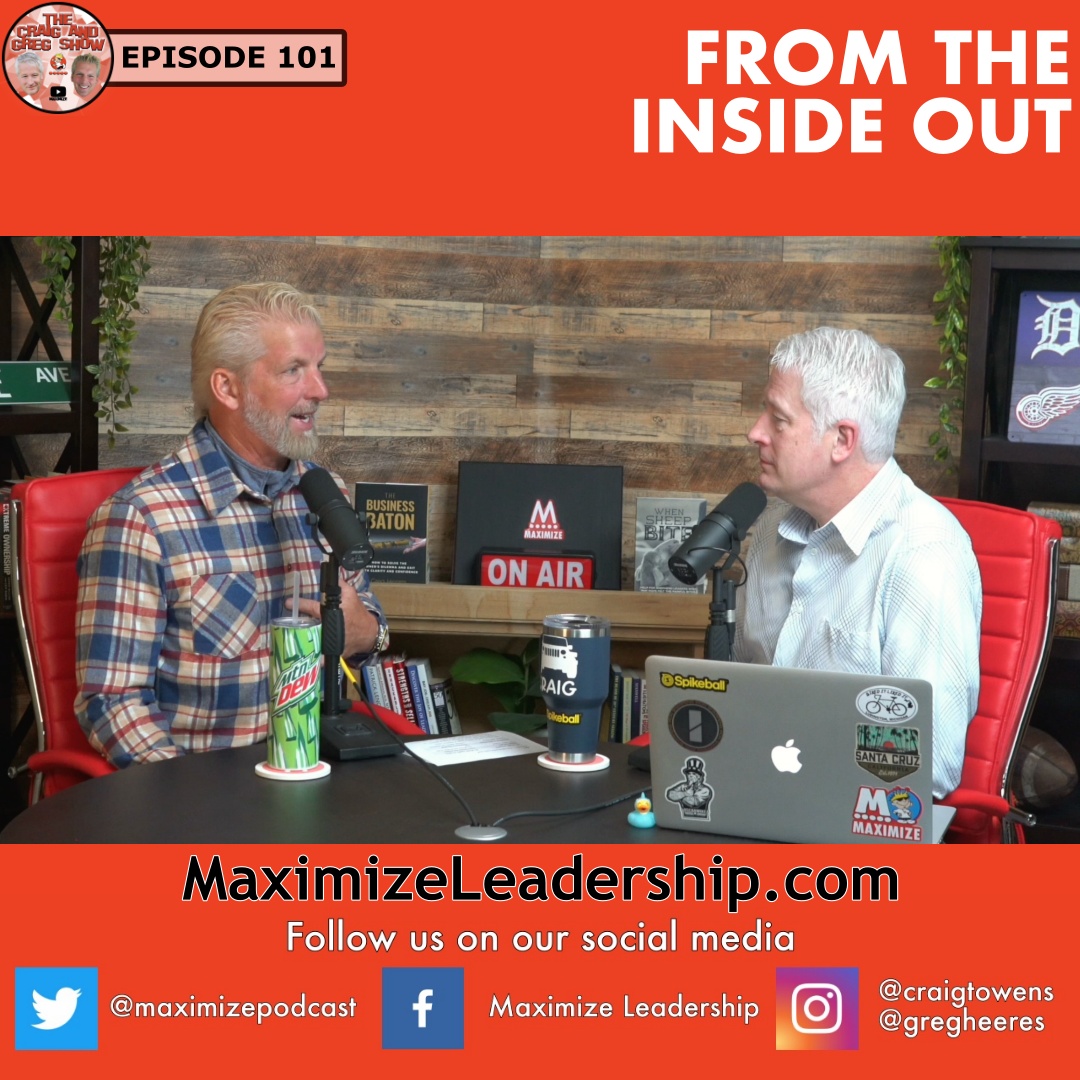
Greg and I addresses this on a recent episode of our leadership podcast The Craig and Greg Show. 

Check out the full conversation Greg and I had on this episode called Healthy Leaders. 

And I dive a lot deeper into the issue of true leadership coming from the inside out in my book Shepherd Leadership. 

►► Would you please prayerfully consider supporting this ministry? My Patreon supporters get behind-the-scenes access to exclusive materials. ◀︎◀︎

The Craig And Greg Show: “The Business Baton”

Listen to the podcast of this post by clicking on the player below, and you can also subscribe on AppleSpotify, or Audible.

Every business owner needs to be prepared for an eventual transition. Whether it be retirement, moving on to a new opportunity, or an M&A offer, nobody can run their business forever. In today’s episode Greg and I sit down to discuss Greg’s new book The Business Baton.

  • [0:35] “Keep your eye on the ball” is important for more than just sports, and far too often business owners forget this advice during the transition process.
  • [2:48] In chapter seven of The Business Baton, Greg discusses how to manage the pace of a transition.
  • [4:04] A Navigator can help you keep your focus on running your company during a transition.
  • [5:34] Greg talks about a few common reasons business owners take their eye off the ball.
  • [12:50] What does an owner disengaging do to the morale of the company?
  • [16:53] I share an interesting statistic from The Business Baton.
  • [19:26] An owners ongoing productivity is essential for maintaining the value of the organization.
  • [23:49] The Business Baton contains real case studies from organizations that Greg has worked with in the past, so you will likely see examples that line up with your industry.
  • [25:04] Greg and I share a section from The Business Baton about productivity.

Check out this episode and subscribe on YouTube so you can watch all of the upcoming episodes. You can also listen to our podcast on Spotify and Apple.
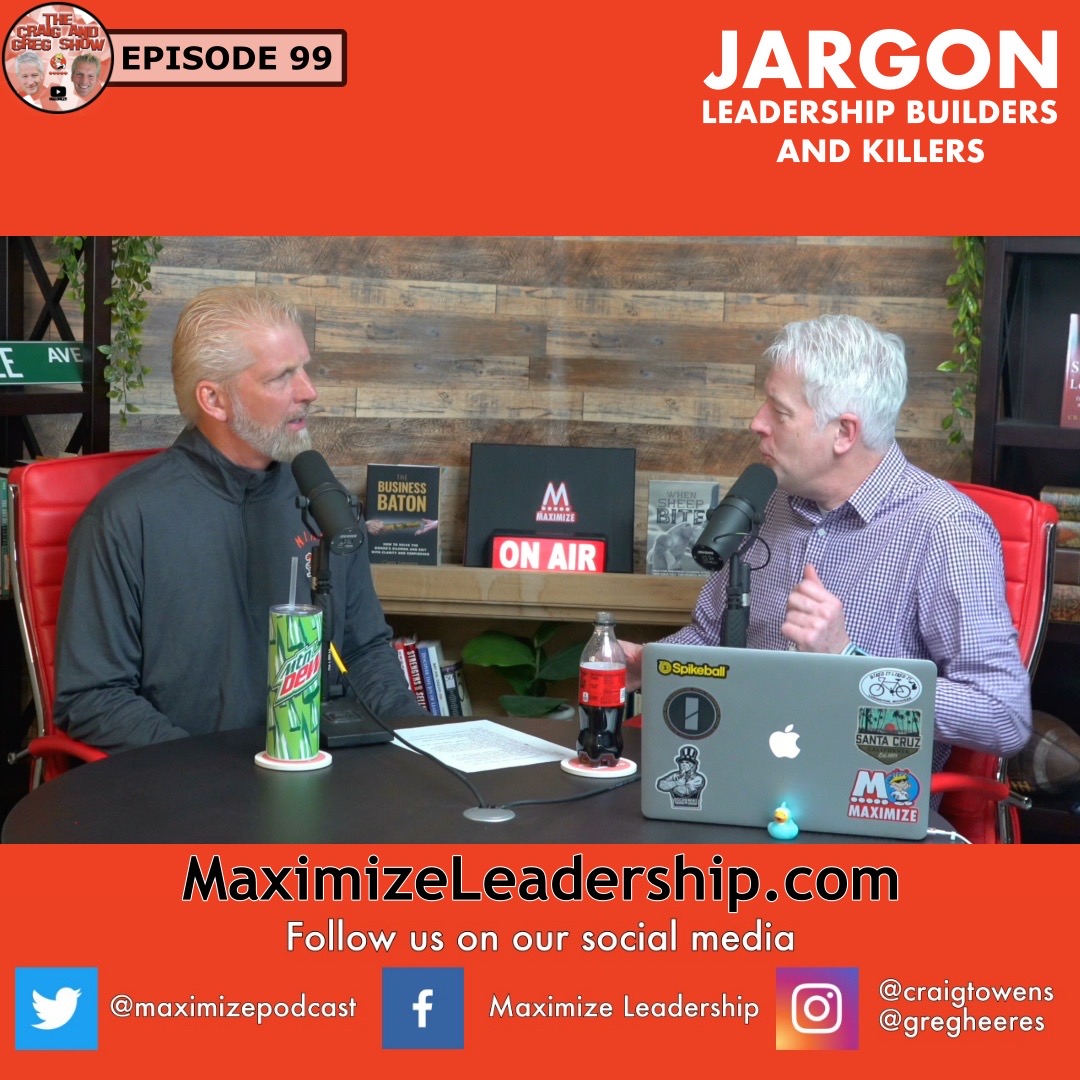
The Craig And Greg Show: Healthy Leaders

Listen to the podcast of this post by clicking on the player below, and you can also subscribe on AppleSpotify, or Audible.

In today’s episode, Greg and I discuss what it means to be a healthy leader. We break down the various facets of leadership health, and highlight why each piece is part of an essential structure that supports all of the other parts. This was a very important part in my book Shepherd Leadership.

  • [0:12] Greg and I are looking dapper today!
  • [1:26] We have both gone through the process of writing books.
  • [2:30] I reveal the section of my book Shepherd Leadership that has gotten the most attention.
  • [6:01] I highlight the development of Jesus as recorded in the Gospel of Luke.
  • [8:40] All aspects of health are important because they support each other.
  • [10:06] What happens when we get bumped?
  • [12:25] How do we maintain healthy relationships?
  • [15:11] Investing time into yourself gives you a greater capacity to serve others.
  • [16:50] What signs should we watch for that tell us a relationship is strained?
  • [17:52] Leaders should empower others to solve problems instead of always solving them on their own.
  • [18:54] It’s easier to avoid relational health in the short-term, but it will hurt you down the road.
  • [21:28] What’s the best way to improve a relationship?
  • [22:55] If we have a desire to improve a relationship, how can we get the other person to reciprocate?
  • [25:40] What was my “aha” moment when writing Shepherd Leadership?
  • [27:11] Maximize Leadership is a great coaching resource for you.

Check out this episode and subscribe on YouTube so you can watch all of the upcoming episodes. You can also listen to our podcast on Spotify and Apple.

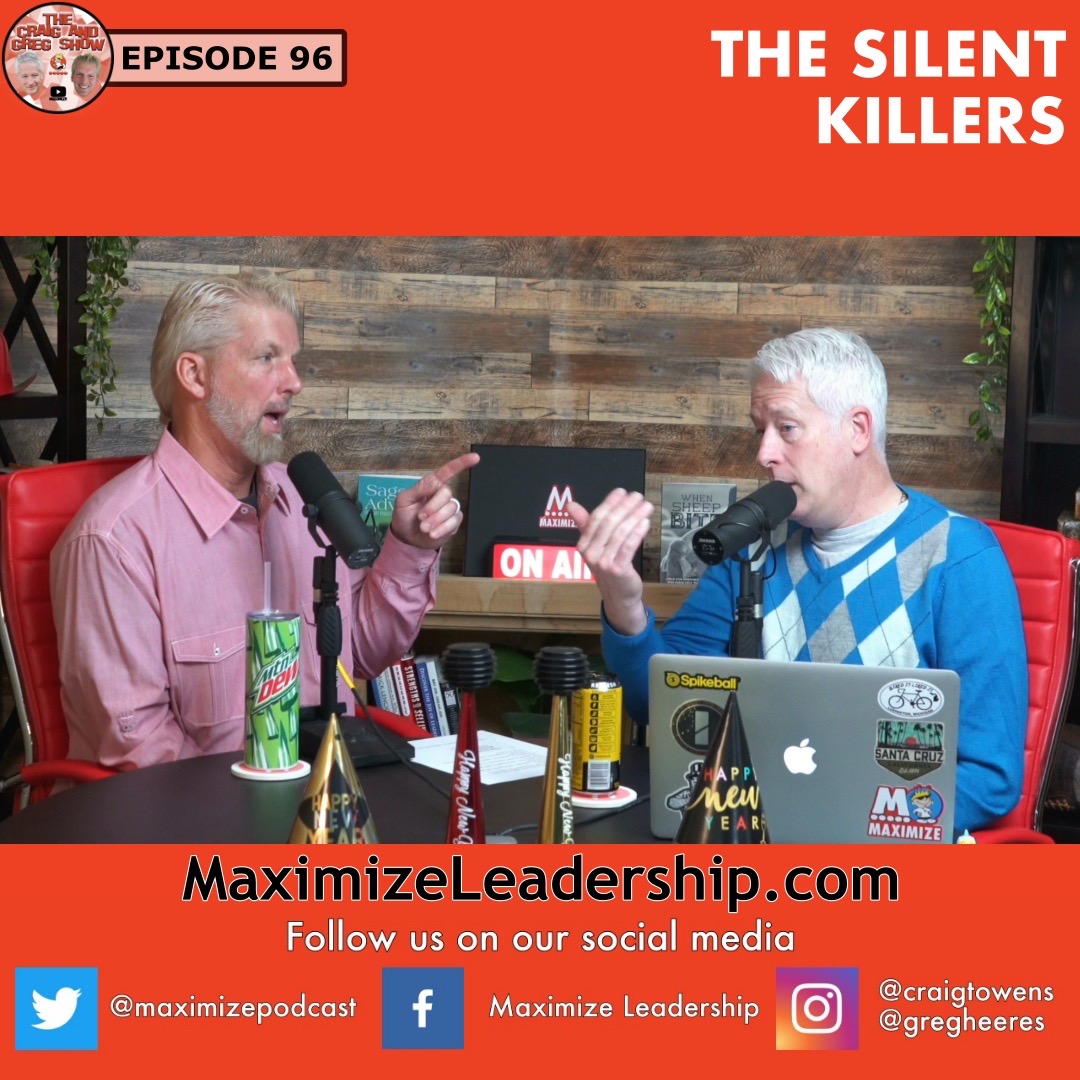
The Craig And Greg Show: The Silent Killers

Listen to the podcast of this post by clicking on the player below, and you can also subscribe on AppleSpotify, or Audible.

To you the term “silent killer” might conjure visions of a lone assassin from a spy movie, or perhaps more mundane but equally deadly things like high blood pressure or carbon monoxide leaks. In today’s episode Greg and I are discussing toxic behaviors that creep into the workplace. They aren’t quite as deadly as the ones listed above, but can still cause massive anger, frustration, and discord in your organization. Join us as we discuss some of the most prevalent toxins we’ve seen, and highlight how you as the leader are responsible for being the safeguard against them.

  • [0:20] Toxic things can sneak into our workplace unless we proactively look for them.
  • [1:35] Leaders need to be honest with their team so their team feels they can be honest with them in return.
  • [3:43] Greg and I discuss some of the toxic behaviors we have seen that create problems in the workplace.
  • [3:54] -Gossip
  • [4:51] -Office Politics
  • [6:42] -Negative Competition
  • [8:37] -Negativity
  • [10:20] -Bureaucracy
  • [12:46] -Braggadocio
  • [14:12] -Bashing
  • [14:46] Toxicity will come to every organization. We as leaders shine in the way we deal with it.
  • [17:47] When I wrote Shepherd Leadership, I spent two chapters discussing the balance between confidence and humility because of how important it is.
  • [19:08] One of our main jobs as leaders is to develop others, but toxicity squashes that.
  • [20:26] A coach can come alongside you to be the “detector” for the silent killers that might be lurking in your organization.

Check out this episode and subscribe on YouTube so you can watch all of the upcoming episodes. You can also listen to our podcast on Spotify and Apple.

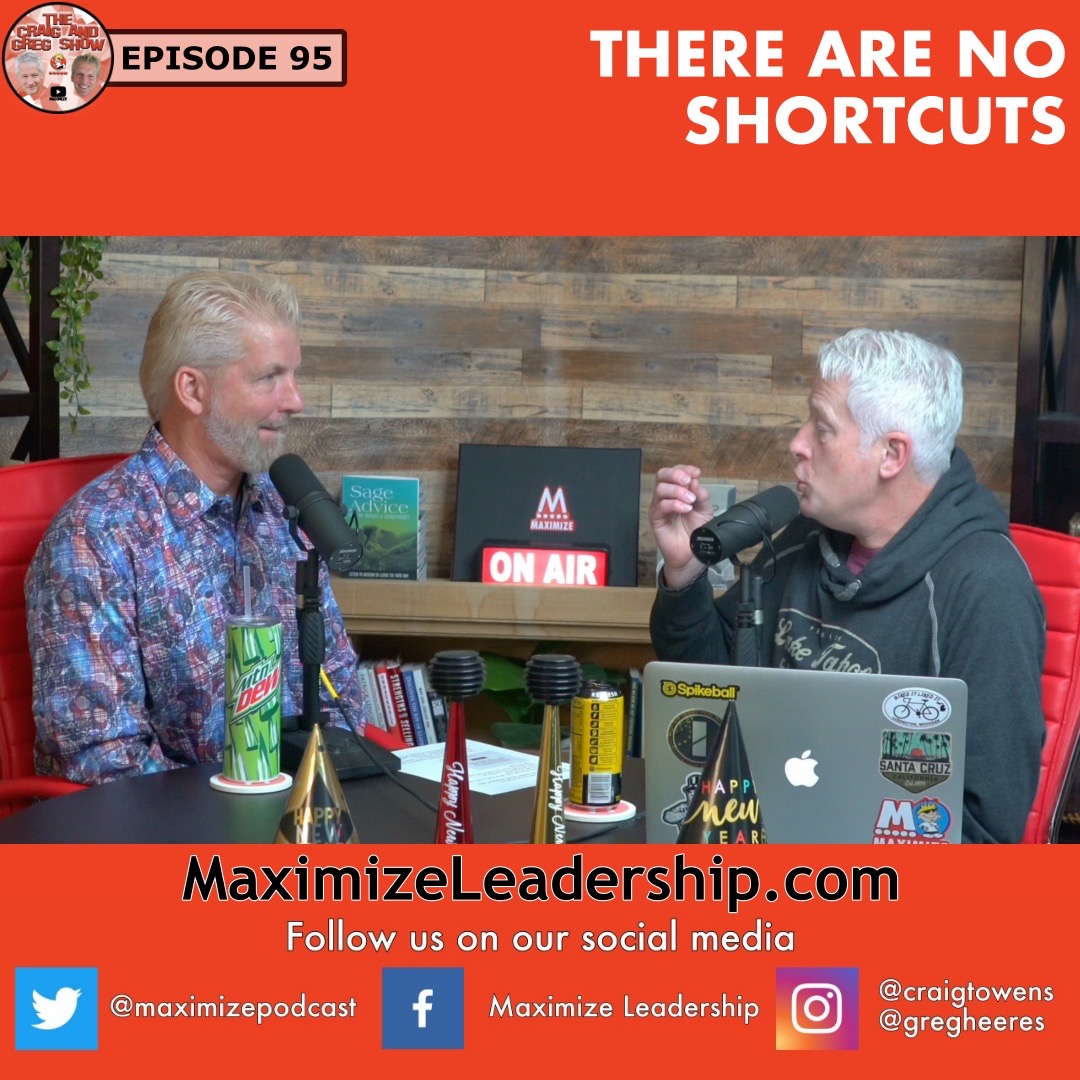
The Craig And Greg Show: There Are No Shortcuts

Listen to the audio-only version of this podcast by clicking on the player below, or scroll down to watch the video.

When you’re trying to accomplish a task it’s natural to want to search for the quickest way to get it done. But what if that’s not the best way? In this episode Greg and I discuss why rejecting shortcuts and persevering through struggles will make you a better leader, and also allow you to help your team get better as well. Join us for some powerful motivation to kick off the new year!

  • [0:23] The shortest distance between two points is ____?
  • [1:04] Why do we want things done so quickly?
  • [2:36] When difficulty makes us slow down, our natural inclination is to bail.
  • [3:40] Sometimes slowing down enriches our lives.
  • [5:22] Leaders have to prepare their team for upcoming hardships, and be willing to fight through them with the team.
  • [7:12] Greg discusses how going the extra mile separates you from the crowd.
  • [8:29] Failure informs your success.
  • [9:27] Greg and I discuss our personal experiences with “shortcut culture” in today’s society.
  • [13:11] We discuss why we love grit and stick-to-it-ivness.
  • [16:02] Greg shares a story from his time coaching football that illustrates how a leader can push the team farther.
  • [18:43] We share action points for leaders to implement this new year.
  • [22:35] A leadership coach will help you improve and be better equipped to lead your team.

Check out this episode and subscribe on YouTube so you can watch all of the upcoming episodes. You can also listen to our podcast on Spotify and Apple.
The Craig And Greg Show: Help Your Teammates Thrive During The Holidays

Listen to the audio-only version of this podcast by clicking on the player below, or scroll down to watch the video.

It’s no secret that the holiday season becomes extremely busy for us at work and in our personal lives. If we are too busy, we can miss out on the joy of this season. On this episode, Greg and I discuss ways that leaders can help their teammates not just survive but thrive during the holidays.

  • [0:36] Leaders help their teammates find and set healthy boundaries. 
  • [2:49] A good starting point is simply acknowledging the stress that we or others are feeling.
  • [4:01] Can we intentionally scale-back some things at work during busy seasons?
  • [5:06] Leaders also need to talk with their teammates about their personal responsibilities.
  • [8:43] Leaders need to make sure they are modeling all that they are telling our teams.
  • [11:02] Stephen Covey had some wise words for us about priorities.
  • [14:07] Be proactive about some of the strong emotions some of your teammates may be experiencing.
  • [18:01] Leadership has to be about the people!
  • [20:33] Here are your leadership takeaways.

Check out this episode and subscribe on YouTube so you can watch all of the upcoming episodes. You can also listen to our podcast on Spotify and Apple.
The Craig And Greg Show: We Are Grateful

Listen to the audio-only version of this podcast by clicking on the player below, or scroll down to watch the video.

We are grateful for you! Greg and I love talking about leadership, and it’s a great joy that you tune in to listen. In this episode we discuss why an attitude of gratefulness is so important for leaders year-round, not just around the holidays.

  • [0:17] We are so grateful for you! 
  • [1:25] What is it about gratitude that make someone a great leader?
  • [4:28] Grateful leaders have greater influence with people around them.
  • [8:14] It’s easier to build consensus on our teams when we have a thankful paradigm.
  • [10:52] Thankful correlates with graceful. This is such an attractive quality for leaders.
  • [14:10] Greg asks me elaborate on how gratitude ties into my book Shepherd Leadership.
  • [16:09] How does a grateful mindset help us get through the tough times?
  • [18:56] Happiness is not the same as joy. Joy is much deeper and serves us as leaders much better because happiness can be gone really quickly.
  • [23:16] We give you some “homework” that will help you grow your gratitude.

Check out this episode and subscribe on YouTube so you can watch all of the upcoming episodes. You can also listen to our podcast on Spotify and Apple.

The Craig And Greg Show: The Business Baton

Listen to the audio-only version of this podcast by clicking on the player below, or scroll down to watch the video.

One of my friend Greg’s passions is helping business owners with the final step of their journey—succession of the organization. It was this passion that drove him to write his new book The Business Baton. In today’s episode Greg and I discuss the new book, and Greg lays out his philosophy for a smooth succession process.

  • [0:15] Greg has written a new book called The Business Baton.
  • [0:53] Greg opened his book with a chapter that surprised me.
  • [1:51] What makes a person ill-prepared to hand off the baton in their organization?
  • [3:26] The questions Greg asks to make sure a business is really ready to hand off the baton.
  • [6:34] Greg’s book has a lot of statistics and case studies to help guide readers who are considering handing off the baton.
  • [8:18] In Greg’s new book he continued a trend he started in his previous book Sage Advice.
  • [10:07] Sometimes a succession navigator has to push for some emotional choices to help you get your business across the finish line.
  • [12:21] Greg discusses the readiness, formation, increase, selection, and succession steps needed to get to a place where a business is ready to sell.
  • [17:02] I really appreciated the voices of other business leaders that Greg included in the book.
  • [17:31] The end of The Business Baton reminds exiting leaders to lead well. 
  • [19:45] Greg gives his final thoughts on writing this book and the role of a succession navigator in the process.
  • [24:03] Visit Maximize Leadership to learn more about how Greg can help you as a succession navigator.

Check out this episode and subscribe on YouTube so you can watch all of the upcoming episodes. You can also listen to our podcast on Spotify and Apple.

The Craig And Greg Show: Is It Time To Move On?

Listen to the audio-only version of this podcast by clicking on the player below, or scroll down to watch the video.

As the saying goes, all good things must come to an end. You might be motivated by a feeling of limitation where you are, excited by a new opportunity, ready to retire and soak up some sun, or many other reasons. Whatever your reasons are, Greg and I would like to give you practical advice to apply when you’re considering moving on.

  • [0:15] Is it time? 
  • [1:42] Greg goes negative first! Don’t make a move because of “greener grass.”
  • [2:54] Some better questions to ask about moving on.
  • [5:30] I always asks, “Why did you start here?” before asking, “Should you leave here?”
  • [8:01] Greg and I wonder about the value of getting “outside advice” when considering a move.
  • [10:40] We need to weigh both emotion and logic when thinking about the timing of a move.
  • [13:26] We can have regrets about leaving and we can have regrets about staying too long. A navigator can help you think through your options.
  • [18:40] Sometimes an owner is not ready to sell but a leader inside is ready to buy. How do we walk through this?
  • [21:16] Here’s the key takeaway on the timing of moving on.

Check out this episode and subscribe on YouTube so you can watch all of the upcoming episodes. You can also listen to our podcast on Spotify and Apple.

Links & Quotes

Leaders need to give others confidence to try something new. We need to help people get moving so that we can coach what they are doing. For more great leadership insights, check out The Craig and Greg Show.

I have lots of new content every week, which you can check out on my YouTube channel.

A couple of thought-worthy quotes for pastors. First from David Mathis: “Pastors, observe that in and of itself, mocking is no clear reflection of the faithfulness or fruitfulness of preaching Christ. Wise preachers do not take mocking as an indicator of failure, nor as an indicator of success. Twice in Athens some mock Paul, which may seem like a failure compared to his homiletic triumphs elsewhere. However, others say, ‘We will hear you again.’ And then, in the end: ‘some men joined him and believed’ [Acts 17:32-34]. … How foolish it would be to distract ourselves with the mockers. Or to call special attention to the mocking as some great badge of our own faithfulness. Rather, we have the example of Paul at Mars Hill, who, so far as we can tell, wholly overlooks, with a holy disregard, these mockers and concerns himself instead with those asking honest questions.”

…and then one from John Piper: “Preaching is a happy business. Because even if the text is a hard word that devastates the hearers, the preacher connects the hard word with the gracious word and the hopeful word, and he catches them as they fall. So, in the end, all preaching is a happy business.

“A people that values its privileges above its principles soon loses both.” —Dwight D. Eisenhower

“For condemnation to work, we must say to God what the devil has said to us and believe it. If I want to stand before God with excuses that make what He said to me void, I’ll have to quote the devil to God. Does that sound like a good thing to do? God’s will for me is not to condemn me, but to liberate me from everything that holds me back from being what He created me to be through an ongoing relationship. To accomplish that, I need to do the opposite of what I used to do when I walked in condemnation. Instead of quoting to God what the devil is saying, I quote to the devil what God has said.” —Jim Wiegand, in Recruiting To Releasing 

Thinking about “how Martin Luther, a professor at Wittenberg University, helped to spark the 16th century Protestant Reformation,” J. Calvin Holsinger conceived the idea of preparing missionaries to US colleges and universities—a ministry called Chi Alpha.

Another great story from the “Here We Stand” series of biographies of notable people during the Reformation. “An attendant asked [King Henry VIII] whom he wished to have at his bedside. The king asked for Thomas [Cranmer]. By the time Cranmer arrived, King Henry was unable to speak. Foxe tells the story. ‘Then the archbishop, exhorting him to put his trust in Christ, and to call upon His mercy, desired him though he could not speak, yet to give some token with his eyes or with his hand, that he trusted in the Lord. Then the king, holding him with his hand, did wring his hand in his as hard as he could (Foxe’s Book of Martyrs, 748).’ The scene sweetly punctuates the most important friendship in the English Reformation. Whatever King Henry believed when he squeezed Cranmer’s hand that day, God used the bond between them to break England free from Roman Catholicism and to recover the one true gospel.”

The ICR reports, “Genesis claims that people in the pre-Flood world routinely attained 900-year lifespans. The best-known example is Methuselah, who had the longest recorded lifespan of 969 years (Genesis 5:27). Skeptics dismiss these great ages as fanciful legends, but recent fossil data are providing unexpected, albeit indirect, corroboration of the Bible’s testimony.” Check out this full report.

“In my experience, each failure contains the seeds of your next success—if you are willing to learn from it.” —Paul Allen, cofounder of Microsoft