Faith-Filled Vocabulary

Listen to the podcast of this post by clicking on the player below, and you can also subscribe on AppleSpotify, or Audible.

I love this short story in Judges 13. There’s this woman, who for whatever reason, cannot have a baby. The Bible doesn’t say whether she had multiple miscarriages or just simply couldn’t get pregnant. Perhaps her husband’s body wasn’t “cooperating” in the process. In any case, this is a couple who desperately wants a child to carry on their family line, but they have been frustrated.

And then an amazing thing happens!

There must have been countless couples who were childless, but an angel from God shows up to this barren woman and says, “You are going to have a baby boy!” This thrilled (and probably somewhat dazed) mother-to-be runs to tell her husband Manoah what has just happened.

We know from the Book of Hebrews that the definition of faith is being sure of what we hope for and certain of what we do not see. But how do we express this faith? … this hope? … this certainty in unseen things?

It starts with our everyday vocabulary choices.

Look at Manoah’s vocabulary. When he hears this news from his wife, he doesn’t say, “Yeah, right!” Instead, he prays this incredible faith-filled prayer:

“O Lord, I beg You, let the man of God You sent to us come again to teach us how to bring up the boy who is to be born.”

Not: “I need more proof.” Or even: “A child.” But: “The boy that is to be born.”

God answers this prayer and the angel appears again. Once again Manoah’s faith-filled vocabulary is on full display for us:

When Your words are fulfilled, what is to be the rule for the boy’s life and work?”

Not: “If.” Or even: “I hope.” But: “When Your words are fulfilled.”

What a great example from Manoah!

Is there something for which you are waiting on God? Do you feel like He’s given you an assurance in your heart for this? Then change your vocabulary—let it be faith-filled vocabulary.

Change your Ifs to Whens to show that you are confident of what you hope for and certain of what you do not see. 

►► Would you please prayerfully consider supporting this ministry? My Patreon supporters get behind-the-scenes access to exclusive materials. ◀︎◀︎
Worry Unlearned

We started a new series yesterday called The Stranglehold Of Worry. The word worry originated with shepherds. When a wild dog or a wolf had killed a sheep by grabbing it by its throat and choking it to death, the shepherds said that sheep had been worried to death.

In modern times, researchers at Purdue University found that worrying can chop 16 years off of someone’s life. Not only does worry rob your life of years, but it can also rob your years of life.

What exactly is worry? Fear is our natural response to real threats, like a car heading toward you in your lane of traffic. Worry is our response to perceived threats (to unseen things), like the car that may head toward your kids’ car when they are driving.

Get this clear: worry is being fearful of the unseen.

Compare that to the Bible’s definition of faithNow faith is being sure of what we hope for and certain of what we do not see. Worry and faith both operate in the unseen dimension.

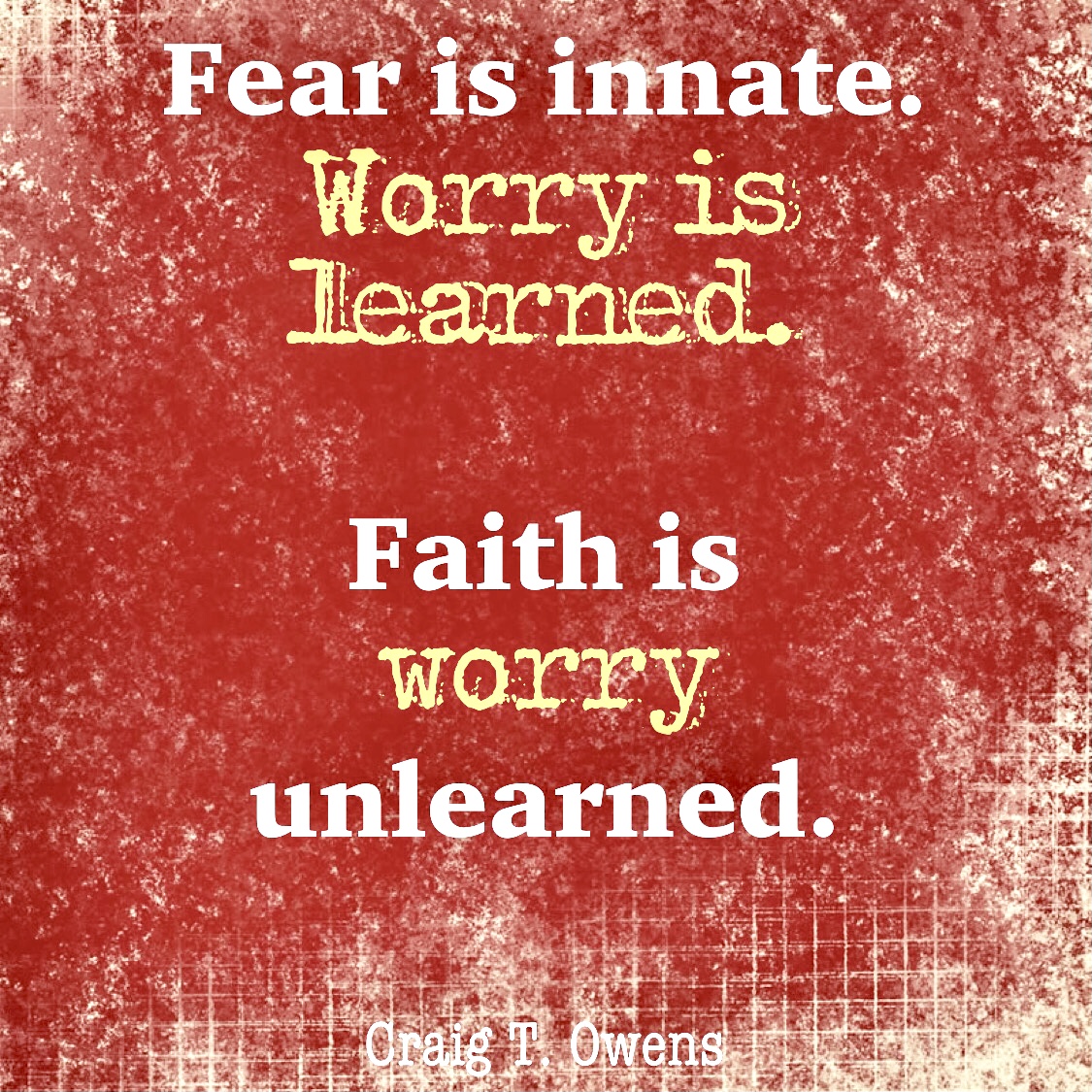
Fear is innate, but worry is learned.

Faith is worry unlearned.

Worry tells your brain a story about bad things that may happen.

Faith tells your brain a story about good things that should happen. Based on what you’ve already experienced of God’s power, what you’ve already seen in God’s provision, or what you already know of God’s promises, your faith in God can help you unlearn your worry.

The prophet Jeremiah tended to be a worrywart. Maybe that’s why he’s been called the “weeping prophet.” But in the middle of his worrying, he unlearns his worry by using his faith to tell a different story about God’s provision, power, and promises:

I well remember [the bad things], and my soul is downcast within me. Yet this I call to mind and therefore I have hope: Because of the LORD’s great love we are not consumed, for His compassions never fail. They are new every morning; great is Your faithfulness. I say to myself, “The LORD is my portion; therefore I will wait for Him.”

Did you notice that Jeremiah talked to himself? He wrote, “I say to myself.” If you have a tendency to worry, it’s time to start talking to yourself and telling yourself a different story. Instead of being fearful of the bad things you cannot see, why not be hopeful of the good things of God you can see?

Let your faith in God help you unlearn your worry. You can overcome worry and anxiety by telling yourself a new faith-filled, hope-oriented story. You can recall God’s faithfulness in the past, and apply it to your current circumstance.

What stories are you telling yourself today? Share with others how you overcame, or are in the process of overcoming worry now. Your faith story will help others overcome and unlearn their worry too.

Contending For The Faith

This Wednesday we’re starting an important series in our Impact youth group called “Spiritual Self-Defense.” Training our students how to defend what they believe. Jude wrote that we need to learn how to earnestly contend for the faith.

I’m also mindful of Peter’s instruction: But in your hearts set Christ apart as holy [and acknowledge Him] as Lord. Always be ready to give a logical defense to anyone who asks you to account for the hope that is in you, but do it courteously and respectfully.

As I’m preparing for this, here are a few things I’m trying to keep in mind. Perhaps you will have some additional things to share with me:

  • Earnestly means wholeheartedly. So I want to convey passion for biblical truths.
  •  Faith means an added dimension beyond scientific proof. Not in place of science, but beyond it. Albert Einstein observed, “Science without religion is lame. Religion without science is blind.”
  • Focusing on the lordship of Christ is the primary focus of Christian apologetics.
  • I need to prepare to answer.
  • My answers need to be logical and well thought out.
  • My answers need to lead people to the hope that is only found in a personal relationship with Jesus.
  • My defense of biblical truths need to be courteous and respectful.

In addition to our training times on Wednesday, we’ll also offer “sparing lessons” in our weekly men’s and women’s Bible studies. If you’re interested to learn more, come and join us at 7PM over the next few Wednesdays.

O Me Of Little Faith

Last night I took some of my youth group leaders to a Speed The Light banquet. For those of you who don’t know, STL is missions giving from youth, with the funds going to help missionaries speed the light of the Gospel. Many times STL funds go for items like 4-wheel-drive vehicles, sound systems, video production equipment, and the like.

Understand that up until a month or so ago our group had never really been exposed to STL. Our grand total to STL last year was $0. That’s right, nothing.

So I took them to this banquet to help them get a better understanding of what STL is. I’m a huge fan, so I wanted them to catch the vision for STL too.

Knowing that we were going to be asked to make a faith promise for 2010, I had a dollar figure in mind. I figured this amount would be doable, but a stretch, for a youth group that hadn’t given anything to STL yet.

Our District Youth Director Jeff Kennedy asked us to huddle as a team to talk about our faith promise amount. He said, “Remember: if it’s truly a faith promise, your amount will make you sweat.”

So I asked my team, “What amount do you think we can do?” And they totally blew me away! They came up with an amount three times LARGER than I had been thinking.

I joyfully wrote in that larger amount on our faith promise card. As I did, I heard the Holy Spirit chide me a bit, “O you of little faith.”

Thanks, team, for dreaming big—bigger than me. Thanks for having such big faith. Thanks for stretching my faith too.

Do It

Here’s what God said to His people through the prophet Ezekiel, “I will judge you according to your conduct.” God says the same thing in the New Testament too.

It’s not what I believe. It’s not what I discuss. It’s not what I intend to do. It’s not what I know is right and wrong. It’s what I do.

I have to give an account of my conduct. I have to answer to God for how I lived out my beliefs. I have to show God what I did with what I believe about Him. I have to put into practice what’s in my heart.

Do I believe God is God? Do I have idols?

Do I believe God is holy? Do I sin?

Do I believe God forgives? Do I repent?

Do I believe God looks after orphans and widows? Do I?

Do I believe God is my Provider? Do I steal?

Do I believe He is Lord? Do I give Him control of everything?

Do I believe I should do something for the hungry, thirsty, naked, sick, and imprisoned? Do I do something?

This is what God judges: belief put into action. Not just beliefs, but godly actions motivated by those godly beliefs.

Faith without works is just wishful dreaming. Works without faith is just religious posturing. Works with faith is God-glorifying!

Don’t just believe it… do it.

Let’s Make A Deal

Have you ever seen the 1970s game show Let’s Make A Deal? Contestants were given some tricky choices to make. They usually held something in their hand that was fairly valuable and were given the opportunity to trade what they could see for what they couldn’t see.

The anxiety about making this decision almost caused some people to have a nervous breakdown on the spot! And, oh, the emotional highs and lows when the contestants discovered what they won or lost!

I was reading about a let’s-make-a-deal moment in the Bible. Jerusalem is facing an imminent threat from an incredibly powerful man (2 Kings 18-19). Sennacherib sent this message to King Hezekiah, “Let’s make a deal” (18:23).

And he made a pretty compelling argument to take the deal. Sennacherib said, “No one who has ever stood up to me has survived before. I’m undefeated. I have a bigger, meaner army than you; more horses and chariots than you; and I’ve blocked your attempts to call on someone else to come rescue you. There’s no way out of this. C’mon, let’s make a deal!”

What makes a deal like this so appealing is that it’s all visible. It’s hard to say “no” to what you can see and say “yes” to what you can’t see.

Hezekiah knew God could deliver them, but would He deliver them? Hezekiah couldn’t see God, but he could see all of Sennacherib’s forces. What to do, what to do??

Hezekiah made the right deal. He put his trust in God! Although He was unseen, Hezekiah believed that God’s deal was better than Sennacherib’s deal. And Hezekiah was not disappointed in the deal he made (19:35-37).

What about you? Are you facing insurmountable odds today? Do you feel like you need to make a deal? Is what you can see more compelling than what you can’t see? I can promise you that any deal that you might make that doesn’t throw your trust entirely on God is a bad deal. A very bad deal!

So we’re not giving up. How could we! Even though on the outside it often looks like things are falling apart on us, on the inside, where God is making new life, not a day goes by without His unfolding grace. These hard times are small potatoes compared to the coming good times, the lavish celebration prepared for us. There’s far more here than meets the eye. The things we see now are here today, gone tomorrow. But the things we can’t see now will last forever. (2 Corinthians 4:16-18, The Message)

Don’t give up! Don’t make a bad deal! Trust God. His way is always the best deal!

Ahead-Of-Time God

I was reading the well-known story of the prophet Elijah this morning, while still thinking about a life in limbo. Elijah has the audacity to say to the king of Israel, “As the LORD, the God of Israel, lives, Whom I serve, there will be neither dew nor rain in the next few years except at my word” (1 Kings 17:1).

That’s it. We just sort of jump right into this story. We don’t read about God instructing Elijah to say this to King Ahab. And more importantly, we don’t see God saying, “Elijah, even though the land will go through a severe drought, here’s how I’m going to take care of you.” Elijah’s life was in limbo. But I’m struck by God’s ahead-of-time provision for Elijah.

At the time of this story, the land of Israel is now under its sixth evil king; each one getting more and more sinful than the one before him. The current king, Ahab is called the most evil of all the kings yet. Israel had lived under sinful kings—which the Bible says were causing all of the people to sin, too—for over 70 years! Yet at least one family still faithfully clung to their belief in Yahweh, the true God. These parents named their son Elijah, which means “Yahweh is the one true God.” Although it might have seemed everyone was sinning and turning their back on God, at least one set of parents raised their son in a counter-cultural way, at least one set of parents trained their son to rely only on God, at least one set of parents equipped their son to stand firm in the face of overwhelming evil.

The ahead-of-time God provided God-fearing parents for Elijah to train him to fear God too.

As the famine began, God directed Elijah to a brook that continued to flow. This was also the place ravens would bring him food.

The ahead-of-time God provided food and water for Elijah.

The drought eventually dried up the brook that Elijah was using for water, and the ravens eventually stopped coming to that dried-up creek bed with food. So God sent Elijah to a widow in Zarephath with this promise, “I have commanded a widow in that place to supply you with food” (1 Kings 17:9). After Elijah entered this widow’s home, her supply of oil and flour never ran out throughout the entire three years of drought, giving all of them food to eat.

The ahead-of-time God provided oil and flour for a widow so that she could make food for Elijah.

My life may be in limbo, but I am confident that my ahead-of-time God has already provided for me. You and I have this promise: “And my God will liberally supply (fill to the full) your every need according to His riches in glory in Christ Jesus” (Philippians 4:19).

This story is in the Bible to reassure you and me that God supplies for us.

Piling On!

It just wasn’t going very well for David!

His boss, Saul, was jealous of him and was trying to kill him.
He had to leave his best friend behind when he ran for his life.
And his wife.
And his Mom & Dad.
And his brothers.
And his pastor.
Then his best friend is almost killed for standing up for David.

So David runs to enemy territory. After all “the enemy of my enemy is my friend,” right?

Um, not so much! The king of Gath was Saul’s enemy, but he wasn’t too fond of David either. How does David get out of this one? He starts drooling like an idiot, clawing weird symbols on the wooden doors and acting like a madman!

David runs away from Gath to Adullam Cave, which then quickly becomes the gathering spot for every distressed, bankrupt malcontent in the country. Some following David had!

Have you ever had one of those days? You know, where nothing is going right, and everywhere you turn is simply more trouble—out of the frying pan and into the fire! The problems just seem to keep piling on!

Yet there in Adullam Cave, David pens some of the most profound words. Read them carefully, and note the progression:

I will extol the LORD at all times; His praise will always be on my lips.
My soul will boast in the LORD; let the afflicted hear and rejoice.
Glorify the LORD with me; let us exalt His name together.
(Psalm 34:1-3)

Notice how David chooses to praise God as an act of his will—I will extol the Lord… I will praise Him with my lips.

And then this act of his will gets into his soul (his emotions), and as a result, the other distressed, bankrupt malcontents begin to see something different in David. He doesn’t break down when the problems pile on; he praises God!

And then these malcontents begin to glorify the Lord with David; they begin to exalt His name together.

Friends, how you choose to respond when the problems pile on is vital. Yes, misery loves company. If you are feeling miserable, other miserable people will flock to you. Don’t use this group to have a pity party, but see it as an incredible opportunity to use your will to praise God.

Remember, feelings follow actions. You may not feel like praising God because the problems are piled on so high, but when you act the feelings will follow. David went from “I will” to “my soul” in just one verse! And the same thing will happen for you too!

A distressed, malcontented world is watching you—what will you do when your problems pile on?