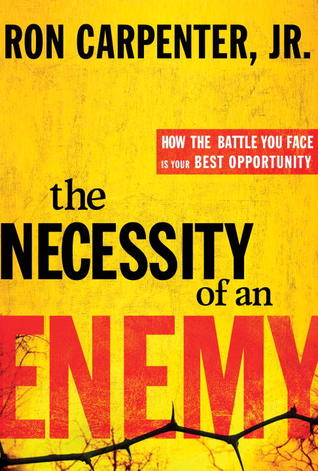
The Necessity Of An Enemy (book review)

Have you ever wished that all of your enemies were totally defeated? Have you ever prayed to ask God to defeat all of your enemies? I’ll be honest with you: I have. But according to Ron Carpenter, Jr. that may not be the best prayer for you. In fact, his book might say the exact opposite; it’s called The Necessity Of An Enemy.

Ron uses his personal story of being attacked and personally vilified to show us—as the subtitle states—how the battle you face is your best opportunity. Near the beginning of the book, Ron states:

“I have some important news for you: to fulfill your purpose and stay true to your calling, you’ll need to understand the reason for enemies. If you do that, then when they rise up against you, you will quickly recognize what’s happening.” 

Many of the enemies we face are to prepare us for the greater purpose for which God created us. We cannot simply run away from every battle or ask God to subdue every enemy we face, because those battles and enemies may be preparing us for something greater. Think about David: before he fought Goliath, he had to learn his stone-slinging skills by fighting off a lion and a bear. What if he had asked God to simply scare away the lion, or strike the bear dead? What would David had learned from that?

This book is divided into several sections, and each section has several very short chapters. This format, combined with the study guide at the back of the book, makes it ideal for applying the principles slowly in your life, or for having a great small group discussion with others.

God wants you to be victorious, but He doesn’t want you to take shortcuts to get there. He allows enemies to help build your spiritual skills, and The Necessity Of An Enemy can be a great part of your battle strategy as well.

I am a Waterbrook book reviewer.

Conformed To His Image (book review)

Oswald Chambers challenges my thinking about the Christian walk like few other authors can. His insights are always so profound, and yet at the same time awaken me to the realization that I am the one who makes the Christian walk something complex. In Conformed To His Image, I was yet again challenged to simply follow Jesus.

Chambers brilliantly turns secular psychology upside down. He takes what psychology wants to ascribe to our minds and emotions, and brings it back to a Scriptural basis that puts these things where they are supposed to be: in the soul.

The thought of being “conformed” rubs against the human desire to be free and in charge of our own destiny. Somehow being “conformed” feels like being controlled and giving up our unique personality. So Chambers contrasts the natural human tendencies for freedom and calling our own shots with what the Bible says about surrendering to God.

Chambers presents Jesus not as some superhuman, extraordinary Man. But He shows the life of Jesus to be what we should all be able to live out daily. Jesus was perfectly conformed and submitted to the will of His Father. And, he says, if we will submit as well, the Holy Spirit will conform us into the image of Jesus.

Beware: this book is not light reading. This is a heavy-duty, confrontational book that will challenge you to submit to the Holy Spirit as perhaps you never have before in your Christian walk. However, if you are ready to take the plunge into a much deeper, more intimate relationship with your Heavenly Father, Conformed To His Image is the resource for you. 

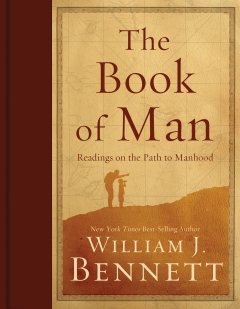
The Book Of Man (book review)

“The purpose of this book is to explore and explain what it means to be a man,” writes William Bennett in the introduction of The Book Of Man: Readings on the Path to Manhood. It seems like an ambitious goal, but this book actually does a wonderful job in achieving that lofty goal.

If you’ve read any of the other compilations that William Bennett has pulled together (such as The Book Of Virtues), you will have a good idea of the layout of this book. In case you haven’t experienced any of Bennett’s other collections, the idea is to pull together some of the wisest words ever spoken or written on a singular topic. In so doing, the reader will get to look at that topic through the eyes of so many different people, that it will give a much fuller view of the topic.

In this book, the topic is men. What does it mean to be a man? To be a Dad? To be a husband? To be a soldier or an employer/employee? To be tough and yet loving? To be thoughtful and yet a man of action? The Book Of Man is divided into six sections:

  • Man in war
  • Man at work
  • Man in play, sports, and leisure
  • Man in the polis
  • Man with woman and children
  • Man in prayer and reflection

In each section you will find the wit and wisdom of men living and dead; of those in the modern world and the ancient; of those from Western cultures and Eastern; of those who have “been there, done that.” This is not necessarily compiled to be read from cover-to-cover (although that’s the way I enjoyed reading it), but to go to the various sections as you are learning and growing in that area. I also love the comprehensive index at the end of the book, as a way to search for a particular author or topic.

As with William Bennett’s other books, this is a great book to read aloud with others. I would especially recommend Dads reading passages with their sons, as a great tool in helping our young men learn what it means to be a true man.

I am a Thomas Nelson book reviewer.

UPDATE: I am sharing some of my favorite quotes from The Book Of Man. You can read them here, and here, and here, and here, and here, and here.

6 Quotes From “When Work & Family Collide”

When Work & Family Collide is a timely message in our busy, go-go-go world. It’s hard to keep everyone in our lives happy when we are so busy. As author Andy Stanley says,  “The issue is never ‘Am I cheating?’ The issue is always ‘Where am I cheating?’” You can read my complete book review by clicking here.

These are six of my favorite quotes from this book:

“Let me take some pressure off. Your problem is not discipline. Your problem is not organization. Your problem is not that you have yet to stumble upon the perfect schedule. And your problem is not that the folks at home demand too much of your time. The problem is this: there’s not enough time to get everything done that you’re convinced—or others have convinced you—needs to get done.”

“Over time, our families learn that the only way to get our attention is to create a crisis. And let’s face it; it’s amazing how much time we can steal from work when our kids are in crisis. …Instead of allowing the most recent crisis to force the issue, why not be governed by the greater purpose? Why not ‘cheat’ by design?”

“Whereas work is task focused, the family is relationship focused. One is about doing, while the other is about loving. …You do your job. You love your family. It’s when we reverse the order that the tension escalates and the tug of war begins.”

“[Your family] wants to feel like your priority. It’s not enough for them to be your priority. They must feel like it.”

“Whenever you compromise the interests of a family member in order to fill gaps somewhere else you shuffle your priorities. Loyalty that was intended for a loved one gets displaced and given to someone else. However small, it increases the emotional load he or she must carry. It may not seem like a big deal. But it sends the message: You’re important… but right now someone else is more important.

“It’s up to us to monitor the emotional weight being carried by each of our family members. Through honest, and sometimes awkward, communication we can learn to monitor the hearts of our loved ones.”

10 Quotes from “True Vine”

I thoroughly enjoyed my 30-day read of True Vine, a devotional by Andrew Murray which focuses on John 15:1-16. I learned a lot during this study, and I highly recommend that you dive into this study too (you can read my full review here).

These are some of the quotes that especially stood out to me from True Vine.

“The branch has but one object for which it exists, one purpose to which it is entirely given up. That is, to bear the fruit the vine wishes to bring forth. And so the believer has but one reason for his being a branch—but one reason for his existence on earth—that the heavenly Vine may through him bring forth His fruit. … The one object of my being a branch, the one mark of my being a true branch, the one condition of my abiding and growing strong, is that I bear the fruit of the heavenly Vine for dying men to eat and live.”

“Consider a moment what this pruning or cleansing is. It is not the removal of weeds or thorns, or anything from without that may hinder the growth. No; it is the cutting off of the long shoots of the previous year, the removal of something that comes from within, that has been produced by the life of the vine itself. It is the removal of something that is a proof of the vigor of its life; the more vigorous the growth has been, the greater the need for the pruning.”

“Many believers pray and long very earnestly for the filling of the Spirit and the indwelling of Christ, and wonder that they do not make more progress. The reason is often this, the ‘I in you’ cannot come because the ‘abide in Me’ is not maintained.”

“There is in the Vine such fullness, the care of the divine Husbandman is so sure of success, that the much fruit is not a demand, but the simple promise of what must come to the branch that lives in the double abiding—he in Christ, and Christ in him. ‘The same bringeth forth much fruit.’ It is certain. Have you ever noticed the difference in the Christian life between work and fruit? A machine can do work: only life can bear fruit. A law can compel work: only love can spontaneously bring forth fruit. Work implies effort and labor: the essential idea of fruit is that it is the silent natural restful produce of our inner life.”

“Begin each day with Him in the morning, to know in truth that you are abiding in Him and He in you. Christ tells that nothing less will do. It is not your willing and running, it is not by your might or strength, but—‘by My Spirit, saith the Lord.’ Meet each new engagement, undertake every new work, with an ear and heart open to the Master’s voice: ‘He that abideth in Me, beareth much fruit.’ See you to the abiding; He will see to the fruit, for He will give it in you and through you.”

“The healthy life of the believer in Christ is equally one of unceasing prayer. Consciously or unconsciously, he lives in continual dependence. The Word of his Lord, ‘You can do nothing,’ has taught him that not more unbroken than the continuance of the branch in the vine, must be his asking and receiving. The promise of our text gives us infinite boldness: ‘Ask whatsoever ye will, and it shall be done unto you.’ …To avail ourselves of the unlimited prayer promises, we must be men who are filled with the Spirit, and wholly given up to the work and glory of Jesus. The Spirit will lead us into the truth of its meaning and the certainty of its fulfillment. Let us realize that we can only fulfill our calling to bear much fruit, by praying much. …Souls are perishing because there is too little prayer. God’s children are feeble because there is too little prayer. We bear so little fruit because there is so little prayer.”

“How can we glorify God? Not by adding to His glory or bringing Him any new glory that He has not. But simply by allowing His glory to shine out through us, by yielding ourselves to Him, that His glory may manifest itself in us and through us to the world.”

“He gave His life to secure a place for His love in our hearts to rule us; the response His love calls us to, and empowers us for, is that we do what He commands us. …We have given a far higher place to privilege than to duty. We have not considered implicit obedience as a condition of true discipleship. The secret thought that it is impossible to do the things He commands us, and that therefore it cannot be expected of us, and a subtle and unconscious feeling that sinning is a necessity have frequently robbed both precepts and promises of their power. The whole relation to Christ has become clouded and lowered, the waiting on His teaching, the power to hear and obey His voice, and through obedience to enjoy His love and friendship, have been enfeebled by the terrible mistake.”

“See here the reason of the lack of prayer, and of the lack of power in prayer. It is because we so little live the true branch life, because we so little lose ourselves in the Vine, abiding in Him entirely, that we feel so little constrained to much prayer, so little confident that we shall be heard, and so do not know how to use His name as the key to God’s storehouse. …Beloved disciple, seek above everything to be a man of prayer. Here is the highest exercise of your privilege as a branch of the Vine; here is the full proof of your being renewed in the image of God and His Son; here is your power to show how you, like Christ, live not for yourself, but for others; here you enter Heaven to receive gifts for men; here your abiding in Christ has led to His abiding in you, to use you as the channel and instrument of His grace. The power to bear fruit for men has been crowned by power to prevail with God.”

“O my Lord, let Thy holy friendship lead me into the love of all Thy commands, and let the doing of Thy commands lead me ever deeper into Thy friendship.”

When Work & Family Collide (book review)

Anyone NOT have a busy life? If your life is dull or uneventful, then you can stop reading this book review right now. However, if you have a full, busy life, you need to make the time to read When Work & Family Collide by Andy Stanley.

The subtitle of this book says it all: Keeping your job from cheating your family. The premise of this book is quite simple—you cannot fully satisfy both your office and your family, so someone is going to have to get cheated. In the introduction to the book, Andy Stanley says,

“Daily we decide to shortchange one thing in order to more fully experience another. …So we “cheat.” We give up certain opportunities for the sake of others. We invest in some relationships while neglecting others. We allocate our time the best we can, knowing all the while that somebody’s going to feel cheated. Unfortunately, that “somebody” is usually someone we care a great deal about.”

Pastor Stanley then goes on to outline why it’s so important that work gets cheated and not our families. One of my favorite quotes in the book is, “You do your job. You love your family. It’s when we reverse the order that the tension escalates and the tug of war begins.”

Like me, you may be thinking, “But I can’t ‘cheat’ on work! I’ll lose my job!” Using the biblical example of Daniel and some very practical advice, Andy Stanley helps you to see how you can keep your priorities in order, and make the adjustments that will help you do your job and love your family.

This book has some amazing thoughts, but it’s also a surprisingly easy read. In your busy, go-go-go schedule, you would be wise to make some time on a weekend to read this book, work through the discussion questions at the back of the book with your family, and then make the changes that will help both your work and your family to thrive. Everyone will benefit from this investment of your time.

I am a Multnomah book reviewer. Check out some of the quotes I shared from this book here.

7 Quotes From “Dreaming In 3D”

It was hard to narrow down the list to just these quotes, but these seven quotes from Dreaming In 3D by Doug Clay will give you a good feel for this empowering book. You can read my complete review by clicking here.

Unless otherwise noted, the quotes are from Doug Clay:

“The poorest of all men is not the one without a nickel to his name. He is the fellow without a dream.… [He is like] a great ship made for the mighty ocean but trying to navigate in a millpond.” —Kenneth Hildebrand

“For me, a healthy view of God’s dream and of becoming His masterpiece begins by avoiding comparison—in fact, carefully defining who I’m not. I can certainly learn by observing the talents and failures of others, but God didn’t call me to be a carbon copy of them. He created me to be an original edition. If I spend my time comparing my status to others and checking where I am on the acceptability scale, my focus is entirely on me, not on God and His purposes. …Most of the time, comparison produces either pride (if I think I’m doing better than others) or discouragement (if I’m not doing as well). In other words, comparison kills.”

“The works of monks and priests, however holy and arduous they may be, do not differ one whit in the sight of God from the works of the rustic laborer in the field or the woman going about her household tasks, but… all works are measured before God by faith alone. …Indeed, the menial housework of a manservant or maidservant is often more acceptable to God than all the fasting and other works of a monk or priest, because the monk or priest lacks faith.” —Martin Luther

“People matter. Christ didn’t die for a cause; He died for people. The focus of a God-given dream is never about the size of an organization, the wealth we earn, or the fame we gain from success. It’s touching people’s lives.”

“What a man actually needs is not a tensionless state but rather the striving and struggling for some goal worthy of him. What he needs is not the discharge of tension at any cost, but the call of a potential meaning waiting to be fulfilled by him.” —Victor Frankl

“In the Trinity, the Father, Son and Holy Spirit love each other and work to accomplish Their unified purposes. God wants us, His Body, to work together to fulfill the dreams He puts on our hearts.”

“No one is outside of God’s incredible dream. Without Jesus, we’re just playing games to impress and control. But when He infuses our lives with love and purpose, we become His partners in the great adventure.”

True Vine (book review)

In my personal Bible reading time, I tend to go rather slowly. I enjoy digging into the words and phrases, the Greek or Hebrew definitions, and the deep truths that can be uncovered in each verse. If you enjoy this type of in-depth Bible study, I think you will enjoy True Vine by Andrew Murray.

True Vine is a 30-day study of John 15:1-16, where Jesus talks about His relationship with us and with the Father, and our relationship with the Father in the language of a vine, branches, and fruit. It may seem like a full month just studying 16 verses is a bit intense, but Andrew Murray’s insights are very easy to grasp.

Each day’s study is not too long, but he pulls out a few insights that are ready-made to apply to your life. And each day’s devotional ends with a prayer that pulls it all together.

It was a very enjoyable study for me. You will enjoy it too, only if you want to go deep.

If you have a Kindle, you can download True Vine for free by clicking here.

[I shared some quotes from this book here.]

Dreaming In 3D (book review)

Everyone has a dream. Maybe you’ve forgotten yours, or maybe you are struggling with how to achieve your dream. Maybe your dream seems a bit muddled, and you’re not sure how to proceed. In any of these cases Dreaming In 3D: Finding And Following God’s Amazing Plan For Your Life by Doug Clay is an excellent resource.

The thing I appreciate most about this book is its affirming tone. I never felt like Doug was talking down to me, or belittling my dreams, or even making me feel like my dreams were unrealistic. Using both his personal life story of following the dream God had birthed in his heart, biblical examples of dreamers, and practical steps for achieving your dream, Dreaming In 3D was enjoyable at every page.

Doug’s focus is not on pursuing selfish dreams, but dreams which help others:

“People matter. Christ didn’t die for a cause; He died for people. The focus of a God-given dream is never about the size of an organization, the wealth we earn, or the fame we gain from success. It’s touching people’s lives.”

In addition to helping you find and follow your own dream, Doug also encourages us to be dream releasers for other dream chasers. In so doing, we please God.

Are you ready to find and follow your dream? Are you ready to help others pursue their dreams as well? If so, Dreaming In 3D will help you do just that.

[Check out some quotes I shared from this book here.]

10 Quotes From “Artificial Maturity”

The other day when I posted my review of Artificial Maturity by Dr. Tim Elmore, I said that for anyone working with children, tweens, teens, or young adults this book is a must-read. I don’t say that about very many books, but it is definitely true of this one (you can read my full review here).

Let me share with you ten of my favorite quotes from this book. Unless otherwise noted, all of the quotes are from Dr. Elmore…

“In short, the artificial maturity dilemma can be described this way: (1) Children are overexposed to information, far earlier than they’re ready. (2) Children are underexposed to real-life experiences far later than they’re ready.”

“Steps to take to build authentic maturity:

  1. Provide autonomy and responsibility simultaneously.
  2. Provide information and accountability simultaneously.
  3. Provide experiences to accompany their technology-savvy lifestyles.
  4. Provide community service opportunities to balance their self-service time.”

“For the most part, adults have failed to build true ‘life skills’ in kids. We haven’t helped them self-regulate and make decisions about concerns that matter. Students’ busy schedules often aren’t all that meaningful, and young people spiral downward into despair over relatively trivial issues. Their days are full of artificial activities with artificial consequences, resulting in artificial maturity. The stress is real, but it is often over things that don’t really matter, and it isn’t building mature people.”

“We must be parents, not pals. We must be coaches, not coddlers. And we must lead them, not just lecture them.”

“Analysts say there are increasing signs that a lack of independence fuels stress, anxiety, and depression among young people. …Kids’ early lives today are too full of information and structure, and too empty of innocence and the freedom to play and explore. But by adolescence, it’s almost the opposite. It’s as though they experience a flip-flop. Their lives are too full of freedom, and too empty of accountability.”

“This appears to be a paradoxical trend—[adolescents] expressing a decline in readiness to actually ‘be’ adults that is proportionate to their desire to leave home. …They want to be consumers but not necessarily contributors. …Our job is to prepare the child for the path, not the path for the child.”

“The fact is, kids—all kids—need adults to lead them well. In our mad obsession to remain cool and on the cutting edge of everything, adults have surrendered what may be their most important responsibility: to provide role models to the next generation. We might win at the game of being liked, but we lose at the game of leading well.”

“For our teens, we’ve defined nurturance largely in terms of the things we can do for them, the stuff we can buy them, and the experiences and opportunities we can provide. In reality, what most teens need is neither more stuff, nor more lessons, nor do most teens even need more tender, loving care or quality time. While young children need a great deal of parental nurturance in the form or direct assistance geared toward meeting their needs, adolescents need something different. Unlike children, teens’ bodies and brains most need us to nurture and develop capacities to function on their own in this world. This means expecting things of them, not just giving things to them.” —Drs. Joseph & Claudia Worrell

“Five parental decisions:

  • Decide that you will build a bridge of relationship that can bear the weight of hard truth.
  • Decide that it’s more important for you to have their respect than for them to like you.
  • Decide that it’s more important for you to pass on essential values than to just have fun.
  • Decide that it’s more important for them to be ready for the future than to be comfortable.
  • Decide to pass on the principles (values) you wish you’d known earlier in life.”

“As adults, we have done a poor job in getting this generation of kids ready for life. If they flounder, it is because we’ve focused on preparing the path for the children instead of the children for the path. I believe in this next generation. These kids are great, and they’re capable of much more than we’ve expected. We have not led them well. We’ve allowed them to mature artificially by default. We’re protected them instead of preparing them for life as adults. It’s time we get them ready to lead the way into the future.”