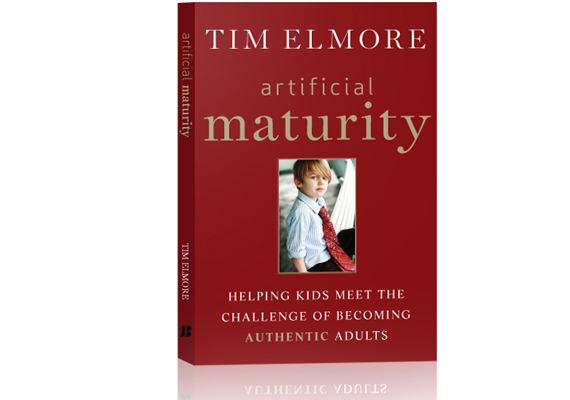
10 Quotes From “Artificial Maturity”

The other day when I posted my review of Artificial Maturity by Dr. Tim Elmore, I said that for anyone working with children, tweens, teens, or young adults this book is a must-read. I don’t say that about very many books, but it is definitely true of this one (you can read my full review here).

Let me share with you ten of my favorite quotes from this book. Unless otherwise noted, all of the quotes are from Dr. Elmore…

“In short, the artificial maturity dilemma can be described this way: (1) Children are overexposed to information, far earlier than they’re ready. (2) Children are underexposed to real-life experiences far later than they’re ready.”

“Steps to take to build authentic maturity:

  1. Provide autonomy and responsibility simultaneously.
  2. Provide information and accountability simultaneously.
  3. Provide experiences to accompany their technology-savvy lifestyles.
  4. Provide community service opportunities to balance their self-service time.”

“For the most part, adults have failed to build true ‘life skills’ in kids. We haven’t helped them self-regulate and make decisions about concerns that matter. Students’ busy schedules often aren’t all that meaningful, and young people spiral downward into despair over relatively trivial issues. Their days are full of artificial activities with artificial consequences, resulting in artificial maturity. The stress is real, but it is often over things that don’t really matter, and it isn’t building mature people.”

“We must be parents, not pals. We must be coaches, not coddlers. And we must lead them, not just lecture them.”

“Analysts say there are increasing signs that a lack of independence fuels stress, anxiety, and depression among young people. …Kids’ early lives today are too full of information and structure, and too empty of innocence and the freedom to play and explore. But by adolescence, it’s almost the opposite. It’s as though they experience a flip-flop. Their lives are too full of freedom, and too empty of accountability.”

“This appears to be a paradoxical trend—[adolescents] expressing a decline in readiness to actually ‘be’ adults that is proportionate to their desire to leave home. …They want to be consumers but not necessarily contributors. …Our job is to prepare the child for the path, not the path for the child.”

“The fact is, kids—all kids—need adults to lead them well. In our mad obsession to remain cool and on the cutting edge of everything, adults have surrendered what may be their most important responsibility: to provide role models to the next generation. We might win at the game of being liked, but we lose at the game of leading well.”

“For our teens, we’ve defined nurturance largely in terms of the things we can do for them, the stuff we can buy them, and the experiences and opportunities we can provide. In reality, what most teens need is neither more stuff, nor more lessons, nor do most teens even need more tender, loving care or quality time. While young children need a great deal of parental nurturance in the form or direct assistance geared toward meeting their needs, adolescents need something different. Unlike children, teens’ bodies and brains most need us to nurture and develop capacities to function on their own in this world. This means expecting things of them, not just giving things to them.” —Drs. Joseph & Claudia Worrell

“Five parental decisions:

  • Decide that you will build a bridge of relationship that can bear the weight of hard truth.
  • Decide that it’s more important for you to have their respect than for them to like you.
  • Decide that it’s more important for you to pass on essential values than to just have fun.
  • Decide that it’s more important for them to be ready for the future than to be comfortable.
  • Decide to pass on the principles (values) you wish you’d known earlier in life.”

“As adults, we have done a poor job in getting this generation of kids ready for life. If they flounder, it is because we’ve focused on preparing the path for the children instead of the children for the path. I believe in this next generation. These kids are great, and they’re capable of much more than we’ve expected. We have not led them well. We’ve allowed them to mature artificially by default. We’re protected them instead of preparing them for life as adults. It’s time we get them ready to lead the way into the future.”

Artificial Maturity (book review)

When I posted my review of Tim Elmore’s previous book Generation iY, I said that book earned a rare “must read” rating from me. Whether you read that book or not, Artificial Maturity has earned the coveted must-read rating again!

If Generation iY described who this current youth generation is, Artificial Maturity describes how to help these youth achieve genuine maturity. Here’s how Dr. Elmore sets the stage for this book from the very first page:

“…I believe in this generation like none before. I believe they have the potential to be the greatest generation—a population Warren Bennis calls the “Crucible Generation.” He and many others believe these young people may just be the ones who transform society globally and restore democracy and goodwill.

I believe this with one caveat. I predict all this is possible if we, the adults, will rethink the way we parent, lead, teach, coach, pastor, and manage them. It’s up to us what kinds of adults our kids will become. So far, many of them are a part of a leaderless generation. The adults have done more protecting than preparing. Some moms and dads want to be pals rather than parents. And many adults are just overwhelmed with the notion of leading kids today—and they surrender their role as leaders.”

So this is not a book that tells you how to change kids, but how we as adults must change.

With persuasive evidence, scientific studies, personal observations, and years of hands-on experience, Dr. Elmore so accurately details how we as parents have contributed to our kids becoming artificially mature. In other words, they know lots of things, but they don’t know how to effectively apply that knowledge to be productive at work, school, and in relationships. 

I, too, share Dr. Elmore’s optimism about this generation. But if I want to see my kids—and other young people with whom I interact—excel and mature, I have to look at myself in the mirror. This generation can’t succeed if we continue to parent, and teach, and pastor, and manage as we have been doing.

I cannot urge pastors, youth pastors, parents, teachers, principals, coaches, and employers to read Artificial Maturity right away! This generation needs us to help them soar!

I am a Jossey-Bass book reviewer.

UPDATE: Read some of my favorite quotes from Artificial Maturity by clicking here.

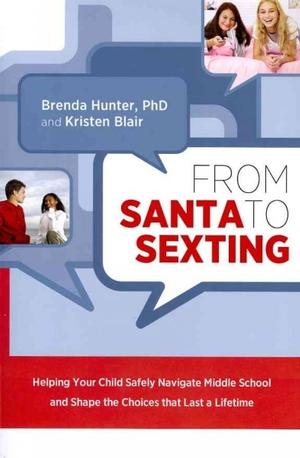
Quotes From “From Santa To Sexting”

If you are a parent of children middle school age or younger, or if you are a teacher or youth pastor that works with this age group, I cannot urge you strongly enough to read From Santa To Sexting (you can read my review here).

These are some quotes from this book that really got me thinking…

Sexual Activity & Sexual Roles

“What helps young adolescents accept a heterosexual sex role identity? Psychiatrist David P. Ausubel, the author of Theory And Problems of Adolescent Development, writes that accepting a heterosexual sex role is aided by the following: 1) witnessing a happy marriage between parents; 2) having positive experiences with the opposite sex; and 3) possessing a strong, positive identification with the parent of the same sex. …In addition, Ausubel believes that parents exert a strong influence on their adolescent’s adoption of a particular biological sex role. For example, if the parent of the opposite sex is negative about the sex role of his child, the child will find it difficult to identify with that role. Suppose a father, for example, put his wife down and is negative about women. Then his impressionable young daughter will find it hard to embrace her femininity and identify with her own sex. The converse is true for boys. According to Ausubel, the preadolescent, depending on the ‘psychological climate’ of his home, may adopt one of three attitudes toward gender: 1) acceptance, leading to heterosexuality; 2) rejection, leading to homosexuality or asexuality (the renunciation of all sexual expression); and 3) ambivalence, resulting in bisexuality, perversion, or sexual delinquency.”

“The evidence is that early sexual experience has consequences for both boys and girls. Joe McIlhaney, MD, an obstetrician and coauthor of the book Hooked: New Science on How Casual Sex is Affecting Our Children, told us that ‘sex is a primary stimulator and molder of the brain. When we have sex, the body secrets the hormone dopamine, and that makes us want to do it again and again. That’s one of the primary reasons to abstain from sex when you’re young, because it becomes addictive.’ He adds, ‘The body also secrets the hormone oxytocin, that some label the love hormone—a hormone that seems to contribute to a girl’s trusting a man she is intimate with and also bonding to him emotionally.’ Then comes the breakup. McIlhaney continues, ‘When young people break up, MRIs show that the pain center of the brain lights up. Emotional and physical pain are felt in the same brain center.’ McIlhaney believes that when kids have multiple breakups, they seem to contribute to their losing their ability to forge lasting connections or attachments with the opposite sex. In addition, they sometimes become depressed and some become suicidal.”

Empathy 

“Sensing what others feel without their saying so captures the essence of empathy. Others rarely tell us in words what they feel; instead, they tell us in their tone of voice, facial expressions, or other nonverbal ways. The ability to sense these subtle communications builds on more basic competencies, particularly self-awareness and self-control. Without the ability to sense our own feelings—to keep them from swamping us—we would be hopelessly out of touch with the moods of others.” —Daniel Goleman 

“Empathy has twin components—one in the affective or emotional area and the other in the cognitive. On other words, we feel the distress of others from birth, but as we grow and our brain develops, we begin to think about what they are feeling and can decide how to help the poor, the distressed, and the handicapped.” 

“If you’re in a relationship, the relationship is a part of you, there’s no way around it. You get an empathetic child not by trying to teach the child and admonish the child to be empathetic; you get an empathetic child by being empathetic with the child. The child’s understanding of relationship can only be from the relationships he has experienced.” —Alan Sroufe 

“If empathy is caught, not taught, then the effect of training students to be empathetic is only skin-deep. The training is focused on a cognitive-behavioral approach; it does not take into account the emotional aspect of empathy and the fact that empathy emerges from an intimate relationship or emotional bond.”

School

“Dr. Robert Balfanz, a research scientist at Johns Hopkins University who studies risk factors for dropping out of school, has found that future dropouts can be identified as early as sixth grade. …Dr. Balfanz’s study of fourteen thousand students in Philadelphia, Pennsylvania, found that sixth grader with just one of the following distress signals had ‘at least a three in four chance’ of dropping out when they reached high school. Here are the four areas he says parents and teachers should monitor:

  • A final grade of F in mathematics;
  • A final grade of F in English;
  • Attendance below 80 percent for the year;
  • A final ‘unsatisfactory’ behavior mark in at least one class.”

“Parents are the first and best anti-bullying program around.”

Video Games & Media

“Scientifically speaking, the notion that media violence harms kids is an open-and-shut case; research has found that violent video games increase levels of aggression hormones in teen players. While their onscreen personas kicked, punched, cut, and shot their way through enemies, testosterone and adrenaline levels rose significantly in the bodies of the players behind the controls…. The strength of the evidence linking media violence to youth aggression is stronger than the evidence linking lead poisoning with mental retardation and more definitive than the case linking secondhand smoke with cancer.” —Dr. David Walsh, Why Do They Act That Way? 

Home Life

“We found that we could actually measure how parents were getting along in two ways. We could either ask them how happy they were—how much conflict they were having—or we could take a 24-hour urine sample from their kids and measure how many stress hormones, particularly adrenaline, were getting secreted in the children’s bodies. So if you’re fighting, your kids are secreting adrenaline. And if they’re secreting adrenaline because they’re stressed out, one of the things that happens to them is that the first and most sensitive system to reflect this stress is the attentional system—the kid’s ability to focus attention, the kid’s ability to shift attention when they want to, and the kid’s ability to sustain attention. And part of what we’re seeing in all of this diagnosis of hyperactivity is, in part, a reflection of increased family stress, increased stress between parents. So the attentional system is really a very sensitive indicator of whether kids are stressed out.” —Dr. John Gottman

“People who become Christians before their teen years are more likely than those who are converted when older to remain ‘absolutely committed’ to Christianity.” —Barna Group

“Revolutionary parenting, which is based on one’s faith in God, makes parenting a priority. Those who engage in revolutionary parenting define success as intentionally facilitating faith-based transformation in the lives of their children, rather than simply accepting the aging and survival of the child as a satisfactory result.” —George Barna

From Santa To Sexting (book review)

Parenting is not for the faint of heart! If you’re a parent and you feel like you need some help in parenting your tween or teen, From Santa To Sexting by Brenda Hunter and Kristen Blair is a wonderful resource.

From Santa To Sexting makes ample use of comments and emails from other parents. As I read these comments, I found myself feeling like I wasn’t alone in my parenting work. Sometimes parents wonder if they are the only one dealing with a particular issue with their son or daughter, so these notes from other parents help us realize that we all face the same parenting challenges.

Beyond that encouragement, From Santa To Sexting presents some rock-solid research on the current state of the youth culture. These stats help parents see what items are “non-negotiable,” and what items are not ones to get worked up about.

This book is written for parents of middle schoolers, or for those about to enter middle school. Without the details becoming gruesome, topics are dealt with in a very matter-of-fact manner. Topics such as friends, internet/media usage, bullying, and family values. I came away with great assurance that although the battle is tough, it’s not only worth fighting, it’s one we can win!

The writer of Proverbs in the Bible said it well: Train a child in the way he should go, and when he is old he will not depart from it (Proverbs 22:6). This book is a great resource in helping parents “train” their children in healthy ways.

I am a Leafwood Publishers book reviewer.

5 Quotes From “Questions Christians Hope No One Will Ask”

Earlier this week I reviewed Questions Christians Hope No One Will Ask Them (you can read my review here).

I wanted to share some of my favorite quotes from this book:

“When we fail to answer someone’s questions and objections, we become just one more excuse for them to disbelieve.” —Walter Martin

“I cannot believe that our existence in this universe is a mere quirk of fate. … We are truly meant to be here.” —Paul Davies, a physicist, cosmologist, and atheist

“Consider what you’d need for a protein molecule to form by chance. First, you need the right bonds between the amino acids. Second, amino acids come in right-handed and left-handed versions, and you’ve got to get only left-handed ones. Third, the amino acids must link up in a specified sequence, like letters in a sentence. Run the odds of these things falling into place on their own and you find that the probabilities of forming a rather short functional protein at random would be one chance in a hundred thousand trillion trillion trillion trillion trillion trillion trillion trillion trillion trillion. That’s a ten with 125 zeroes after it! And that would only be one protein molecule—a minimally complex cell would need between three hundred and five hundred protein molecules. … To suggest chance against those odds is really to invoke a naturalistic miracle.” —Stephen Meyer, a Cambridge-trained philosopher of science

“Here’s the key point to remember: there never was a time when the earliest community of followers of Jesus did not regard Him as far, far more than a good teacher.” —Mark Mittelberg

“If a good God made the world, why has it gone wrong? … My argument against God was that the universe seemed so cruel and unjust. But how had I got this idea of just and unjust? A man does not call a line crooked unless he has some idea of a straight line. What was I comparing this universe with when I called it unjust? If the whole show was bad and senseless from A to Z, so to speak, why did I, who was supposed to be part of the show, find myself in such violent reaction against it? … Thus in the very act of trying to prove that God did not exist—in other words, that the whole of reality was senseless—I found I was forced to assume that one part of reality—namely my idea of justice—was full of sense. Consequently, atheism turns out to be too simple. If the whole universe has no meaning, we should never have found out that it has no meaning: just as, if there were no light in the universe and therefore no creatures with eyes, we should never know it was dark. Dark would be without meaning.” —C.S. Lewis

Questions Christians Hope No One Will Ask (book review)

Apologetics is not the right way to ask forgiveness. Apologetics is the art and science of defending what you believe. One of the most accessible apologists we have is Mark Mittelberg and his very helpful book Questions Christians Hope No One Will Ask.

I have taken a passage from the Bible as my guideline for defending the Christian faith. The Apostle Peter wrote:

But in your hearts set apart Christ as Lord. Always be prepared to give an answer to everyone who asks you to give the reason for the hope that you have. But do this with gentleness and respect, keeping a clear conscience, so that those who speak maliciously against your good behavior in Christ may be ashamed of their slander. (1 Peter 3:15-16)

Focus on Christ … Be prepared to answer … Answer gently and respectfully. In this book, Mark Mittelberg arms Christians with information to help them do just that. He doesn’t shy away from the tough questions like the apparent disharmony between Science and the Bible, or God’s existence, or Christ’s divinity. All of these he addresses using Scripture, philosophy, science, and logic. Mittelberg frequently quotes both Christian and atheist apologists to help make his point. And he does so very winsomely.

Each chapter is designed as sort of a lecture and lab. Mittelberg teaches, and then he walks through some possible conversations and objections an atheist or non-Christian may have about Christian’s beliefs. s

It’s a helpful and enjoyable read.

10 Quotes from The Gospel Of Yes

I really loved this book by Pastor Mike Glenn. Check out my review here. These are 10 quotes I loved from this book:

“Following Jesus is much more than being careful not to do wrong. …Defining your life by what you oppose makes your life small….”

“For too many of us, Christianity has been narrowed down to sin management. Sure, we all want to go to Heaven. But under the sin-management paradigm, getting to Heaven is no longer about Jesus’ sacrifice on our behalf and His invitation to follow Him in a new life. The focus on sin makes getting to Heaven a matter of keeping score. You get points for doing good things and lose points for doing bad things. Being a Christian becomes a spiritual frequent-flier program. If you work at it hard enough and accumulate enough points, you can fly for free.”

“As long as our first thought is What do I need to avoid?, the guiding influence in our lives is sin, not Christ. To be sure, we are working hard to avoid things that God disapproves of, but we are missing God in the process. The hard work of avoiding a mistake or misstep looms so large that God gets blocked from our view. If all we think about is sin, even when we’re thinking of ways to avoid it, we increase our chance of failure. This is the irony of sin-management Christianity.”

“No matter how much [your circumstances] look like ‘no,’ God does everything possible to turn then into a ‘yes.’”

“God said ‘no’ to sin because it violates His holiness, but wanting us not to break His laws is not His number-one reason for opposing sin. He hates sin because it destroys the people He loves. Jesus took into Himself the ‘no’ of our sin and died in God’s mercy so we might find our ‘yes.’” 

“Christianity is not an escape from the past but redemption of the past.”

“Why do we think that we alone committed a sin so horrible it exceeds Jesus’ ability to forgive? This kind of thinking is the ultimate heresy. What we are saying is the death of Jesus was payment enough for everyone else’s sin, but our sin is so monstrous that His death isn’t enough to cover it.”

“The gospel message isn’t ‘Do these ten things, and you can get to God.’ The gospel message is ‘The Shepherd is still looking for lost sheep.’”

“The Christian teaching is that people are extremely valuable indeed. But our value is not based on the promise of exceptional achievement or a positive feeling about ourselves. It is grounded in the reality of Who God is and what He has done for us in Christ.”

“What unifies us as believers is our shared relationship with Jesus Christ, not the protocol of a particular discipleship process.”

The Truth About Forgiveness (book review)

One of my favorite quotes about forgiveness comes from the pen of C.S. Lewis. He wrote: “We all agree that forgiveness is a beautiful idea until we have to practice it.” How true that is! In this short, but power-packed book, The Truth About Forgiveness, John MacArthur shares how beautiful and freeing true forgiveness is.

You may know John MacArthur as a preeminent Bible teacher. If so, you will not be disappointed in the content of this amazing book. Pastor MacArthur eloquently explains the need for forgiveness, how unworthy we are of God’s forgiveness, how unthinkable it is that God forgives us anyway, and how we should now live as people who regularly ask for forgiveness.

Pastor MacArthur’s Bible teaching skills are on full display as he digs deeply into well-known scriptural stories, and places us squarely in the middle of the character’s lives. In fact, one story he so beautifully portrays through the lens of forgiveness, but I had never seen it that way before!

This is not a long treatise on forgiveness, but it is a easy-to-read guide into new thinking about forgiveness. Trust me, after reading The Truth About Forgiveness, you will never look at forgiveness the same way again.

I am a Thomas Nelson book reviewer.

What Would Jesus Read? (book review)

Many people are familiar with the phrase that goes with the acrostic WWJD: What Would Jesus Do. But I was very intrigued to see WWJR, which turns out to be an interesting book What Would Jesus Read? by Joe Amaral.

The premise behind the book is a historical setting. As the Jews were dispersed into captivity after Jerusalem fell, there was no longer a Temple to serve as the gathering place for religious worship, nor was there a central location for the storing and preservation of the scrolls which made up what we now refer to as the Old Testament of the Bible. The Jews themselves were now going to be the keepers of Scripture, and their homes would be the places of worship. So the Jewish rabbis divided up the biblical texts into daily reading portions, and distributed these among the scattering Jewish families. So each day of each week, a different portion of Scripture was read, and meditated on, and memorized so that it could be passed on to future generations.

So by following the reading plan in What Would Jesus Read you will be participating in a 2500-year-old tradition. It’s pretty cool to think of Bible reading that way!

Each day includes a portion of Old Testament scripture to read, and a brief devotional thought from Joe Amaral. It’s a great way to join your heart and thoughts to a tradition that started so long ago, and still continues today.

I am a FaithWords book reviewer.

The Gospel Of Yes (book review)

I run into so many people who know so much about what Christians are against, and very little about what Christians are for. Or others who don’t want to step into a relationship with Jesus because they mistakenly believe that their life will then be ruled by a bunch of don’t-do-that rules.

Sadly, many Christians help perpetuate these stereotypes. That’s why I’m so excited about The Gospel Of Yes by Pastor Mike Glenn!

Pastor Glenn reframes the whole discussion from “No” to “Yes.” He makes the case that God is for us and wants to tell us “Yes!” From our relationships with others, to the way we view our circumstances, even to the way we think about prayer and Bible reading, there is a huge difference if we see it from the “Yes” paradigm.

Here’s a video review I was asked to do for other pastors:

I would encourage you to read The Gospel Of Yes to learn how to look at our relationship with God in a completely different light. I found this book very liberating!

I am a Multnomah book reviewer.