Get Up And Do

I was reading an article posted on WebMD about how much damage we can do to our hearts by spending more time in front of the TV or computer than we do exercising. You’re probably thinking, “Well, duh!, isn’t that obvious?!” It should be, and yet we still have a tendency to just sit there. (By the way, you can read the article here.)

One quote from this article especially stood out to me:

“It’s not even about the exercise. It’s about not sitting,” says Suzanne Steinbaum, DO, a preventive cardiologist at Lenox Hill Hospital in New York City. “I think that sort of points us in a little different direction. In order for you not to cause harm to yourself, you really need to focus on getting up and moving.”

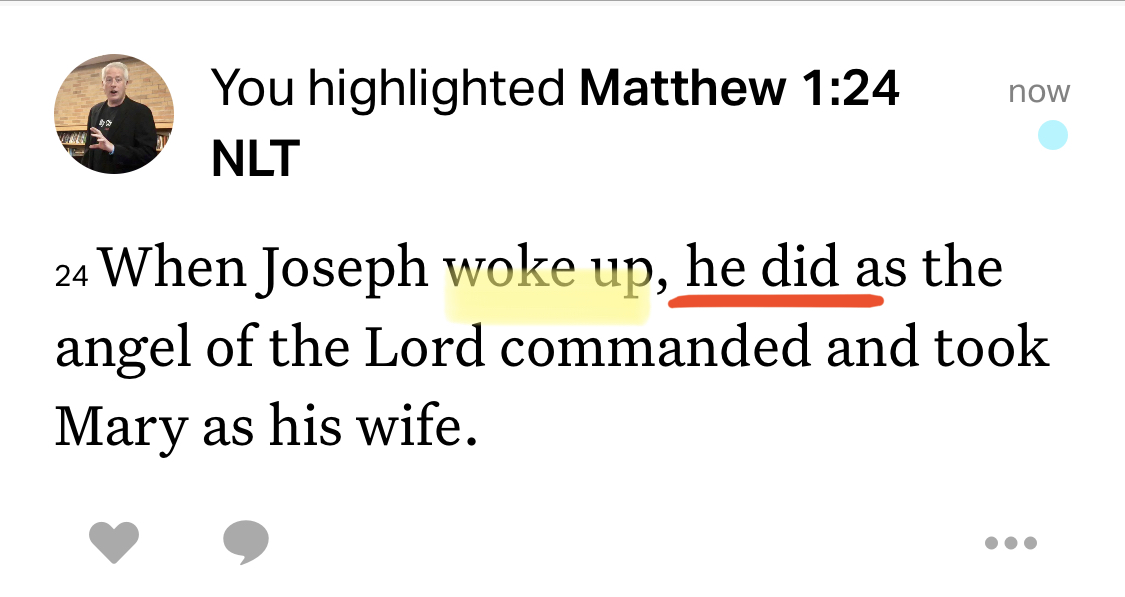
This reminds me of Joseph (Mary’s husband) in the Bible. God seemed to speak to him quite often in dreams. Instead of just sitting there contemplating the vision, there’s a phrase that shows up after every vision…

“Joseph got up and did.”

Has God given you a vision for your life? If so, just sitting there may do damage to your heart. So follow Joseph’s example and Get up and do!

Responding For Those Who Can’t

Do you know what empathy is? It’s not the same thing as sympathy. Sympathy is just wallowing with someone who is hurting, but empathy goes beyond that. Empathy is a compound word:

em- + -pathos = joined + feeling 

I feel what you feel, but I can respond like you should even when you think you can’t.

Sometimes people get paralyzed by their deep hurts, or crushing depression, or infuriating anger. Someone in sympathy feels the pain, the depression, the anger, but their involvement stops at the feeling stage.

Someone in empathy feels the hurt AND responds in an appropriately healthy way.

Check out what Paul wrote:

Who is weak without my feeling that weakness? Who is led astray, and I do not burn with anger? (New Living Translation)

When someone gets to the end of his rope, I feel the desperation in my bones. When someone is duped into sin, an angry fire burns in my gut. (The Message)

Paul took those feelings his friends and loved ones were experiencing and he turned them into positive action. This is challenging and desperately needed.

Sympathy is easy; empathy is hard work.

Sympathy keeps people paralyzed; empathy helps them move forward.

Sympathy enables people to remain unchanged; empathy gives people a healthy way to respond.

If you want to help your hurting, discouraged, or angry friend, don’t sympathize with her hurt, empathize to help her heal. By responding in a healthy way—a way she isn’t able to yet—and you will help her move to a place of wholeness.

Apathy Is Not An Option

The old joke goes like this—

Q: What’s the difference between ignorance and apathy?

A: I don’t know and I don’t care.

Corny, I know, but it does make a point.

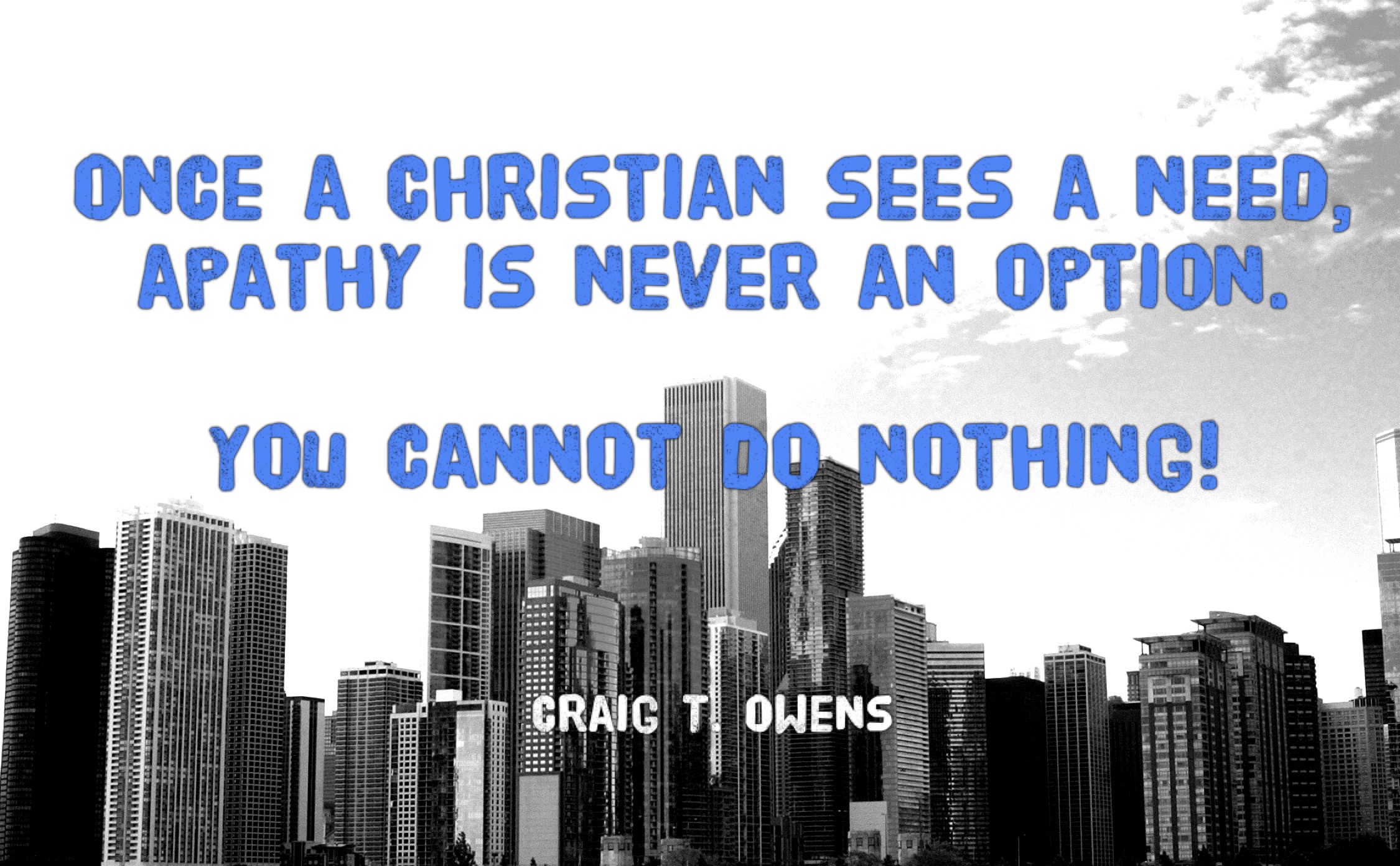
For followers of Jesus Christ, sometimes ignorance of a situation is acceptable, but apathy is never an option. In other words, you may not know what’s happening around you, but once you know, you’re on the hook. You cannot do nothing. Especially when people need help.

Nowhere in Scripture will you ever see something like this:

  • “If you feel like helping the poor, go for it. If you don’t feel like it, that’s okay.”
  • “It’s okay to look away from the hurting.”
  • “If you’re too busy to get involved, God will understand.”
  • “If it makes you uncomfortable to see that, just pretend you didn’t see it.”

Nope. I cannot do that and call myself a follower of Jesus.

Anyone, then, who knows the good he ought to do and doesn’t do it, sins. (James 4:17)

The consistently righteous man knows and cares for the rights of the poor…. (Proverbs 29:7 AMP)

The godly care about the rights of the poor; the wicked don’t care at all. (Proverbs 29:7 CEV)

Get informed and then get involved.

Do It

Here’s what God said to His people through the prophet Ezekiel, “I will judge you according to your conduct.” God says the same thing in the New Testament too.

It’s not what I believe. It’s not what I discuss. It’s not what I intend to do. It’s not what I know is right and wrong. It’s what I do.

I have to give an account of my conduct. I have to answer to God for how I lived out my beliefs. I have to show God what I did with what I believe about Him. I have to put into practice what’s in my heart.

Do I believe God is God? Do I have idols?

Do I believe God is holy? Do I sin?

Do I believe God forgives? Do I repent?

Do I believe God looks after orphans and widows? Do I?

Do I believe God is my Provider? Do I steal?

Do I believe He is Lord? Do I give Him control of everything?

Do I believe I should do something for the hungry, thirsty, naked, sick, and imprisoned? Do I do something?

This is what God judges: belief put into action. Not just beliefs, but godly actions motivated by those godly beliefs.

Faith without works is just wishful dreaming. Works without faith is just religious posturing. Works with faith is God-glorifying!

Don’t just believe it… do it.

The Hole In Our Gospel (book review)

Hole In Our Gospel, The coverWhen I first heard the title of Richard Stearns’ book—The Hole In Our Gospel—a thought crept into my mind. When I read on the back cover the phrase “to walk with the poorest of the poor in our world,” I was convinced: I just knew this book was going to be a guilt trip.

I couldn’t have been more wrong!

“The idea behind The Hole In Our Gospel is quite simple. It’s basically the belief that being a Christian, or follower of Jesus Christ, requires much more than just having a personal and transforming relationship with God. It also entails a public and transforming relationship with the world,” writes Stearns as he introduces his book.

Using his life as a personal example, and presenting a stark but realistic picture of the suffering humanity in the world today, Stearns challenged me to look outside my own paradigm. I’ve seen the infomercials about sponsoring a child, and I keep abreast of the latest calamities in the world, but Stearns presents these sobering facts in a way that made me want to do something. Stearns quoted his friend Gary Gulbranson, “It’s not what you believe that counts; it’s what you believe enough to do.”

The other thing I wrongly assumed from the cover of this book was that the problems facing us were so huge, that even if I got involved little would change. Instead, Stearns showed me practical ways to help.

Far from being a “downer” or a guilt-trip, I found this book to paint an exciting picture of what was possible if I would just get involved. I could begin to imagine a world in which humanity was better off because I was in it.

Don’t shy away from this book just because it’s written by the president of World Vision: you will not read a single “commercial” or appeal to donate to World Vision or sponsor a child. But you will be changed. You will be challenged. On the closing page, Stearns asks a poignant question: “And when you close this book, what will you do now?”

I’m going to get involved.

Doing Thinking Doing

To think or to act? That is the question. Or maybe the question should be, which comes first: the thinking or the acting? Do I think about something and then go do it? Or do I do something first and then think about what I’ve done and how I could do it better next time?

The answer, I believe, is yes.

You could be the most creative thinker in the world, your thoughts could be off on another plane, but if you do nothing with what you’re thinking, all of those great insights are wasted.

On the other hand, many people hold to the axiom that experience is the best teacher, so they just do and do and do. But experience is not the teacher; we only learn when we stop to think about what we’ve done.

William Wilberforce was already a rising star in British politics when he experienced a deeper understanding of his relationship to God. Suddenly this man of word and action wanted to do nothing more than meditate on the greatness of God. Wilberforce believed that he could best serve God by withdrawing from society and simply thinking about God.

His good friend and future prime minister William Pitt disagreed. Pitt wrote to Wilberforce, “Why then this preparation of solitude which can hardly avoid tincturing the mind either with melancholy or superstition? … Surely the principles as well as the practice of Christianity are simple and lead not to meditation but to action.” Or as the line from Amazing Grace has it, “We humbly suggest you can do both.”

I love Oswald Chambers’ counsel—

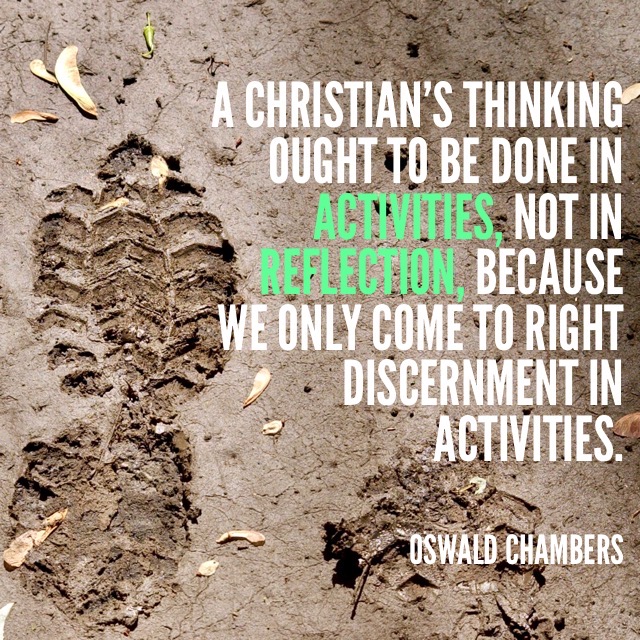
“God will never allow us to divide our lives into sacred and secular, into study and activity. We generally think of a student as one who shuts himself up and studies in a reflective way, but that is never revealed in God’s book. A Christian’s thinking ought to be done in activities, not in reflection, because we only come to right discernment in activities.”

Whether it starts with thinking or starts with action, successful thinking-doing must include both. Think about it → act on it → think about your results → do it again better than last time.

Paul wrote to the Romans how thinking and action work together when he said, “for their own conscience and thoughts either accuse them or tell them they are doing right” (Romans 2:5 NLT). The Amplified Bible renders this phrase, “their consciences (sense of right and wrong) also bear witness; and their decisions (their arguments of reason, their condemning or approving thoughts) will accuse or perhaps defend and excuse them.”

Think about it → do it → think about it → do it = the pattern for success.

T.G.I.T.

Today is Friday, and all over the country this morning people forced themselves out of bed by saying, “T.G.I.F.—thank God it’s Friday!” But today I’m saying,

T.G.I.T.—Thank God It’s Today!

I did a quick search in my Bible concordance. Check out the number of times these words appear in Scripture:

Today—203                Tomorrow—56
Now—1186                 Later—83

Clearly today is the day, and now is the time. So T.G.I.T.—Thank God It’s Today!

Natalie Grant has a great song “What Are You Waiting For” (lyrics here). The chorus in her song captures the essence of T.G.I.T.

So you wanna change the world
What are you waiting for
You say you’re gonna start right now
What are you waiting for
It only takes one voice
So come on now and shout it out
Give a little more
What are you waiting for

In the Old Testament Moses wrote a song about T.G.I.T. too. It’s in Psalm 90—

Teach us to number our days aright, that we may gain a heart of wisdom.
Satisfy us in the morning with Your unfailing love, that we may sing for joy and be glad all our days.
May the favor of the Lord our God rest upon us; establish the work of our hands for us—yes, establish the work of our hands. (Psalm 90:12, 14, 17)

Don’t make today just T.G.I.F., make today and everyday T.G.I.T.—Thank God It’s Today! Do something memorable today … do something life-altering today … do something for God TODAY and He will establish the work of your hands.

Make today a great today! T.G.I.T.!