I live by the axiom, “If you’re through learning, you’re through.” So I try to learn something new every day.
I just finished a class called New Testament Survey: a quick overview of the 27 books that compromise the New Testament of the Bible. Here’s a couple of interesting factoids I picked up from my studies:
The earliest-written book was James. Interesting, because at one point James thought Jesus (his half-brother) was nuts.
Only Matthew uses the term kingdom of heaven; all of the other writers use kingdom of God.
Mark uses the word immediately more times than anyone else. Perhaps because his source (Peter) was always doing things so quickly… sort of a ready, FIRE!, aim kinda guy.
Luke wrote what is called “the global gospel” for everyone, so he included 45 teachings/events that no one else records.
John doesn’t record any of Jesus’ parables.
John uses the word believe nearly 100 times— way more than any other writer.
Luke talks about the Holy Spirit nearly 60 times in the 28 chapters of Acts.
Romans is the longest of Paul’s epistles with 7101 words; Philemon is the shortest with just 355 words.
With the exception of the pastoral epistles (1 Timothy, 2 Timothy, Titus) Paul’s letters are arranged in the Bible from longest to shortest.
In 1 & 2 Thessalonians (only 136 verses) Paul refers to God, Christ, the Holy Spirit, or a combination thereof more than 150 times.
Paul gives Timothy seven word pictures to describe the kind of pastor he should be: son, soldier, athlete, farmer, workman, instrument, and servant.
Hebrews is called “the book of better things” so better is used 13 times. This word is used only six times in the remaining 26 books of the New Testament.
James wrote 108 verses but issues 50+ direct commands.
In John’s three short epistles he uses the word know 33 times, and the word dear ten times.
Keep on learning! There’s a lot of good stuff out there. What have you learned lately?
Listen to the podcast of this post by clicking on the player below, and you can also subscribe on Apple, Spotify, or Audible.
I sort of remember the days of full-service gas stations. My Dad would drive in and say, “Fill ’er up!” and the gas station attendant would jump into action. Filling up the gas tank, cleaning the windshield, checking the oil level, and even checking the air pressure in the tires.
But, alas, those days of full service seem to be long gone, replaced by highly-efficient, less-personal self-serve stations. And I’m not necessarily talking just about gasoline stations either.
All of our lives seem to have become more efficient and less personal. We are a more do-it-yourself, leverage-technology kind of society today. And I wonder if the result is that many people aren’t getting filled up like they used to.
There is a well-known Bible story in 2 Kings 4. A widow is facing what would amount to foreclosure today. Except this foreclosure was on her sons. Her husband, a God-fearing man, had died and left her with debts she could not pay. The practice in that society was for her sons to be “sold” to pay off the debts. These boys would have to work all day long for someone else, and whatever money they would have earned for their labors would go to the creditors.
In her desperation, the widow turned to the prophet Elisha. He asked her if she had anything of value in her house, and she replied, “Just a little oil. But not enough to pay off my debts.” The counsel Elisha gave her is applicable for our self-serve society today—
Elisha said, “Go around and ask all your neighbors for empty jars. Don’t ask for just a few” (v. 3).
Elisha asked the woman and her family to humble themselves—ask all your neighbors. Sometimes this is one of our biggest hindrances: pride which keeps us from admitting we have a need. And this was no small task because she had to ask ALL her neighbors to, “Fill ’er up!”
Elisha asked them to be persistent—don’t ask for just a few. Not just a jar here and there, but ask for every available jar to, “Fill ’er up!”
The principles in this story shouldn’t just apply to times of desperation in our lives. Because maybe if we worked on being around our neighbors and asking what needs they have, and sharing our needs as well, maybe we wouldn’t get into such desperate situations.
In the story in 2 Kings, the oil stopped flowing only after every available jar had been filled. If I want God to continue to pour His oil of blessing into my life, He has to have room in which to pour. That means that I need to be pouring into others’ lives as often as I can. Listen to the blessings when we, “Fill ’er up!”—
I want you to know how delighted I am to have Stephanas, Fortunatus, and Achaicus here with me. They partially make up for your absence! They’ve refreshed me by keeping me in touch with you. (1 Corinthians 16:17-18, The Message paraphrase)
In addition to our own encouragement, we were especially delighted to see how happy Titus was, because his spirit has been refreshed by all of you. (2 Corinthians 7:13)
God bless Onesiphorus and his family! Many’s the time I’ve been refreshed in that house. And he wasn’t embarrassed a bit that I was in jail. The first thing he did when he got to Rome was look me up. May God on the Last Day treat him as well as he treated me. (2 Timothy 1:16-18, The Message paraphrase)
Your love has given me much joy and comfort, my brother, for your kindness has often refreshed the hearts of God’s people. (Philemon 7 NLT)
Get around other “full” people and let them fill you up.
Seek out “empty” people and pour abundantly into them.
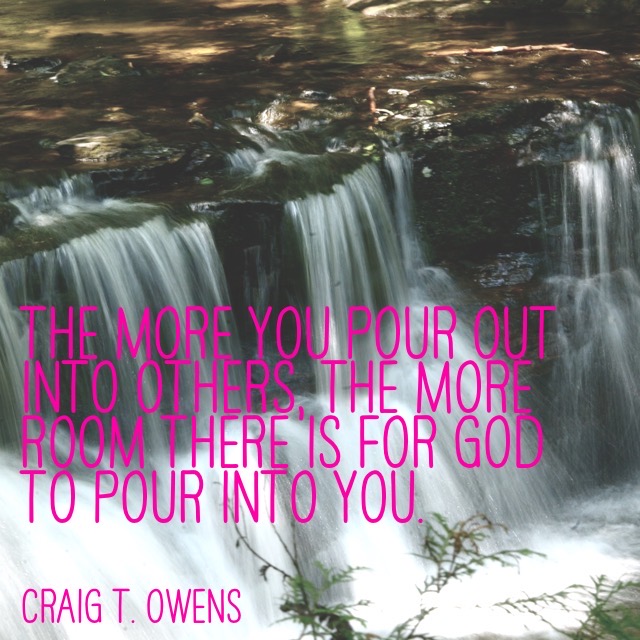
The more you pour out into others, the more room there is for God to pour into you.
God is always pleased when our lifestyle is one of “Fill ’er up!”



 I live by the axiom, “If you’re through learning, you’re through.” So I try to learn something new every day.