Listen to the podcast of this post by clicking on the player below, and you can also subscribe on Apple, Spotify, or Audible.
One of a leader’s most important jobs is guiding the vision of their organization. Much has been said about getting others to follow that vision, and in our most recent episode Greg and I talked about being careful to stay true to the vision you have set.
You can watch this full episode of The Craig and Greg Show here.
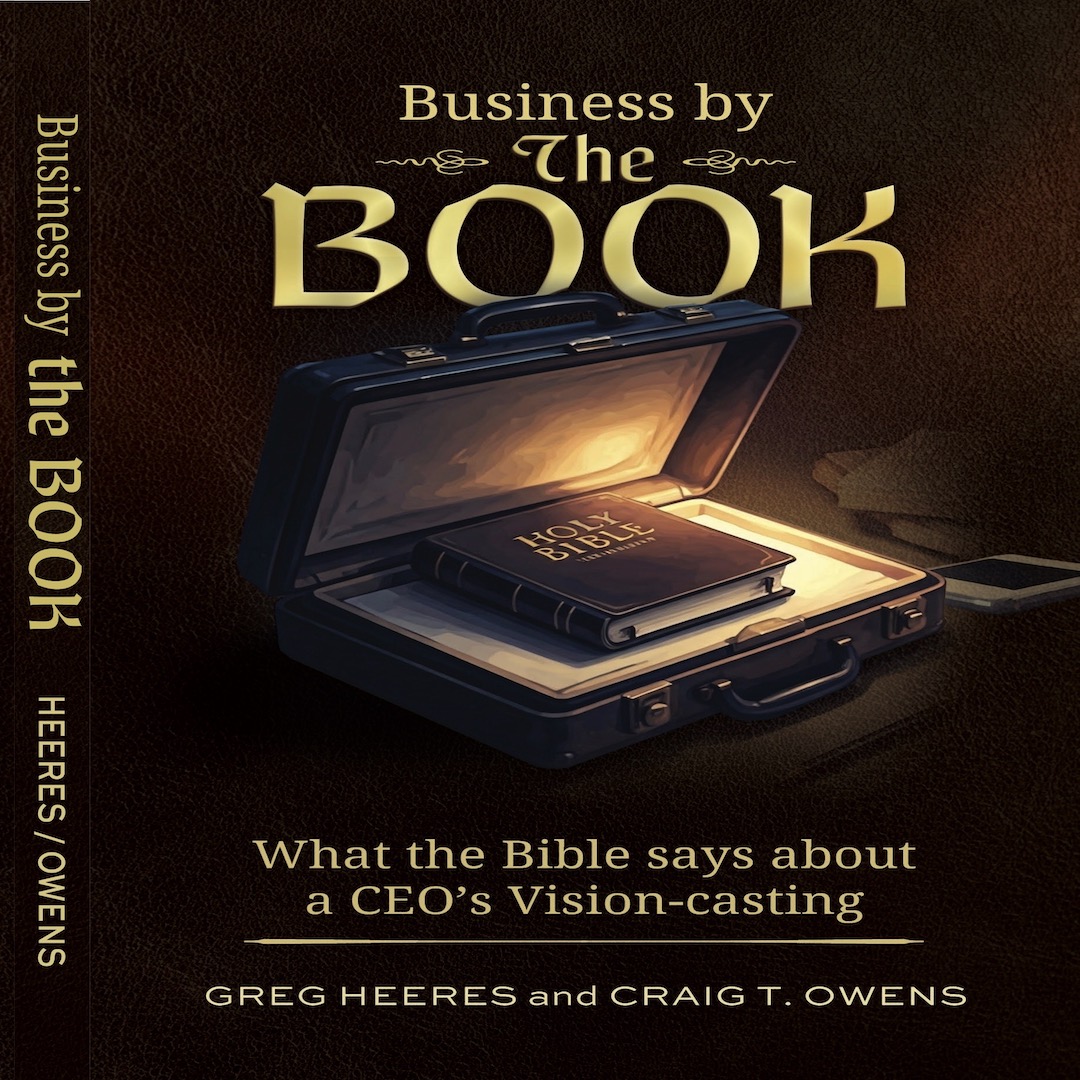
The first book in our Business by the Book series is on a CEO’s vision casting. This will be available soon. In the meantime, check out some other leadership resources from Greg and me:
Listen to the podcast of this post by clicking on the player below, and you can also subscribe on Apple, Spotify, or Audible.
In a previous episode we brought you the exciting news that Greg and I are collaborating to write a series of books called Business By The Book. In today’s episode, we revisit the first book in this series—A CEO’s Vision—and discuss how once the vision has been cast the next vital step is to bring your team along with you.
[0:00] Introduction
[0:11] I welcome Greg to an exclusive club!
[0:49] We show why we think we are over-achievers.
[2:00] Leaders need to take others along with them, transitioning from “I” to “we.”
[4:39] How do leaders handle the frustration of a slow-moving team?
[6:51] How we wrote “Business by the Book” for a CEO who is casting vision.
Listen to the podcast of this post by clicking on the player below, and you can also subscribe on Apple, Spotify, or Audible.
Before a leader can cast a compelling vision for an organization, he or she has to be living a compelling personal vision. Greg and I explain why this is an indispensable first step.
This clip is from an episode of The Craig and Greg Show where we are discussing the first book in our new series of books called Business by the Book. The first book is What the Bible says about a CEO’s vision-casting.
Check out my other podcasts, my books, and so much more by clicking here.
Listen to the podcast of this post by clicking on the player below, and you can also subscribe on Apple, Spotify, or Audible.
One of the amazing things about the Bible is that it has practical application for every aspect of our lives—including the business world! Today Greg and I are excited to announce that for the first time in our long friendship we are writing collaborators on a new series of books entitled Business By The Book. In today’s episode we preview the first book in this series about a CEO’s vision.
[0:56] Some new and exciting news on a great new project—a book that we have co-written. The first book in our series called Business by the Book.
[2:20] Vision cannot be delegated to a committee, but the CEO must be the chief vision-caster.
[2:54] Greg and I first met on a basketball court, but there was an important lesson in that game that teaches CEOs about vision-casting.
[4:40] Why does a CEO need to have a personal vision statement before they lay out a vision for their organization?
[7:23] We layout how the book is organized and share insights on the first two chapters.
[9:17] CEOs would do well to show the way to the vision before they tell others the way to the vision.
[11:00] Greg uses a concept from “Alice in Wonderland” to talk about minimizing the things that distract leaders from pursuing their vision.
[16:45] Here’s what we hope you will takeaway from this series of books.
Listen to the podcast of this post by clicking on the player below, and you can also subscribe on Apple, Spotify, or Audible.
If the expected target metrics of today’s program are met, we expect significant workflow performance advancements from team lead positioned individuals.
Does that seem a little complicated? Jargon in the workplace can very quickly cause significant problems, leading to confusion and disengagement in your team. The solution is simple—clear, concise communication. So let’s try this again without the jargon: Greg and I hope that this episode inspires you to remove the jargon from your communication, and as a result you will see your leadership influence grows.
[0:41] Today we are returning to Leadership Builders and Killers with a topic inspired by a series of videos I saw online about business jargon.
[3:21] Greg asks, “Why all the jargon?”
[5:34] Jargon can take away from what you want to communicate, and can cause others to disengage from the conversation.
[8:26] Jargon is antithetical to a commitment to clarity.
[9:33] I share a story of a conversation with students that highlights wisdom we can take into the workplace.
[12:06] One of the lowest form of communication is assumption.
[14:03] It’s important to circle back with people after a meeting to maker sure they understood.
[15:13] Jargon frequently shows up when there’s bad news to share, and when leaders are trying to cast vision.
[16:50] Sometimes we use jargon to hide.
[19:30] I share a story from the life of John Wesley about how he became a better communicator.
[21:14] It’s important to communicate with everyone on an even playing field, and not use jargon to avoid being pinned down.
[22:39] Using jargon can negatively impact your influence as a leader. Conversely, clear communication will lift your influence.
[24:58] Jargon can creep into your communication without you being aware of it. A coach from outside your industry can help you notice these blind spots.
Check out this episode and subscribe on YouTube so you can watch all of the upcoming episodes. You can also listen to our podcast on Spotify and Apple.
Listen to the audio-only version of this podcast by clicking on the player below, or scroll down to watch the video.
Everyone loves stories! Whether it be a book, movie, or even a friend’s tall tale, we love hearing stories because they connect with us on a deeply personal level. As leaders, we can use stories as a powerful tool to connect with our staff and help reinforce the point we’re trying to make. Stories aren’t just for kids, they’re a vital part of effective communication.
[0:10] “Once upon a time there was a podcast…”
[0:48] Stories portray the point better than just telling someone what to do.
[5:59] Vision casting sticks better with a story instead of a “talking point.”
[7:43] Stories are more compelling than facts. Leaders need to listen to the stories of their teammates.
[10:39] Stories are under-utilized by far too many leaders.
[12:04] Stories set the stage for everything else the leader is going to share next. But we better be sure the story is true!
[13:28] Paul Harvey illustrates how a good story can expand a leader’s influence.
[15:30] Stories get a reaction and lock it in our brains.
[16:48] Stories bridge the gap between people.
[17:28] Is storytelling a gift, a skill, or both?
[19:42] We need to tell our stories so that others can connect to their own stories.
[21:32] Leaders, you have a great story to tell! We can help coach you in how to tell your story even better.
Check out this episode and subscribe on YouTube so you can watch all of the upcoming episodes. You can also listen to our podcast on Spotify and Apple.
One of the things that contributes to “quiet quitting” is a lack of passion. But when the leader has conveyed a compelling vision for all that the organization is doing, that vision fuels the passion to work excellently. Vision can change a “have to” attitude into a “get to” attitude. Check out the full conversation Greg and I had about quiet quitting on the Craig And Greg Show. I have lots of new content every week, which you can check out on my YouTube channel.
“One important key to success is self-confidence. An important key to self-confidence is preparation.” —Arthur Ashe
“Strange as it may seem, the first rule of gracious speech is sincere listening: ‘So then, my beloved brethren, let every man be swift to hear, slow to speak, slow to wrath’ (James 1:19). Being an attentive and sincere listener is like cutting a swath through the jungle. It creates a path along which conversations can develop and people can journey together.” —T.M. Moore
J. Warner Wallace discusses how scientists who were Christians used their biblical worldview to drive their scientific pursuits. As a result, Christian scientists have been awarded more Nobel Prizes than any other group of scientific contributors!
“The devil will not stand by quietly and watch his realm decline and erode. He counterattacks with rage; his onslaught is fierce. One of the tricks he uses is to preoccupy Christian workers with issues that are detrimental to a healthy relationship with Christ. The scenario is all too familiar: a Christian worker gets busy in the ministry and work takes priority over relationship with God. He no longer has the time to sit at Jesus’ feet in quiet solitude and listen to God’s Word. Spiritual emptiness comes unnoticed and with it vulnerability to satan’s sifting (Luke 22:31-34); dishonest handling of monies or power or an illicit relationship is justified, and whoa! immorality has lured and sent such a Christian worker tumbling. He commits what he has preached against. Sin is dangerous. Sin is destructive. Its price is very costly—separation from God, irreversible stigma, damage to family relations, loss of ministry, loss of reputation, a black mark on God’s work, and the list goes on.” —Sobhi Malek
Our Creator gave us an amazing gift of the human brain! I love the fascinating new discoveries that scientists are continuing to make. Like this one: “To be spatially capable creatures, humans need their brains to tell them 1) where things are in relation to themselves and 2) where everything is in relation to everything else—the so-called allocentric map of space. To navigate an environment, the brain seems to generate a mental representation of its surroundings. This is often called a cognitive map.” Read more about our cognitive map here.
I hope you have had a chance to see the movie “Sound of Freedom.” Thankfully, this has gotten a lot of people talking about how to eliminate sex trafficking. Fight The New Drug has an excellent post on how you can spot and report human trafficking, and you should also check out Operation Underground Railroad, which was founded by Tim Ballard (whom Jim Caviezel portrays in the movie).
“It will be a comfort to me all my life to know that the scientist and the materialist have not the last word, that Darwin and Spencer, undermining ancestral beliefs, stand themselves on a foundation of sand.” —C.S. Lewis
In my book Shepherd Leadership, I talk about the simple three-word phrase that has helped me maintain this balance: God chose me. The fact that God did the choosing should give me the confidence to cast vision, but the humility that God chose me—out of all of the other people He could have chosen—should bring an appropriate humility that allows me to involve other leaders on my team.
If you would like to watch this full interview on the Leading From Alignment podcast, please go here. And if you would like to check out other clips I’ve already shared, please click here.
I’ll be sharing more clips from this interview soon, so please stay tuned. Shepherd Leadership: The Metrics That Really Matter is available in print or ebook, and in audiobook through either Audible or Apple.
God doesn’t give a vision to a leader so that a leader can have a better life, but so that the leader can help the people get to a better place. Vision is always through the leader to the people.
Daniel exhibits this in his life.
This video is a short clip from a longer video that is exclusive content for my Patreon supporters.
Listen to the podcast of this post by clicking on the player below, and you can also subscribe on Apple, Spotify, or Audible.
When the righteous thrive, the people rejoice… (Proverbs 29:2).
I have read hundreds of leadership books and biographies of history’s most influential leaders. But no book even comes close to the leadership principles I discover on an almost daily basis in my Bible. Without a doubt, my Bible is my go-to leadership Book!
A great place to start mining leadership principles is the book of Proverbs. Take time to study just one of the 31 chapters each day, and you will be astounded at the leadership insights you will have gleaned by the end of the month.
Take Proverbs 29 as an example. Reading through this chapter, I’m reminded that:
righteous leadership causes people to rejoice
a leader builds stability through consistent justice, but bribes or showing favoritism undermines a leader’s foundation
leaders who speak up for those without a voice of their own will continue to exert influence long after their tenure is over
wise leaders energize people when they share a compelling vision
justice comes through a righteous leader, but ultimate justice come from God
I even read an important warning for leaders who make it their goal to lead righteously: Bloodthirsty men hate a man of integrity and seek to kill the upright (v. 10).
But even on the heels of that warning I read this assurance to continue to lead righteously: Fear of man will prove to be a snare, but whoever trusts in the Lord is kept safe (v. 25).
A mark of a godly leader is one who is continually finding new leadership principles in the Bible.
Try it for yourself and see how applying God’s wisdom will increase your influence as a leader.
This is part 58 in my series on godly leadership. You can check out all of my posts in this series by clicking here.








 Craig T. Owens