(Red) & Convoy Of Hope

I love to see when individuals and businesses and organizations come together to address a pressing need. Sometimes we see it in short bursts (like tsunami or earthquake response), but once the tragedy is no longer in the headlines, people quickly forget. But the need remains.

(Red) is an ongoing project addressing the huge need of AIDS in Africa.

Convoy of Hope not only responds immediately to disasters but stays in place for the long haul to make sure that infrastructures and displaced people are reestablished.

I encourage you to buy (Red) products, follow (Red) on Twitter, Facebook, YouTube, and on their website.

You can do with same with COH: follow them on Twitter, Facebook, YouTube, and on their website.

Here’s a great (Red) video:

Christians, we need to especially be people who stay informed and get involved.

BOGOF

Sometimes to get a point across, the only thing you can do is create a new word. Does anyone remember Rich Hall’s list of sniglets on Saturday Night Live? A list of 20 sniglets is here.

This morning we talked about the Parable of the Talents, where the servants were expected to do something with the talents God had given them. Then Jesus talks about the end of time judgment where we are divided into those who did something for God by addressing human needs, and those who ignored the human needs around them.

How do we remember this? How do we apply it to everyday life?

Then it hit me: we all eat; in fact, most of us eat every day. In order to eat, many of us go to the grocery store. And to help stretch the food budget, we often use coupons. When we get one of those buy-one-get-one-free coupons (a BOGOF), what do we do with the free one? Do we consume it ourselves, or could we give it away? Wouldn’t giving away the free one honor God by helping feed the hungry?

So we created a word—BOGOF—and turned it into a refrigerator magnet. We’re going to do our best to build into our daily lives the habit of loving others by addressing their practical needs.

Why don’t you try it yourself? Maybe you can create your own word too! If you do, please be sure to share it in the comments below.

Satisfied Service

I started a conversation last week about being a servant (you can catch up here).

Serving should be a two-way street. Contrary to the way that some people look at servanthood, being a servant is not the same thing as being a doormat. Consider two key verses:

  • Each of you should look not only to your own interests, but also to the interests of others. (Philippians 2:4)
  • Submit to one another out of reverence for Christ. (Ephesians 5:21)

We should look equally to others’ needs as well as our own needs. Zig Ziglar says it this way, “You can have everything in life you want, if you will just help other people get what they want.”

This can be manipulation if you’re simply looking to someone else’s interests as a form of flattery or as a quid pro quo. But if you are truly serving—if you truly have the other person’s best interests in mind—if you are willing to submit to them out of reverence for Christ, serving can be liberating.

Last week Rick Warren tweeted, “The more self-centered I am, the more unsatisfied I’ll be.” I retweeted with this addition, “So the more I serve, the more satisfied I’ll be.” I believe that.

Try it for yourself—it works!

Loving Servanthood

Over the past couple of days I’ve been thinking a lot about something: What does it mean to serve? Or more specifically, what does God say about how we should serve?

The typical image that comes to mind when someone says “servant” is a person of lower status—someone who is at the lower end of the organizational chart, someone who is expected to do more with less, someone who doesn’t have many opportunities for advancement (or even a day off), or maybe someone who is expected to be tuned into everyone else’s needs but seldom has his own needs met.

Is being a servant the same thing as being a doormat?

Consider Jesus:

He now showed them the full extent of His love…. Jesus knew that the Father had put all things under His power, and that He had come from God and was returning to God; so He got up from the meal, took off His outer clothing, and wrapped a towel around His waist. After that, He poured water into a basin and began to wash His disciples’ feet, drying them with the towel that was wrapped around Him.

Jesus was the most important person in the room: Jesus KNEW that the Father had put all things under His power. He was also the most love-filled person in the room. What did He do with all of His love and power? He served others.

When He finished, John writes that He returned to His place, and asked His disciples a question, “Do you understand what I just did?” Then in the only instance of Scripture where Jesus Himself said this, “I have set you an example that you should do as I have done.”

Servants are people who use the power they have to lovingly serve others.

Servants don’t serve because someone else forces them to serve. Servants serve because the love of God empowers them to serve.

Do you love your spouse enough to serve him/her? Do you love your family enough to serve them? Do you love your coworkers enough to serve them? The greater the love we have for others, the greater the empowerment to serve. Love empowers us for service.

Take The Initiative

“You have not lived today until you have done something for someone who can never repay you.” —John Bunyan

I love doing something unexpected for someone. Something kind and thoughtful, but totally “out of the blue.” It’s especially nice when the person for whom you do something nice needs it the most, yet would be the last person to ask for help.

In Matthew 25 Jesus talks about people who take the initiative to help the poor, the hungry, the needy. Jesus never says that they asked for help, but simply that His followers saw the need and addressed it. Jesus concludes by saying, “When you did it to one of the least of these My brothers and sisters, you were doing it to Me!

Even better: we take the initiative to bless one of the least of these and we get a blessing from God. How cool is that!

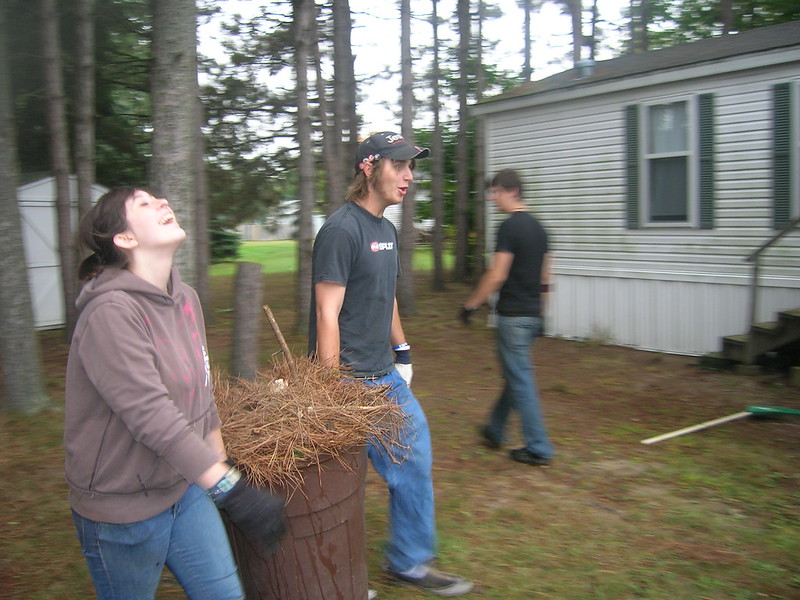
Over the weekend our youth group showed up at a precious lady’s house unannounced. We all affectionately refer to Thelma as “Grandma.” We didn’t tell her that we were coming, we just showed up and started cleaning up her yard. (Disclaimer: I have to admit that we did get an immediate blessing, in that Grandma’s daughter Joan made us a cake, so we got a slice before we left.) Pictures are here.

I’m so proud of these young servants who showed up to bless Grandma. As you helped her, you were helping Jesus. Great will be your reward in heaven—way to go!

Give It Away To Have More

It seems like we never have enough. Enough time. Enough money. Enough food. Enough friends.

As weird as it sounds—the cure to have enough is to give what you have away.

Imagine a drought … famine … despair. Lakes drying up and wells running dry. The dairy cows aren’t producing as much milk as usual, and the beef cows don’t have as much meat on them as they used to. The wheat fields aren’t growing as abundantly, and the corn is dry and mealy. Men don’t work as much, their wives don’t visit as much, and the kids don’t play as much.

Now, what if you found out you were going to be fortunate enough to host a VIP at your home? How do you prepare a decent meal? How do you think this VIP is going to react to the meager meal set before him? What if someone came from a distance away and brought you 20 loaves of freshly-baked bread?

Do you know how Elisha responded in these settings? He said, “Give it to the people to eat” (2 Kings 4).

Elisha shows up at his guests’ home and says, “Put the large pot on the stove and make some stew.” The large pot?!? Don’t you know we’re in a famine? Don’t you realize that we don’t have very much to spare?

Put the large pot on the stove and make some stew, then serve it to the people to eat,” Elisha said. He didn’t ask for the food to be prepared for himself, but for others. And not just a little stew either—he said make stew in the large pot. It’s interesting to me, too, that the householders had all the ingredients for a stew, but they were trying to stretch it out and make it last longer. They were hoarding what they had.

Then a friend arrives from a distant land bringing Elisha 20 loaves of bread.

Do you know how Elisha responded to this gift? “Give it to the people to eat.” Give it to the people?!? There are over 100 people here and we only have 20 loaves! That seems a bit cruel to just whet people’s appetites with so little; why don’t we just keep it for ourselves.

But Elisha said, “Give it to the people to eat. Not only will they all eat, but there will be leftovers too.”

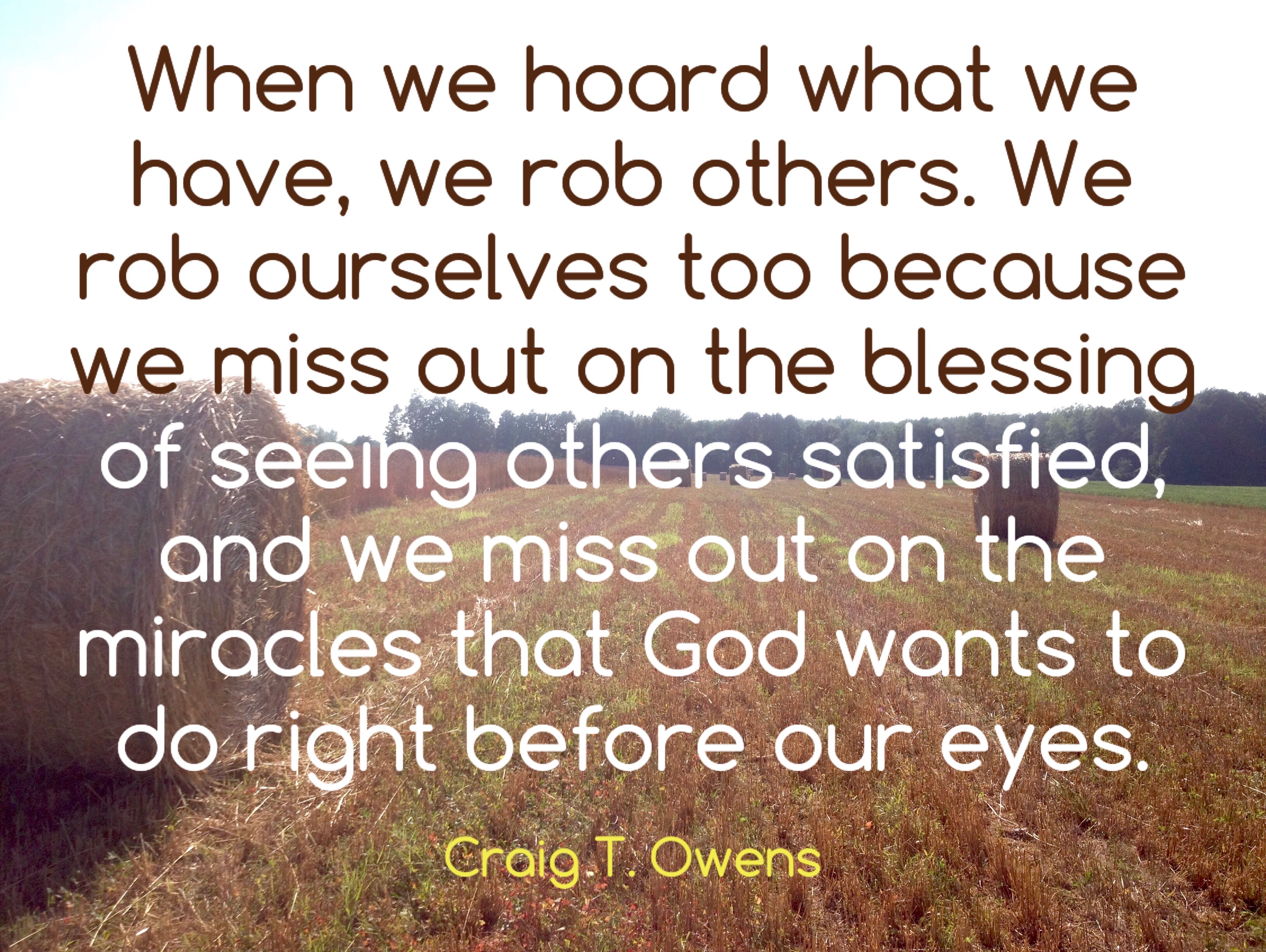
When we hoard what we have, we rob others. We rob ourselves too because we miss out on the blessing of seeing others satisfied, and we miss out on the miracles that God wants to do right before our eyes.

“Why does God bless us with abundance? So we can have enough to live on and then use the rest for all manner of good works that alleviate spiritual and physical misery. Enough for us; abundance for others.” —John Piper

So, when you think about it, don’t you really have enough time to help someone in need?

Don’t you really have enough money to alleviate someone’s suffering?

Don’t you really have enough food to satisfy someone’s hunger?

Don’t you really have enough love to make a new friend?

Don’t rob yourself by hoarding. Don’t buy into the scarcity mindset that looks away from others. The more you give away, the more you will have. Try it, it works!