The Right Questions

“The uncreative mind can spot wrong answers, but it takes a creative mind to spot wrong questions.” —Sir Anthony Jay

This has always been a challenge for me—maybe for you, too. I can easily spot when someone gives me a wrong answer, but it’s harder to spot when I’ve asked a wrong question. It could very well be that the answer I’m hearing is correct in light of the question I asked.

But spotting wrong questions requires a humility on my part to admit I may be wrong. Spotting wrong questions requires creativity, a new way of looking at things.

There is a short story about the life of King Abijah recorded in 2 Chronicles 13 in the Bible. Abijah is the second king to reign in Judah after the 10 northern tribes had seceded. He is vastly outmanned and out-spent by King Jeroboam of the northern tribes (called Israel). When it comes to a battle between north and south, Abijah can only field half as many men as Jeroboam.

Yet it is Abijah who takes charge of the battlefield before the fighting begins. He climbs to the top of Mount Zemaraim to make sure all of the northern tribes can hear him. The wrong question would have been, “Which side is God on: Israel’s or Judah’s?” The correct question which Abijah must have asked and answered for himself—is, “Are we on God’s side?

Abijah begins to recount how God chose for a descendant of David to sit on the throne (Abijah), but northern Israel was following a rebel (Jeroboam). God intended for the descendants of Aaron to oversee the sacrifices and religious practices; Judah was doing this, but Israel had their own priests. God was to be worshipped exclusively; Judah was doing this, but Jeroboam made golden calves for Israel to worship.

So Abijah correctly concludes, “God is with us; He is our leader.”

Abijah didn’t assume God was with Judah. Abijah didn’t ask, “Does God lead us or them?” Abijah asked, “Are we doing the things that God has asked of us?” Since Judah was following God, Abijah could then state with confidence, “God is with us.”

The question is not, “Is God on your side?” It’s better to ask, “Am I on God’s side?

The question is not, “What would Jesus do if He was here?” It’s better to ask, “What did Jesus already do that I can follow?

What questions are you asking? Change your questions and you just may change your life.

I Like People With Less

You would probably think that if I needed counsel or advice I would seek out someone who is well educated in the area I need help. I should probably find an expert in the matter that’s troubling me. It seems somewhat counterintuitive, but I am finding that those who know less can actually help me more.

Listen to C.S. Lewis, “The fellow-pupil can help more than the master because he knows less. The difficulty we want him to explain is one he has recently met.” He can help me more because he knows less.

I know this tends to be true when one of my children asks me to help them with something in their homework, or a friend asks my help on a computer problem she is experiencing. Because I have already worked out the steps, I no longer have to proceed sequentially; that is, I don’t have to go from Step A to Step B to Step C, and so on until I get to the answer. Because of my past experience, I can jump right to Step K.

Great for me. Totally unhelpful to those asking for my advice. In essence, I’m doing all of their thinking for them. I haven’t taught them anything, except that I’ll do their work for them.

Lately, I’ve been spending quite a bit of time with a friend who is thinking about what it means to have a relationship with Jesus. He has very, very little church background, so I have been forced to go back to Step A with him, because Steps K, L, M, and the like would make no sense to him.

This is why I love being around the unchurched, the dechurched, and the never-churched. This is why I love talking to and listening to teenagers and 20-somethings who are new to their relationship with Jesus. These fellow pupils are so recently going through situations that it really makes me pause to go back to my beginnings.

Try it yourself. There is some great wisdom in those who have “been there done that.” But I’m also getting some great insights from those who are “here now doing this.”

A Silly Dream World Or The Real Deal?

“What is ‘real’? How do you define ‘real’? If real is what you can feel, smell, taste, and see, then ‘real’ is simply electrical signals interpreted by your brain. … Have you ever had a dream, Neo, that you were so sure was real? What if you were unable to wake from that dream? How would you know the difference between the dream world and the real world?” —“Morpheus” in The Matrix

We are created in God’s image. God is eternal and unrestricted, yet we are contained in finite bodies and constrained to the time-space dimension of our universe. That hardly seems “real.” Yet our souls—the “real” part of us—were made to be timeless and unbound. It seems like a dream, and yet sounds real.

To help humanity navigate the dream-real state in which we find ourselves, God gave us incredible insights into His Word: the Bible. The answers to our dream-real questions are there if we’re willing to search for them.

C.S. Lewis wrote, “What we see when we think we are looking into the depths of Scripture may sometimes be only the reflection of our own silly faces.” The Apostle James talks about God’s Word as a mirror in his letter to the church (1:22-25). In this, I see three people.

(1) One who never looks in the mirror; one who simply accepts what’s presented to him. Again “Morpheus” comes close: “You have the look of a man who accepts what he sees because he is expecting to wake up.” James says this is a man who attends church regularly, but never applies what he hears. In fact, he probably never even hears anything other than what he thinks the pastor said. That man is silly, shallow, and stunted in his spiritual growth (if there is even any growth at all!).

(2) One who looks in the mirror but doesn’t do anything about what he sees. He hears the Word of God at church and perhaps even reads his Bible often at home; he knows all the stories and how everything should be. But he, too, never makes any changes in his spiritual “appearance.” He is content with where he is. If he ever feels the pull of desire that there could be more real to his dream-real world, he quickly explains it away. He is at the same spiritual maturity level today as he was years ago.

(3) One who looks into the mirror, recognizes that he is silly-looking, and then does something about it. It’s hard work and often this man feels like he’s not growing because he continues to see his silly face reflected back to him. As Albert Einstein noted, “As a sphere of light increases, so does the circumference of darkness around it.”

James says only this third man has been freed from his dream-real constraints and is called blessed by God. Only he is beginning to understand how to make the dream real.

In which category are you? Are you brave enough to look into the depths of God’s Word and see your silly face? Are you willing to make the changes the Bible shows you to free your soul?

Sharper Thoughts

John Maxwell said, “Some of my best thinking has been done by others.” I believe that what Dr. Maxwell was saying is that our creative thoughts can become even better when someone else helps sharpen them.

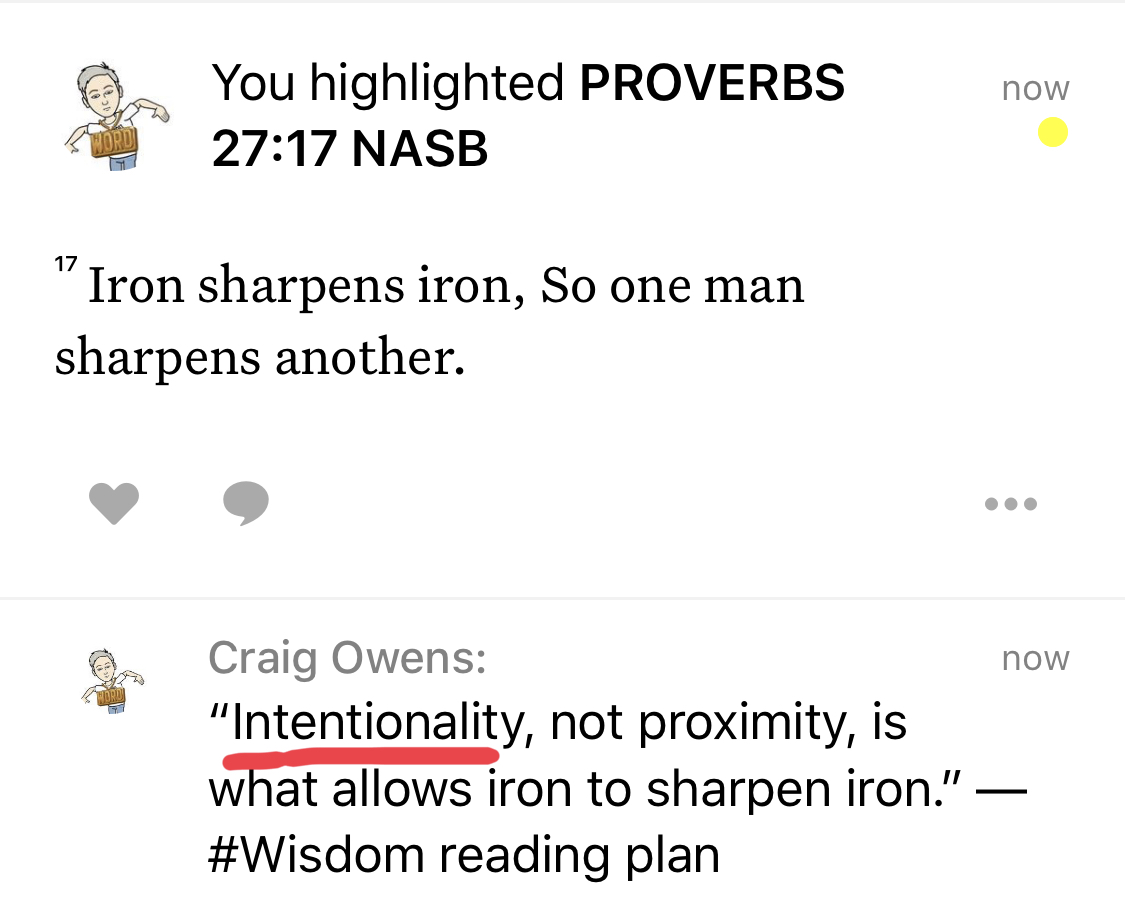
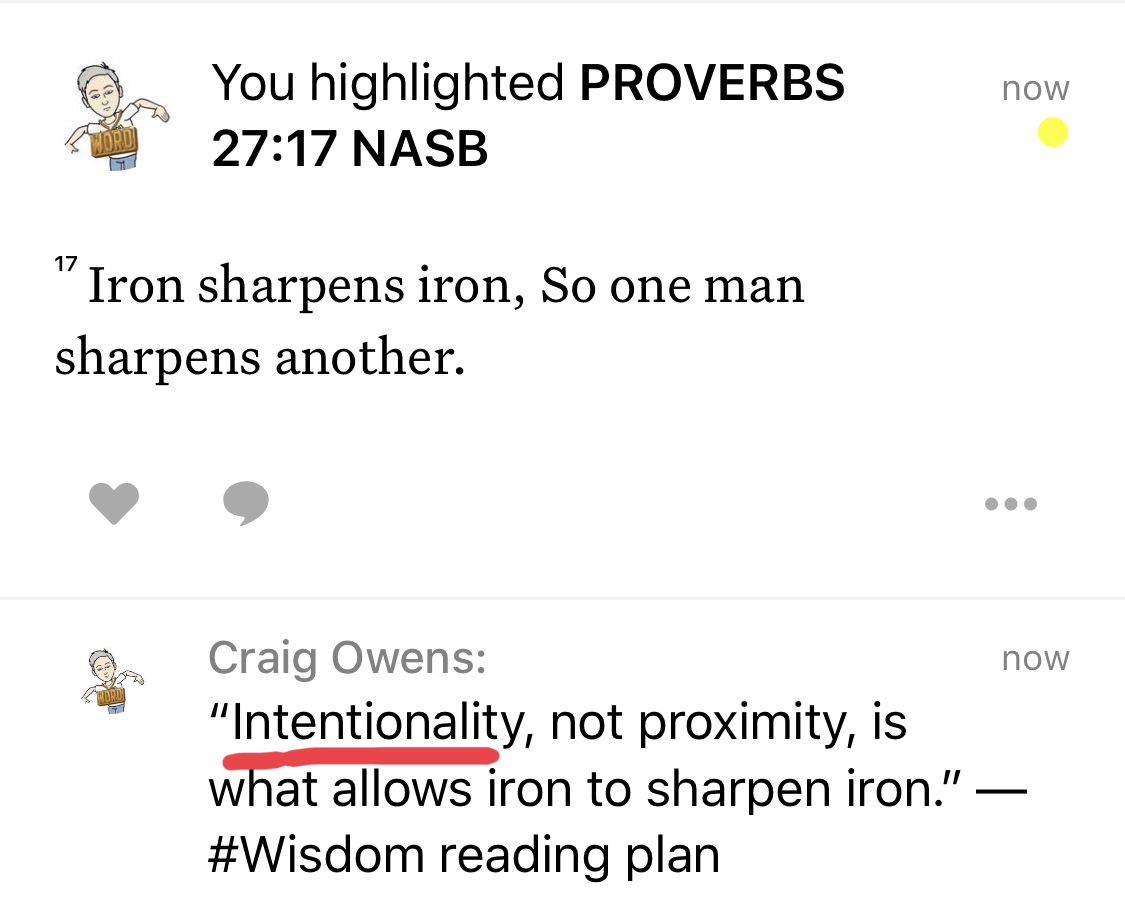
King Solomon, a pretty fair thinker himself, said the same thing when he wrote, “As iron sharpens iron, so one man sharpens another” (Proverbs 27:17). In other words, you need some pretty sharp people to help you think better thoughts, sharper thoughts.

Check out what John Stuart Mill wrote in On Liberty

“Nor is it enough that he should hear the arguments of adversaries from his own teachers, presented as they state them, and accompanied by what they offer as refutations. That is not the way to do justice to the arguments, or bring them into real contact with his own mind. He must be able to hear them from persons who actually believe them; who defend them in earnest, and do their very utmost for them. He must know them in their most plausible and persuasive form; he must feel the whole force of the difficulty which the true view of the subject has to encounter and dispose of; else he will never really possess himself of the portion of truth which meets and removes that difficulty. Ninety-nine in a hundred of what are called educated men are in this condition; even of those who can argue fluently for their opinions. Their conclusion may be true, but it might be false for anything they know: they have never thrown themselves into the mental position of those who think differently from them, and considered what such persons may have to say; and consequently they do not, in any proper sense of the word, know the doctrine which they themselves profess.”

General George C. Marshall, chief of staff of the Army during World War II, created the largest army the world had ever seen (13 million soldiers) in the shortest time possible. General Omar Bradley tells of being called into Marshall’s office in 1939, a week after the outbreak of war in Europe. Marshall was disappointed in Bradley, “You haven’t disagreed with a single thing I have done all week!” Marshall wanted to make sure he was doing his very best so he was calling on another sharp comrade to challenge his thinking.

Do you have some sharp people around you? Do you listen to those who disagree with you? If you do, your creative thoughts can become even sharper.

Are You Out Of Your Mind?

I love this thinking thought from James William Fulbright—

“We must dare to think ‘unthinkable’ thoughts. We must learn to explore all the options and possibilities that confront us in a complex and rapidly changing world. We must learn to welcome and not to fear the voices of dissent. We must dare to think about ‘unthinkable things’ because when things become unthinkable, thinking stops and action becomes mindless.”

After you have identified the negative thoughts and you have started thinking creatively, you have to be able to take it further. You have to be able to think unthinkable things.

Too many times we don’t let our minds begin to go into “unknown” places, so we look at everything through the lens of what we’ve experienced in the past. Our thoughts are “in our minds.” When Albert Einstein began to propose that there were more dimensions to our universe than scientists had previously thought, people had a hard time following his reasoning. Even those in the scientific community thought he was “out of his mind.”

One of Einstein’s favorite books was called Flatland. In this book, Square lives in the two-dimensional world that Sphere came to visit. Because Square’s world only has length and width (no height), he can only see the part of Sphere that was on his level. As Sphere moves through Flatland, Square can see different parts of him, but he can never see all of him at the same time. If Sphere moves above Flatland, Square can still hear his voice but cannot see his shape.

So, too, with us. Many times we only perceive what moves through the “line of sight” we have previously experienced. We are—so to speak—in our minds.

But look what God has in store for you—

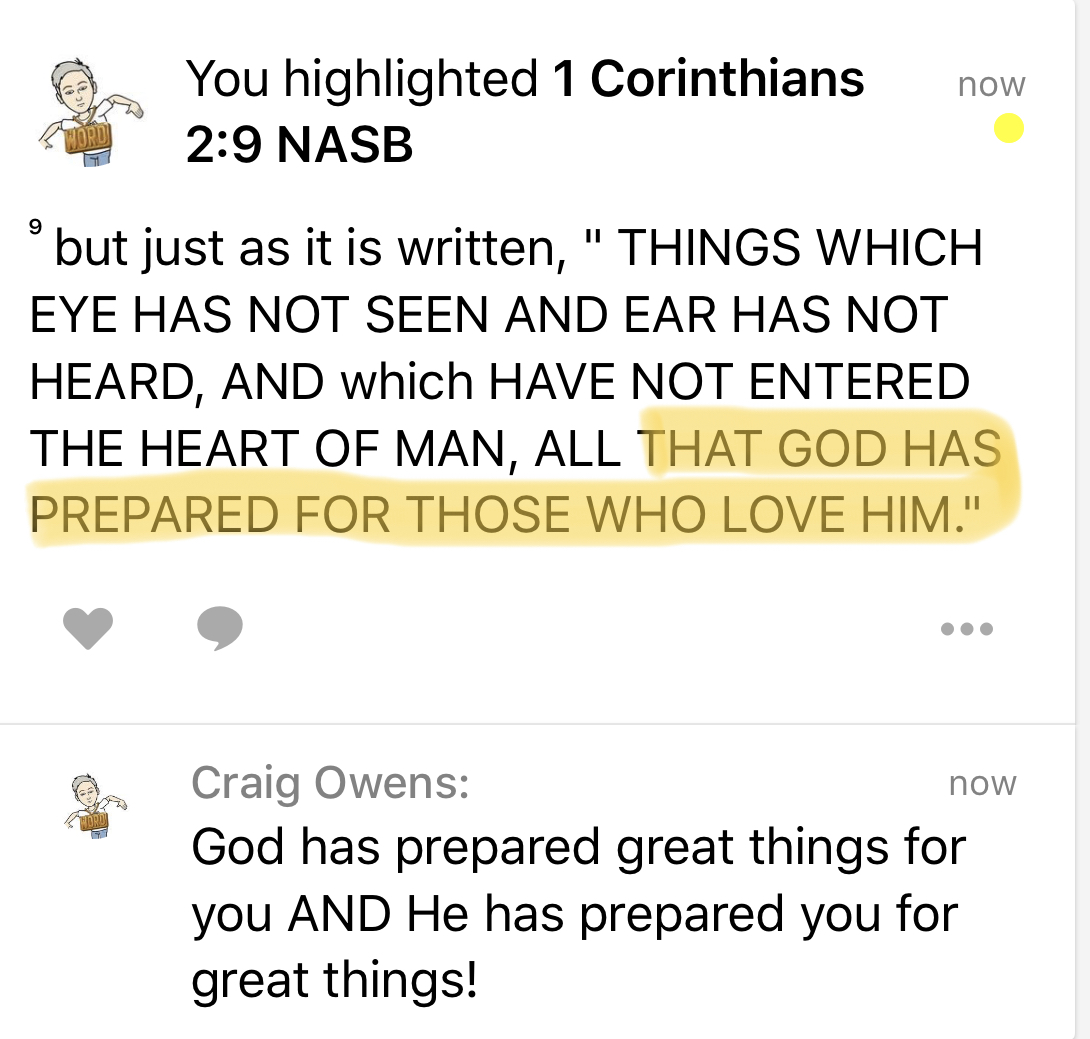
No eye has seen, no ear has heard, and no mind has imagined what God has prepared for those who love Him. (1 Corinthians 2:9 NLT)

So here’s how Scripture teaches us to pray—

I pray that from His glorious, unlimited resources He will empower you with inner strength through His Spirit. Then Christ will make His home in your hearts as you trust in Him. Your roots will grow down into God’s love and keep you strong. And may you have the power to understand, as all God’s people should, how wide, how long, how high, and how deep His love is. May you experience the love of Christ, though it is too great to understand fully. Then you will be made complete with all the fullness of life and power that comes from God. Now all glory to God, who is able, through His mighty power at work within us, to accomplish infinitely more than we might ask or think.(Ephesians 3:16-20 NLT)

God wants to do infinitely more than you can ask or think. He wants to show you new dimensions of His greatness and His love—notice that Paul goes out of his way to list four dimensions (wide, long, high, deep) even though we live in a three-dimensional world.

Here’s the question: are you OUT of your mind or IN your mind? In other words, are you only looking for things that you know can happen, or are you believing God for things that are completely OUT OF YOUR MIND?

Get Your Mind Out Of That Rut!

“Don’t become so well-adjusted to your culture that you fit into it without even thinking.” —Apostle Paul (Romans 12:2, The Message)

It’s important to think about your thinking—to analyze why certain thoughts are swirling through your mind. But after you identify unhealthy thoughts, you need some creative thinking to be able to move your life in a new direction. This requires a whole new set of thinking skills that are called critical thinking.

Stephen Brooking described it this way, “Critical thinkers are continually exploring new ways of thinking about their lives…. Critical thinking is complex and frequently perplexing, since it requires the suspension of belief and the jettisoning of assumptions previously accepted without question.”

  • What have you accepted without question?
  • What have you become so well-adjusted to that you simply accept it?
  • Are there things you do just because it’s always been done that way?
  • Are there some things that you won’t try because it’s never been done that way?

Two warning signs in your thinking are always and never. With the exception of God, everything changes. So when you start thinking in terms of always and never you are essentially saying, “Nothing changes. And I’ve got everything figured out.” This is mind-in-the-rut thinking!

You’ve probably heard this before but it is valuable enough to be repeated—If you always do what you’ve always done you’ll always get what you always got.

If you need a change in your life, start with a change in your thinking. Ask God to help you think in new ways. In talking to His people about what He had done for them in the past God said it was time to think in creative ways—

But forget all that—it is nothing compared to what I am going to do. For I am about to do something new. See, I have already begun! Do you not see it? I will make a pathway through the wilderness. I will create rivers in the dry wasteland. (Isaiah 43:18-19 NLT)

Don’t let your thinking stay stuck in a rut. Allow God to help you jettison the old ways of thinking and expand your horizons. God will give you greater creativity if you ask Him.

Thinking About What You’re Thinking About

When was the last time you thought something new for the first time? Atheist Bertrand Russell said something painful, but true, “Most men would rather die than think. Many do.”

I’ve written before about the most important and most lengthy conversation all of us have every day. It’s the conversation we have with ourselves—it’s called thinking. But for many people, their thinking is stuck in a rut.

I’ve often had conversations with people bucking against a new thought where I have asked them why they believe what they believe. Far too many times they tell me, “That’s just the way I was raised.” Okay, but what do you think about it? “I don’t know. That’s just the way I was raised.”

Two books that have really helped my thinking are As A Man Thinketh (James Allen) and Thinking For A Change (John Maxwell). Allen uses the analogy of our minds as gardens where we need to constantly pull out the weeds and plant the thoughts that will bear the fruit we desire. Maxwell challenges us to look differently at the way we think our thoughts.

The Apostle Paul tells us to take captive every thought and make it obedient to Christ (2 Corinthians 10:5). And then we can begin to change the way we think: Fix your thoughts on what is true, and honorable, and right, and pure, and lovely, and admirable. Think about things that are excellent and worthy of praise (Philippians 4:8).

“Rarely do we find men who willingly engage in hard solid thinking. There is an almost universal quest for easy answers and half-baked solutions. Nothing pains some people more than having to think.” —Martin Luther King, Jr.

If your thinking is ever going to go to a higher level it has to start with this: You have to be willing to think about what you’re thinking about.

In other words, why are you thinking what you’re thinking? Start capturing the thoughts running through your mind and ask them, “Why are you here?” Are you thinking what you’re thinking because you thought it, or because someone else thought it for you?

It is only by capturing the thoughts that are already in your head that you can sort out the healthy thoughts from the unhealthy thoughts.

The Thinking Book

“The book to read is not the one which thinks for you, but the one which makes you think. No book in the world equals the Bible for that.” —James McCosh

My kids recently returned from a PK (Pastor’s Kids) Retreat weekend. Our Michigan Assembly of God District Youth Director Jeff Kennedy coordinates this weekend every year. A fun part of their time together is a take-off of Jeff Foxworthy’s “You might be a redneck if…” routine. It’s called “You might be a PK if….” Here are a couple of my favorites—

  • You might be a PK if you’ve used the church sound system as your personal stereo.
  • You might be a PK if National Take Your Kid To Work Day is any day you don’t have school.
  • You might be a PK if you’ve ever taken a bath in the baptismal tank.
  • You might be a PK if you occasionally take Sunday afternoon naps on a church pew.
  • You might be a PK if every answer your Dad gives you comes from the Bible.

Cute! And, for the most part, dead-on accurate!

But that last one got me thinking: do I do this? I sincerely hope (not just because I’m a pastor) that the answer is always “yes.”

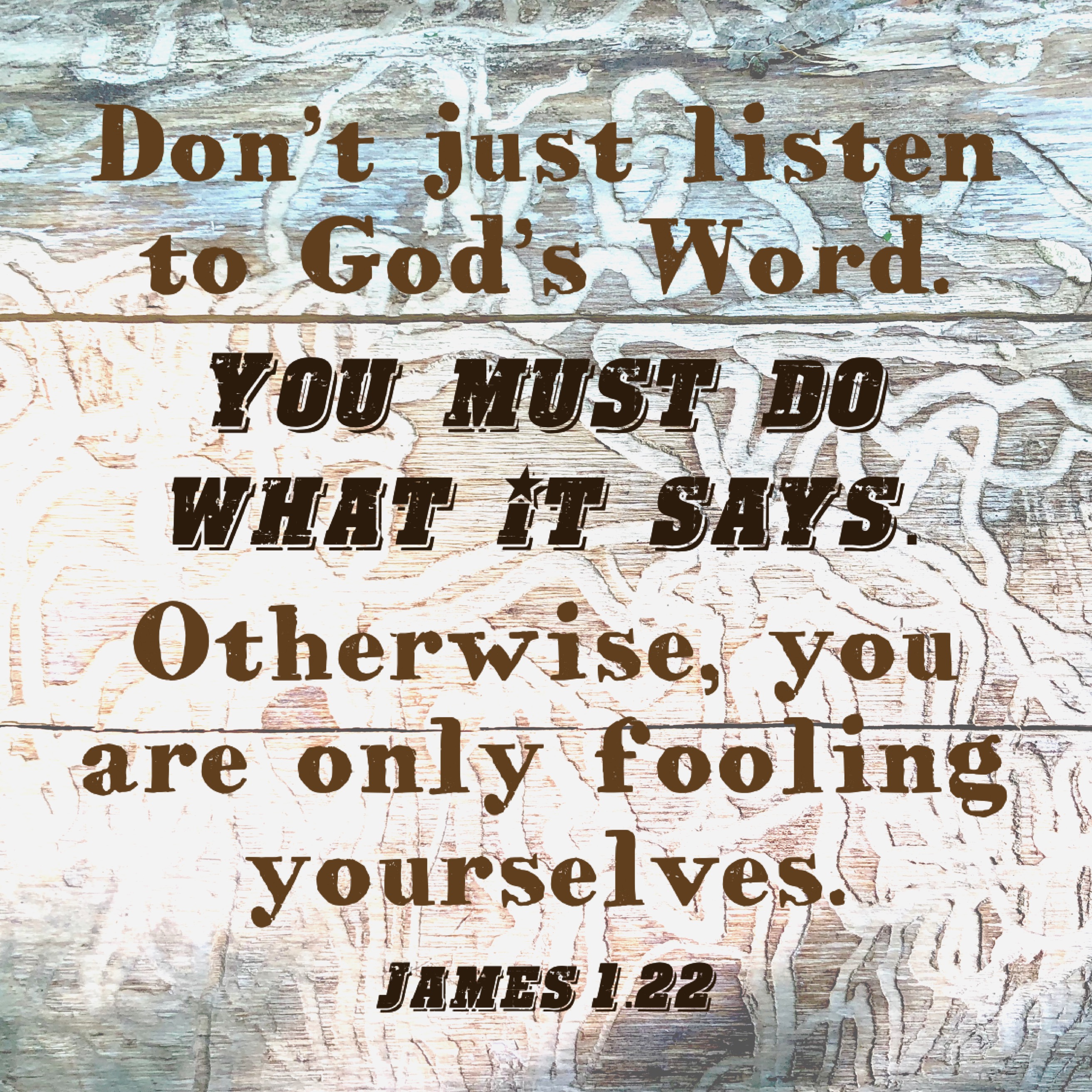
I agree with James McCosh that no other book in the world compares to the Bible for challenging me to think. In the King James Version of the Bible, there is a phrase that James uses about God’s Word: he says that we should “receive with meekness the engrafted Word” (James 1:21).

The more I read the Bible, the more its principles become engrafted into my thought patterns. The more I think about the Bible, the more my attitude about life conforms to God’s attitude. And the more my attitude conforms to God, the more my actions and words align with the Bible.

You don’t have to read much every day for God’s Word to make a difference in your life. If you are honest with the Holy Spirit as He illuminates a passage of Scripture to you, you will see how God’s Word can be applied to your life today.

“The Bible is…a chart by which the Christian sails to eternity, the map by which he daily walks; the sundial by which he sets his life; the balance in which he weighs his actions.” —Thomas Watson

To be successful make sure you are looking often at the chart, the map, the sundial, and the balance of God’s Word.

A Powerful Prayer

“Bible study is love reading its Lover’s letters. Prayer is love keeping tryst.” —S.D. Gordon

The Bible is God’s love letter to humanity; more specifically, to you and me. But did you know that the Bible can also be used as our love letter to God?

If you’re a parent, you know how powerful it is when one of your children quote you back to you. Like when my daughter reminds me, “Dad, you said that you would….” Even if I haven’t forgotten what I said, it’s still so nice to know that she was listening to me and remembered what I promised her.

God has never, ever forgotten His word to us. But as our Heavenly Father, He loves to know that we hear His words, that we remember His promises, and that we love Him. So one of the most powerful prayers you can pray is when you pray God’s own words back to Him.

Personalized prayer based on God’s Word is a powerful prayer.

Let me give you an example. Here’s a prayer I wrote out the other day from 1 Chronicles 22:19—

Now…

There is no time to wait, I have to begin now. I cannot put it off a moment longer. It’s never an interruption of my day for me to draw closer to You, my God. Now I come to You in love.

devote…

This is not a partial commitment. I’m giving You my all. I’m laying all of me on Your altar. I’m not holding anything back. It’s all Yours, God, all of me.

your…

This is mine to give, and I’m choosing to give it to You. I’m not living for someone else; I’m not riding anyone’s coattails. I’m giving You what is mine to give. I’m giving you me.

heart…

My dreams, my passions, my desires. They’re all Yours, Heavenly Father. I reserve no passions for my own selfish pursuits, but I only have passion for You.

soul…

My inmost being—who I really am—the part of me that’s truly me is all Yours. My mind, my will, my emotions, my personality is only alive because of You.

seeking…

My longing, my soul’s craving is for You. I look for You’re everywhere and in everything. I seek You in the bird’s song, in the ocean’s roar, in the mountain’s majesty, in the midnight’s silence, in the bee’s buzz, in my children’s laughter, in my wife’s kiss, in my friend’s counsel, in Your love letter to me.

the Lord…

You are Lord over all. There is not now, nor ever will there be, anyone to take Your place in my heart.

your God…

You are mine and I am Yours. Forever. Because You loved me I love You, my God.

Now devote your heart and soul to seeking the Lord your God (1 Chronicles 22:19).

Use your Bible to form your own powerfully intimate prayers to the Lover of your soul.

Sharper Thinking

Yesterday I was challenged to do a lot of thinking. To think about things I’ve not considered before, and to think about things I have considered before but from a different perspective.

Yesterday a fellow pastor convened a Pastor’s Leadership Thinking Lab. The purpose was to use Warren Bullock’s book When The Spirit Speaks as a springboard to talk about the vocal gifts of the Holy Spirit in operation in our church services (see 1 Corinthians 12-14). At the outset, we all reaffirmed our unwavering commitment to our fellowship’s fundamental truths—those were non-negotiable. The challenge was to think about and discuss the practicalities of the how’s in our church services.

It was a bit intimidating being in the room with such smart people. These are guys with way more education and experience than me—guys who have had the privilege of studying and discussing this topic with some of the greatest Pentecostal thinkers of our generation. I felt a little out of place. In fact, during the lunch break, one of my friends commented, “Have you ever felt like that in a roomful of tuxedos you’re the one brown shoe?” My feelings exactly.

But King Solomon wrote, “As iron sharpens iron, so one man sharpens another” (Proverbs 27:17). The iron of my colleagues definitely sharpened me yesterday.

I also like what John Maxwell said, “Some of my best thinking has been done by others.” In other words, these really smart guys have thought about some things in ways I haven’t; they’ve been exposed to some great thinkers that I haven’t; they’ve experienced some things that I haven’t. But spending the day with them was like getting that education they received, having those conversations with great thinkers they had, and experiencing those things they experienced.

Did I agree with everything that was shared? No.

Was I challenged to think differently? Yes.

F. Scott Fitzgerald wrote, “The truest test of a first-rate mind is the ability to hold two contradictory ideas at the same time, and still retain the ability to function.”

If you really want to sharpen your thinking, get around some people smarter than you. Spend time with people who see things differently than you. But most of all, make sure these folks are one in purpose with you. All of the guys in this Lab shared the same passion to see God glorified and people drawn into a deeper relationship with Jesus. That’s what made yesterday so rewarding for me.

Do you have some “iron” friends in your life that are sharpening your thinking?