Flexibility

I am working through a fascinating devotional book called Live Dead. It’s not just a book, but a challenge to live differently. I strongly encourage you to purchase this book, and then take the Live Dead challenge. With the permission of the book’s editor, I am reproducing Day 22’s challenge.

Flexibility: God’s Music, Written In Three Flats by Bob McCulley

Some of the most dangerous times in our life and ministry are when we lock our dreams and hopes in concrete, when we become so focused on what we are planning to do that we cannot see what God is trying to do. One day, while serving among the Maasai people of East Africa, I was running late for an appointment to meet with the village elders in a place called Mbirikani, which was about an hour away from our home. The purpose of the meeting was to appeal for a site where we could build a church in that village. My planned departure was delayed and my wife, Murriell, tried to soothe my anxiety with the words, “God has everything under control.”

I drove my four-by-four vehicle quickly up the road and was making good time until I got a flat tire, which I hurriedly changed. A few minutes later, I had a second flat and again made a tire change that would make a pit crew proud. Deep in the bush and well off the road, I had a third flat tire, and my third and final spare had to be removed from the luggage rack. In the process of getting it off the roof, it rolled away from me and down the hill into a large clump of thorn brush. By the time I retrieved it, my clothes were torn and my face and arms were bleeding from multiple scratches.

As I was preparing to mount the third spare tire, a Morani, a Maasai warrior, came walking out of the forest and greeted me. I did not wish to have a conversation because I was dirty from changing the flats and was now very late for what I thought was a critical appointment. His greeting was congenial and correct, while mine was harsh and abrupt. But I had good reason: I was late, dirty, bleeding, and angry. His next words stopped me. He knew my name. He had heard me preach a few weeks before, and that morning on awakening had decided to go to town to find me and to ask me to help him receive Christ. He had set off before sunrise to walk about 15 miles to town to find me and only halfway there, had found me on the roadside. I stopped changing the tire, cleaned my hands, and got my Bible out. Soon we were sitting under a thorn tree, reading and praying together as he became a newborn follower of Jesus.

When we were done, he thanked me and disappeared back into the forest, and I sat in wonder of the way God schedules our lives. By then I knew I had been right on time for the only appointment God had scheduled for me that day. I had no spare tires left, so I finished mounting the third spare and turned the truck around and headed home. Days later, I learned that the meeting had been postponed until the following day and our appeal had been granted. The community had given us 10 acres of ground on which to develop the ministry.

Our plans and dreams are often far removed from what God has in mind for us, and a lack of flexibility may cause us to miss Him and to be broken in the missing.

Live Dead Challenge—Look for a way you can be flexible today. Anticipate an interruption and welcome it as an opportunity, an event God has scheduled for you — even if it makes you late or it means that something you planned does not happen. In the days to come, look for ways you can be flexible. In service opportunities down the road, commit to flexing — dying to your plan and schedule that you might live to the surprises God injects in your daily life.

You can order the Live Dead book and other resources by clicking here.

And, for those of you who live in or near Cedar Springs, join us for a series of messages and a free copy of Live Dead in February.
On The Verge (book review)

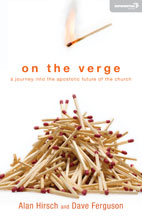
I’ve only been acquainted with the writings of Alan Hirsch for a short time, but—wow!—do his thoughts resonate with me. On The Verge, which was co-authored with Dave Ferguson, is a thought-provoking, paradigm-challenging look at the potential of the church.

Alan and Dave make it very clear right from the outset that the church in America is at a crucial make-or-break point. They point out that the church in Europe and Australia have already lost their effectiveness in their cultures, and if the church in America doesn’t wake up soon, it will soon head down that same sad path toward irrelevancy.

The good news is that everything the church needs to become the disciple-making, missionally-minded, Christ-centered force it should be is right within it. If churches are willing to realign themselves with the apostolic gene at their core, they are right on the verge of something great!

On The Verge focuses on how churches can imagine, shift, innovate, and then move. Both Alan and Dave are well-suited to inspire their readers to take up this challenge before it’s too late. Alan’s thoughts about the church are so far ahead of the curve, and Dave is not just a church theorist, but he’s successfully doing all of the practices shared in this book.

Pastors and church leaders especially need to read this book. But—as Alan and Dave point out—this is not an issue just for professional clergy. In fact, if the church in America is going to survive and thrive, everyone needs to be involved. This will be a challenging book to read, but well worth your time.

I received a free copy of this book for review.

Does Either-Or Work?

Sometimes I read about this debate whether churches should be “attractional” or “missional.” The first approach says that church should attract people first, and then share the gospel with them. The second approach says that if churches simply focus on sharing the gospel they will then attract people.

Either-or. Either missional or attractional.

What about both-and?

Consider the life of Jesus. No one would ever argue that He wasn’t “on mission” all the time. In fact, numerous times He says, “I’m doing what My Father wants me to do,” or even, “It’s not time for me to do that yet.” Jesus was missional.

And yet… “Tax collectors and other notorious sinners often came to listen to Jesus teach. This made the Pharisees and teachers of religious law complain that He was associating with such sinful people—even eating with them! (Luke 15:1-2). People loved being around Jesus. Jesus was attractional.

Jesus exemplified both-and missional-attractional. I think He was able to perfectly balance this because of the work of the Holy Spirit. I can aim for the both-and of missional-attractional in my life … I can give it my best shot. But the only way I can truly achieve anything is by allowing the Holy Spirit to shape and direct my life, just as He did for Jesus. Henry & Melvin Blackaby, in their book Experiencing The Holy Spirit, wrote:

“The world doesn’t need to see good people giving their best to God; they need to encounter God doing in and through us what only He can do! …Our best isn’t good enough when it comes to kingdom work; we need the Holy Spirit in our lives if we’re going to be of use to God.”

I need the Holy Spirit in my life if I’m going to be of use to God, and be of any benefit to people.

I need the Holy Spirit in my life if I’m going to balance both-and missional-attractional like Jesus.

Are You A Missionary?

My cousin is a missionary in a country that is over 98% Muslim. Every day he engages Muslims using their language, their culture, their beliefs, their traditions. He’s in their homes, their businesses, their marketplaces.

He shows them how much Jesus loves them by showing them how much he loves them.

The other day I was reading one of his recent e-newsletters where he described what a missionary is:

Missionaries engage culture respectfully, learning local languages, celebrating what is good, speaking against injustice, speaking for those too weak or abused to speak for themselves. Missionaries often love their adopted countries as much as natural citizens do. Missionaries exalt Christ and point to Him as the only answer for our common sin problem, and the only hope for lasting peace. They are a blessing to their families and society. They are loyal to their families, faithful to their authorities, and servants to their communities.

When I read this description I thought, “I’m a missionary. I do all of these things right here in Cedar Springs. Like learning the local culture and traditions; celebrating the good in our community; speaking out for those who can’t; supporting our schools, police, fire, and elected officials.

I My Church and I Cedar Springs!

Two questions:

1.  Do you agree with my cousin’s definition of missionary?

2.  Are you a missionary in your community?

The Only Thing Missing

Last night we kicked off our week of pray by focusing our prayers on missionaries. We had a special missionary guest with us, and I was moved by his prayer. In essence, he prayed:

With all of the millions and millions of Christians in our churches, and with all of the millions and millions of dollars in resources we have, the only that is keeping us from reaching the 6900 unreached people groups is a “Yes.”

Wow!

I pray more people will say…

  • Yes, I will pray for missionaries.
  • Yes, I will give to missions.
  • Yes, I will go.

The only thing missing is a “Yes.” Can you be a part of that “Yes”?

Thinking About And

These are my “raw notes” from The And Conference. If anyone wants to add on, modify, or delete, please feel free.

Alan Hirsch

Cultural differences – imagine numbers 1-4 as barriers to even starting a conversation (m1-m4).

In western culture we’re pushing more toward m3 or m4. In fact, the gap between m0 and m1 is shrinking.

Our idea of church is 17 centuries old (tracing back to Constantine), so there is a HUGE assumption we’re making when we think “church.” From m0 to m1 is the church’s current domain. No cultural barriers have to be crossed. However, much of culture is in m3-m4.

If we act attractionally in a missional setting, we’ve extracted them from their “m” zone. New believers in 3-5 years after becoming a Christian will have no non-Christian friends. We’ve extracted them!

Most people feel good about God, Jesus, and spirituality. However, there are negative feelings about “church.” Most people remember or focus on only three things in their “perceived set.” Marketers try to get their product/service in that perceived set.

Jesus, yes; church, no. Kind of like iPhone, yes; AT&T, no. But now the Apple logo on the iPhone reminds people of AT&T.

The dechurched have been inoculated against the church.

Dream out-loud at high volume about what the church could be!

“As the Father sent Me, so I send you.” How did the Father send Jesus? He stepped into culture, He lived in the culture and spoke to people out of culture. Church should come out of mission, not mission out of church. Just like the Acts church didn’t require Gentile believers to adopt Jewish practices. So we don’t plant churches, we plant the Gospel and let the church grow out of that.

The Bible doesn’t know the difference between “clergy” & “laity.” Why do we persist in putting people in these categories?

————–

“Apostolic” is the Greek version of the Latin “missional.” We need an apostolic environment to take movements to a place of spontaneous expansion. The apostle is a catalyst to growth.

Paul starts churches which start churches = movement → expansion.

Paul then teaches. He is the custodian of the movement’s DNA. He is also the guardian of the purity of the DNA.

An “apostle” is not an apostle if it’s a top-down leadership. An apostle is a servant leader.

Ephesians 4

  • vv. 7-11  APEST = apostle, prophet, evangelist, shepherd, teacher.
  • vv. 12-16  maturity—cannot get to maturity without all of APEST. Most denominations focus just on S & T. “Shepherd” is only used once in the New Testament, and the New Testament says, “Not many of you should presume to be teachers.”

Leadership is a calling within a gifting. APEST gifts are given to everyone, but some are called to be leaders within their gifting.

APEST gifts carry more of a vocational weight. Gifts of the Spirit are more of empowerments for the moment. The gifts of Romans 12 are motivational/paradigmal gifts.

———-

Re-Jesus = a renewed focus on full Christology: most of our focus is on the Cross, resurrection & return. We need to include Incarnation & His life among humanity. We make Him Savior, but not Lord.

Re-mission = who God is must determine what the church does.

Re-organize = missional churches are responsive to the world around us. Our churches must be organized to be nimble.

Tim Stevens

Every new term that comes out tells us we’re doing church wrong. So Tim says “Missional schmissional!” and “Attractional schmactional!”

Most churches are defined as “Come to us.” But this only works for <40% of people. People are still “spiritual,” but they don’t like “church.”

Do we attract the unchurched 60% OR missionalize the churched 40%. How about BOTH-AND? We have to help the 40% reach their 60%.

We can still say “Come and see,” but emphasize “So that” = “Come and see what Jesus does so that you can tell others.”

There is no one-plan-for-all method for churches to do BOTH-AND. Each church must discover what works for them in their community.

Jason Miller

Linear thinking is how our brains process info. That’s why telling stories with a plot twist is so powerful. Like when Jesus said, “You have heard… but I tell you….” Twists get people’s attention.

People in the world have had their imaginations devastated by culture who says love is conditional. When we talk about God’s unconditional love, it’s a plot twist they never imagined.

We have a mandate to do something beautiful. Beauty awakens imaginations to see God’s love. Like sympathetic vibrations: God’s beauty begins to resonate and awaken imagination.

“The church is God’s imagination to the world.”

Dave Ferguson

What can we do for those who won’t come to church?

Missional people (micro level) + Multiplying churches (macro level) = Missional movement

How to create a missional culture: (1) Ordain every member; (2) Lead with a “Yes”; (3) Make heroes of everyday people.

Saying “Yes” doesn’t mean funding the project or even announcing the project. It just means giving people permission to reach out.

Business paradigm that makes money but not movements: say “No” to anything that you haven’t fully researched.

Matt Carter

We can’t have “professional Christians” that do ministry & those that only receive ministry.

Christianity today needs to look like what we see in Acts.

What if instead of attracting new people to church, we released current attendees to do ministry?

What if it wasn’t “come and see” but “go and do”?

Small group success = seeing & addressing a need in the community. “Nothing builds community better than mission. When we aim at community, we may get it. But when we aim at mission, we get that and community too.”

Need to share success stories and failure stories. This creates a culture that let’s everyone know that it’s okay to try.

Hugh Halter

We need to redefine “disciple” because now we define them as “church attendee.”

Two categories: missional and sojourners. Missional people prepare the way for sojourners to become missionals by making the Kingdom of God tangible.

A better definition of disciple is apprentice. An apprentice is learning by doing; they’re hands-on.

Second decision environment = people choose to get more involved. For example, Sunday morning attendance is a first decision; a small group is a second decision.

Barriers to discipleship: individualism, consumerism, materialism. To overcome these barriers, Jesus put people in a place of tension. This typically can’t take place in a first decision environment.

Other ways to address these barriers: modeling, confrontation, action/reflection.

Jesus wasn’t interested in followers, but in disciples.

Rob Wegner

“Every member is a minister.” —Mark Beeson

Attractional churches use centripetal force to bring people in. Missional churches use centrifugal force to send people out.

Attractional is embedded inside missional. Attractional is the seed for missional. As Hirsch said, it’s more “extractional.”

Attractional seeds → Missional community → Extractional movement

Do we have to see church as institution and church as movement as opposites? Or co-existing? Genius of BOTH-AND!

Attractional Or Missional?

Yesterday was a full day at The And Conference. I’m so glad I came to this! All day long I had so many thoughts swirling through my head and emotions tugging at my heart.

The idea behind And comes from the conundrum of The Tyranny of Either-Or versus The Genius of Both-And. Is there a way for two seemingly opposing ideas to coexist, or even to enhance each other? In the case of this conference, the both-and/either-or tug is between attractional churches and missional churches.

Yesterday I listened to profound thinkers like Alan Hirsch, Rob Wegner, Hugh Halter, Matt Carter, and Dave Ferguson. Many of them shared their personal tension with the attractional/missional models. There were so many other terms that were thrown around too.

But sitting in my hotel room last night debriefing, I began to think about Jesus. He is the only One to ever balance both-and perfectly.

  • He both attracted and repelled people.
  • He both called and sent.
  • He was both in the church and in the community.
  • He was both religious and irreligious.
  • He spent time with both crowds and individuals.
  • He was both attractional and missional.

Of course, the Bible doesn’t use any of these terms—they’re all man-made—but Jesus embodied them all.

He embodied them.

He was Himself.

He is “I AM.”

That’s what I want: To be myself … be who God created me to be … be more and more conformed to the image of Jesus … be listening more attentively to the counsel of the Holy Spirit.

If I am myself, terms like missional and attractional will take care of themselves.

(By the way, I’ll be tweeting throughout the conference again today. Follow me on Twitter here, and search for the hashtag #and10.)

Yummy

It’s noon, He’s hot and thirsty after a lengthy journey and some intense ministry, so Jesus sits down by a well to get a drink. He’s hungry too, so He sends His disciples into town to buy some lunch. Along comes a woman from the town, whom Jesus engages in conversation about eternal life. (It’s a really cool story—read the whole thing here.)

While this woman runs back into town to invite others to come hear what Jesus has to say, the disciples return with lunch.

“Here, Jesus,” they say, handing Him some food, “eat something.”

“No, thanks,” Jesus replies, “I’m not that hungry right now.”

The disciples start talking among themselves, “What? Where did He get food? Did someone bring Him something to eat?”

Jesus overhears them and makes this fascinating statement:

The food that keeps Me going is that I do the will of the One who sent Me, finishing the work He started.

What nourished Jesus was feeling the Father’s approval.

What energized Jesus was seeing other people begin to understand the Father’s love for them.

What motivated Jesus was to take every opportunity to tell someone else about God’s love.

Finishing the work that God started is good and good for you.

It’s yummy and it’s nourishing!

So I’m asking myself:

  • What nourishes me?
  • What energizes me?
  • What motivates me?
  • What is so fulfilling that I cannot go a day without it?

My prayer—my heart’s desire—is that the answer to all of these questions every single day is finishing the work of God in my generation.

A Sense Of Urgency?

I’m reading a challenging book today called Endued With Power: The Holy Spirit in the Church. I just read a thought-provoking quote from the book:

“If the church that is claiming to be Spirit-filled is not a missionary community that is living with a sense of urgency, then its members will be caught up in the rush to respectability and social accommodation” —Steven J. Land

(1) Do we have that sense of urgency? Are we living and working and sharing like today is the day Jesus could return?

…or…

(2) Or are we more concerned about what is socially acceptable and politically correct? Are we just playing church?

I pray that I am leading our church always into that first category. I pray that I personally am always living with that sense of urgency.

Convoy Of Hope

I’m a big fan of Convoy of Hope. They provide timely humanitarian need in time of disaster, giving people a tangible picture of the compassion of Jesus.

A couple of huge miracles

  1. Convoy Of Hope had just restocked their warehouse in Haiti just before the earthquake hit.
  2. The COH warehouse wasn’t damaged during the earthquake.
  3. A couple of missionaries in the Dominican Republic had just secured passes to travel back-and-forth from the D.R. to Haiti. This made them a great resource to be able to take supplies and workers into Haiti.

You can see a video update from COH president Hal Donaldson. You can also donate to COH here.

Our church took a special offering for Convoy of Hope on Sunday. I’m glad we can help in this way.