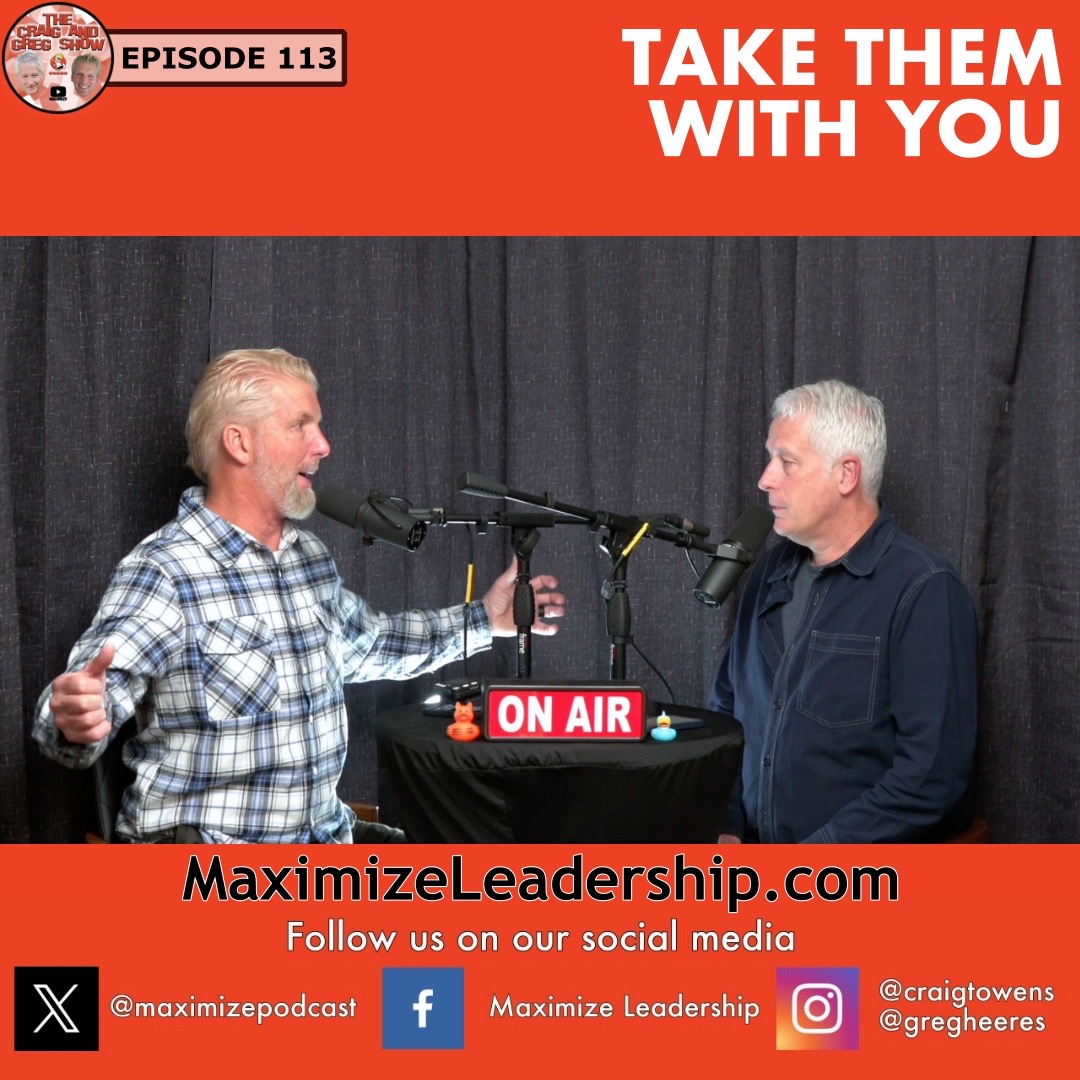
The Craig And Greg Show: Leading Generations

Listen to the podcast of this post by clicking on the player below, and you can also subscribe on AppleSpotify, or Audible.

“Kids these days just don’t understand!”

That’s probably a phrase you’ve heard more than a few times from members of generations your elder, and there is some truth to it! Each generation has very diverse experiences which make them unique from the groups before and after them. In today’s episode, Greg and I want to encourage you to understand and embrace generational differences to make your team stronger.

  • [0:00] Be sure to pick up Greg’s new book Sales Armageddon.
  • [0:32] I got called a Boomer!
  • [1:18] Communicating with a multi-generational team requires different approaches.
  • [2:52] Many from the Boomer generation are past retirement age, but still enjoy the work they do.
  • [4:09] Boomers tend to respect authority, where Gen X might be more skeptical.
  • [4:42] Boomers value formality, but Gen X have embraced a more relaxed work culture.
  • [6:01] “Put in the time” versus “the value I bring” mentalities.
  • [6:59] Boomers have a very work first mentality, Gen X embraced more of a work-life balance.
  • [8:33] Newer generations are much more likely to work multiple jobs in their career.
  • [9:43] Motivations and loyalties across different generations.
  • [12:31] Generation iY.
  • [13:32] The learning and work styles of different generations.
  • [14:39] Gen Y are heavily influenced by internet and social media thought.
  • [16:01] Gen Y are very well informed, but sometimes lack practical experience.
  • [16:44] Desire to collaborate varies across generations.
  • [17:33] We like to lead in our preferred style, but that isn’t always the best approach.
  • [20:18] Gen Z have in many ways begun to mirror Boomers.
  • [21:18] The top line takeaway is respect.
  • [22:51] I share my biggest lessons learned growing in the workforce.
  • [24:14] Greg shares his final thoughts on generational divides.
  • [26:43] Maximize coaching can help you learn to better connect with your team.

Links & Quotes

When leaders come into a new organization, they need to be aware that they have to overcome the expectations—good or bad—that others have from their former leader.

I have a lot of new video content on my YouTube channel every week. Please check it out and subscribe so you don’t miss anything.

Greg Morse has an intriguing question for preachers: “Lawyers, politicians, celebrities, actors, podcasters, YouTubers all train to improve their voices—why not those who speak the very oracles of God?” But he also concludes, “Yet the aim is to speak like you—not like Chrysostom, Whitefield, Spurgeon, or your favorite preacher, though we learn from them. God made you to sound like you.”

J. Warner Wallace makes the case for why we can trust the “chain of evidence” that speaks to the reliability of the Bible. 

Researchers discovered tree amber where it shouldn’t be: deep within the ocean! “These sedimentary rocks contain more than amber. The researchers found abundant plant debris, including pieces of large tree trunks, some longer than four feet, mixed into the layers. The tree trunks showed no sign of erosion from transport or borings from shallow marine organisms, indicating they moved fast out to the deep water and were quickly buried.” This is more evidence for the worldwide Flood described in the Bible.

Axis’ Culture Translator shared this important note especially for parents: “In his book Achilles in Vietnam, Veterans Affairs psychologist Jonathan Shay unpacks the psychological devastation of war and the causes of PTSD. He makes the argument that PTSD isn’t just caused by witnessing trauma, but by seeing people in authority choose not to act against evil—what he calls a ‘moral injury.’ War correspondent Sebastian Junger takes this research a step further. In his book Tribe, he concludes that being exposed to a traumatic event without any resilience training, and without a strong, cohesive community to help us process violence, are two strong risk factors for PTSD—stronger even than experiencing prolonged, bloody, hand-to-hand conflict. We see evidence for this theory in emerging research about drone operators and intelligence officers, who appear to experience PTSD at higher rates than other veterans. When our kids open their social media feeds, they encounter a war zone, and they haven’t even had basic training. They are looking to those in authority to help them understand what they just saw. But instead, they often get a cacophony of competing voices and no clear answer. They get a moral injury. Our broken society makes cult heroes of deeply disturbed individuals who are controlled by evil forces and motivated by their own pain. But Proverbs 3:31 is absolutely clear that we are never to envy those who do violence, and not to choose any of their ways. His private counsel, His intimacy, His secret—lies with the upright, and we can have it. But only if we dare to make distinctions, refuse to celebrate wrongdoing no matter the circumstances, and unapologetically stand up for human life.”

Shepherd Your Family

Listen to the podcast of this post by clicking on the player below, and you can also subscribe on AppleSpotify, or Audible. 

One of the most important boundaries that shepherd leaders need to establish—especially when contending with biting sheep—is the protection of their family. Check out this clip from The Craig and Greg Show. 

You can watch the full episode in which Greg and I talk about some of the principles in When Sheep Bite by clicking here. 

Please pick up a copy of When Sheep Bite for yourself by clicking here. 

►► Would you please prayerfully consider supporting this ministry? My Patreon supporters get behind-the-scenes access to exclusive materials. ◀︎◀︎

The Craig And Greg Show: First You Need Trust

Listen to the podcast of this post by clicking on the player below, and you can also subscribe on AppleSpotify, or Audible.

In the wise words of John C. Maxwell, “He who thinketh he leadeth and hath no one following him is only taking a walk.” As always Maxwell is right on the money. And the first step to getting others to follow you is trust. If you want to lead your team into uncharted territory they have to first trust that you’re not going to lead them off a cliff! In today’s episode Greg and I cover why trust is so vital and offer suggestions on how to build and maintain trust.

  • [0:42] People only listen to leaders that they can trust. 
  • [2:03] Trust is an emotional glue between a leader and the team.
  • [3:03] Trust has to be built over time.
  • [6:07] Sometimes our teammates will test our trustworthiness.
  • [6:57] How leaders build trust.
  • [10:22] Phrases leaders should never use!
  • [12:07] Be careful of becoming defensive if someone questions your trustworthiness.
  • [13:26] Some people are unaware that they are not trustworthy.
  • [13:59] In building trust, be sure to extend grace to others.
  • [15:10] An external coach can help you spot the areas where you may be undermining your own foundation of trust.
  • [16:28] Trust builds culture and culture builds trust.
  • [18:04] Trusting cultures foster greater creativity and camaraderie.

Leaders Slow Down

Listen to the podcast of this post by clicking on the player below, and you can also subscribe on AppleSpotify, or Audible. 

On the Church Lobby podcast, Karl Vaters asked me for the best piece of advice I have received as a pastor. Here’s what a wise mentor told me that changed my leadership style. 

Leaders can individualize their care for those around them by slowing down. Here’s another conversation I had with Karl on this topic. 

You may also be interested in my full interview on The Church Lobby podcast.

►► Would you please prayerfully consider supporting this ministry? My Patreon supporters get behind-the-scenes access to exclusive materials. ◀︎◀︎

Don’t Undo The Good

Just one moment of indulgence…

Just one small compromise in values…

Just a little bit of childish folly…

…and you undo all that you had done so well. 

Dead flies cause the ointment of the perfumer to putrefy and send forth a vile odor; so does a little folly in him who is valued for wisdom outweigh wisdom and honor. (Ecclesiastes 10:1 AMPC) 

You can go a bit deeper on this in my posts Don’t Putrefy Your Leadership

Recovering From Mistakes

Listen to the podcast of this post by clicking on the player below, and you can also subscribe on AppleSpotify, or Audible.

Everyone knows that we all make mistakes. Good leaders know more than this: They know that it is their responsibility to help those around them recover from those mistakes. 

Check out this clip from an episode of The Craig and Greg Show called “The struggle is real (but necessary).” 

You may also want to check out these videos: 

And these blog posts may be of interest too:

►► Would you please prayerfully consider supporting this ministry? My Patreon supporters get behind-the-scenes access to exclusive materials. ◀︎◀︎

Links & Quotes

If you want your heart to be able to perform better, you are going to have to stress it a bit—that’s called exercise. The same thing is true for the heart of leadership—we have to exercise our leadership so that it can rise to the challenge later.

I have a lot of new video content on my YouTube channel every week. Please check it out and subscribe so you don’t miss anything.

J. Warner Wallace wrote, “Everyone, whether they realize it or not, is engaged in worship. We all adore something, elevating it above the rest, sometimes so much that we overlook its flaws.” Check out this post about being careful about what we worship.

“Nothing teaches us about the preciousness of the Creator as much as when we learn the emptiness of everything else.” —Charles Spurgeon 

“We should avoid end-time hysteria and ‘not grow weary in doing good’ (2 Thessalonians 3:13). There will be good work to do (vocationally and socially and personally) right up to the Lord’s coming. Our normal earthly duties will not end until the Lord appears. The rule then, until he comes, is, ‘Whatever you do, work heartily, as for the Lord and not for men’ (Colossians 3:23).” —John Piper 

Greg Morse has a fascinating post connecting the fable of Chicken Little with the historical account of Noah and the imminent return of Jesus. “I hope an acorn falls afresh on our heads as we observe an Old Testament saint who was the Chicken Little of his day. A man who remained awake and faithful with his back against the end of the world: a man named Noah.”

Get Some More

Do you want to lead better?
Yes!
Then ask God for wisdom.

Got it?
Yes!
Good!

Now ask Him for more—“If any of you is deficient in wisdom, let him ask of the giving God Who gives to everyone liberally and ungrudgingly, without reproaching or faultfinding, and it will be given him.” (James 1:5)

Get it?
Got it.
Good, get more!

Related posts:

Links & Quotes

Leaders must resist trying to rush in “to save the day.” We need to let our teammates learn how to rescue themselves through a time of productive struggle. Check out the full conversation Greg and I had in our episode “The struggle is real (but necessary).”

I have a lot of new video content on my YouTube channel every week. Please check it out and subscribe so you don’t miss anything.

I have had an ongoing series of posts and videos called “Is that in the Bible?” Many times we discover that a phrase we think is biblical isn’t found in the Scripture or it is being used out of context. John Stonestreet addresses this same concern. He writes, “Selective proof-texting points to how widespread and deep biblical illiteracy is. In addition to an ignorance of the actual content of the Bible, there is ignorance about what the Bible even is, and how Christians throughout the ages have used it. It’s bad when this ignorance shows up in politics. It’s sad when it shows up in our churches and Christian subcultures.”

“Strength does not come from winning. Your struggles develop your strengths.” —Arnold Schwarzenegger 

Marcus Buckingham shared something fascinating: “I studied 3000 Disney housekeepers. Eight of them told me what they loved about their work. One vacuums herself out of every room to make perfect carpet lines. Another lies on every bed to test the ceiling fan because dust falling means guests think the room is dirty. A third arranges kids’ toys in elaborate scenes—Mickey with the TV remote, Minnie with french fries. All breaking Disney’s rules. All excellent for completely different reasons. Stop building competency models for leaders. The best leaders are super different from each other. Average is homogenous. Excellence is idiosyncratic.”