Anger That Crosses The Line

Last night in our Bible study we looked at some words that David penned when he was angry. He was on the run from his son Absalom, and it seemed like everywhere he turned people were after him, or slandering him, or just doing their best to make him miserable. Yet in two back-to-back Psalms David says, “I lay down every evening and get a great night of rest.”

His sweet sleep comes from a moment of reflection before dozing off. He says:

In your anger do not sin; when you are on your beds, search your hearts and be silent. Selah.

  • Did my anger today cross the line into sin?
  • Am I allowing the time for the Holy Spirit to search my heart?
  • When the Holy Spirit points out where my anger crossed the line, do I justify my anger, or am I silent?

How do we know if our anger has not crossed that line and become sin?

Aristotle wrote, “Anybody can become angry—that is easy; but to be angry with the right person, and to the right degree, and at the right time, and for the right purpose, and in the right way—that is not within everybody’s power and is not easy.”

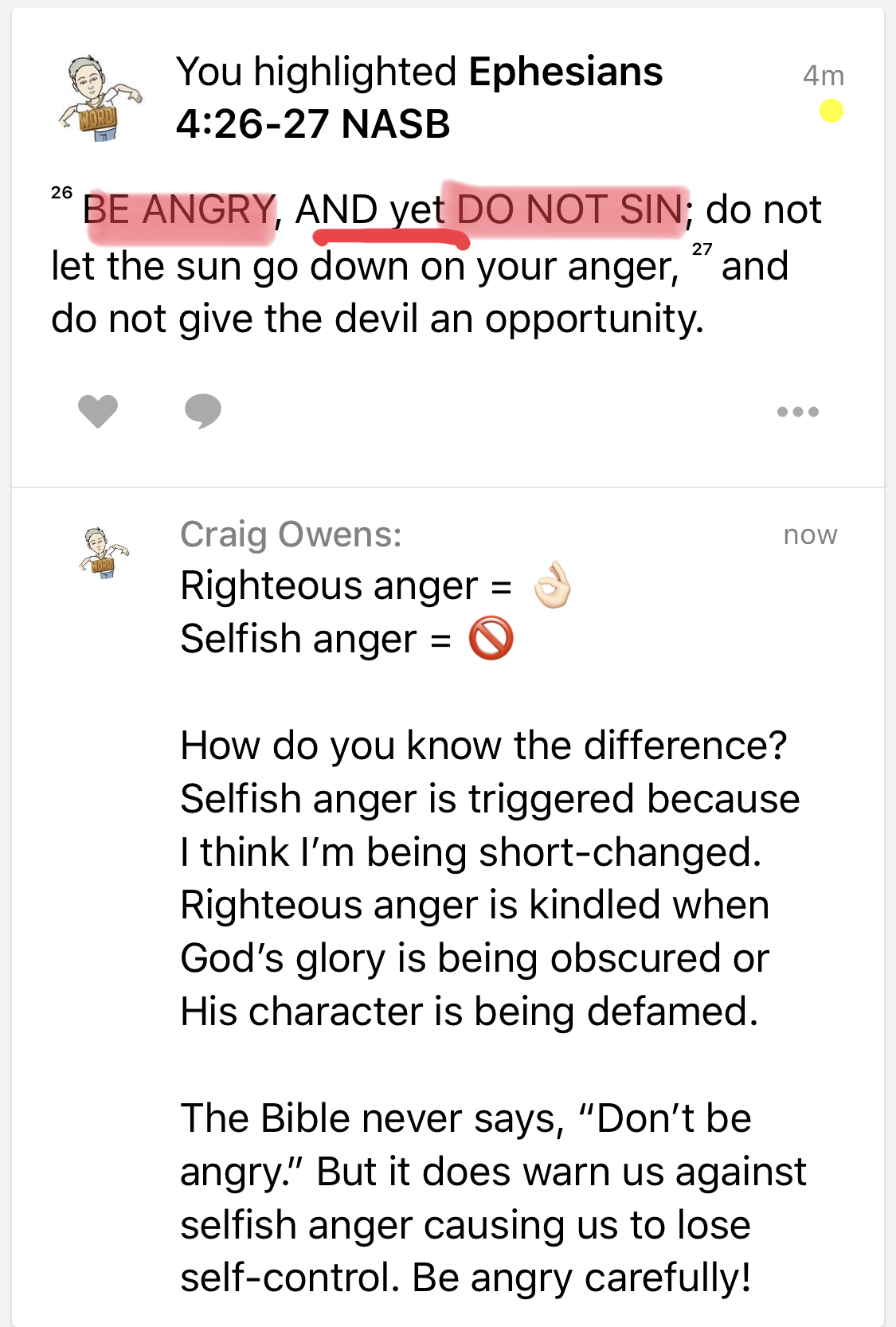
Being angry is not the issue. David said it (and Paul quoted it in Ephesians 4:26): “Be angry; just don’t sin.” God gets angry, but He does not sin. Jesus, in His public ministry, got angry, but He did not sin. We need to search our hearts to make sure our anger has not crossed the line to sin. We have to be angry in a godly way.

I see at least four ways to become angry without crossing the line into sin:

1.  Selfless Anger = anger at sin, but not angry at the sinner.

Love is not rude, it is not self-seeking, it is not easily angered, it keeps no record of wrongs. Love does not delight in evil but rejoices with the truth. (1 Corinthians 13:5, 6)

2.  Slow Anger = lengthen your fuse a bit.

Do not be quickly provoked in your spirit, for anger resides in the lap of fools. (Ecclesiastes 7:9)

My dear brothers, take note of this: Everyone should be quick to listen, slow to speak and slow to become angry, for man’s anger does not bring about the righteous life that God desires. (James 1:19, 20)

Good advice from Thomas Jefferson: “When angry, count to ten before you speak; if very angry, a hundred.”

3.  Protective Anger = when sinners entice others to join them in their sin. God is sad when people leave Him; He is angry at them when they take others with them.

But they put God to the test and rebelled against the Most High; they did not keep His statutes. Like their fathers they were disloyal and faithless, as unreliable as a faulty bow. They angered Him with their high places; they aroused His jealousy with their idols. When God heard them, He was very angry; He rejected Israel completely. (Psalm 78:56-59)

4.  Righteous Anger = against those who are keeping others from coming closer to God.

For I endure scorn for Your sake, and shame covers my face. I am a stranger to my brothers, an alien to my own mother’s sons; for zeal for Your house consumes me, and the insults of those who insult You fall on me. (Psalm 69:7-9)

This verse was recalled by Jesus’ disciples when they saw Him get angry and clear out the Temple in Jerusalem. Jesus was angry because of the religious clutter that was keeping God’s house from being a house of prayer for all nations.

I think everyone is familiar with the acrostic WWJD = What Would Jesus Do?

I’d like to propose something similar: WGGA = Would God Get Angry?

This is a great question to ask to make sure our anger does not cross that line into sin. Get angry—in a godly way—and do not sin.

Uniquely You

Thanks to Mr. Cochrane, my 10th grade English teacher, I have become somewhat of a literalist when it comes to the use of words. For instance, it bothers me when writers confuse your and you’re, or its and it’s, or their, there, and they’re.

Another vocabulary use that bothers me is when someone uses a qualifier with the word unique. It’s incorrect to say, “You’re very unique” or “It’s an unusually unique situation.” Unique, by its very definition, means there is nothing else like it.

Unique is defined as “existing as the only one or as the sole example; having no like or equal; unparalleled; incomparable.”

Do you know another great definition of unique: YOU.

Really, you are unique. You are the only one like you; you are the sole example of you; there is no one like you; you are unparalleled and incomparable. That’s you!

In one of his most intimate prayers, David says to God, “I praise You because I am fearfully and wonderfully made.” The Hebrew word for wonderfully means someone who is one-of-a-kind… unique.

You are uniquely you.

You were created in God’s image—uniquely.

You were created unlike anyone else who has ever lived—uniquely.

You are endowed by your Creator with a set of talents, strengths, and abilities (a gift package) that has never been seen before in the history of mankind, nor will it ever be seen again—uniquely.

You will cross paths with particular people at particular times in your life and their lives that can never be duplicated or recreated—uniquely.

In order to seize unique opportunities, you have to be uniquely you. In order to be uniquely you, you have to become more like Jesus. He embodied every godly attribute perfectly; He lived every moment perfectly; He handled every situation perfectly. “The more I become like Jesus the more uniquely I become myself” (Dr. George O. Wood).

How might you live your life differently today knowing that no one can do what you do the way you do it? The more you become like Jesus, the more uniquely you you will be. Try it!

Consequences

It was a beautiful sunny evening. All of my work was done, Betsy was home from school, our cooler was packed, and we were off to the park. We were all looking forward to spend this lovely evening grilling some hotdogs, splashing in the water, enjoying the breeze off the lake, and just spending time as a family.

But like an unexpected rear-end collision, all our plans for a fun evening were smashed in a single moment. As we were carrying our cooler and towels and toys toward the picnic tables, a couple of my kids acted up… they broke some of our family no-no’s.

Their actions took less than two seconds. It was just between two of them. But the entire family was affected. We turned around and headed home. No hotdogs on the open grill, no beach time, no after-dinner walk on the trails.

Two made a mistake, but all suffered because actions have consequences.

Isaac Newton said for every action there is an equal and opposite reaction. We often think of this when, for instance, in a game of billiards the cue ball hits another ball. The energy from the cue ball is transferred to the other ball, moving it in the direction it was struck. Sometimes we might be tempted to believe that the only two balls affected were the cue ball and the ball that was struck. But that is not correct. Since those two balls have now been moved to another position on the table, their new positions now affected the entire table—the entire game is now different because of action and reaction.

There are consequences for our actions. And almost always those consequences are felt by someone other than the one who acted. Sometimes the consequences are pleasant and sometimes they are painful or even disastrous.

In Old Testament history, we see good consequences. King David was a righteous man, one who loved God and obeyed God’s commands. About 300 years later King Hezekiah sat on the same throne of Israel. When the Assyrian army was headed toward Jerusalem, Hezekiah prayed and asked for God’s help. God responded, “I promise that the king of Assyria won’t get into Jerusalem, or shoot an arrow into the city, or even surround it and prepare to attack. … I will protect it for Myself and for My servant David.

And we see bad consequences. There was a wicked king of Judah named Manasseh. He is not only one of Judah’s longest-reigning kings, but he is also widely regarded as Judah’s most wicked king. Yet in his lifetime, his kingdom seemed to prosper. And even though his grandson Josiah turned away from evil and turned toward God like no other king ever had done before, just four years after his death Jerusalem fell. King Jehoiachin was defeated and all of Judah was carried off into exile by Nebuchadnezzar as a consequence of Manasseh’s sinful behavior.

Our kids that acted up wrote notes of apology which they read to the family (as we ate our hotdogs at home) and we all forgave them. And we had a nice evening playing around the house. But the evening still had the tinge of regret for what could have been.

Our choices today will have consequences tomorrow. Our actions always affect more than just ourselves—they affect everyone close to us. The people in Hezekiah’s day were grateful for the blessed consequences of David’s right choices. The people in Jehoiachin’s day were grieved for the disastrous consequences of Manasseh’s wrong choices.

What about you? What will your descendants feel about the consequences they are experiencing because of your choices today? It’s up to you, and it’s for them, so live right today.

The Right Questions

“The uncreative mind can spot wrong answers, but it takes a creative mind to spot wrong questions.” —Sir Anthony Jay

This has always been a challenge for me—maybe for you, too. I can easily spot when someone gives me a wrong answer, but it’s harder to spot when I’ve asked a wrong question. It could very well be that the answer I’m hearing is correct in light of the question I asked.

But spotting wrong questions requires a humility on my part to admit I may be wrong. Spotting wrong questions requires creativity, a new way of looking at things.

There is a short story about the life of King Abijah recorded in 2 Chronicles 13 in the Bible. Abijah is the second king to reign in Judah after the 10 northern tribes had seceded. He is vastly outmanned and out-spent by King Jeroboam of the northern tribes (called Israel). When it comes to a battle between north and south, Abijah can only field half as many men as Jeroboam.

Yet it is Abijah who takes charge of the battlefield before the fighting begins. He climbs to the top of Mount Zemaraim to make sure all of the northern tribes can hear him. The wrong question would have been, “Which side is God on: Israel’s or Judah’s?” The correct question which Abijah must have asked and answered for himself—is, “Are we on God’s side?

Abijah begins to recount how God chose for a descendant of David to sit on the throne (Abijah), but northern Israel was following a rebel (Jeroboam). God intended for the descendants of Aaron to oversee the sacrifices and religious practices; Judah was doing this, but Israel had their own priests. God was to be worshipped exclusively; Judah was doing this, but Jeroboam made golden calves for Israel to worship.

So Abijah correctly concludes, “God is with us; He is our leader.”

Abijah didn’t assume God was with Judah. Abijah didn’t ask, “Does God lead us or them?” Abijah asked, “Are we doing the things that God has asked of us?” Since Judah was following God, Abijah could then state with confidence, “God is with us.”

The question is not, “Is God on your side?” It’s better to ask, “Am I on God’s side?

The question is not, “What would Jesus do if He was here?” It’s better to ask, “What did Jesus already do that I can follow?

What questions are you asking? Change your questions and you just may change your life.

Success Is Going

King David is one of the most well-known characters in the Old Testament. Such incredible stories are told about him that his life can be summed up in one phrase that occurs four times in Scripture—The Lord gave David victory everywhere he went (2 Samuel 8:6, 14; 1 Chronicles 18:6, 13).

When David was faced with a challenge or an enemy, he threw himself fully into meeting the enemy head-on, and he was always successful. There is no record of David ever being defeated in battle. If he went out, he won.

Aha, keyword alert—The Lord gave David victory everywhere he WENT.

The only times David was defeated was when he stood still:

• When his son Absalom killed another of David’s sons, Amnon, David didn’t do anything. Even when Absalom returned from exile, David stayed home and didn’t reconcile with his son (2 Samuel 13-15).

• David’s son Adonijah behaved inappropriately and eventually rebelled against David, too. But David “never interfered with him by asking, ‘Why do you behave as you do?’” (1 Kings 1:6).

• David lusted after and then committed adultery with Bathsheba when, “In the spring, at the time when kings go off to war, Joab led out the armed forces. … But David remained in Jerusalem” (1 Chronicles 20:1).

• David angered God by ordering that a census be taken of all of the men eligible for military service in Israel. “So David said to Joab and the commanders of the troops, ‘Go and count…” (1 Chronicles 21:2). In other words, David stayed while others went.

Solomon correctly noted, “The path of life leads upward for the wise to keep him from going down to the grave” (Proverbs 15:24). There are only two directions: forward (or up) OR backward (or down). There is no standing still.

The Lord gave David victory everywhere he WENT, not everywhere he stood still. To stand still is to begin to go backward.

Is there a battle you need to fight? Is there a challenge you’ve been avoiding? Is there something you need to complete? Are you waiting for something to happen? Are you content just to stand still?

Stop standing still and start going! If you are following God, He will give you victory everywhere you go.