My Hope

Then you will know that I am the Lord; those who HOPE in Me will not be disappointed. (Isaiah 49:23)

HOPE = to look forward to with desire and reasonable confidence.

Where can you find “reasonable confidence”?

  • …the economy?
  • …your parents?
  • …your pastor?
  • …your savings account?

God says, “If you place your HOPE in Me [your reasonable confidence], you will never be disappointed.”

My HOPE is built on nothing less
Than Jesus’ blood and righteousness.
I dare not trust the sweetest frame,
But wholly lean on Jesus’ Name

When darkness veils His lovely face,
I rest on His unchanging grace.
In every high and stormy gale,
My anchor holds within the veil.

His oath, His covenant, His blood,
Support me in the whelming flood.
When all around my soul gives way,
He then is all my HOPE and Stay.

On Christ the solid Rock I stand,
All other ground is sinking sand;
All other ground is sinking sand.

Worry Unlearned

We started a new series yesterday called The Stranglehold Of Worry. The word worry originated with shepherds. When a wild dog or a wolf had killed a sheep by grabbing it by its throat and choking it to death, the shepherds said that sheep had been worried to death.

In modern times, researchers at Purdue University found that worrying can chop 16 years off of someone’s life. Not only does worry rob your life of years, but it can also rob your years of life.

What exactly is worry? Fear is our natural response to real threats, like a car heading toward you in your lane of traffic. Worry is our response to perceived threats (to unseen things), like the car that may head toward your kids’ car when they are driving.

Get this clear: worry is being fearful of the unseen.

Compare that to the Bible’s definition of faithNow faith is being sure of what we hope for and certain of what we do not see. Worry and faith both operate in the unseen dimension.

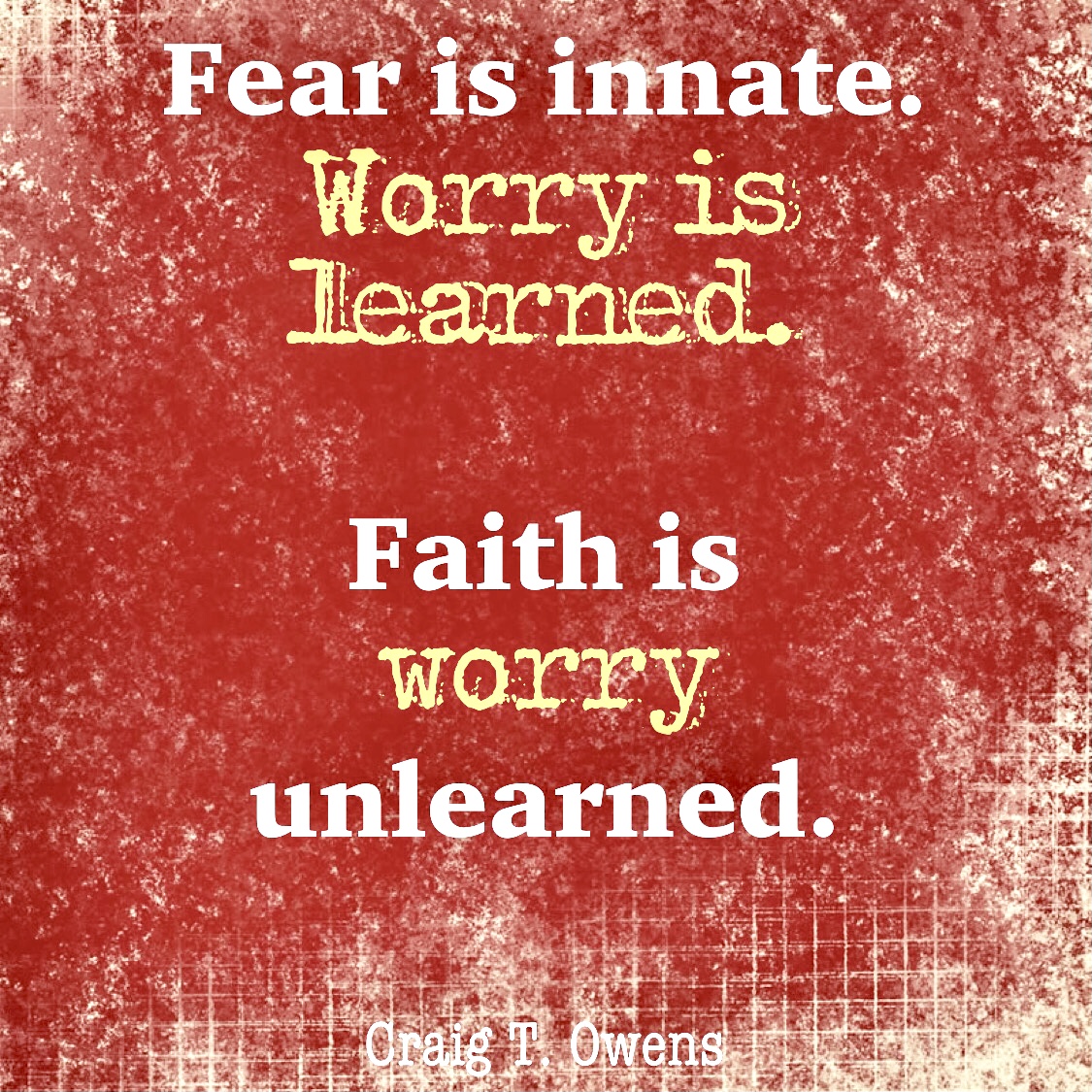
Fear is innate, but worry is learned.

Faith is worry unlearned.

Worry tells your brain a story about bad things that may happen.

Faith tells your brain a story about good things that should happen. Based on what you’ve already experienced of God’s power, what you’ve already seen in God’s provision, or what you already know of God’s promises, your faith in God can help you unlearn your worry.

The prophet Jeremiah tended to be a worrywart. Maybe that’s why he’s been called the “weeping prophet.” But in the middle of his worrying, he unlearns his worry by using his faith to tell a different story about God’s provision, power, and promises:

I well remember [the bad things], and my soul is downcast within me. Yet this I call to mind and therefore I have hope: Because of the LORD’s great love we are not consumed, for His compassions never fail. They are new every morning; great is Your faithfulness. I say to myself, “The LORD is my portion; therefore I will wait for Him.”

Did you notice that Jeremiah talked to himself? He wrote, “I say to myself.” If you have a tendency to worry, it’s time to start talking to yourself and telling yourself a different story. Instead of being fearful of the bad things you cannot see, why not be hopeful of the good things of God you can see?

Let your faith in God help you unlearn your worry. You can overcome worry and anxiety by telling yourself a new faith-filled, hope-oriented story. You can recall God’s faithfulness in the past, and apply it to your current circumstance.

What stories are you telling yourself today? Share with others how you overcame, or are in the process of overcoming worry now. Your faith story will help others overcome and unlearn their worry too.

Plan B (book review)

I was immediately intrigued by the title of Pete Wilson’s book Plan B because it’s a phrase we use so much in my family. In fact, we sometimes take it farther than that: many times we’re talking about Plan F or even Plan Q!

Yet at the same time, I found myself asking, “Does God have a Plan B for my life?” As I read Pete’s book I discovered the answer to my question is a resounding and loving, “No!” God only has a Plan A, nothing takes Him by surprise. I, however, often get taken by surprise: that’s where Plan B comes in. And that’s where Pete’s book is so beneficial.

This book is not about scrambling to come up with an alternate plan, but learning how to rest assured in God’s Plan A for my life.

I’m pretty sure that all of us have been disappointed at some point. We thought things were heading in the right direction, but then everything seemed to be going sideways. Our first inclination is to try to come up with a Plan B to deal with our ‘crisis’. But Pete Wilson’s Plan B is a reminder that God’s Plan A still prevails, that we can still place our hope in God. I love this quote from the book:

“There is an undeniable relationship between crisis and hope. Between waiting hopefully and being transformed. Between Plan B and the glory of God.”

A practical and timely book to help you successfully navigate through the tough spots, to not collapse in crisis, but to be buoyed by hope.

I am a Thomas Nelson book reviewer.

It’s A Love-Hate Thing

Are there things you love to do, but hate to do at the same time?

Ah, yes, that wonderful love-hate relationship. I spent most of the first part of this week in a love-hate thing, and I discovered yet again that love outweighs hate. To rediscover this, all I had to do was agree to walk through a funeral with a grieving family again.

I hate seeing families grieving. I love being able to share hope with them.

I hate how drained I feel after funerals. I love seeing the flicker of encouragement glow in others.

I hate tearful goodbyes. I love the knowledge of joyful reunions.

I hate preparing funeral messages that remind people of eternity. I love sharing that Jesus is the Promise of an eternity in heaven.

I hate having every eye in the room on me. I love seeing God speak His truth through me.

Yup, it’s true: walking through a funeral with a grieving family is—hands down—something that so drains me physically, emotionally, mentally, and spiritually more than anything else I do. But I wouldn’t trade this privilege to step into hurting people’s lives for anything. Yes, love triumphs over hate!

A Tale Of Two Funerals

I was involved in two funerals in the last three days, and they couldn’t have been more different.

At both funerals people said goodbye in their own way.

At both funerals family members cried.

At both funerals there was singing.

At both funerals the life of the deceased was celebrated.

At both funerals loved ones grieved.

The huge difference was how they grieved.

The Apostle Paul wrote, “Brothers and sisters, we want you to know about those Christians who have died so you will not be sad, as others who have no hope” (1 Thessalonians 4:13).

Paul says that we are sad, we grieve, but we grieve differently when we have hope. What hope? The hope of life after death. The hope that only belief in Jesus can bring. Jesus said, “I am the resurrection and the life. Anyone who believes in Me will live, even after dying. Everyone who lives in Me and believes in Me will never ever die” (John 11:25-26).

At Thursday’s funeral the family grieved deeply because they had no hope of life after death, no assurance, only wishful thinking.

At today’s funeral it was a joy to grieve with a family because they had such solid hope! They have an absolute, unshakable assurance that their loved one has life after death. And that makes all the difference in the world in how they will grieve.