The Measure Of A Man

An anonymous poem that should make any man or woman ponder the impact of their legacy…

Not “How did he die?”

But “How did he live?”

Not “What did he gain?”

But “What did he give?”

These are the units

To measure the worth

Of a man as a man

Regardless of birth.

Not “What was his station?”

But “Had he a heart?”

And how did he play

His God-given part?

Was he ever ready

With a word of good cheer,

To bring back a smile,

To banish a tear?

  Not “What did the sketch in the newspaper say?”

But “How many were sorry when he passed away?”

A Life Well Lived

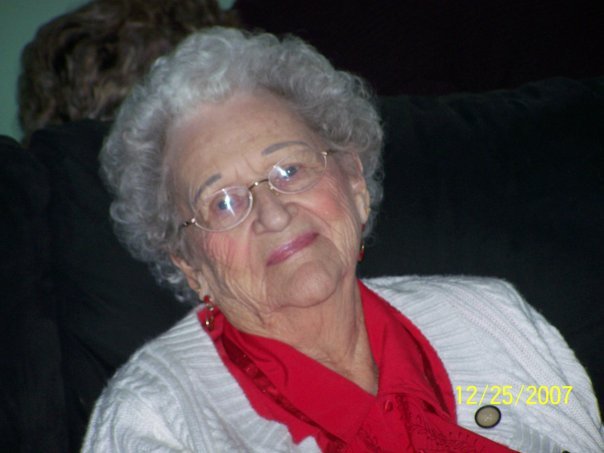
Early yesterday morning, a saint went home to be with Jesus. She was known to all of us at Calvary Assembly of God simply as Grandma. And she was the hippest Grandma we ever knew!

So full of Jesus, and radiating love through her smile. She loved to laugh, she loved to live, she loved to love. But as full of life as we thought she was here on this earth, it’s nothing compared to the life she is experiencing now in the presence of her Savior! She’s home now, and more alive than ever.

We will be celebrating her life for a long time, but we will especially focus on the blessing she was to us this week (the details are here). Please be a part of the visitation time and the homegoing celebration service at the end of this week.

We love you, Grandma! Thanks for showing us how to live so well.

Final Words

I’m working on a message for a funeral that I will speak at tomorrow. It’s very humbling to think that a family has chosen me to say the final words about their loved one. How do I accurately sum up someone’s life in just a few minutes?

This process always gets me thinking about what final words I would want to have said about my life. I have three passages in the Bible that I would love to have said about me:

He had no great joy than knowing his family all walks in the truth. (3 John 4)

He always took the spiritual truths that he heard and taught and entrusted them to reliable people who were also qualified to teach others. (2 Timothy 2:2)

He fought the good fight, he finished the race, he kept the faith. (2 Timothy 4:7)

What about you? What final words do you want people to say at the end of your life?

Stephen Covey wisely advises us to begin with the end in mind. See your goal—your final words—clearly fixed in your mind now, then live to fulfill it.

Imagine Attending 86 Funerals A Day

Right after the Israelites came out of Egypt, God told Moses to count everyone (not coincidentally, this is recorded in the book of Numbers… get it?).

I’m sure you know the story well of the ten scouts who by their negative report turned everyone against Moses. They all believed that they couldn’t go into the Promised Land because of the big giants. So God said everyone in that generation (except Joshua and Caleb) would die before they entered the Promised Land.

Fast forward 38 years and God has Moses count the people again (can you guess where this is recorded in the Bible?). If you compare the two lists, you will see that 1.2 million Israelites had died.

Let that sink in: 1.2 million dead in 38 years.

That’s 31,579 funerals per year.

Or 86 funerals per day.

Talk about mixed emotions! With every funeral the younger Israelites attended, they were sad for their loss but they also knew they were one step closer to getting out of the desert and into the Promised Land.

Every day they heard about deaths—86 of them every day.

What did these deaths remind them of? Maybe these two thoughts:

  • Sin causes death.
  • I’m just as capable of sinning as they were.

Every death should have been a reminder to them to stay as close to God as possible.

Every day I hear about divorce. This should be my reminder to cherish my wife every day.

Every day I hear about a pastor’s moral failing. This should be my reminder to pursue holiness passionately every day.

Every day I hear about pornography addictions. This should be my reminder to take every precaution I can every day.

When the Israelites heard about 86 deaths every day, they had to do something positive with that.

When I hear about divorce and sin and addiction, I cannot just shake my head and say, ‘Tisk, tisk,” but I must do something positive with it.

I must use every “death” as a reminder to move closer to God.

“And Then He Died…”

Listen to the podcast of this post by clicking on the player below, and you can also subscribe on AppleSpotify, or Audible.

That’s the end of his life. All those years living and that’s all his obituary says: “and then he died.”

Genesis 5 is the lineage of Adam. A mind-numbing list of names and years scroll by:

  • Adam lived 930 years, and then he died.
  • His son Seth lived 912 years, and then he died.
  • His son Enosh lived 905 years, and then he died.
  • His son Kenan lived 910 years, and then he died.
  • His son Mahalalel lived 895 years, and then he died.
  • His son Jared lived 962 years, and then he died.
  • And on and on and on….

For each man we hear the name of one of his sons and how long he lived, but nothing more. Like a modern-day tombstone:

Birth DateDeath Date

The dash between the dates covers childhood, schooling, marriage, inventions, parenthood, and so many other things. But years later, more and more of the details are forgotten and only the dash remains to represent the sum total of the deceased’s life.

And then comes Enoch.

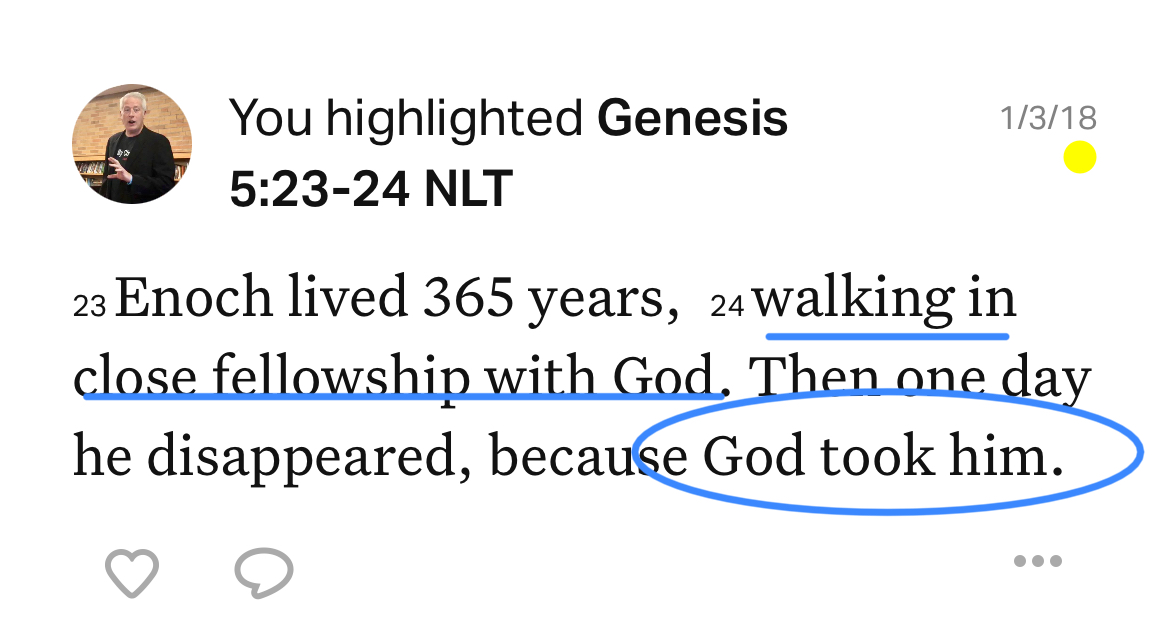
All of the same details are there. Well, except for the “and then he died” epitaph. But actually, there’s so much more. Instead of a death, there’s a phrase that appears only for him: “Enoch walked with God.” The phrase literally means “to be continually conversant.”

Because Enoch lived this way, he didn’t really die. Instead, “He was no more.” He wasn’t here any longer because he is still walking with God. What an incredible blessing to his future generations! He was a blessing while he was alive, and he continues to be a blessing after he is no more.

Enoch’s tombstone reads differently from everyone else. The birth date is there, the dash is there, but instead of “and then he died” we read “he was no more.”

It’s the way I would want my tombstone to read:

Craig T. Owens

1966He walked with God─He was no more (because he is still walking with God)

In The Seven Habits Of Highly Effective People, Stephen Covey suggests living my life today consistent with what I would like said at my own funeral. It starts with a decision: “Today I will be continually conversant with God.” Then at my funeral, they can say of me, like the Bible says of Enoch: “He didn’t die. He’s just not here any longer. He is walking with God in heaven, just like he walked with Him here on earth.”

What do you want said about your dash?

Do you want your life to simply end with “and then he died”? Do you want something more?

Make your dash a continual conversation, a daily walk with God, and all of your future generations won’t see just a dash, they’ll remember “He is no more. He walked with God, and he is still walking with God!

Start walking today!

►► Would you please prayerfully consider supporting this ministry? My Patreon supporters get behind-the-scenes access to exclusive materials. ◀︎◀︎

It’s A Love-Hate Thing

Are there things you love to do, but hate to do at the same time?

Ah, yes, that wonderful love-hate relationship. I spent most of the first part of this week in a love-hate thing, and I discovered yet again that love outweighs hate. To rediscover this, all I had to do was agree to walk through a funeral with a grieving family again.

I hate seeing families grieving. I love being able to share hope with them.

I hate how drained I feel after funerals. I love seeing the flicker of encouragement glow in others.

I hate tearful goodbyes. I love the knowledge of joyful reunions.

I hate preparing funeral messages that remind people of eternity. I love sharing that Jesus is the Promise of an eternity in heaven.

I hate having every eye in the room on me. I love seeing God speak His truth through me.

Yup, it’s true: walking through a funeral with a grieving family is—hands down—something that so drains me physically, emotionally, mentally, and spiritually more than anything else I do. But I wouldn’t trade this privilege to step into hurting people’s lives for anything. Yes, love triumphs over hate!

Unusual Blessing

On Saturday night I was in the hospital with a family as their loved one took his final breath. It’s not the first time I’ve been in a room with someone as their life here ends. And I’m certain it won’t be the last time. I feel blessed to be able to do this.

Before you think I sound morbid, hear me out on this.

I feel blessed to have had some valuable training for this. Long before I became a pastor (a “doctor” of the spirit) I was studying to be a medical doctor (a doctor of the body). I’m so grateful that I received enough training to be prepared for these settings.

I feel blessed to be there for the grieving family. When the emotions are so raw and the pain so deep, I’m grateful that God places me in a position to truly be a minister to hurting people.

I feel blessed to be reminded of the shortness and preciousness of life. It reminds me that life is fragile and short. It reminds me to hug more often, express love more frequently, and not take any time with my loved ones for granted.

Being in the hospital room as someone passes from this life is not an easy thing. But I wouldn’t trade the blessing of being a pastor for anything.

Finishing Well

Asa started so well, accomplished so many things, was known for his greatness, won an unbelievable victory, made the tough choices that the people loved, and then faded into disrepute.

Starting well is important; finishing well is so much more important. After we’re gone, people usually remember us for how we went out.

Asa was a great king of Judah (see 2 Chronicles 14-16). He began to clean out all of the false gods and pull down the places where these idols were worshipped. The people were so unified behind Asa that none of their enemies even dared to attack them. And Asa recognized this. He said, “The land is ours and is at peace because we have sought God; we’ve sought Him and He’s given us peace everywhere.”

An army from Cush (modern-day Sudan and Libya) marched up to challenge Asa in battle. The Cushites came with an army too large to even count, while Asa had about 500,000 fighting men. Asa and his men called on God, and God helped them win an incredible victory. In fact, they inflicted such heavy casualties on the Cushites that they never returned to their former strength.

Then something happened.

Baasha, the king of Israel, began fortifying the city of Ramah. This wasn’t hostile in itself, but it did look to Asa like the build-up to war. Israel’s army wasn’t nearly the size of the army of Cush that Asa had just seen God help him defeat. But instead of calling on God, Asa bribed Ben-Hadad, king of Aram, to break his treaty with Israel. This political turnabout caused Baasha to quit building up Ramah to move his forces to protect himself from Aram.

At first glance, it looks like Asa won. He was the clever one. He did it himself. And there’s the problem: he did it himself—he didn’t rely on God.

Why did Asa do this? Why did he abandon God? Why didn’t he seek God as he did before?

The prophet Hanani came to ask Asa these very questions. Hanani told Asa it was foolish of him to turn his back on God. Instead of this prompting Asa to recognize he had slipped away from God, he got angry and threw Hanani in prison. Then in his guilt-provoked rage, Asa began to oppress his own people.

A short time later Asa contracted some sort of disease in his feet. The Bible says, “Though his disease was severe, even in his illness he did not seek help from the Lord, but only from the physicians.”

Asa started out so well, yet finished so poorly. Starting well is important; finishing well is so much more important.

The Lord is with you when you are with Him. If you seek Him, He will be found by you, but if you forsake Him, He will forsake you (2 Chronicles 15:2).

What are you doing today to make sure you finish well? The best thing you can do is seek God with all your heart. Do that and you will finish well. People usually remember us for how we go out.

Finish well.

Routine Weekend Rewind

Whoa, this weekend seemed like a whirlwind! Lots of interesting and noteworthy stuff packed into 72 hours.

Great homegoing celebration for John “Jack” Rivers on Saturday morning. What an incredible legacy he left. We celebrated his life with his wife, children, grandchildren, great-grandchildren, and great-great grandchildren. Wow!

I love my extended family. Not just those related to me by blood, but those that call me “brother” because of our mutual relationship with Jesus Christ. It was great to see brothers and sisters comforting the extended Rivers family. There’s just something special about having those that truly love you around in times of loss or crisis.

Driving in the rain is just slightly (!) stressful. We were in torrential rain all the way to West Michigan, and most of the way back home. That kind of rain makes a two-hour trip seem a whole lot longer when the stress level is elevated. I’m grateful that God kept us safe.

Short, but sweet, time with my family. Nice to have some of Mom’s cooking and spend time with my folks, my sister and brother-in-law, and my nephews.

Incredible service at Calvary Assembly of God in Cedar Springs! The worship team loves Jesus and they rock! Loved seeing the enthusiasm for worship and for the Word among both young and old. I look forward to getting back to visit this enthusiastic group again!

Great phrase in Switchfoot’s song Faust, Midas and Myself, “And what was once routine was now the perfect joy.” My life is anything but routine, but the “simple” things around me everyday are truly the perfect joy.

Enjoy your “perfect joys” this week!

Grateful For My Powerlessness

This has been a very hard week!

I conducted a funeral service yesterday for a family whose baby died after only 18 days on earth. As a pastor, without a doubt the most physically-, emotionally-, spiritually-, and mentally-draining activity I do is a funeral. The Bible says that we grieve with those who grieve, and yet in the midst of that grieving, the family and loved ones are still turning to me to give them answers. Sometimes it seems there are more questions than answers. Between the grieving and the answer seeking, it’s very draining!

But God was gracious to me. He gave me a comforting word to share at the funeral, and at the conclusion eight people said that after their days on earth were done they wanted to have the assurance that they would be welcomed into God’s presence, just as baby Blake was. I had the privilege of praying with those folks as they invited Christ into their lives!

Probably the second-most draining thing I have to do as a pastor is deal with problems in the church. And, boy, did a big one crop up this week! It was supposed to culminate in a meeting this afternoon. So yesterday I was dealing with my two most draining issues at the same time! Today, this church problem wasn’t resolved, but God gave me such a peace about its outcome. I’m not sure what’s going to happen next, but what a peace flooded my heart to let me know that He is in control.

This morning I read this great quote from Oswald Chambers—

“It is a good thing to feel our own powerlessness in the face of destruction, it makes us know how much we depend upon God. … When a man gets to despair he knows that all his thinking will never get him out, he will only get out by the sheer creative effort of God, consequently he is in the right attitude to receive from God that which he cannot gain for himself.”

I am grateful today for my powerlessness. I am grateful that I feel so dependant on God. I am grateful for the sheer creative effort of God. And I am grateful for His peace.

I’m also grateful for the challenges. Why? Because without the challenges, I would not have felt such gratitude for my powerlessness, God’s provision, and God’s peace.