O Come, All Ye Faithful

Who is GodPastor Tom Kaastra continued our series The Carols Of Christmas by looking at the well-known Christmas hymn O Come, All Ye Faithful. The line he especially highlighted comes from the third stanza—Word of the Father, now in flesh appearing.

It is so vital that we keep both of those aspects of Jesus Christ in mind: He is both the Word of the Father and the Word become flesh. As Tom pointed out, this fact helps us answer the two most vital questions that humans have:

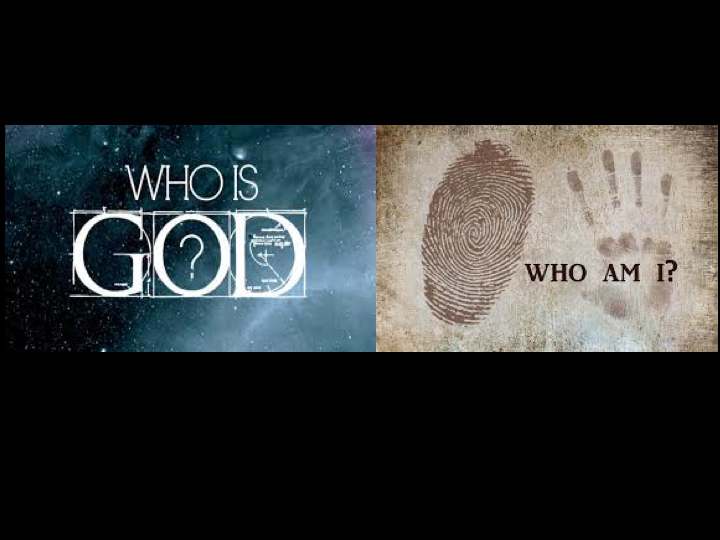
  • Who is God?
  • Who am I?

I can learn more about who I am when I know more clearly Who God is. And when I know this, I can more fully—as the song says—come and adore Christ the Lord.

Jesus is fully God:

Jesus revealed to us the Father’s love; after all, God is love (1 John 4:16). Jesus came to show us the love of God.

Jesus is fully Man:

  • He got tired and hungry (John 4:6)
  • He limited Himself to do only what the Father told Him to do (John 5:19-20)
  • He limited Himself to say only what the Father told Him to say (John 12:49)
  • He felt anguish and pain (Luke 22:44)

As C.S. Lewis said, “The Son of God became a man to enable men to become sons of God.” And as sons of God, we have access to the Heavenly Father—

Those who are led by God’s Spirit are God’s children. For the Spirit that God has given you does not make you slaves and cause you to be afraid; instead, the Spirit makes you God’s children, and by the Spirit’s power we cry out to God, “Abba! My Father! (Romans 8:14-15)

Word of the Father now in flesh appearing is cause for adoration because Jesus has made it possible for us to become sons and daughters of God!

O come let us adore Him!!

If you’ve missed any of the messages in this series, you may check them out by clicking here.
Come, Thou Long-Expected Jesus

AdventWe began our series on The Carols Of Christmas by looking at the poem written by Charles Wesley in 1744: Come, Thou Long-Expected Jesus. As far as I can find, Wesley never shared where he got his inspiration for this prose, but I have a hunch that it might be from a song in the Bible called The Benedictus.

Zechariah had been unable to speak for nearly a year because of his doubt over the message God sent him through the angel (see Luke 1:5-20). When his son was born and Zechariah named him John, his tongue was loosed and he “was filled with the Holy Spirit” and burst into song (Luke 1:67-79). The first word of his song in Latin is benedictus, from which the name is derived.

Here’s what I love about both Zechariah’s and Wesley’s songs—they both look forward to Christ’s First Advent and His Second Advent. Mary was still pregnant with Jesus when Zechariah sang his song, but his lyrics reflect the Redemption story that Jesus would fulfill as Emmanuel, God with us. Charles Wesley picks up this same theme, rejoicing over Christ’s birth and His imminent return.

In fact, that’s exactly the point! We aren’t celebrating Christmas as much as we are celebrating Advent. Jesus was born “when the time had fully come” for His First Advent (Galatians 4:4-5), and “this same Jesus, Who has been taken from you into Heaven, will come back in the same way you have seen Him go into Heaven” (Acts 1:11). That’s the message that should encourage us (see 1 Thessalonians 4:13-18).

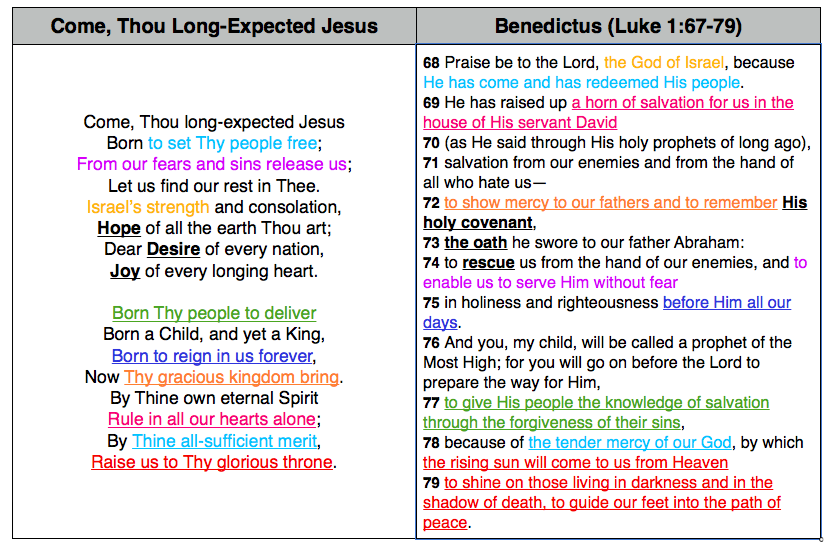
Check out the remarkable parallels between the Benedictus and Wesley’s hymn—

Come Thou Long-Expected Jesus & Benedictus

If you’d like to download a PDF of this side-by-side comparison, here it is → Come Thou Long-Expected Jesus & Benedictus ←

If you’ve missed any of the messages in this series, you may check them out by clicking here.
The Carols Of Christmas

Carols Of ChristmasI heard the bells on Christmas Day
Their old familiar carols play,
And wild and sweet the words repeat
Of peace on earth, goodwill to men. (Henry Wadsworth Longfellow)

How many “old familiar carols” have you heard Christmas after Christmas, until the words have almost lost their meaning? If we’re not careful, any song repeated too often can lose the richness of its original intent.

There are some amazing messages in many of our old familiar Christmas carols, because many of those messages are saturated with the old familiar story of Redemption that the Bible tells over and over again.

Please join me this Sunday as we take a new look at the old familiar messages in our Christmas carols. These messages will bring a new appreciation of God’s love that was sung at Christ’s Advent, and reawaken the sweetness of meaning for this Christmas Day.

If you’ve missed any messages in this series, check them out here:

No More Fear

Have you ever noticed the overarching message throughout the Christmas story? In both Matthew’s and Luke’s account of the birth of Jesus there is a repeated angelic message to humankind: “Do not be afraid.”

  • Do not be afraid, Zechariah; your prayer has been heard” (Luke 1:13).
  • Do not be afraid, Mary, you have found favor with God” (Luke 1:30).
  • “Joseph, son of David, do not be afraid to take Mary home as your wife” (Matthew 1:20).
  • Do not be afraid. I bring you good news of great joy that will be for all people” (Luke 2:10).

Why all this fear? Quite simply sin brings fear: Fear of God’s impending judgment. But the canceling power is Jesus. In the Christmas carol Joy To The World there are powerful, fear-lifting words in the third verse:

No more let sins and sorrows grow,
Nor thorns infest the ground;
He comes to make His blessings flow
Far as the curse is found,
Far as, far as, the curse is found.

His blessing comes to bring joy wherever the curse of sin has brought fear! Jesus defeats sin, and so therefore His joy displaces all fear!

  • “His mercy extends to those who fear Him” (Luke 1:50).
  • “Praise be to the Lord, the God of Israel, because He has come and has redeemed His people…. To show mercy to our fathers…. To enable us to serve Him without fear…. To give His people the knowledge of salvation through the forgiveness of their sins” (Luke 1:68, 72, 75, 77).
  • “He will save His people from their sins” (Matthew 1:21).
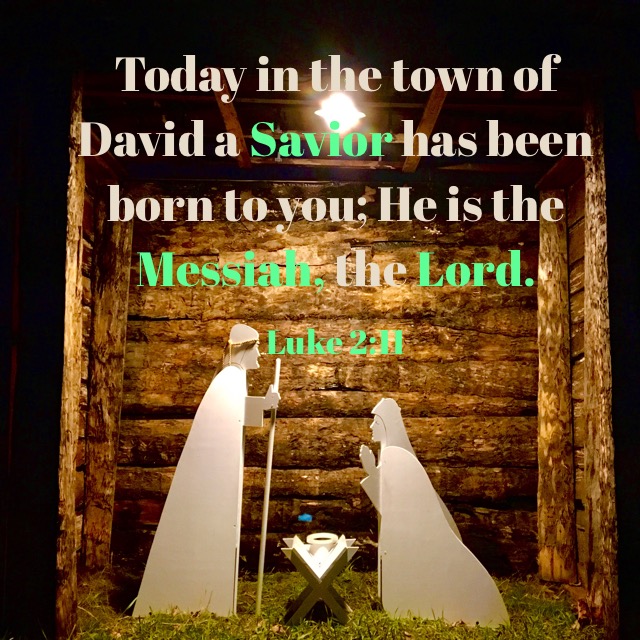
  • “Today in the town of David a Savior has been born to you; He is Christ the Lord” (Luke 2:11).

Sin forgiven. Curse canceled. Fear removed. Joy has come because Jesus has come.

My prayer for you is that you are living without fear because you are living without sin. It’s only possible because Jesus came for you. Merry CHRISTmas!