Listen to the podcast of this post by clicking on the player below, and you can also subscribe on Apple, Spotify, or Audible.
Sir Isaac Newton may have said for every action there was an equal and opposite reaction, but that’s not true for God-fearing leaders.
Check out this episode of The Podcast.
The story of Paul and Barnabas that I reference in this video is found in Acts 14:1-21.
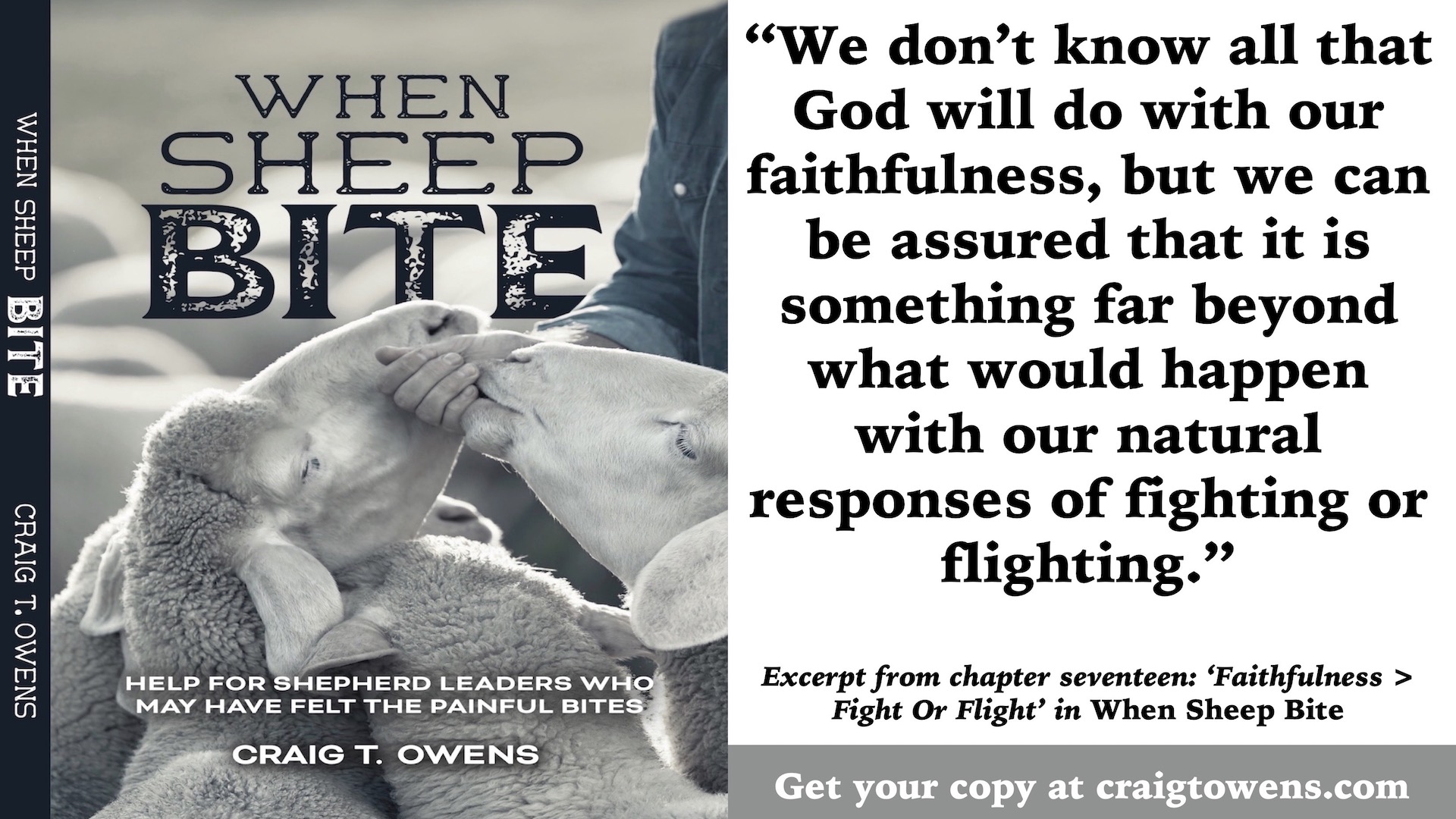
My book When Sheep Bite is divided into three section. In the first section I talk about a shepherd leader’s heart and section two diagnosis the sheep bites leaders endure. The final section is all about the faithfulness to finish well—not giving in to the natural responses of fight or flight.
I open that final section of the book like this—
Psychologists and medical doctors have all described what happens to our minds and bodies when we are under attack. They are universal responses that our loving Creator has implanted in all of us to be able to respond to threats that come at us. When confronted with a biting sheep, without consciously thinking about it our minds and bodies prepare for fight or flight.
But let’s consider those responses in the context of a shepherd pasturing his sheep. Is it an effective strategy for the shepherd to fight his sheep? No, of course not. Paul told Timothy that a shepherd is “not quarrelsome but forbearing and peaceable” (1 Timothy 3:3 AMPC).
Is it allowable for the shepherd to run away from the threat, leaving the flock without a shepherd? Again, no, as Jesus told us that one who resorts to flight isn’t worthy to be called a shepherd but is considered a mere “hired hand [who] cares nothing for the sheep” (John 10:12-13).
So if godly shepherds cannot give in to the natural responses of fight or flight, what are we to do? Since we serve an all-power, all-loving Chief Shepherd we must look to Him for the supernatural response of faithfulness.
Listen to the podcast of this post by clicking on the player below, and you can also subscribe on Apple, Spotify, or Audible.
The men who were guarding Jesus mocked Him and beat Him. They blindfolded Him and hit Him again and then demanded, “Prophesy! Who hit You?” And it wasn’t just the physical abuse, but they heaped mocking insult upon mocking insult upon Jesus (Luke 22:64-65).
All four of the Gospel writers recount how Jesus responded to both the physical and verbal abuse:
To the false charges before the Sanhedrin, Jesus remained silent (Matthew 26:57-63)
To the spitting and hitting by the members of the Sanhedrin, Jesus remained silent (Matthew 26:67-68)
To the physical abuse of the guards, along with their mocking insults, Jesus remained silent (Mark 14:65; Luke 22:64-65)
To the mocking He endured before King Herod, Jesus remained silent (Luke 23:9-11)
To the false charges announced to Governor Pilate, Jesus remained silent (Matthew 27:12-14)
To the insults and mocking thrown His way as He hung on the Cross, Jesus remained silent (Matthew 27:38-44; Mark 15:29-32; Luke 23:35-36)
His only verbal response was after being slapped in the face by one of the officials in the Sanhedrin. Jesus said, “If I said something wrong, testify as to what is wrong. But if I spoke the truth, why did you strike Me?” (John 18:22-23).
These are what we call an ad hominem attack. That is attacking the person, instead of confronting the ideas or arguments the person is presenting.
The self-control of Jesus here is absolutely astounding! Peter records, “When they held their insults [and their fists and their spit] at Him, He did not retaliate; when He suffered, He made no threats. Instead, He entrusted Himself to Him who judges justly” (1 Peter 2:23).
Even as His trial got underway, Luke records, “the council of the elders of the people…met together, and Jesus was led before them” (Luke 22:66).
Dr. Henry Halley points out that extra-biblical sources have told us that this trial violated at least four of the Sanhedrin’s own rules:
Meeting on the morning of a festival
Meeting in Caiaphas’ personal residence
Trying a defendant without defense
Passing the verdict of a death sentence in one day instead of two days
I would add a fifth rule which is found in Scripture: At least two witnesses need to be in agreement with their testimony for there to be a death sentence (Deuteronomy 17:6, 19:5; Mark 14:55-59).
When the Sanhedrin then hauled Jesus before Pontius Pilate, even their charges made before the governor in Luke 23:1-2 were flimsy at best:
Subversion—there is no proof for this
Opposing taxes to Rome—this was false (see Luke 20:20-25)
Jesus was a rival to the Roman throne—not true
And still Jesus remained almost completely silent! He only spoke when asked a direct question, but He remained silent throughout the false accusations, the verbal taunts, and the physical abuse.
When I am treated unfairly, when the rules are bent against me, when false charges are lodged against me, I get angry! I want to defend myself! I want to put my accusers or abusers in their place!
Could Jesus have prevented His arrest? Yes (Matthew 26:53)!
Could Jesus have defended Himself before the Sanhedrin, Pilate, and King Herod? Yes!
Could Jesus have come down from the Cross to prove His power? Yes!
But Jesus wasn’t trying to win a momentary argument; He was winning souls for eternity!
Jesus came not to be served, but to serve, and to give His life as a ransom for many (Mark 10:45). So, “for the joy set before Him He endured the Cross, scorning its shame, and sat down at the right hand of the throne of God.”
When anger boils up because of the mistreatment we are enduring, we must “consider Him who endured such opposition from sinners, so that you will not grow weary and lose heart” (Hebrews 12:2-3).
Like Jesus, let’s not try to win just a momentary argument that may result in the loss of a soul for all of eternity. There is a time to speak and there is a time for silence. As we keep our eyes on Jesus, we will know what time it is.
“We are more vulnerable to an attack (and a temporary defeat) after a victory than after a defeat. Why is that? Because victory tends to make us self-satisfied, but defeat tends to make usGod-dependent.”
The same is true with our God-given gifts. In his book on spiritual warfare, William Gurnall identifies great giftings in an individual’s life as a vulnerable place for an attack:
“Great gifts lift a saint up a little higher in the eyes of men, but they also tempt him to pride. Do not envy those with great gifts; instead, pity and pray for them. It is hard for them to escape the error of supposing that God’s grace in them is their own doing. …
“Had God given you gifts merely for your own pleasure or edification, the sin of pride would not be quite so bad. But when you use your gifts to lift yourself up, you tear down the Body of Christ. Your gifts are necessary to the health of the whole Body, but they must be administered properly.” —William Gurnall, in The Christian In Complete Armor (emphasis mine)
Nehemiah had enemies on almost every side as he attempted to complete his work (the rebuilding of the wall around Jerusalem). Check out his enemies’ strategy and his response to them—
Enemy’s tactic #1—Get Nehemiah preoccupied with attending meaningless meetings.
Nehemiah’s response—“I’m doing a great work; I can’t come down. Why should the work come to a standstill just so I can come down to see you?”
Enemy’s tactic #2—Send out letters slandering Nehemiah.
Nehemiah’s response—“There is no truth in any part of your story. You are making up the whole thing.” Then he prayed, “God, give me strength.”
Enemy’s tactic #3—Try to scare Nehemiah into running away.
Nehemiah’s response—“Should someone in my position run from danger? I know that God wouldn’t like that.”
Nehemiah had a vision from God and he stayed focused on that.
It determined his priority
It set his daily agenda
It gave him discernment
It gave him courage
The result: “When all our enemies heard [that we had completed our project]…they were frightened and humiliated. They realized this work had been done with the help of our God.”
A mark of a godly leader is one so focused on God’s plan that he pays no attention to his critics or enemies.
This is Part 7 in my series on godly leadership. To read my other posts, please click here.
Sometimes only a big word will do. Specificity means something particularly fitted to a use or purpose. In pharmacology terms, it is a remedy intended for a particular ailment or disorder, or the selective influence of one substance on another.
In other words, the medicine is targeted for a selected pain or disease.
Yesterday at Calvary Assembly of God we heard a powerful word from our guest speaker Jeff Hlavin. But one thought from Jeff has been particularly working on me. He said, “The enemy fires his darts at your most vulnerable places.” Or said another way: the enemy is specific in his targeting.
My defense against the attack of the enemy is prayer. But mybest defenseis prayer with specificity.
Perhaps something like this:
In praying for Bethany, I’m not just praying for healing from cancer, but healing from neuroblastoma.
In praying for Brody who has Pierre Robin Syndrome, I’m praying with specificity for his lower jaw to continue to grow to its proper size. And in the meantime, that he will not experience any problems with choking.
In praying for friends whose marriage is in trouble, I’m praying specifically for healing from past mistakes, for open lines of communication, and for a willingness to seek out professional counseling.
In praying for a young man who is in a soul-searching time, I’m targeting my prayers at the low self-esteem issues he’s battling.
Let’s not just pray; let’s pray with specificity. The devil is targeting his attacks deliberately; let’s target our prayers just as deliberately.



 Psychologists and medical doctors have all described what happens to our minds and bodies when we are under attack. They are universal responses that our loving Creator has implanted in all of us to be able to respond to threats that come at us. When confronted with a biting sheep, without consciously thinking about it our minds and bodies prepare for fight or flight.



 Craig T. Owens