
Time For A Self-Check

Listen to the podcast of this post by clicking on the player below, and you can also subscribe on AppleSpotify, or Audible. 

Have you ever heard this little saying: “To live above with saints we love, oh, that will be glory. But to live below with saints we know, well, that’s a different story”? I’ve found that it’s sometimes true! 

We love Psalm 133:1-3 when the saints are all together. What a great “selling point” to invite someone to be a part of the Christian community! But Psalm 41:7-9 is kind of embarrassing as David talks about former friends who have hurt him deeply. 

(Check out all of the Scriptures in this post by clicking here.)

But being bitten by a fellow sheep is a reality we all have experienced, and, sadly, we will probably have to deal with again in the future. There is a natural way we tend to react when we’ve been bitten, but there is also a supernatural response that the Bible consistently calls us to. This is the God-glorifying way we all need to strive for. 

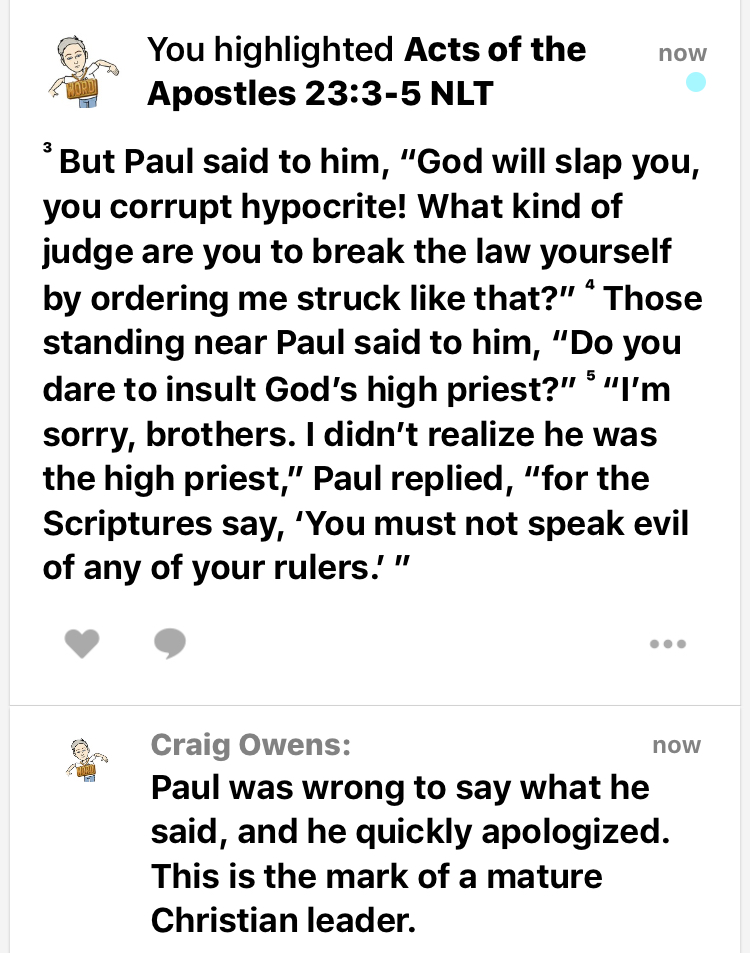
In Acts 23, Paul is standing before the Sanhedrin. He opens his remarks by simply saying he has a clear conscience before God, and the high priest immediately orders that Paul be smacked on the mouth! That seems like a bit of an over-reaction on the part of the high priest, but maybe it was a bit of show of force to let Paul know who was really in charge. Paul responded with an immediate—and natural—reaction when he says, “God will slap you!” 

Paul is an old man by this time. He’s been through shipwrecks, beatings, imprisonments, gone without food, traveled more miles than he can count, and preached more sermons than he can remember. His body was giving out on him, and his eyesight was especially weak. Clearly, Paul didn’t realize to whom we was addressing his remarks. But when he became aware, he immediately owned up to his mistake. Paul offered no excuses or justifications, just a quick, simple, sincere apology. 

When you have been bitten (slapped) by another sheep, you should ask: 

  • Could I have provoked them by something I said or did? 
  • Could I have hurt them by something I didn’t say or do? 

David prayed a great prayer in Psalm 139:23. But this prayer is only effective if we are willing to accept that we may have been the agitator that led to the bite. In the last words that Job speaks in the Book of Job, he is very introspective. Check out all of the “If I have” statements throughout Job 31. 
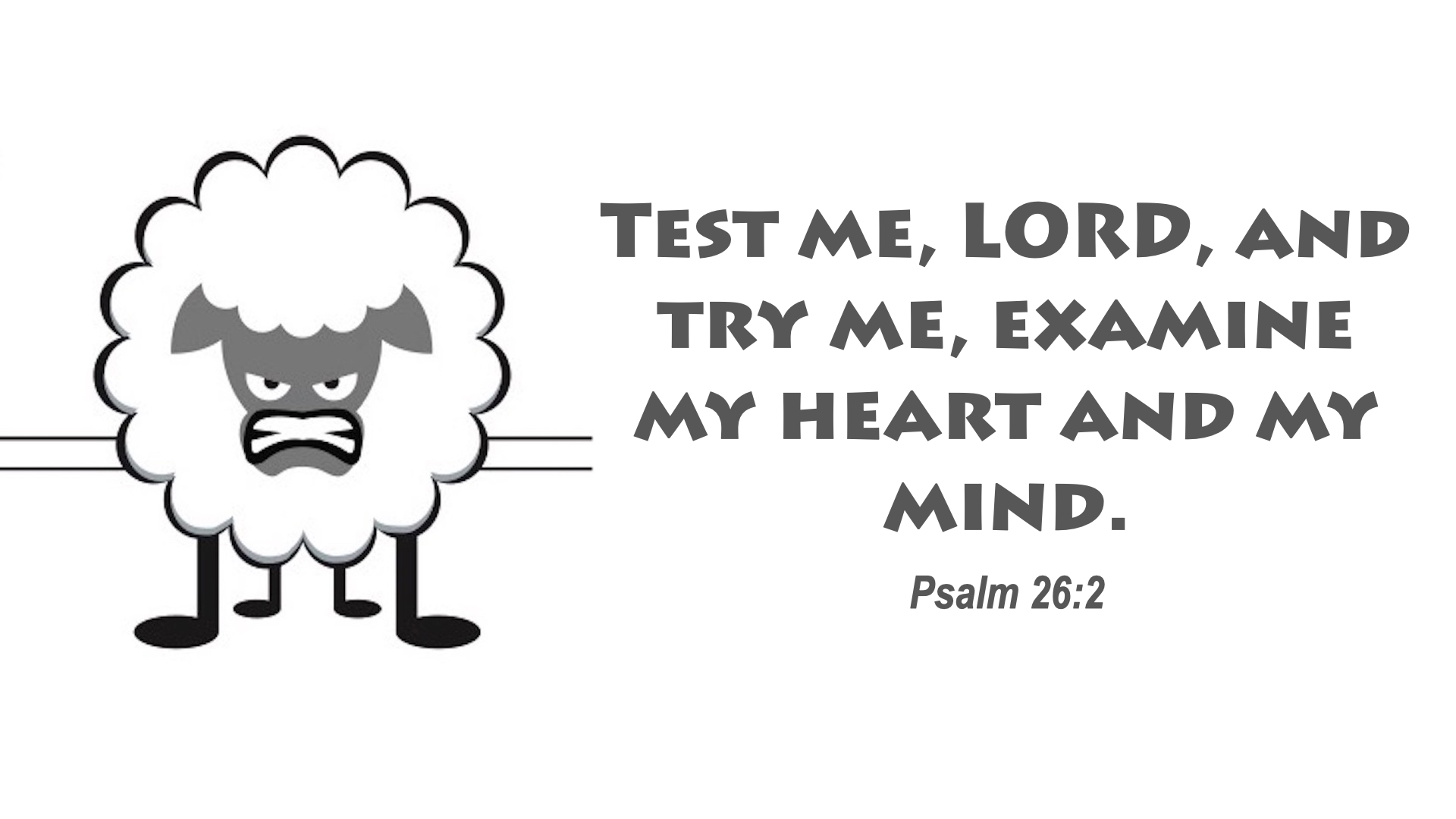
In Psalm 26:2, David invites the Holy Spirit to check him three times! 

  • test me = scrutinize me 
  • try me = assay me 
  • examine me = refine me in the fire 

When we are bitten, we should be open to the possiblity that God is using this bite to get my attention—to make me aware of a fault in my life or something that’s been in a blind spot. 

So we should consider the following: 

  1. Has this kind of bite happened more than once? From different sheep? 
  2. Has a spiritually wise person attempted to address this with me before? 
  3. Do I ever admit that I’m at fault, or is it always the other person’s fault? 
  4. Do I find myself making a list of why they should apologize to me? 
  5. When was the last time I apologized to someone else? 

If the Holy Spirit reveals something in us, He will also empower us to make the change and make amends. The natural response is to place all the blame on others. The supernatural response to pray Psalm 26:2 before responding. 

If we react only the natural way, it is a lose-lose for us and for the whole pasture. But if we learn to respond in a supernatural way, it becomes a win-win for everyone. Listen to the wise words of King Solomon—

He who heeds instruction and correction is not only himself in the way of life but also is a way of life for others. And he who neglects or refuses reproof not only himself goes astray but also causes to err and is a path toward ruin for others. (Proverbs 10:17 AMPC) 

Let’s all strive for the supernatural response that is a win-win for the whole Kingdom of God! 

Please follow along with all of the messages in this series by clicking here. 

P.S. If you are a pastor, you may want to check out my book When Sheep Bite.

►► Would you please prayerfully consider supporting this ministry? My Patreon supporters get behind-the-scenes access to exclusive materials. ◀︎◀︎
Murmuring Sheep

Listen to the podcast of this post by clicking on the player below, and you can also subscribe on AppleSpotify, or Audible. 

If you’re a shepherd leader, what do you do when the sheep under your care go, “Grrrr!”? 

To make sure that you haven’t done anything that caused the murmuring, you should humbly pray, “Search me, O God” (Psalm 139:23-24). And then, if you see you have done something wrong, repent and make things right. You may want to check out my blog post A Leader’s Sincere Apology. 

After this, Moses has given us in Exodus 16:8-9 two actions to take with murmuring sheep:

  1. If it wasn’t anything that you did, you need to remind yourself that the people are murmuring against God. 
  2. If it wasn’t anything that you did, you need to remind the sheep that they are murmuring against God. 

The other Scriptures I reference in this episode are Ephesians 4:15; Proverbs 27:5; Numbers 20:2-12. And the blog post I referred to in this video is How Are Godly Leaders To Use Their Authority. 

I would also encourage you to pick up a copy of When Sheep Bite to help you handle your murmuring sheep in a productive and God-honoring way. 

►► Would you please prayerfully consider supporting this ministry? My Patreon supporters get behind-the-scenes access to exclusive materials. ◀︎◀︎

A Leader’s Sincere Apology

…I’m sorry, brothers… (Acts 23:5). 

It started off innocently enough. Paul was addressing the Jewish high counsel and simply said, “Brothers, I have always lived before God with a clear conscience!” 

That doesn’t seem too controversial nor insensitive, but the next move does—Instantly Ananias the high priest commanded those close to Paul to slap him on the mouth. What?! That seems like a bit of an over-reaction on the part of the high priest, or maybe a bit of show of force to let Paul know who was really in charge here. 

If you were Paul and got slapped in the face for a pretty simple and true statement, how would you respond? Paul responded like I think I may have, with a little verbal “slap” of his own: “God will slap you, you corrupt hypocrite! What kind of judge are you to break the law yourself by ordering me struck like that?” 

Yeah, take that, you big meanie! 

Those standing closest to Paul must have gasped in horror as they said, “Do you realize who you’re talking to?” 

Paul is an old man by this time. He’s been through shipwrecks, beatings, imprisonments, without food, traveled more miles than he can count, preached more sermons than he can remember. His body was giving out on him, and his eyesight was especially weak. Clearly, Paul didn’t realize to whom we was addressing his remarks. 

But Paul immediately owned up to his mistake. “I’m sorry, brothers. I didn’t realize he was the high priest, for the Scriptures say, ‘You must not speak evil of any of your rulers.’” 

A mark of a godly leader is one who is quick to apologize.

Paul could have made excuses. He could have justified what he said by explaining, “He deserved it because of how he spoke to me!” or “He started it!” 

But Paul offered no excuses or justifications, just a quick, simple, sincere apology. 

Oh, that all Christian leaders were as sensitive as Paul and as quick to apologize!

This is part 26 in my series on godly leadership. You can check out all of my posts in this series by clicking here.

Jim Daly On Forgiveness

Jim Daly“Have you noticed? It can be a challenge to say, ‘I’m sorry.’ Oh, it’s not hard to speak the words, but it can be tough to say them with sincerity. Why? Probably because we understand that to apologize is to accept responsibility for ill-spoken words or misbehavior. It requires humility on our part, which can often be confused with giving someone else the upper hand over us. That’s why apologies tend to be viewed as a weakness.

“It’s also why people offer apologies that have been stripped of any real meaning. We minimize the severity of our actions; we blame our behavior on others; or maybe we say all the right words, but dilute them with sarcasm or humor. Whatever the method, we recognize a false act of contrition when we see it because the result is always the same: the appearance of an apology without the substance of one. And rather than healing, shallow platitudes often deepen a loved one’s wounds. Like a doctor’s empty syringe, an empty apology pierces the soul but offers nothing that can bring healing.

“That’s why, far from being a weakness, a heart-felt apology requires strength because it demands deep sincerity on behalf of the person offering it. That inner strength and humility often requires God’s grace to express. The Lord’s role is crucial because mending a relationship-gone-wrong has little to do with the specific words we use to express our contrition. The healing comes from the authenticity we pour into our words and actions.” —Jim Daly