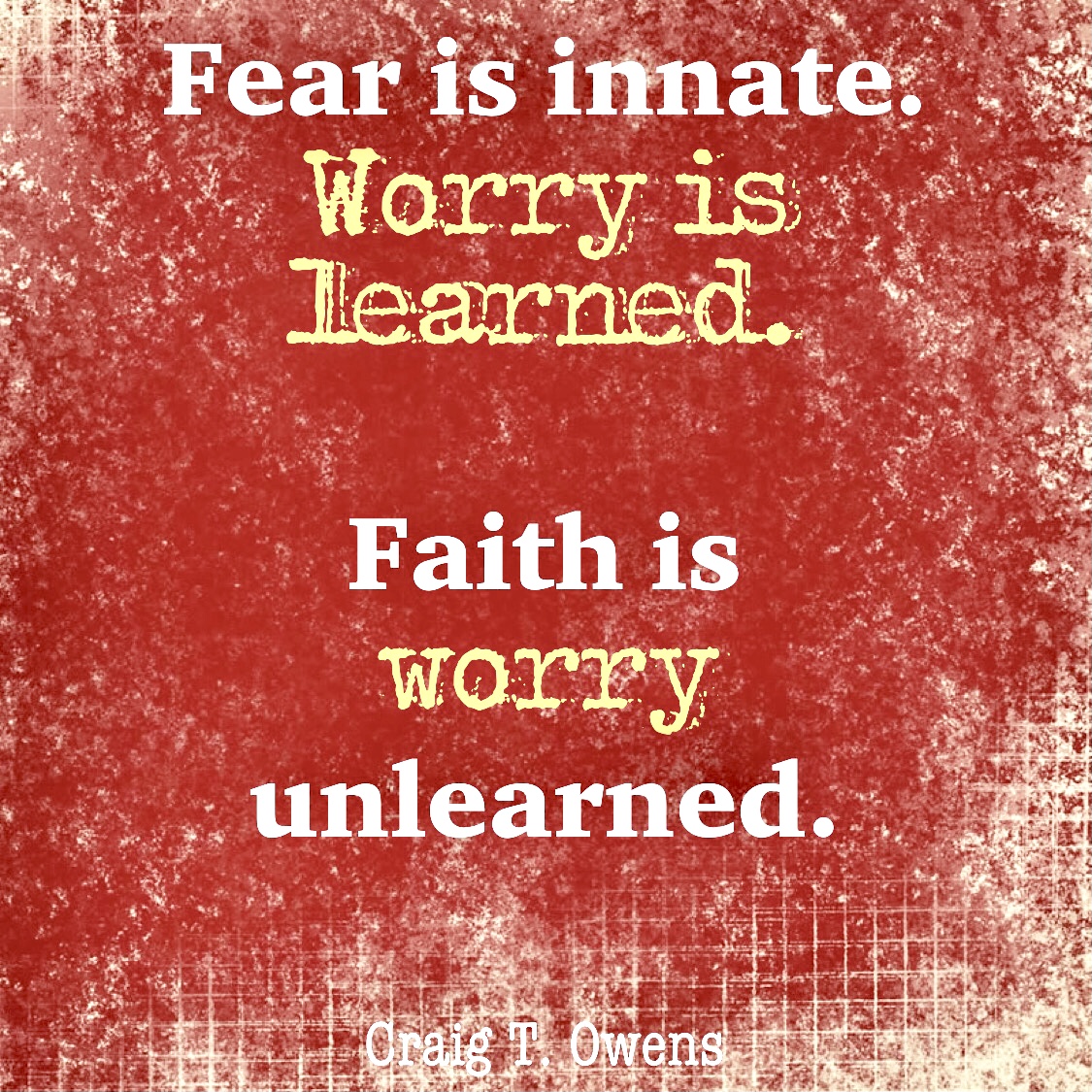
Worrywart

“Worry indicates we’re not willing to let God handle certain things—at least not in His way, and certainly not in His time.” —Craig Groeschel, in The Christian Atheist

Worry is a control issue

…that is, I want to be in control.

Worry is a sovereignty issue

…that is, I think I know best how things should work out.

Worry is a trust issue

…that is, I trust God only when things are happening on my timeframe.

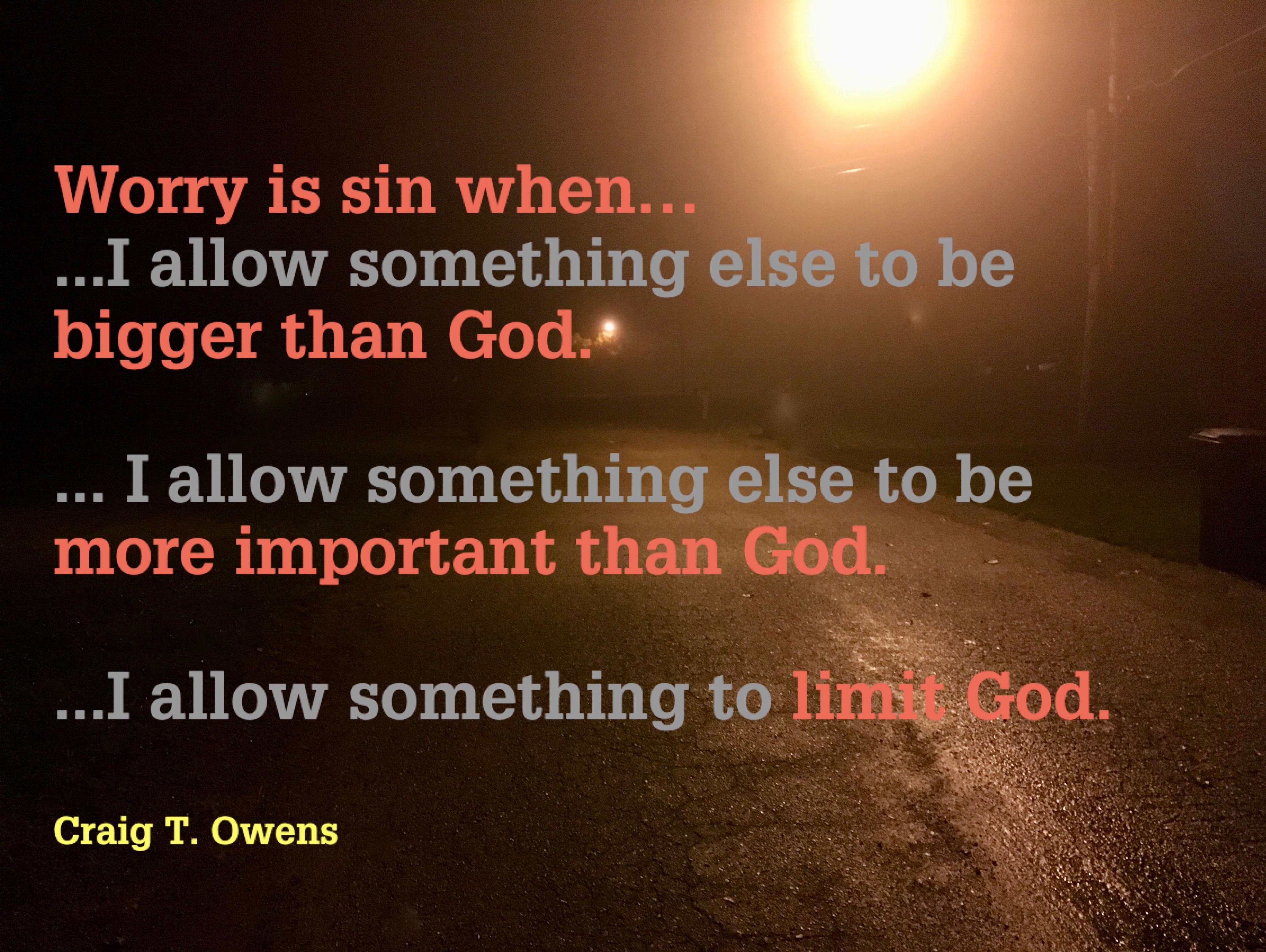
Bottom line: Worry is sin when

  • …I allow something else to be bigger than God.
  • …I allow something else to be more important than God.
  • …I allow something to limit God.
  • …I look more to myself for solutions than I look to God.

Any worry should be a call to prayer: Don’t worry about anything; instead, pray about everything. Tell God what you need, and thank Him for all He has done. Then you will experience God’s peace, which exceeds anything we can understand. His peace will guard your hearts and minds as you live in Christ Jesus. (Philippians 4:6-7)

Any extended worry should be a call to repentance: Jesus commands us four times, “Do not worry” (Matthew 6:25-34).

Worry can be disguised in a lot of different forms, but it’s still worry. And it’s still sin. I’m working on this.  

The Blessing

Listen to the podcast of this post by clicking on the player below, and you can also subscribe on AppleSpotify, or Audible.

Just some personal musings on a well-known blessing.

The Lord bless you…

  • May you find nothing missing, nothing lacking.
  • May you be full and complete.
  • Then you will be better able to bless others.

…and keep you;

  • Safe and secure.
  • As a priceless heirloom.
  • As the apple of His eye.

…the Lord make His face to shine upon you,

  • So you are basking in His presence.
  • Reflecting His glory.
  • Distinguished from all others.

…and be gracious to you;

  • As He renews His mercies to you every morning.
  • Lavishing you with His blessings.
  • Not treating you as your sins deserve.

…the Lord turn His face toward you,

  • Knowing that you have His full notice.
  • Enjoying His full approval.
  • Living in His abundant favor.

…and give you peace 

  • All your anxieties banished.
  • Your confidence renewed.
  • Your direction assured.

When you say, “May God bless you” to someone, you are saying one of the most powerful, loving things that you could ever utter. There is nothing like God’s blessing: nothing compares to it, and nothing can detract from it.

May I encourage you to more regularly ask for God’s blessing to be on your life, and may you be lavish with your request for God’s blessings on others’ lives too.

GOD BLESS YOU!

►► Would you please prayerfully consider supporting this ministry? My Patreon supporters get behind-the-scenes access to exclusive materials. ◀︎◀︎

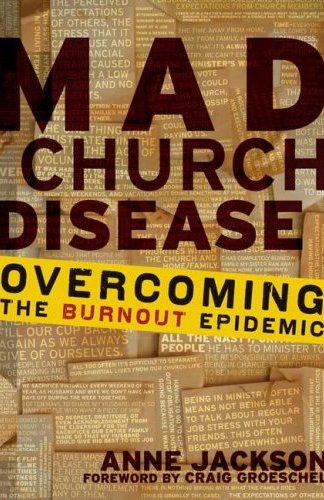
Mad Church Disease (book review)

Read this book and save your life.

Seriously.

I have seen far too many good people get burned-out in the most unlikely place. The one place where you would expect wholeness and vitality and safety and health: Church! In Mad Church Disease Anne Jackson draws the comparison to bovine spongiform encephalopathy (better known as mad cow disease) to confront mad church disease head-on.

Here’s the insidious thing about the way mad cow disease spreads: after infected cows die, they are ground up and fed to healthy cows. So unwittingly the disease is perpetuated because no one recognizes it’s there. Sadly that’s what happens far too often in the church. We have developed cultures that continue to burn-out people, and then we let those burned-out people feed (develop) new people

Anne shines the light of truth on this ugly disease. She confronts the symptoms head-on, and offers practical steps for helping people get healthy.

As someone who came very close to getting burned-out by mad church disease, I can attest how right-on-the-mark Anne’s book is. And to bolster her diagnosis, Anne interviews several leading pastors whose “second opinion” confirm the original diagnosis. I liked this observation from Bill Hybels:

“Especially as leaders in the church, we consistently need to be filled up and buoyed in our spirits because everybody takes their cue from the leader. If the leader is exhausted, then the people following that leader will feel exhausted. If the leader is wearing thin on hope, then people start losing hope too. If the leader gets pessimistic, everybody gets pessimistic.”

So who should read Mad Church Disease?

  • Pastors
  • Paid church staff
  • Volunteer church ministers
  • Counselors
  • Church board members

Whether you have been infected by mad church disease or not, you need to read this book. It will either be a source of healing for you, or an eye-opener to help protect yourself and others around you from this deadly disease.

The first step to eliminating mad church disease is recognizing its symptoms. Mad Church Disease does just that, and then goes further to talk about the steps for healing. Thanks, Anne, for a straightforward look at this serious disease.

Limbo

According to the dictionary, limbo has some unusual definitions:

  • a region on the border of hell or heaven;
  • an intermediate, transitional, or midway state or place;
  • a place or state of imprisonment or confinement.

Have you ever felt you were in limbo? I have, and it does sometimes feel like a place of imprisonment. As a follower of Jesus Christ, I’ve been wondering why I should ever be in limbo. And I have come to the conclusion that it’s because I’m in such a hurry to arrive someplace.

We get so anxious to get somewhere—anywhere—and while we are between two points we feel the transitional state very acutely, and it often feels like a prison.

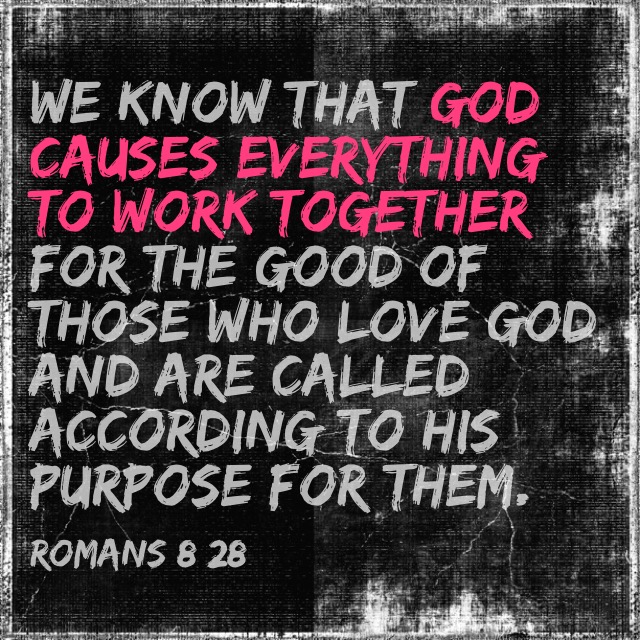
But I think God is more interested in our development process than He is in our destination. There is Bible verse quoted often when people are in limbo: “And we know that in all things God works for the good of those who love Him…” (Romans 8:28). But the verb tense here is not a destination verb but a process verb. It’s better stated, “And we know that in all things God is working for the good of those who love Him.”

Look at the differences—

  • “I really thought I was supposed to get that job” [destination focus] versus “Here’s what God taught me while I was pursuing that job” [process focus].
  • “What am I supposed to do next, God?” [destination focus] versus “What are you teaching me while I wait on You?” [process focus]
  • “Why did it turn out this way?” [destination focus] versus “Here’s how I am growing through this time” [process focus]

Limbo isn’t fun (or as one of my friends said on Facebook this morning, “A life in limbo sucks!”). But it is in the limbo times—the times of process—that we learn the most about all of the good that God is working in us and through us.

If you feel like you’re in limbo today, take your eyes off a destination, and look at the process. Believe me, this is a lesson I am learning right now—big time! What limbo lessons have you learned—or should I say, what limbo lessons are you learning right now? 

Justifying Myself

One of my favorite prayers is recorded in Psalm 139. It is such an intimate prayer of how well God knows us. I‘m frequently struck by the two thoughts that seem to contradict themselves in the opening and closing verses.

David begins his prayer, “O Lord, You have searched me and You know me. … You perceive my thoughts from afar.” But then he ends his prayer with these words, “Search me, O God, and know my heart; test me and know my anxious thoughts. See if there is any offensive way in me, and lead me in the way everlasting.”

Now why would David ask God to search his heart and his thoughts after he said God had already searched him? I think it‘s because our natural tendency is to justify ourselves. It goes like this: God searches us → He shows us things that need to be changed → We justify why we don‘t need to change those things → We try to forget what God had pointed out to us and move on.

When the Holy Spirit points out an anxious thought or an offensive way, our natural response is to quickly say, “Yes, but…

  • …I know I shouldn‘t have said that to her, but you don‘t know how she pushes my buttons!”
  • …I know it‘s wrong of me to desire that, but having it won‘t really hurt anything.”
  • …I know I should make that change in my behavior, but it‘s just not realistic in my current situation.”
  • …I know I should have talked to him about Christ, but it wasn‘t the right time.”
  • …I know my I‘ve been battling anxiety over this, but I‘m scared to make any changes because things might get worse!”

I echo Augustine‘s prayer: “O Lord, deliver me from this lust of always vindicating myself.”

David sets an example for me that I‘m trying to make a consistent practice in my life: Regularly allowing the Holy Spirit to search me for any anxious thoughts or offensive ways, and then addressing those without trying to justify or vindicate myself (no “yes-but‘s”). Because if I justify myself, I‘m really saying I know better than God what’s best for my life.

And all the while, God is simply trying to lead me in the way everlasting. He‘s trying to occupy more of my life with His presence.

If thou couldst empty all thyself of self.
Like to a shell dishabited,
Then might He find thee on the Ocean shelf,
And say, “This is not dead,”
And fill thee with Himself instead.
But thou art all replete with very thou,
And hast such shrewd activity,
That, when He comes, He says, “This is enow
Unto itself—‘Twere better let it be:
It is so small and full, there is no room for Me.“ —T.E. Brown

Are you making room for Him today? Or are you justifying the anxious thoughts and offensive ways the Holy Spirit is trying to reveal to you? 

The Carbon Monoxide Of Anxiety

Carbon monoxide can poison our bodies and our emotions

Carbon monoxide can poison our bodies and our emotions

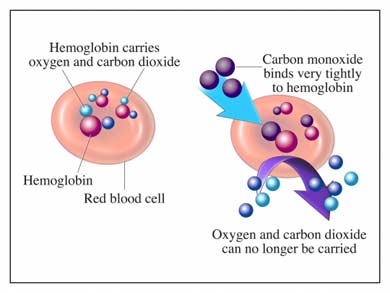
Our human red blood cells have a unique protein that carries life-promoting oxygen throughout our bodies. Hemoglobin binds to both oxygen (O2) and carbon dioxide (CO2) in a way that holds them “loosely” so that they can be released at just the right place and time in our bodies.

Carbon monoxide (CO) is the enemy of this respiration process. CO binds to hemoglobin 240 times more firmly than oxygen and CO2. With the CO so firmly attached to the hemoglobin, O2 and CO2 cannot be exchanged properly in our bodies. In other words, CO hijacks the respiration process. The sneaky thing is that CO is odorless, tasteless, and colorless, so it’s subtle poisoning. It simply brings about a lethargy that deepens into death.

As we move past Thanksgiving Day, I believe that a similar process can take place in our emotional lives. Thankfulness is the “oxygen” of our souls, and anxiety is the “carbon monoxide.”

In Philippians 4:6 Paul says, “Do not be anxious about anything,” where he is echoing the words of Jesus in Matthew 6:25: “Do not worry about your life.” Anxiety and worry can begin to dominate our emotional life: they bind so tightly that thankfulness and gratitude are forced out. This leads to emotional lethargy, and—if not corrected quickly—emotional deadness.

The cure for carbon monoxide poisoning is to twofold: (1) remove the victim from the toxic environment, and (2) give the victim pure oxygen to breathe. The same cure holds true for emotional CO poisoning—(1) Get out of that environment: “Do not be anxious about anything, but in everything, by prayer and petition, with thanksgiving, present your requests to God” (Philippians 4:6); and (2) get the pure emotional oxygen: Philippians 4:8 gives us the checklist for the pure oxygen of our emotional thought life: “Fix your thoughts on what is true, and honorable, and right, and pure, and lovely, and admirable. Think about things that are excellent and worthy of praise.“

If you find yourself sighing, or emotionally drained, or even depressed, it could be that the carbon monoxide poisoning of anxiety has snuck in. Get out of that toxic environment by praying and giving thanks to God, and then guard against future hijack attempts by breathing deeply on the things which are pure and lovely and excellent.