Empowering The Team

In reading Leadership Is Dead, one passage particularly stood out to me:

“The wise leader understands that sharing the burden benefits the entire team over the long term. Empowering others makes tasks manageable while also allowing team members to sharpen their skills and build upon their strengths. When a leader refuses to share the load, he brings disservice to the organization because those on his team are not allowed to develop their own leadership skills, and the next generation of leaders are not developed properly for future organizational success.”

Think back to the first two kings in Israel’s history: Saul and David. Both stood out from everyone around them as a strong leader. But only one of them left behind a lasting leadership legacy.

Both Saul and David had men who were immediately attracted to them. Saul was surrounded by valiant men, while David was surrounded by society’s rejects. But clearly David was an empowering leader, and Saul was not. Want proof?

The Bible gives a lengthy list of David’s mighty men, along with quite a résumé of their heroic accomplishments. The list of Saul’s mighty men is: .

I think David was secure in the fact that God called him to lead, while Saul was constantly second-guessing.

  • This made David generous, and Saul jealous.
  • David liberated his men, and Saul contained his men.
  • David encouraged, and Saul controlled.

In the end: David left a legacy, and Saul did not.

What kind of leader do you want to be?

UPDATE: Being secure to serve is one of the main points I tackle in my book Shepherd Leadership: The Metrics That Really Matter. Check out this short clip—

Don’t Get Left Behind

This post is especially for the men (but, ladies, feel free to read along too).

No, I’m not talking here about the series of Left Behind books that tell a story about people who may miss out on the rapture of the Church. I’m talking about you leaving the protection of your friends and being exposed to a serious defeat.

Most times when I am counseling men who have given in to a temptation, or those who are battling the same old perplexing problems, I find a common theme. It’s not something new—it’s been around a long, long time.

Take this for example:

In the spring of the year, when kings normally go out to war, David sent Joab and the Israelite army to fight the Ammonites.

You probably know the rest of this sad story: David cannot contain his lust for Bathsheba (another man’s wife) so he seduces her, sleeps with her, gets her pregnant, and then kills her husband to try to cover it up. But look where it all started: David was alone. When he normally would have been with his brothers-in-arms, he stayed behind.

I’m a big believer in accountability, so I’ve written before about a brother who makes sure I stay on the straight-and-narrow. What about you? Are you trying to stay pure all by yourself? Are you battling temptations on your own?

Two people are better off than one, for they can help each other succeed. If one person falls, the other can reach out and help. But someone who falls alone is in real trouble. Likewise, two people lying close together can keep each other warm. But how can one be warm alone? A person standing alone can be attacked and defeated, but two can stand back-to-back and conquer. (Ecclesiastes 4:9-12)

Don’t try to go into battle all by yourself. If David—a man after God’s own heart—couldn’t win on his own, what makes you think you can?

Loyalty

Listen to the podcast of this post by clicking on the player below, and you can also subscribe on AppleSpotify, or Audible.

How would you define loyalty? All of the dictionary definitions have to do with faithfulness. It’s almost implied that there is a blindness (at worst), or a dogged persistence (at best), to remain loyal to a person or to an idea. The thinking goes, “If I’m loyal to someone, like it or not, I become their Yes-man.”

But I think…

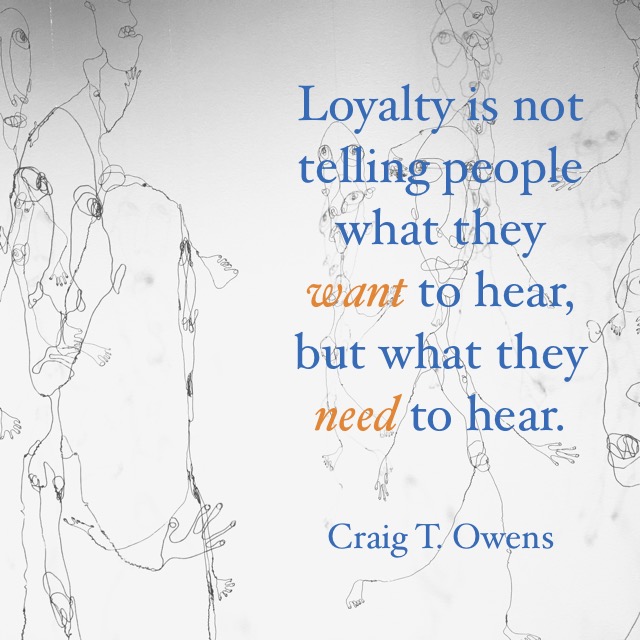
Loyalty is not telling people what they want to hear, but what they need to hear.

For an example, take the prophet Nathan in the Bible. We don’t know how old he is when he steps on the scene, or even where he came from. There isn’t a clue as to his tribal ancestry or even his father’s name.

King David wanted to build a temple for the ark of the covenant of the Lord, and he asked Nathan about this. Nathan immediately said, “Yes!” (kinda reinforces that idea of loyalty = Yes-man, doesn’t it?) But wait! That night, God speaks to Nathan and says, “Tell David he’s not the one to build the temple for Me.” So Nathan returns to David and loyally tells him no.

Later on, David steals another man’s wife and contrives a plan to have that man murdered on the battlefield. David thinks he’s gotten away with it until Nathan, the loyal friend, shows up to confront David with his sin. Nathan didn’t want to see David fail, but he wanted to give him a chance to confess and repent.

Near the end of David’s life, one of David’s sons, Adonijah, wanted to take the throne for himself. Many of the officials in David’s palace jumped on the bandwagon, but loyal Nathan did not. In fact, Nathan even got word to the King about Adonijah’s plans. As a result, David asked Nathan to anoint his son Solomon as king.

During David’s life, Nathan wrote David’s biography. If Nathan was just a mindless Yes-man, he could have easily left out the messy parts of David’s life. But the loyal friend wanted to show future readers that we all mess up, but God forgives and restores us when we repent.

Nathan’s name means the gift God gave or a giver. Both meanings fit this loyal man.

David was so blessed by Nathan’s loyalty that he named one of his own sons after the prophet.

Loyal friends give their friends the gift of life. They don’t let friends go down a destructive path. They don’t join with others when they attack. They remain constant, always-there, friends.

What a blessing to be called a loyal friend! And what an even greater blessing to have “Nathans” in our own lives!

►► Would you please prayerfully consider supporting this ministry? My Patreon supporters get behind-the-scenes access to exclusive materials. ◀︎◀︎

Lead Like David

I’ve always been fascinated by the leadership of Israel’s second king: David. There are so many leadership lessons to be learned from his life. A few things I’ve noted about his leadership that I am always trying to implement in my life as well.

Respect—David treated everyone (even his enemies) with respect.

Shrewdness—David used his wits exceptionally well. He knew how to shower gifts on the right people, show recognition to those who needed their ego stroked, be gracious to those who were uncertain, and even flex his muscles with show-offs who got out of line.

Prayer—David was a man of prayer. He prayed for direction, he asked God for strategies, he prayed for deliverance. He prayed for everything.

Confident humility—I know it sounds like an oxymoron (how can someone be both confident and humble?), but David really got this. Check out this commentary:

And David became more and more powerful, because the Lord God Almighty was with him. … And David knew that the Lord had established him as king over Israel and had exalted his kingdom for the sake of His people Israel.

Man of the people—David didn’t closet himself away; he lived and led in full sight of everyone.

All the people took note and were pleased; indeed, everything the king did pleased them.

I want to lead like David led!

What about you? Are there other areas of David’s leadership that you admire or want to imitate?

Lamenting Over The Fallen

How The Mighty Have Fallen! Long before Jim Collins entitled his latest book with this phrase, David said this when King Saul and Prince Jonathan were killed in battle. In fact, he said it not once, but three times in just eight verses.

It is understandable that David would lament the death of his friend Jonathan. They were covenant brothers, they shared the same heartbeat for God and for Israel, and they stood by each other through thick and thin.

But Saul? Why would David lament the death of Saul? This is the man who was jealous of David. So jealous that he did everything he could to trip David up. Including trying to kill him. Saul chased David from his home, from his family, from his wife, even from his country.

Why would David lament Saul’s death? Wouldn’t it be more appropriate to rejoice over it?

But David still saw Saul as “the Lord’s anointed.” David recognized the good in Saul. He called him…

  • the glory of Israel
  • a successful warrior
  • gracious
  • lovable
  • strong
  • Israel’s provider

When David heard Saul had been killed, he lamented, Oh, how the mighty have fallen!

When I see the mighty, God-anointed leader fall, do I lament?

I may shake my head, I may feel vindicated, I may be disgusted, but I don’t know that I have ever lamented or grieved when one of these mighty brothers has fallen. Or if I have, my lament has been short-circuited by other less appropriate emotions.

Despite their sin, they are still God’s anointed.

Who am I to sit in judgment? Who am I to do anything but lament their fall?

Lord, forgive me! Father, help me to see Your anointed ones in the proper perspective: as Your anointed. Holy Spirit, remind me of the tragedy of even one mighty one who falls. May my response be one of lament, and mercy, and prayer.

The Pits

I recently finished reading two books that both have “the pits” in their title, and they both are solidly based on Scripture. But they couldn’t be more different.

Get Out Of That Pit by Beth Moore is based on three verses in Psalm 40: I waited patiently for the LORD; He turned to me and heard my cry. He lifted me out of the slimy pit, out of the mud and mire; He set my feet on a rock and gave me a firm place to stand. He put a new song in my mouth, a hymn of praise to our God. Many will see and fear and put their trust in the LORD.

Beth’s book is all about getting out of a pit. Those places we’ve slipped into, been shoved into, or keep going back to. Those things that limit our perspective on life. Those hurts that keep us from enjoying the full life Jesus wants to give us. In a word, this book is all about deliverance from a pit.

In A Pit With A Lion On A Snowy Day by Mark Batterson is based on two verses in 2 Samuel 23: Benaiah son of Jehoiada was a valiant fighter from Kabzeel, who performed great exploits. He struck down two of Moab’s best men. He also went down into a pit on a snowy day and killed a lion. And he struck down a huge Egyptian. Although the Egyptian had a spear in his hand, Benaiah went against him with a club. He snatched the spear from the Egyptian’s hand and killed him with his own spear.

Mark’s book is all about going into a pit. Benaiah was an initiator. Mark leads us through Benaiah’s life to show us that sometimes problems come as opportunities disguised as Moabite warriors or roaring lions or huge giants. And in order to live the full life God has in mind for us, we have to seize those roaring opportunities. In a word, this book is all about taking the initiative to go into a pit.

The pits can limit your life. Either you can be stuck in one, or you can be afraid to go into one. God wants you to live a victorious life. Whether you are stuck and need deliverance, or you are stuck and need initiative, these books can help awaken in you the great things God wants to do through you.

Both books have discussion questions to go along with each chapter, which makes them excellent for use as either an individual or small group study.

Ready? Go get out of that pit—or dive headlong into one—to live the full life God has for you!

Success Is Going

King David is one of the most well-known characters in the Old Testament. Such incredible stories are told about him that his life can be summed up in one phrase that occurs four times in Scripture—The Lord gave David victory everywhere he went (2 Samuel 8:6, 14; 1 Chronicles 18:6, 13).

When David was faced with a challenge or an enemy, he threw himself fully into meeting the enemy head-on, and he was always successful. There is no record of David ever being defeated in battle. If he went out, he won.

Aha, keyword alert—The Lord gave David victory everywhere he WENT.

The only times David was defeated was when he stood still:

• When his son Absalom killed another of David’s sons, Amnon, David didn’t do anything. Even when Absalom returned from exile, David stayed home and didn’t reconcile with his son (2 Samuel 13-15).

• David’s son Adonijah behaved inappropriately and eventually rebelled against David, too. But David “never interfered with him by asking, ‘Why do you behave as you do?’” (1 Kings 1:6).

• David lusted after and then committed adultery with Bathsheba when, “In the spring, at the time when kings go off to war, Joab led out the armed forces. … But David remained in Jerusalem” (1 Chronicles 20:1).

• David angered God by ordering that a census be taken of all of the men eligible for military service in Israel. “So David said to Joab and the commanders of the troops, ‘Go and count…” (1 Chronicles 21:2). In other words, David stayed while others went.

Solomon correctly noted, “The path of life leads upward for the wise to keep him from going down to the grave” (Proverbs 15:24). There are only two directions: forward (or up) OR backward (or down). There is no standing still.

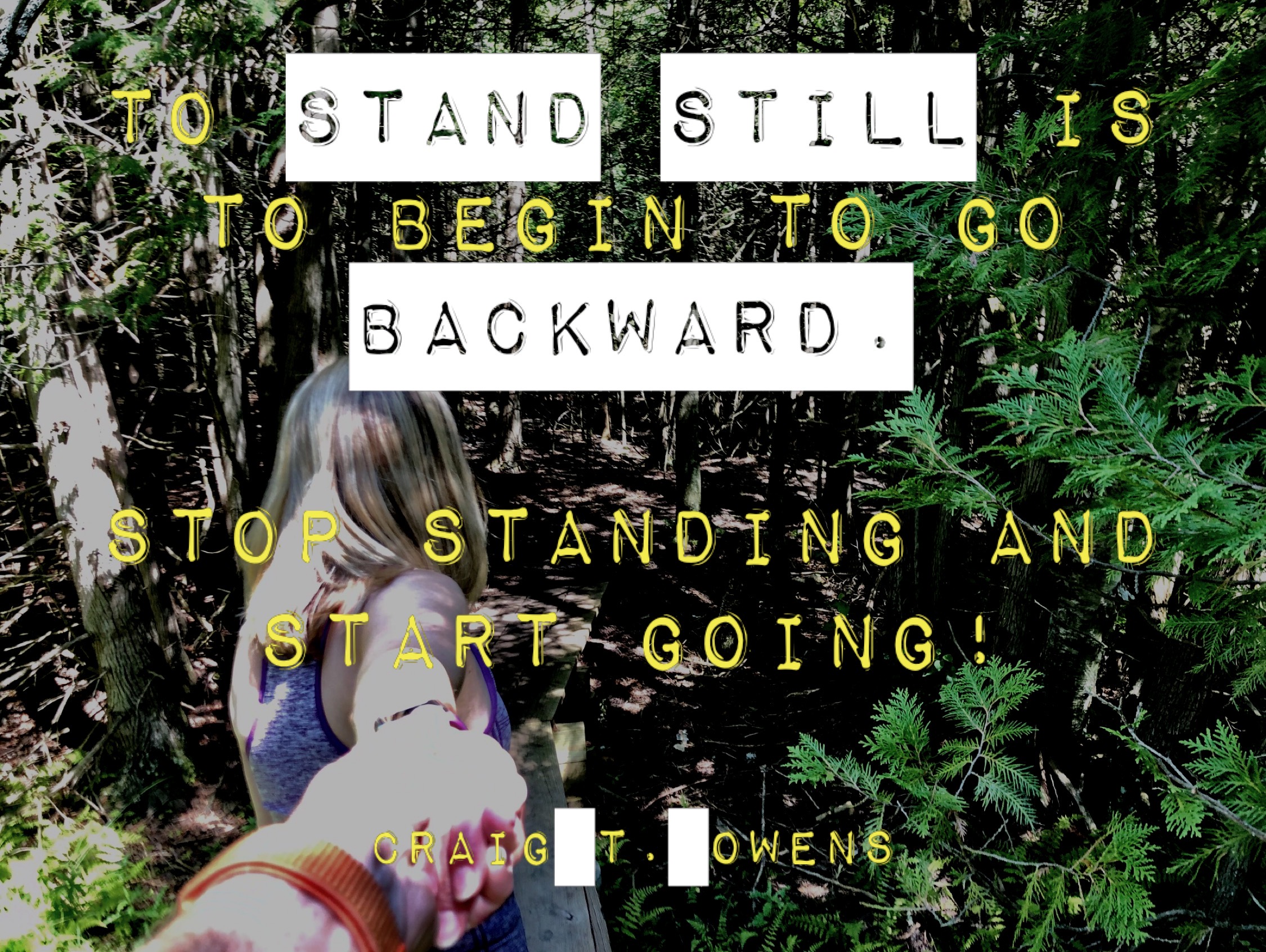
The Lord gave David victory everywhere he WENT, not everywhere he stood still. To stand still is to begin to go backward.

Is there a battle you need to fight? Is there a challenge you’ve been avoiding? Is there something you need to complete? Are you waiting for something to happen? Are you content just to stand still?

Stop standing still and start going! If you are following God, He will give you victory everywhere you go.

Mighty People

I was reading King David’s list of Mighty Men. Many theologians believe that the names that appear in 2 Samuel 23 was the list and descriptions that David wrote himself. He was not threatened to have such competent and gifted people around him. Those leaders challenged David to lead at a higher level.

In the spirit of this list, I was thinking about my own list of Mighty Men (and Women). These are some of the incredibly gifted and highly competent people who surround me and help me do more than I could have done on my own. David listed his “Big Three” first, and then the rest of the names in no particular order of importance. I, too, list my Big Three first, and then the rest of my Mighty People in no special order.

Jesus – my Master; as I’ve gotten to know Him better through the years He becomes a closer and closer Friend.
Betsy – my helpmate and very best friend.
Bubba – my covenant brother, like Jonathan was to David.
My parents – incredible counselors, godly examples.
Tom & Pinky – fearsome fellow warriors.
Dick Jr. – sharpening my iron more than anyone else can.
T.J. – armor-bearers don’t come any stronger or any more valiant.
C-Dog – one of the wisest, kindest people I know.
Steve & Keri – faithful, dependable, Spirit-led prayer warriors.
Dave & Jessica – ready for anything at anytime.
Bob & Pat and Stan & Clara – mature Christians who are still young at heart and so forward-looking.
Sister Warnick – always seeing more in me than I can see myself.
Barney – personifies all of the reasons why I do what I do, a trophy of God’s grace.
Jim – a fellow shepherd whose hindsight and insight give me foresight.
Hank – years of wisdom continually poured into my life.
Aaron – growing like Timothy, destined to be a world-changer.

To my Mighty Men & Women I say, “Thanks!”

Mine!

I often joke that the first word infants learn to speak after “mama” and “dada” is “mine!” I usually joke that this is an indication of the sinful, prideful nature that is inherent in all humans.

But what do you think about when God says, “Mine!”?

He does say this, and He says it about you. God says, “You are Mine!” Not only that, but God wants us to say back to Him, “God, You are mine!” David expresses this I-am-God‘s-and-He-is-mine mentality in a great prayer in 2 Samuel 22. Forty-four times in just 51 verses David uses the personal possessive pronoun my.

David is thankful for the reality that God is close to him. He calls God my Rock, my Fortress, my Deliverer, my God, my Shield, my Salvation, my Stronghold, my Refuge, my Savior, my Support, my Lamp.

David says, “I am aware that God hears my voice and my cry, and He sees my distress. He delivers me from my enemies, my foes, my disaster. He rescued me because He delighted in me! Why? Because of my righteousness and the cleanness of my hands.

“God makes my way perfect, He makes my feet like the feet of a deer so that I will not stumble. God trains my hands and strengthens my arms for battle. You stoop down to make me great. You make my adversaries bow at my feet; You make my enemies turn their backs in flight; I destroy my foes. You delivered me from the attacks of my people. You set me free from my enemies; You exalted me above my foes.

Therefore I will praise You, O Lord, among the nations; I will sing praises to Your name. The Lord lives! Praise be to my Rock! Exalted be God, the Rock, my Savior!

Why does God want me to say, “Mine!”? Because it‘s only when I know that I am fully His possession that He is fully exalted. God loves to bless me when I acknowledge that “I am Yours and You are mine!”

Right now God is saying to you, “You are Mine!” Have you said “Mine!” to God today?