Incapable Of Innocence

Incapable of innocenceThis is God’s description of ancient Israel, but it sounds a lot like modern-day America to me. God said they (we) have…


  • Broken My covenant
  • Revolted against My law
  • Rejected what is good
  • Appointed rulers without My consent
  • Made idols
  • Acted as if My laws don’t apply to you
  • Practiced a meaningless religion (see Hosea 8)

And then God asks them (us) this question—

How long will you be incapable of innocence?

God’s question triggers a bunch of additional questions…

  • What are we waiting for?
  • Why don’t we repent of our sins?
  • What’s keeping us from returning wholeheartedly to God?
  • How much longer will we remain incapable of innocence?
  • How much longer will we tempt God’s mercy?

I’m not waiting for them to change; I’ve got to change. I must recognize my sin, repent of my sin, and return wholeheartedly to God. Will you join me in this?

Yet

God’s mercy is AMAZING! Charles Spurgeon said:

“There is nothing little in God; His mercy is like Himself—it is infinite. You cannot measure it. His mercy is so great that it forgives great sins to great sinners, after great lengths of time, and then gives great favors and great privileges, and raises us up to great enjoyments in the great heaven of the great God.”

In the Bible, Daniel called on God’s mercy:

We do not make requests of You because we are righteous, but because of Your great mercy. O Lord, listen! O Lord, forgive! O Lord, hear and act! For Your sake, O my God, do not delay, because Your city and Your people bear Your Name. (Daniel 9:18, 19)

Mercy, simply put, is not getting the punishment we deserve. I am so grateful for God’s mercy which is new every morning. I need it.

But mercy is not something to be treated lightly. Mercy requires something of its recipient. In the verses preceding Daniel’s prayer, notice the use of the word YET:

  • All this disaster has come upon us, YET we have not sought the favor of the Lord our God by turning from our sins and giving attention to Your truth (v. 13).
  • The Lord our God is righteous in everything He does; YET we have not obeyed Him (v. 14).

If we receive God’s gift of mercy and YET do not change, we repudiate that mercy. In other words, it’s a slap in the face of God to not receive the penalty for our sins, and YET continue to live the same way.

My friend, if you have received God’s mercy gift turn from your old ways, give attention to His truth, and obey Him. This is the only way to show proper appreciation to our just God for His incredible mercy.

Lamenting Over The Fallen

How The Mighty Have Fallen! Long before Jim Collins entitled his latest book with this phrase, David said this when King Saul and Prince Jonathan were killed in battle. In fact, he said it not once, but three times in just eight verses.

It is understandable that David would lament the death of his friend Jonathan. They were covenant brothers, they shared the same heartbeat for God and for Israel, and they stood by each other through thick and thin.

But Saul? Why would David lament the death of Saul? This is the man who was jealous of David. So jealous that he did everything he could to trip David up. Including trying to kill him. Saul chased David from his home, from his family, from his wife, even from his country.

Why would David lament Saul’s death? Wouldn’t it be more appropriate to rejoice over it?

But David still saw Saul as “the Lord’s anointed.” David recognized the good in Saul. He called him…

  • the glory of Israel
  • a successful warrior
  • gracious
  • lovable
  • strong
  • Israel’s provider

When David heard Saul had been killed, he lamented, Oh, how the mighty have fallen!

When I see the mighty, God-anointed leader fall, do I lament?

I may shake my head, I may feel vindicated, I may be disgusted, but I don’t know that I have ever lamented or grieved when one of these mighty brothers has fallen. Or if I have, my lament has been short-circuited by other less appropriate emotions.

Despite their sin, they are still God’s anointed.

Who am I to sit in judgment? Who am I to do anything but lament their fall?

Lord, forgive me! Father, help me to see Your anointed ones in the proper perspective: as Your anointed. Holy Spirit, remind me of the tragedy of even one mighty one who falls. May my response be one of lament, and mercy, and prayer.

What Are Rules For?

Listen to the podcast of this post by clicking on the player below, and you can also subscribe on AppleSpotify, or Audible. 

David is on the run from Saul. He leaves town so quickly that he didn’t have time to kiss his wife goodbye. He didn’t even have enough time to grab a weapon, a change of clothes, companions, or food. So he stops by Ahimelech’s house to see if this priest has any food.

Remember this old nursery rhyme?

Old Mother Hubbard
Went to the cupboard,
To give the poor dog a bone:
When she came there,
The cupboard was bare,
And so the poor dog had none.

That’s just about what happened here. Ahimelech said, “The only bread I have is the holy showbread.” This consecrated bread was 12 loaves laid out each Sabbath in God’s presence. When this bread was replaced each week, it became food for the priests. Ahimelech recognized he had a moral obligation to save David’s life which superseded the ceremonial rules.

Jesus used this incident as an example when the Pharisees accused Him of breaking the law concerning the Sabbath day. Jesus and His followers had been walking through a wheat field, plucking some pieces of grain on which they could munch. The rule-keeping Pharisees said this amounted to work, and a violation of Sabbath rules.

I think sometimes we get so caught up in keeping the rules (or following tradition, or preserving decorum) that we forget the meaning behind the rule. Or, more accurately, we forget God’s design behind the rule.

Every rule God gives is to keep us in a place where we can experience His presence. Rules are not life, but they are boundaries that keep us on the path to life.

Ahimelech kept David alive with showbread. Jesus and His disciples sustained themselves with wheat kernels. Jesus healed the sick on the Sabbath to bring life and wholeness.

Following rules just to follow rules misses the point. What is the point? Following God’s rules to find God’s heart is THE point.

So let me ask you: Do you get the point?

You may also want to check out series on God’s rules called The Love In The Law, or the post called Rules Are Overbearing—Love Never Is.

►► Would you please prayerfully consider supporting this ministry? My Patreon supporters get behind-the-scenes access to exclusive materials. ◀︎◀︎

I Am The Judas

I received this email from a trusted ministry partner today and thought it was so impactful that I wanted to pass it along. The author of this story is a missionary in a heavily Muslim country.

Hassan has been a friend and confidant for ten years. He came to know the Lord as a refugee in Eritrea before moving back to the country I’m in looking for work. He started working with us as a teacher at one of our English centers, and over time rose up through the ranks to become its director. Personable, caring, charismatic, and intelligent, Hassan grew the center and it now ministers to over 500 people on a daily basis.

Different people on our team have interacted with Hassan over the years in his home, on ministry trips, and at the small Bible study that he led for other believers from a Muslim background. Many of us can point back to times of sweet fellowship, worship, praise, prayer, and ministry. I have seen Hassan cry real tears in the presence of the Lord.

Three months ago we discovered Hassan stole tens of thousands of dollars from the ministry center. Time revealed that he has taken a second wife, more time revealed he actually has three wives, is possibly a security informant (he knows everything about us), and allegedly paid other Muslims to pretend they were believers to widen the deception.

I am of two hearts on this. On one side I wonder how Hassan could live in both worlds so convincingly. I also realize that I am just as skilled an actor, I have two faces. I can move from praise and legitimate worship to carnality in a moment. I can read my Bible and my eyes mist up at some discovery of Jesus, and then rise up out of my chair to yell at my sons. I can stand in the pulpit and scan the audience for pretty ladies.

I am the “Judas” in the midst. Oh Lord, have mercy on me. O Lord, have mercy on us all.

May we take this word to heart and all take a deep look in our heart—

Search me, O God, and know my heart; test me and know my anxious thoughts. See if there is any offensive way in me, and lead me in the way everlasting. (Psalm 139:23-24)

Therefore let anyone who thinks he stands [who feels sure that he has a steadfast mind and is standing firm], take heed lest he fall [into sin]. (1 Corinthians 10:12)

Liberal Forgiveness

I was reading about how Moses and God responded to the grumbling of the Israelites. After the twelve spies came back from sniffing around Canaan, only two of the spies said, “It’s all good. Let’s go!” The other ten said, “Yeah, it’s good, but there are too many giants for us to be successful.” These ten were able to persuade all of the Israelites to say to Moses, “We don’t want to go any further with you. Take us back to Egypt!”

God spoke out and said, “Stand aside, Moses. I’m going to destroy all of these ungrateful, rebellious people and begin again with you.”

But Moses stepped forward to intervene. He reminded God that He was slow to anger, abounding in love and forgiving sin and rebellion.

And then comes this amazing response from God: “I have forgiven them, as you have asked.”

Did you catch that?

The depth of forgiveness was exactly as Moses had asked!

Forgiveness doesn’t mean that the consequences for sin are removed. God said, “I have forgiven them, nevertheless they are still not going to be able to enter the Promised Land.”

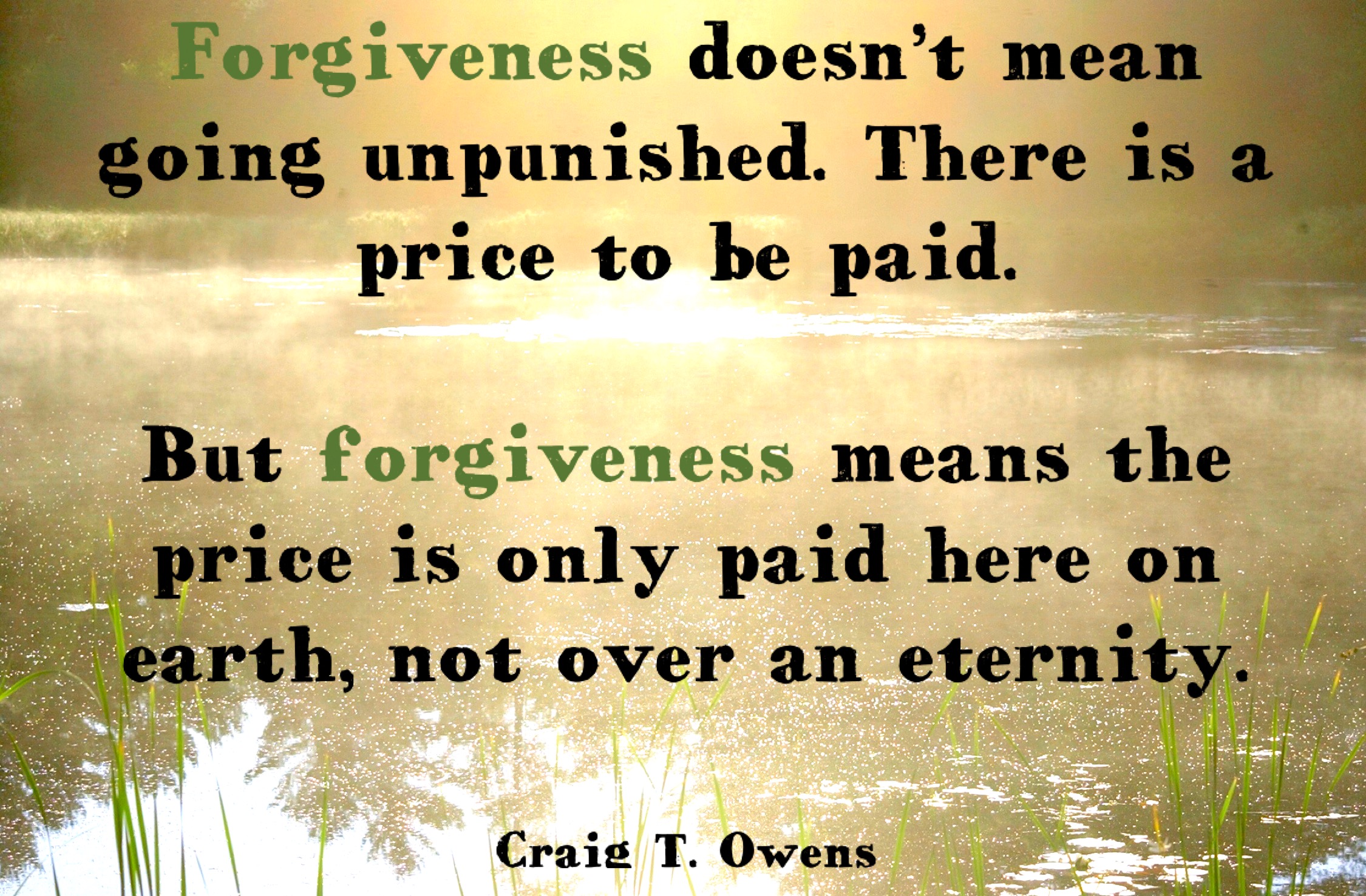
Being forgiven doesn’t mean going unpunished. There is a price to be paid. But forgiveness means the price is only paid here on earth, not over an eternity.

How liberally and deeply and completely do YOU want to be forgiven? Whatever that level is, ask God to just as liberally and deeply and completely forgive OTHERS. Hear Him say, “I have forgiven them, just as you have asked.”

Naked Before God

Imagine: You and your wife are the only people on the face of the earth. No bills, no employer, no economic downturn, no kids, no school, no traffic. Just you and God. That was Adam and Eve in the Garden of Eden. The Bible gives this commentary, “Now the man and his wife were both naked, but they felt no shame.”

Nothing to hide from God. Nothing to hide from each other. A perfect relationship with God. A perfect relationship with each other.

Then the temptation, and the bite of the forbidden fruit. Sin enters. Now, something changes when God comes to talk with His favorite couple: “Then the man and his wife heard the sound of God as He was walking in the garden in the cool of the day, and they hid from God among the trees.”

“Why are you hiding from Me?” God asks.

“Uh,” Adam stammers, “because we’re naked.”

Sin made mankind uncomfortable in God’s presence. Sin made them want to hide from God. They knew He was there, but they tried to pretend He wasn’t. This is why I think many of us don’t come into God’s presence in prayer: we’re uncomfortable because of our sin.

We should not run away from God, instead, we should run to Him. “If we confess our sins to Him, He is faithful and just to forgive us our sins and to cleanse us from all wickedness” (1 John 1:9).

What happens when we’re forgiven? We’re re-clothed. God Himself clothes us. He made clothes for Adam and Eve, and He clothes us, too, in the righteous robes of Jesus. “And all who have been united with Christ in baptism have put on Christ, like putting on new clothes” (Galatians 3:27).

And when we’re clothed in Christ, we no longer have to hide from God, nor feel uncomfortable in His presence. Instead, we can “come boldly to the throne of our gracious God. There we will receive His mercy, and we will find grace to help us when we need it most” (see Ephesians 3:12 and Hebrews 4:16).

Perhaps the reason we don’t spend enough time in prayer is that we feel self-conscious, sinful, uncomfortable… naked.

You don’t have to be naked. You can be clothed in Christ. You can enter into God’s presence without shame and find the mercy and grace and help that you need.

Conjunction Junction: BUT

Do you remember the School House Rocks videos? Fun and yet so educational! One of my favorite ones is called “Conjunction Junction.”

Conjunctions are very powerful connectors. Especially when I’m reading the Bible I slow down when I see and, or, or but. These conjunctions can open up a wealth of Scriptural knowledge.

Another thing that stands out to me when I’m reading God’s Word is the (parentheses). Little sidebars that can add so much richness. Today I saw a parenthetical comment followed by one of these powerful conjunctions.

Here’s the parenthetical comment: (There was never a man like Ahab, who sold himself to do evil in the eyes of the LORD, urged on by Jezebel his wife. He behaved in the vilest manner by going after idols, like the Amorites the LORD drove out before Israel) (1 Kings 21:25-26).

Ahab is not just evil—he’s not just bad—he’s the evilest, worst king… ever!

BUT = not one thing, but an entirely different thing.

But Ahab—the evilest king ever—humbled himself before God: “Have you noticed how Ahab has humbled himself before Me? Because he has humbled himself, I will not bring this disaster in his day, BUT I will bring it on his house in the days of his son” (v. 29).

I’m so glad God recognizes our humility and then extends His mercy. BUT is a great conjunction! Check out these passages with BUT

Do you not know that the wicked will not inherit the kingdom of God? Do not be deceived: Neither the sexually immoral nor idolaters nor adulterers nor male prostitutes nor homosexual offenders nor thieves nor the greedy nor drunkards nor slanderers nor swindlers will inherit the kingdom of God. And that is what some of you were. BUT you were washed, you were sanctified, you were justified in the name of the Lord Jesus Christ and by the Spirit of our God. (1 Corinthians 6:9-11)

Here is a trustworthy saying that deserves full acceptance: Christ Jesus came into the world to save sinners—of whom I am the worst. BUT for that very reason I was shown mercy so that in me, the worst of sinners, Christ Jesus might display His unlimited patience as an example for those who would believe on Him and receive eternal life. (1 Timothy 1:15-16)

It doesn’t matter if you were the vilest, meanest, worst-person-ever, when you humble yourself to ask for God’s forgiveness, He pronounces that great conjunctionBUTthat completely cancels your past!!

Wow! What a merciful, loving God! And what a great conjunction He inserts in our lives—BUT!

I’m happy today that I’ve been to God’s Conjunction Junction and He’s hooked a BUT between my former life and my present life. How about you?