Sword-dropping Trust

Listen to the podcast of this post by clicking on the player below, and you can also subscribe on AppleSpotify, or Audible. 

God called Gideon to lead Israel to victory over the oppressive Midianites. He told Gideon, “Go in the strength you have and save Israel” (Judges 6:14). When Gideon hesitated because he didn’t think he had much strength nor influence to raise an army, God assured him of two things: “I am sending you” and “I will be with you” (vv. 14, 16). 

Gideon’s initial recruitment netted him 32,000 soldiers from four tribes: “And he sent messengers throughout all Manasseh, and the Manassites were called to follow him; and he sent messengers to Asher, to Zebulun, and to Naphtali, and they came up to meet them” (v. 35). 

God said this large army would be tempted to take the credit for themselves for defeating the Midianites, so God pared down the army to 10,000 men and then to 300 men (7:3, 6).

When God said He would deliver Midian into Gideon’s hands (v. 7), He meant it! HE would do the delivering, with Gideon’s 300 men merely being the instruments He would use. These men would defeat the invaders simply with trumpets and torches. 

When these 300 men surrounded the Midianite forces during the night, I want you to notice the bracketed phrase in the AMPC: 

And the three companies blew the trumpets and shattered the pitchers, holding the torches in their left hands, and in their right hands the trumpets to blow [leaving no chance to use swords], and they cried, “The sword for the Lord and Gideon!” (v. 20 AMPC) 

The Israelites had to leave their swords hanging on their belts to fully obey God! 

It was only this posture of full obedience that brought the victory. “They stood every man in his place round about the camp, and all the Midianite army ran—they cried out and fled. When Gideon’s men blew the 300 trumpets, the Lord set every Midianite’s sword against his comrade and against all the army” (vv. 21-22).

Those who weren’t in the 300 were still needed to finalize the pursuit, as they were called up to complete the victory (v. 23). 

Perhaps only the 300 had enough faith to not drop their torch and their trumpet and grab their sword. 

If it seems like God has stripped you of what you considered your source of security—like the swords that hung unused on the belts of Gideon’s 300—perhaps that is because He is getting ready to do something that only He can do! Whether you feel well armed or simply left holding something as simple as a trumpet and a torch, trust God’s strength. He can deliver you far better than you can deliver yourself. 

►► Would you please prayerfully consider supporting this ministry? My Patreon supporters get behind-the-scenes access to exclusive materials. ◀︎◀︎

“Alas!” To “Aha!”

Listen to the podcast of this post by clicking on the player below, and you can also subscribe on AppleSpotify, or Audible.

…oh no… (2 Kings 6:5, 15). 

The words “Oh no!” are actually a single word in the Hebrew language (Hebrew: ‘ahahh) that has been transliterated into English as “Aha!” 

But I think the old English translation is better in this context: ALAS! 

ALAS is usually a painful realization of the situation, not a cry of enlightened discovery. Here are the other times that this Hebrew/English word for ALAS! is used: 

  • Joshua said it after his army was defeated at Ai 
  • Gideon said it after realizing he had been face-to-face with God 
  • Jephtha cried it out after he knew that his daughter would have to be sacrificed
  • King Joram uttered this when he realized his troops and animals had no water in the desert 
  • Jeremiah said this to God after he was called to be a prophet, and after he was asked by God to speak countercultural words (he actually said ALAS! four times!) 
  • Ezekiel also cried out ALAS! four times when God asked him to do or to watch difficult things 
  • Joel cried it out when he saw the Day of the Lord quickly approaching 

(check out the above references by clicking here) 

In all of these ALAS! painful moments, these men were at their wits’ end, at the end of their own abilities—they couldn’t do anything to help themselves. 

In all of these ALAS! moments, they came to just one important realization: Only Yahweh can help me. That realization is truly the AHA! of an enlightened discovery! 

Calling on God turns a painful ALAS! moment into a God-glorifying AHA! moment. God alone can provide where no one else can.

Don’t despair in the ALAS! times, but cry it out loud to the only One who can help you, and then watch to see how He alone will turn your situation into a defining, God-glorifying AHA! testimony. 

►► Would you please prayerfully consider supporting this ministry? ◀︎◀︎

Does Self-Help Get God’s Help?

This is part 1 in our series looking at phrases that sound biblical and then asking, “Is that in the Bible? 

Statement #1—God helps those who help themselves. Is that in the Bible? No, it is not! 

The reason why I think people have accepted this as biblical is an incorrect view of God. 

  1. Humanism says God is us, which makes us believe, “If it’s going to be, it’s up to me.” 
  2. Fatalism says there is no God and therefore no meaning to life, which makes us believe, “The outcome is what it is and no one has any say in the matter.” 
  3. Deism says there is a God, but it’s hard to get His attention, which makes us believe “He is either disinterested in me or unapproachable. He’s only available for the ‘big’ things.” 

The Bible flat-out rejects all three of these isms. 

Instead, we see a loving, approachable God. One who is both all-powerful and all-loving. He says things like…

  • I made you and know everything about you, and I remain infinitely interested and intimately involved in your life 
  • Come to Me and I will give you rest
  • I want you to cast all your anxieties on Me
  • Don’t be anxious about anything, but tell Me about everything that troubles you (Psalm 139:1-18; Matthew 11:28-29; 1 Peter 5:7; Philippians 4:6)

Not only is “God helps those who help themselves” untrue, but the exact opposite is also true—God helps those who cannot help themselves! 

In Isaiah 40:28-29, we read that God gives strength to the weary and increases the power of the weak. 

“Yes, it is our strength, not our weakness, that is our hindrance and stumbling block.” —Horatius Bonar 

God gives power to the weak. He gives strength to those with no might of their own. God does NOT help those who think they can help themselves! God helps those who cannot help themselves! This is what Jesus came to do, and why we should rejoice in the fact that He does indeed help those who could never rescue themselves (Isaiah 53:4-5; 2 Corinthians 12:9)!

It is our can’ts that God uses as His opportunities to show how limitless He is. Our limitations magnify His love and His power. 

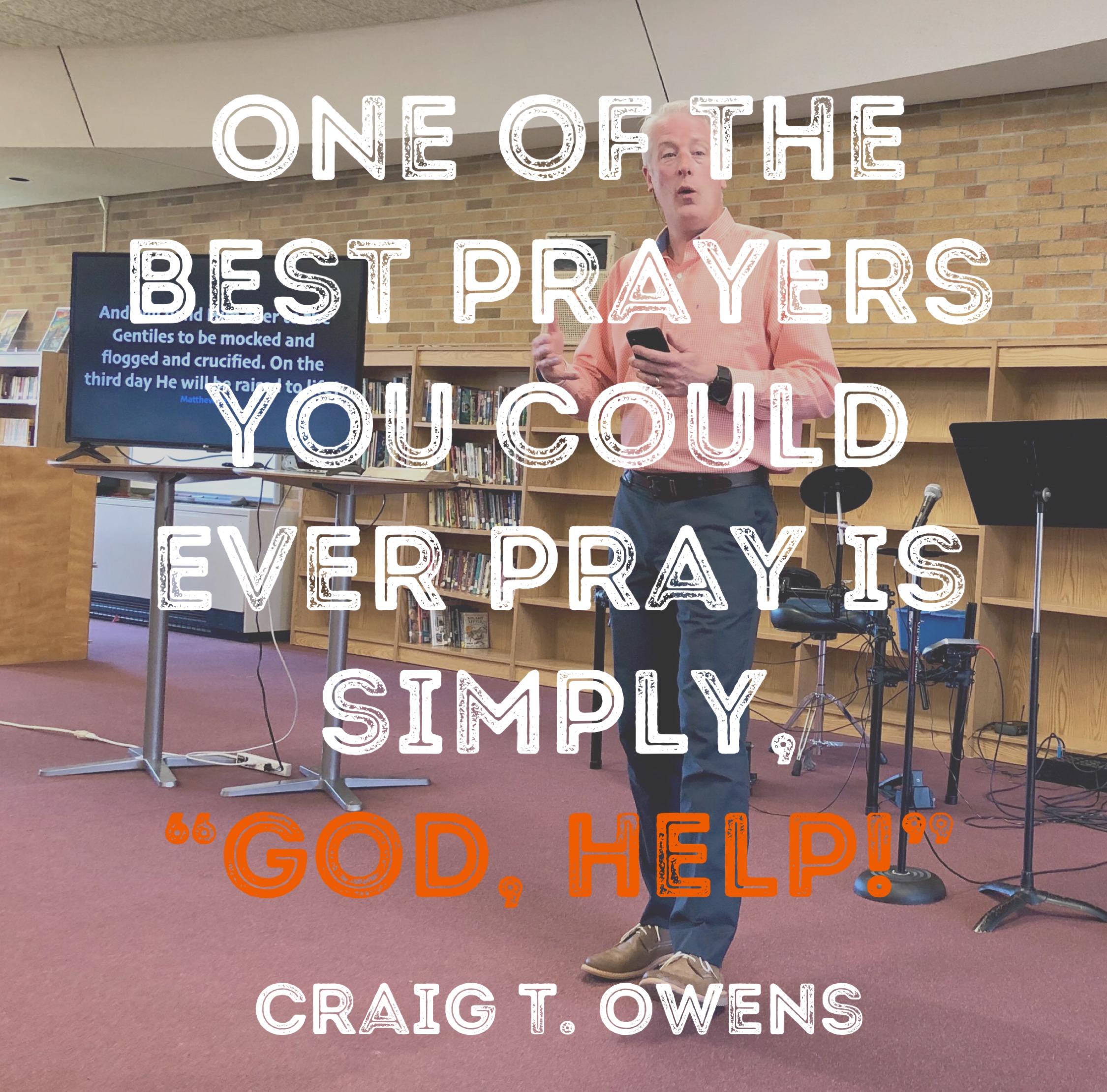
One of the best prayers you could ever pray is simply, “God, help!” This simple prayer acknowledges in just two words that you can’t but He most assuredly can! 

But those who wait for the Lord—who expect, look for, and hope in Him—shall change and renew their strength and power; they shall lift their wings and mount up close to God as eagles mount up to the sun; they shall run and not be weary, they shall walk and not faint or become tired. (Isaiah 40:31 AMP) 

Join me next week as we continue to explore various statements and ask, “Is that in the Bible?