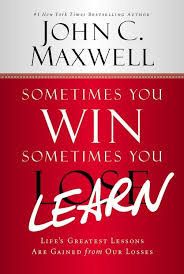
21 Quotes From “Sometimes You Win, Sometimes You Learn”

Sometimes You WinAs I mentioned in my book review (which you can read by clicking here), John Maxwell always expands my horizons with his writings. I appreciate his ability to use his own life experiences as well as historical and contemporary examples and writings. So some of my favorite quotes from Sometimes You Win, Sometimes You Learn are from Dr. Maxwell, and some are from others that he quotes. Enjoy!

“I sometimes react to making a mistake as if I have betrayed myself. My fear of making a mistake seems to be based on the hidden assumption that I am potentially perfect and that if I can just be very careful, I will not fall from heaven. But a mistake is a declaration of the way I am, a jolt to the way I intend, a reminder that I am not dealing with facts. When I have listened to my mistakes, I have grown.” —Hugh Prather

“Those who profit from adversity possess a spirit of humility and are therefore inclined to make the necessary changes needed to learn from their mistakes, failures, and losses. … When we are focused too much on ourselves, we lose perspective. Humility allows us to regain perspective and see the big picture. … Humility allows us to let go of perfection and keep trying.” —John Maxwell

“Most people spend their entire lives in a fantasy Island called ‘Someday I’ll.’” —Denis Waitley 

“An idealist believes the short-run doesn’t count. A cynic believes the long run doesn’t matter. A realist believes that what is done or left undone in the short-run determines the long run.” —Sydney J. Harris

“Those things that hurt, instruct.” —Benjamin Franklin

“You can’t grow and learn if your focus is on finding someone else to blame instead of looking at your own shortcomings.” —John Maxwell

“The highest reward for our toil is not what we get for it but what we become by it. … Mistakes are not failures. They are proof that we are making an effort. When we understand that, we can more easily move out of our comfort zone, try something new, and improve. … Improvement demands a commitment to grow long after the mood in which it was made has passed.” —John Maxwell 

“Success in most things comes not from some gigantic stroke of fate, but from simple, incremental progress.” —Andrew Wood

“The main trouble with despair is that it is self-fulfilling. People who fear the worst tend to invite it. Heads that are down can’t scan the horizon for new openings. Bursts of energy do not spring from a spirit of defeat. Ultimately, helplessness leads to hopelessness.” —Norman Cousins

“Positive thinking must be followed by positive doing.” —John Maxwell

“When you are influential and highly respected, people tend to tell you what you want to hear, not what you need to hear. They are seeking your approval, or they flatter you. Unfortunately, this creates a gap between what you hear and reality. If you find yourself in that situation, you will need to work extra hard to get the people close to you to speak honestly into your life. And you will have to become highly intentional in observing and listening.” —John Maxwell 

“Wisdom is the reward you get for a lifetime of listening when you would have preferred to talk.” —Doug Larson

“Circumstances are the rulers of the weak; but they are the instruments of the wise.” —Samuel Lover 

“Mistakes are painful when they happen, but years later a collection of mistakes is what is called experience.” —Denis Waitley

“Ninety percent of those who fail are not actually defeated; they simply quit. … As you face bad experiences, it’s important for you to remember that you can rarely see the benefits while you’re in the midst of them. You usually gain perspective on the other side of it.” —John Maxwell 

“Most people would rather change their circumstances to improve their lives when instead they need to change themselves to improve their circumstances. They put in just enough effort to distance themselves from their problems without ever trying to go after the root, which can often be found in themselves. Because they don’t try to change the source of their problems, their problems keep coming back at them.” —John Maxwell

“To grow, you must be willing to let your present and future be totally unlike your past. Your history is not your destiny.” —Alan Cohen

“If I had my life to live over again, I’d make the same mistakes, only sooner.” —Tallulah Bankhead

“Maturity is doing what you are supposed to be doing, when you’re supposed to be doing it, no matter how you feel.” —Dom Capers 

“Have you not succeeded? Continue! Have you succeeded? Continue!” —Fridtjof Nansen, Nobel Peace Prize winner

“How we think when we lose determines how long it will be until we win.” —G.K. Chesterton
Sometimes You Win—Sometimes You Learn (book review)

Sometimes You WinIf you’re like me, you grew up being able to quickly finish the phrase, “Sometimes you win, sometimes you… lose.” But John Maxwell gives us a far better way to finish this well-worn phrase in his latest book Sometimes You Win—Sometimes You Learn: Life’s Greatest Lessons Are Learned From Our Losses.

As in his other books, Dr. Maxwell shares very candidly about his own missteps, and the lessons he learned from them. He also brings in the insight from other friends and authors who have also learned the value of making mistakes and learning the hard lessons from them.

What always amazes about John Maxwell’s writing is the depth of insight. On the surface you would think there wouldn’t be much to say about learning from our losses except another well-worn cliche, “If at first you don’t succeed, try, try again.” But that try-again spirit is only one part of the learning process. John shows us the value of:

  • Humility
  • Reality
  • Responsibility
  • Improvement
  • Hope
  • Teachability
  • Adversity
  • Problems
  • Bad experiences
  • Change

Following through on all of these aspects leads to the most important step in the learning process: Maturity.

The insight, historical stories, personal anecdotes, and wisdom of other been-there-done-that people are woven together with John’s unique teaching style to give us a book that is highly beneficial. I’d especially recommend this book to parents, coaches and mentors.

I am a Center Street book reviewer.

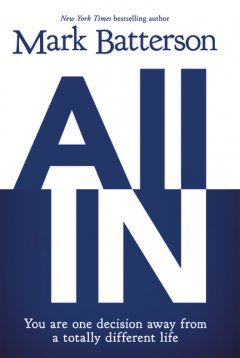
21 Quotes From “All In”

All InAll In by Mark Batterson is the sequel to his fantastic book on prayer called The Circle Maker. All In is the challenge to followup our prayer times with bold action. You can read my full book review by clicking here. These are some of the quotes I especially liked from All In—

“When did we start believing God wants to send us to safe places to do easy things?”

“You cannot be in the presence of God and be bored at the same time. For that matter, you cannot be in the will of God and be bored at the same time.”

“The Rich Young Ruler may rank as one of the most religious people in the pages of Scripture. The text tells us that he kept all the commandments. He did nothing wrong, but you can do nothing wrong and still do nothing right. By definition, righteousness is doing something right. We’ve reduced it to doing nothing wrong. … [Jesus] asks the Rich Young Ruler to ante up everything. Why? Because He loved the Rich Young Ruler too much to ask for anything less! We focus on what Jesus asked him to give up but fail to consider what He offered up in exchange.”

“God cannot reveal His faithfulness until we exercise our faith.”

“The first step is always the longest and the hardest. And you can’t just take a step forward into the future. You also have to eliminate the possibility of moving backward into the past.”

“One of our fundamental spiritual problems is this: we want God to do something new while we keep doing the same old thing.”

“When we cling too tightly to what God did last, we often miss what God wants to do next.”

“We all want to spend eternity with God. We just don’t want to spend time with Him. We stand and stare from a distance, satisfied with superficiality. We Facebook more that we seek His face. We text more than we study The Text. And our eyes aren’t fixed on Jesus. They’re fixed on our iPhone and iPads—emphasis on ‘i.’ Then we wonder why God feels so distant.”

“You cannot go to church because you are the church. … Your workplace is your mission field. Your job is your sermon. Your colleagues are your congregation.”

“Our lack of guts is really a lack of faith. Instead of playing to win, we play not to lose.”

“There are two kinds of people in the world—those who ask why and those who ask why not. Going all out is asking why not. Why people look for excuses. Why not people look for opportunities. Why people are afraid of making mistakes. Why not people don’t want to miss out on God-ordained opportunities.”

“We treat failure and success like their antonyms. Failure is a part of every success story. Think of it as the prologue.”

“No matter what tool you use in your trade—a hammer, a keyboard, a mop, a football, a spreadsheet, a microphone, or an espresso machine—using it is an act of obedience. It’s the mechanism whereby you worship God. It’s the way you do what you are supposed to do.”

“I’ve discovered that if I don’t take the first step, God generally won’t reveal the next step.”

“It doesn’t matter what you do, God wants to help you do it. He wants to favor your business plan, your political campaign, your manuscript, your lesson plan, your legal brief, your film, and your sales pitch. But you’ve got to position yourself for that favor by acting in obedience. And if God knows He’ll get the glory, He will bless you beyond your ability, beyond your resources.”

“Courage doesn’t wait until situational factors turn in one’s favor. It doesn’t wait until a plan is perfectly formed. It doesn’t wait until the tide of popular opinion is turned. Courage only waits for one thing: a green light from God. And when God gives the go, it’s full steam ahead, no questions asked.”

“Opportunities typically come disguised as impossible problems.”

“When it comes to sinful rationalizations, we are infinitely creative. But it’s our rationalizations that often annul His revelations. When we compromise our integrity, we don’t leave room for divine intervention. When we take matters into our own hands, we take God out of the equation. When we try to manipulate a situation, we miss out on the miracle.”

“Integrity won’t keep us from getting thrown into a fiery furnace, but it can keep us from getting burned.”

“It’s much easier to act like a Christian than it is to react like one!”

“There has never been and never will be anyone like you, but that isn’t a testament to you. It’s a testament to the God who created you. And that means no one can worship God like you or for you. You are absolutely irreplaceable in God’s grand scheme. And God is jealous for you—all of you.”

Why Great Men Fall (book review)

Dr. Wayde Goodall addresses a subject that I wish didn’t have to be addressed in Why Great Men Fall. Unfortunately, we’ve all seen it; perhaps you’ve even experienced it firsthand with someone close to you. How tragic it is when we see spiritual, business or political leaders lose their influence in the wake of a devastating fall.

Dr. Goodall pulls no punches as he identifies the things that seem to trip men up time and time again. He looks squarely at the root causes – not just the symptoms – and challenges men to do the same. We’re all susceptible to sin and failure. The Bible warns us: “So, if you think you are standing firm, be careful that you don’t fall!” (1 Corinthians 10:12).

These words from J.C. Ryle are a sober reminder:

“Great falls seldom happen to a saint, without a previous course of secret backsliding. The church and the world are sometimes shocked by the sudden misconduct of some great professor of religion. Believers are discouraged and stumbled by it. The enemies of God rejoice and blaspheme. But if the truth could be known, the explanation of such cases would generally be found to have been private departure from God. People fall in private, long before they fall in public. The tree falls with a great crash, but the secret decay which accounts for it, is often not discovered until it is down on the ground.”

Why Great Men Fall is not a long book, nor does Dr. Goodall present complicated arguments. It’s a straightforward, easy-to-understand diagnosis of the most common things which trip up great men. I cannot encourage you strongly enough to not only read this book, but to read it with a friend who will hold you accountable.

Guys, your family, your church, and your community need you to STAND STRONG!

Me, Myself & Bob (book review)

As a parent of young children, I really appreciated the biblical values delivered in a fun way through so many VeggieTales videos. Now I’m really appreciating the wisdom of VeggieTales creator Phil Vischer in his book Me, Myself & Bob.

Written in the same witty style that made the VeggieTales videos so engaging, Me, Myself & Bob leads us through the meteoric rise and sudden collapse of Big Idea Productions. We read about the passion that drove the start of this incredible vision, and how—as the Bible says—zeal without a foundation of wisdom is a  dangerous thing.

With such candor, Phil shares about the vision and talents God gave him to do something so groundbreaking, how others caught that vision and jumped on board to help, and then how the company sort of took on a life of its own and how corporate executives took this highly successful business in a direction Phil never imagined.

This book is more like a business strategy book told as Phil Vischer’s autobiography. From the business board room to the family living room, there are valuable lessons to be learned from the rise and fall of VeggieTales. So whether you’re a fan of Bob the Tomato & Larry the Cucumber, an entrepreneur, or a parent, you will find something to love about Me, Myself & Bob.

How The Mighty Fall (book review)

This is the third in the series of books from Dr. Jim Collins: Built To Last, Good To Great, and now How The Mighty Fall. This is a book that Dr. Collins wished he didn’t have to write, as he uncovers the markers that contributed to the failure of once-great companies.

If you are a frequent reader of my blog, you’re probably wondering why I’m reading/reviewing a business book. The answer is simple: the principles Jim Collins uncovers in his books are rock-solid principles of success and failure, regardless of the organization in which they are practiced or ignored. In all three of his books, I have mined so many great truths to apply to my personal life, as well as the organizations I lead.

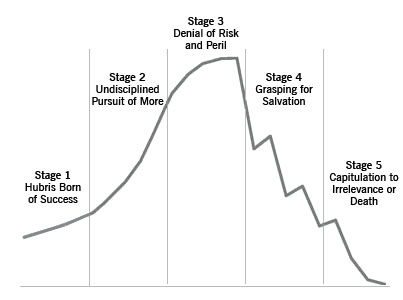
In How The Mighty Fall we learn about the five stages of decline for once-great organizations. Working backward from his evidence, Dr. Collins then gives us “markers” to look for in our own organizations that would tip us off to the stages of decline.

Why study this? Because I want to lead a great church! This quote from the book especially resonates with me:

“The point of struggle is not just to survive, but to build an enterprise that makes such a distinctive impact on the world it touches, and does so with such superior performance, that it would leave a gaping hole — a hole that could not be easily filled by any other institution—if it ceased to exist.” (emphasis added)

If you are involved in the leadership of any organization (whether for-profit or non-profit), I would encourage you to devour all three of Jim Collins’ books.

What’s Your Excuse?

It’s so easy to make excuses, isn’t it?

  • I wasn’t feeling well
  • I don’t have enough training
  • The sun was in my eye
  • The other guy was supposed to….
  • I don’t have the right tools
  • If only….
  • I can’t because….

John Maxwell has started a new teaching series where he presents a one-minute lesson on one word every day. Today’s lesson was on excuses. Watch the clip here.

Here are some other quotes on excuses:

“Ninety-nine percent of failures come from people who have the habit of making excuses.” —George Washington Carver

“There’s a difference between interest and commitment. When you are interested in doing something, you do it only when it is convenient. When you are committed to something, you accept no excuses only results.” —Kenneth Blanchard

“Obstacles are not excuses for failure, they are opportunities for growth.” —Craig T. Owens

“People who are good at making excuses are seldom good at anything else.” —Benjamin Franklin

Let’s stop making excuses and start taking responsibility! 

No Such Thing As Overnight Success

Although to the outsider it sometimes appears that way, success does not happen overnight. So much of the work and preparation and study that are done are simply unnoticed by others.

On the flip side, there is no such thing as an overnight failure either. So much of the work and preparation and study that was left undone is also usually unnoticed by others.

Both public success and public failure are the culmination of years of private decisions. Every single day I am either preparing for success or preparing for failure.

The battles are being won or lost before I even take the field. It’s the everyday private practice that determines the game day public performance.

I have to pay careful attention to the “little things” in private every day if I hope to successfully handle the “big things” in public someday.

The heights of great men reached and kept,
Were not attained by sudden flight,
But they, while their companions slept,
Were toiling upwards in the night. —Henry W. Longfellow


What are you doing to prepare today?

Pray Now

Listen to the podcast of this post by clicking on the player below, and you can also subscribe on AppleSpotify, or Audible.

The Gibeonites had a great strategy. They had heard about the advancing Israelite army, they knew how God had given them victory at every step of the way, and they knew that the Israelites weren’t going to make a peace treaty with anyone living even remotely close to them. So the Bible says the Gibeonites resorted to a ruse (v. 4).

They put on worn-out shoes and clothes and packed moldy bread. That way they would have all of the appearances of a delegation that traveled a long, long distance. And it worked. The Israelites examined their clothing and food and said, “Yep, it sure looks like you made a long journey to get here. We’re convinced.”

The Bible records an important footnote—

The men of Israel sampled their provisions but did not inquire of the Lord (v. 14).

How many times do I do this…

  • …I use my five senses, but not the wisdom of the Holy Spirit?
  • …I use my logical brain, but not the supernatural resources of God?
  • …I use my experiences, but not the insight of an All-Knowing God?

I have to make it a habit to pray about EVERY decision. It might only be a 5-second prayer, but I must inquire of the Lord.

►► Would you please prayerfully consider supporting this ministry? My Patreon supporters get behind-the-scenes access to exclusive materials. ◀︎◀︎

Square One

One of my all-time favorite movies is The Princess Bride. There is a scene about halfway through the movie where Inigo and Fezzik are reunited:

[Scene: Outside a hut. Inigo is sitting, nursing a bottle]

Inigo:      I am waiting for you, Vizzini. You told me to go back to the beginning. So I have. This is where I am, and this is where I will stay. I will no be moved.

Assistant Brute:    Ho there!

Inigo:      I do not budge. Keep your “Ho there.”

Assistant Brute:     But the prince gave orders.

Inigo:      So did Vizzini. When the job went wrong he went back to the beginning. Well, this is where we got the job, so it’s the beginning. And I am staying till Vizzini come.

Even though Inigo was slightly the worse for alcohol, he gives some sage advice. When we run into problems—when we get off track—it’s good to go back to the beginning.

After his ill-advised trip to Egypt, Abraham returns to square one. He goes back to the last place he heard from God.

He moved on from the Negev, camping along the way, to Bethel, the place he had first set up his tent between Bethel and Ai and built his first altar. Abram prayed there to God. (Genesis 13:3-4)

When I seem to be on the wrong path, I must go back to the place I last heard from God. Perhaps it’s significant where Abraham’s tent and altar were set up. Between two cities:

  • Ai which means “heap of ruins.” It comes from a root word meaning “bend, twist, distort.”
  • Bethel which is made up of two words beth (house) + El (God) = house of God.

This is my life: always between two options. I can have a distorted/twisted view that leads to a heap of ruins, or I can live where God dwells.

I can have my way or God’s way.

I can have blessing or ruin.

When I find what I’m doing is a mess, it’s time to go back to the beginning—to go back to square one—to go back to the last place I heard from God.