Links & Quotes

link quote

These are links to articles and quotes I found interesting today.

“The patience of hope does not turn men and women into monks and nuns, it gives men and women the right use of this world from another world′s standpoint.” —Oswald Chambers

The proper place of science in our culture: Science And Its Limits

Astronomers, cosmologists and physicists are always trying to explain the “missing” parts of their evolutionary theories: Missing Galaxy Mass Found

Very good! The Non-Physical Sides Of Sex

“You may think it out of place for me to say so, but in our churches today we are leaning too heavily upon human talents and educated abilities. We forget that the illumination of the Holy Spirit of God is a necessity, not only in our ministerial preparation, but in the administrative and leadership functions of our churches.” —A.W. Tozer

“It is not the man who has too little, but the man who craves more, who is poor.” —Seneca

“Selfish religion loves Christ for His benefits, but not for Himself.” —David Brainerd

“Few marriages can make it if both partners are hiding out from God. Show me a marriage without one partner that is close to Jesus, and I’ll show you a marriage with little chance of survival. At least one of the partners must be in daily consultation with the Lord. It is best when both husband and wife are talking to Him, but if one partner is running from God, it is all the more important that the other be able to run to a secret closet of prayer for help and direction. A praying wife can often save her marriage, as can a praying husband. Love alone is not enough to keep a marriage strong—only God’s power can do that. That power is at work right now, healing and keeping marriages. Where Jesus rules, the marriage can make it.” —David Wilkerson
6 Quotes From “The Cell’s Design” (and a cool infographic too)

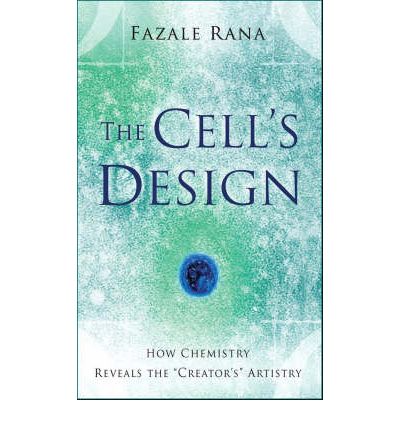
The Cell's DesignThe Cell’s Design by Fazale Rana, a distinguished biochemist, is an amazing apologetic for an intelligent designer of our universe: A Creator. You can read my full book review by clicking here. Below are a few quotes I wanted to pass along, and a graphic I created based on Rana’s findings.

“This elegance, evident in virtually all aspects of the cell’s chemistry, carries profound philosophical and theological significance that prompts questions about the origin, purpose, and meaning of life. Though I once embraced the evolutionary paradigm, its inadequate explanations for the origin of life coupled with the sophistication and complexity of the cell’s chemical systems convinced me as a biochemistry graduate student that a Creator must exist.”

“Richard Dawkins, an outspoken atheist, acknowledges that ‘biology is the study of complicated things that give the appearance of having been designed for a purpose.’”

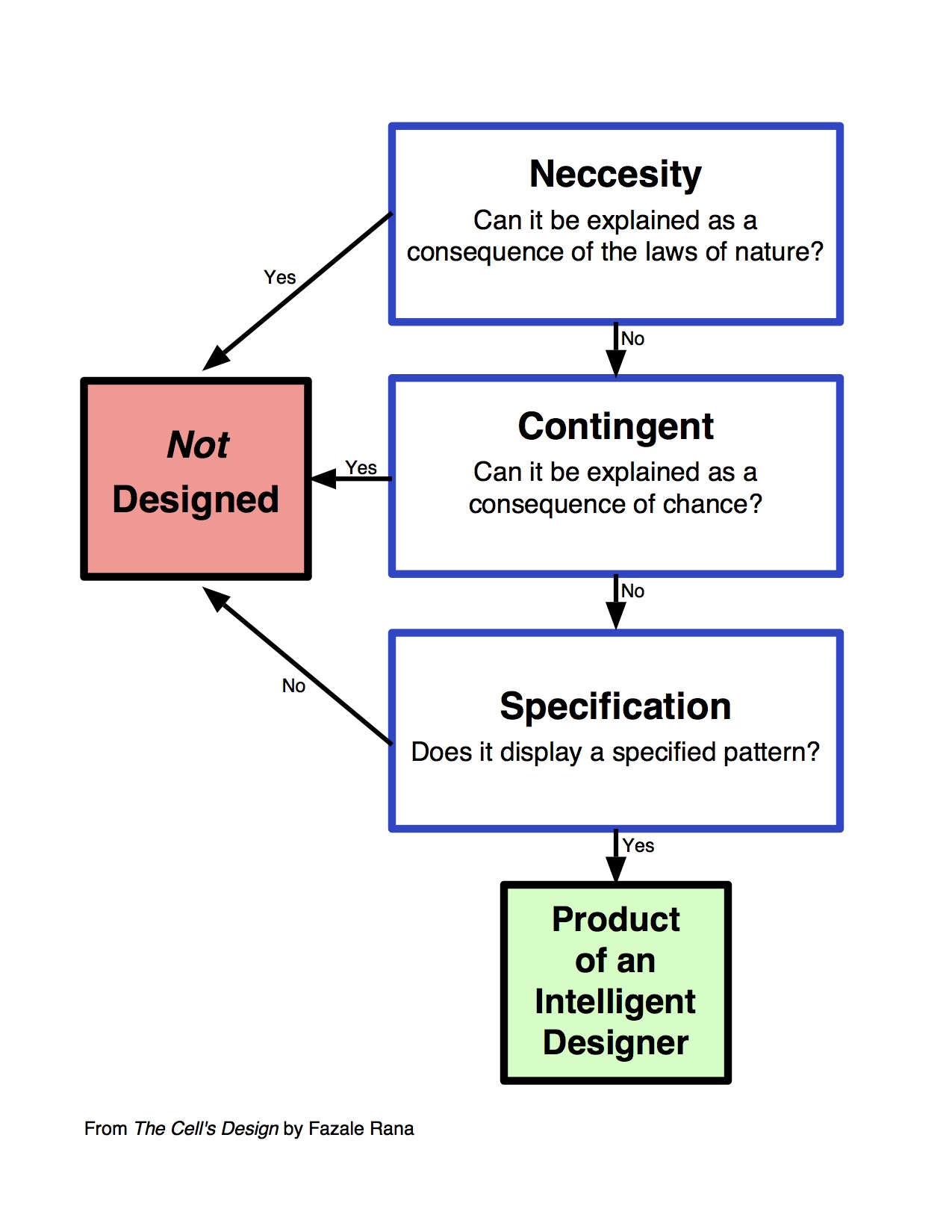
“An event, system, or object is intentionally produced by a designer, then it will (1) be contingent, (2) be complex, and (3) display an independently specified pattern. … Three questions are used to determine if an event, system, or object stems from the activity of an intelligent agent. Can it be explained as a consequence of the laws of nature (necessity)? If yes, then it is not designed. If no, then can it be explained as a consequence of chance (contingent)? If yes, then it is not designed. If no, then does it display a specified pattern (specification)? If no, then it is not designed. If yes, then it must be the product of an intelligent designer.”

Intelligent design flowchart

(Click image for a larger view, or click here to download a PDF version → Intelligent design flowchart)

“These advances indicate that life’s bare essentials extend far beyond the number of proteins that must simultaneously occur for life to exist. Life’s minimum complexity also requires organization of these gene products within the cell.”

“It is superastro-nomically improbable for the essential gene set to emerge simultaneously through natural means alone. If left up to an evolutionary process, not enough resources or time exist throughout the universe’s history to generate life in its simplest form.”

“Instead of resembling a preschooler’s messy fingerpainting, the interior of the simplest cell is best described as a carefully planned and marvelously executed work of art—one that masterfully carries out life’s most basic processes in living color. Disrupting this arrangement is often lethal.”

The Cell’s Design (book review)

The Cell's DesignAfter my years in the medical science field, I’m still fascinated by the findings and operations of the many disciplines of science. I used to engage in frequent debates with my fellow students who believed our world was a result of chance and mutation spread over billions of years. But I always found it so astronomically improbable that such beautiful intricacies could result from chance. In The Cell’s Design biochemist Fazale Rana delves even deeper into the cell’s inner workings to make a powerful case for intelligent design.

Time and time again Rana shows us where there is such high-level, picture-perfect designs and operations at the smallest levels of the cell. Wherever scientists used to think, “This is as much design as we can expect, anything lower than this will be random,” they are now discovering unexpected and perfect designs.

This book is definitely not “layman” reading, but is geared for those with a working knowledge of scientific vocabulary and principles. But if you want to dive into it, you will find the results of the research to be absolutely astounding. And I think you will also find the case for a Intelligent Creator to be harder to refute. 

This quote is not in The Cell’s Design, but I think it accurately captures the essence of Rana’s findings—

“There is something in the nature of things which the mind of man, which reason, which human power cannot effect, and certainly that which produces this must be better than man. What can this be but God? … The celestial order and the beauty of the universe compel me to admit that there is some excellent and eternal Being, who deserves the respect and homage of men.” —Cicero

Winning The Argument Or The Battle

When I entered college, I did so as a science major: pre-med biomedical chemistry, to be exact. I still really enjoy all of the medical sciences: biology, microbiology, organic chemistry, inorganic chemistry, and the like.

As you might be aware many of the scientists today have a bent toward the theory of evolution. That means that a few of my professors and several of the authors I was reading taught and wrote from that paradigm.

This set up the environment for me to want to debate for my Creationist beliefs.

I had one professor who would specifically challenge me during lectures to refute what he had just said about evolution. An author who wrote a lengthy book about evolution carried on a year-long correspondence with me where we each brought out our best arguments. In all instances—although we believed passionately in our positions and could adequately defend them—the discussions never became shouting matches.

The Bible taught me how to do this.

(This week I’m discussing my favorite book—the Bible—from a couple of different aspects. You can read some of those thoughts here, here and here.)

At times I was tempted to “cross the line” to win the argument. And I may have won the argument, but I would have put myself in a position to lose the overall battle. There are two key passages of Scripture that I keep in mind to help me with this.

(1) In telling His followers about the Holy Spirit (John 14-16), Jesus said, “But when He, the Spirit of truth, comes, He will guide you into all truth” (John 16:13). And also, “But the Counselor, the Holy Spirit, whom the Father will send in My name, will teach you all things and will remind you of everything I have said to you” (John 14:26).

The Holy Spirit helps me apply biblical truths and principles to my everyday life. He guides me and reminds me of what I have studied.

(2) The second key passage is, “But in your hearts set apart Christ as Lord. Always be prepared to give an answer to everyone who asks you to give the reason for the hope that you have. But do this with gentleness and respect, keeping a clear conscience, so that those who speak maliciously against your good behavior in Christ may be ashamed of their slander” (1 Peter 3:15-16).

Yes, it is important for me to be prepared to give an answer, but this is the middle thought. First, I have to make sure what I’m saying is exalting Christ as Lord. Then I do my best to study and prepare to give an answer, but I must give that answer gently and respectfully.

Allowing the Holy Spirit to help you prepare from the Bible, and allowing Him to guide you into answering questions/critics gently and respectfully honors Christ. And that always wins the battle.