Faith Of Our Fathers (book review)

I almost want to quote George Santayana every time I post a review about an historical book, but for Faith Of Our Fathers compiled by Eric Buehrer it is especially appropriate. So allow me to quote two sage pieces of wisdom from Santayana—

“Those who do not learn from history are doomed to repeat it.” —AND—  “A child educated only in school is an uneducated child.” 

I am flabbergasted at how little time is spent in public schools educating our kids on the founding of our country. And frequently when it is taught, the lessons seem to go out of their way to not mention the biblical principles that went into crafting our nation’s founding documents. 

I have become a big fan of Gateways To Better Education. The founder of Gateways, Eric Buehrer, has put together a very helpful book for parents to help their children learn about the Christian faith of our Founding Fathers. 

Eric has given us a very short biography of our Founders, a quote attributed to them, Bible verses that undergird that Founder’s quote, and then some discussion questions for the family. Parents, please make full use of this great resource! 

And best of all: You can download the PDF version of this book FREE by clicking this link.

Bible Gateway’s Bible Audio App (review)

Typically, I post book reviews. So what’s a review of an audio app doing here? Quite simply, the Bible Gateway Bible Audio App is a wonderful companion piece to the Book of books—the Bible. 

I am a voracious reader, but my all-time, hands-down, nothing-else-is-even-close book is my Bible. I enjoy finding new ways to interact with God’s Word, so I am always on the lookout for study aids or companion pieces. This audio Bible meets this desire very nicely! 

I enjoy how streamlined this app is. Not a lot of options or distractions on the screen. Just pick your passage, select which version you would like to listen to, and tap the big play button. It’s that simple! If you would like to look at the screen while you listen, the verses appear one-by-one at the top of the screen as they are being read. Other options include playback speed, repeat options, and a sleep timer. 

I recently recommended this app to a friend of mine and he wrote, “I have two learning disabilities: dyslexia and ADD. I found the audio easy to listen to and appreciate the large print text. This app is now the first thing and last thing I do every day!” 

The free version of this app is more than adequate, but for a small fee, you can upgrade to add even more versions to your library, which you may then listen to even when you’re not on a WiFi. 

Bible Gateway is owned by Zondervan. Some of the other Zondervan Bible study tools I have reviewed in the past (and I am still using today) include:

I downloaded this audio app for free, and you can too by clicking here. 

Thursdays With Spurgeon—Comments On Commentaries

This is a weekly series with things I’m reading and pondering from Charles Spurgeon. You can read the original seed thought here, or type “Thursdays With Spurgeon” in the search box to read more entries.

Comments On Commentaries

     It has been said that the passage I have taken for my text [Isaiah 7:1-17] is one of the most difficult in all the Word of God. It may be so. I certainly did not think it was until I saw what the commentators had to say about it, and I rose up from reading them perfectly confused! One said one thing, and another denied what the other had said. And if there was anything that I liked, it was self-evident that it had been copied from one to the other and handed through the whole of them! 

     One set of commentators tells us that this passage refers entirely to some person who was to be born within a few months after this prophecy….

     Well, that seems a strange frittering away of a wonderful passage, full of meaning, and I cannot see how they can substantiate their view when we find the evangelist Matthew quoting this very passage in reference to the birth of Christ [Matthew 1:22-23]….

     I find, moreover, that many of the commentators divide the sixteenth verse from the fourteenth and fifteenth verses, and they read the fourteenth and fifteenth verses exclusively of Christ, and the sixteenth verse of Shear-Jashub….

     Then another view, which is the most popular of all, is to refer the passage, first of all, to some child who was then to be born, and afterward, in the highest sense, to our blessed Lord Jesus Christ. … 

     But I think that if I had never read those books at all, but had simply come to the Bible without knowing what any man had written upon it, I would have said, ‘There is Christ here as plainly as possible! Never could His name had been written more legibly than I see it here.’ 

From The Birth Of Christ

Spurgeon was not advocating that we never consult commentaries because elsewhere he said about the use of commentaries: “I find it odd that he who thinks so highly of what the Holy Spirit teaches him speaks so little of what the Holy Spirit teaches others also.” 

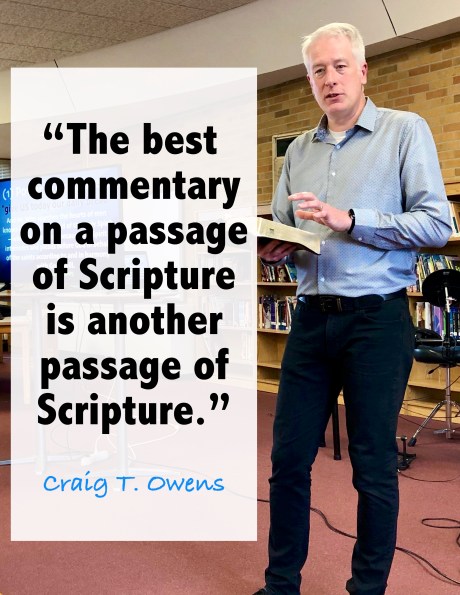
But what I believe Spurgeon is advocating here is this important principle—The best commentary on a passage of Scripture is another passage of Scripture. Which is why he used the passage in Matthew to help him understand the passage in Isaiah.

God makes Himself clear in His Word. The same Holy Spirit that inspired the pen of those who wrote the words in the Bible is the same Holy Spirit in you that can illuminate those words to your heart and mind. 

Commentators have their place. I believe that place is after you have prayed through and wrestled with a passage of Scripture for yourself. Think of commentators as the answers in the back of your math book. After you have worked through the equations for yourself, go to the answer key to verify your answers. If you simply look up the answer before you wrestle with the problem, how have you benefitted yourself? 

And always remember that God’s Word is infallible, but men are fallible. Commentators may provide an insight that helps you see something more clearly, but they are never a substitute for God’s very own word on a matter. 

Should you use commentaries? Sure! Find a good one, but consult it only after you have asked the Holy Spirit to help illuminate the passage, and after you have allowed the commentary of Scripture itself to shine its light on the difficult verse or passage.

12 Quotes From “The Art Of War”

Sun Tzu wrote in China in the fifth century BC to help military leaders hone their warcraft, but you might be surprised at the truths you can apply to your life today. Check out my full book review by clicking here. 

“Hence to fight and conquer in all your battles is not supreme excellence; supreme excellence consists in breaking the enemy’s resistance without fighting.” 

“Thus we may know that there are five essentials for victory: (1) He will win who knows when to fight and when not to fight. (2) He will win who knows how to handle both superior and inferior forces. (3) He will win whose army is animated by the same spirit throughout all its ranks. (4) He will win who, prepared himself, waits to take the enemy unprepared. (5) He will win who has military capacity and is not interfered with by the sovereign.” 

“Hence the saying: If you know the enemy and know yourself, you need not fear the result of a hundred battles. If you know yourself but not the enemy, for every victory gained you will also suffer a defeat. If you know neither the enemy nor yourself, you will succumb in every battle.” 

“The good fighters of old first put themselves beyond the possibility of defeat, and then waited for an opportunity of defeating the enemy. To secure ourselves against defeat lies in our own hands, but the opportunity of defeating the enemy is provided by the enemy himself.” 

“That general is skillful in attack whose opponent does not know what to defend; and he is skillful in defense whose opponent does not know what to attack.” 

“Disciplined and calm, to await the appearance of disorder and hubbub amongst the enemy—this is the art of retaining self-possession. To be near the goal while the enemy is still far from it, to wait at ease while the enemy is toiling and struggling, to be well-fed while the enemy is famished—this is the art of husbanding one’s strength.” 

“Do not linger in dangerously isolated positions. … If, on the other hand, in the midst of difficulties we are always ready to seize an advantage, we may extricate ourselves from misfortune.” 

“The art of war teaches us to rely not on the likelihood of the enemy’s not coming, but on our own readiness to receive him; not on the chance of his not attacking, but rather on the fact that we have made our position unassailable. There are five dangerous faults which may affect a general: (1) Recklessness, which leads to destruction; (2) cowardice, which leads to capture; (3) a hasty temper, which can be provoked by insults; (4) a delicacy of honor which is sensitive to shame; (5) over-solicitude for his men, which exposes him to worry and trouble.” 

He who exercises no forethought but makes light of his opponents is sure to be captured by them.” 

“Regard your soldiers as your children, and they will follow you into the deepest valleys; look upon them as your own beloved sons, and they will stand by you even unto death. … If, however, you are indulgent, but unable to make your authority felt; kind-hearted, but unable to enforce your commands; and incapable, moreover, of quelling disorder: then your soldiers must be likened to spoilt children; they are useless for any practical purpose.” 

“Carefully study the well-being of your men, and do not overtax them. Concentrate your energy and hoard your strength.” 

“Keep your army continually on the move.”

The Art Of War (book review)

You don’t have to be a military officer to appreciate some of the timeless and widely applicable lessons in the classic text from Sun Tzu called The Art Of War.

The Art Of War was written in roughly the fifth century BC in China. Just by knowing those brief facts, many people might dismiss the book from their potential reading list because it doesn’t appear to “fit” where they are. Granted, Sun Tzu’s thrust is to help military generals win the battles against their enemies, but I found many of his strategies and observations helpful to other areas of life. 

    • … business leaders can glean strategies for marketing victories 
    • … sports coaches can learn how to motivate their teams during training
    • … pastors can see spiritual warfare tactics
    • … teachers could learn the best times and ways to motivate students for academic success
    • … even those who want to be lifelong learners can discover how to self-motivate and organize their daily lives

The Art Of War is a fairly short read, and each of the chapters are presented in bite-size verses (almost like the biblical book of Proverbs), so it is a book you can read in short bursts in between other tasks. 

If you really want to “shake up” your regular reading routines, this little classic might be just the thing for you! 

Quest Study Bible (book review)

I was excited to get my copy of The Quest Study Bible. As I began to leaf through it and notice its unique format, I was suddenly transported back more than 20 years into my past…

“Daddy, what are you doing,” my young son asked, as I bent over some forms spread across my desk. 

“I’m filling out these tax forms,” I explained.

“Why?”

“So that I make sure I’m sending the right amount of tax money in to our government.”

“Why?”

“Because I don’t want to have to pay any late fees.” 

“Why?” 

“So we can keep more of my hard-earned money.” 

“Why?” 

“Go ask your mother….”

Any parent or grandparent knows that the incessant questions of kids is how they learn. Our youngsters are processing the world around them, asking questions, trying to make sense of how everything fits together. As our Heavenly Father’s children, we still learn about His world in much the same way. 

Some of the best-known catechisms of history have been handed down to us in a question-and-answer format like the Westminster Catechism—Q: What is the chief end of man? A: Man’s chief end is to glorify God, and to enjoy Him forever. 

The Quest Study Bible preserves this Q&A learning format for those of us that are (hopefully) lifelong learners of God’s Word. Each book starts off with the basic Who, Why, When, and To Whom questions that many of us are asking. Then every single page contains the catechism-like Q&As that query the text you’re reading. For example, in the first chapter of Matthew’s Gospel we are treated to questions like: “Why give the genealogy of Jesus the Messiah?” and “What’s the significance of calling Jesus the Messiah?” 

To help you more quickly find some of the answers you may be seeking, I also appreciate the quite extensive “Index to Subjects” at the back of this Bible.

If you are looking for a unique way to engage with Scripture—especially if you have an eager-to-learn mind—you will really enjoy The Quest Study Bible. 

I am a Zondervan book reviewer. 

Symbolic Hebrew Names In The Old Testament

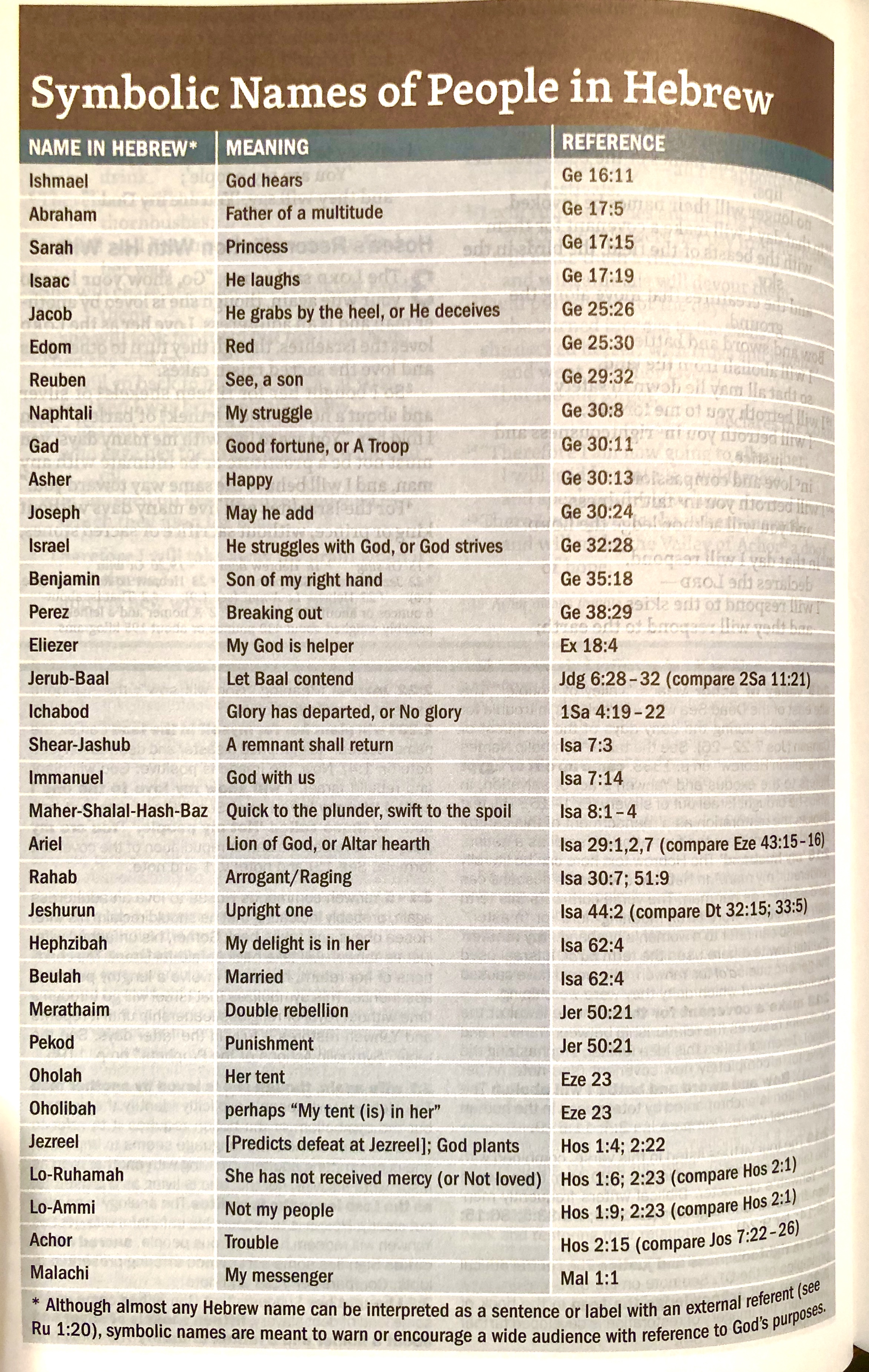
In studying for our ongoing series Major Lessons From Minor Prophets, I came across this chart in my Faithlife Illustrated Study Bible. This isn’t an exhaustive list by any means, but it is a good list to get you started on your own Bible study. 

I always find it fascinating when God names something, or instructs parents to name their children, or especially when a name gets changed. Many study Bibles contain a footnote by these names to give you the Hebrew or Greek definition, so don’t breeze by those too quickly! 

You can also find this list from the Faithlife Bible by clicking here. 

Happy studying! 

P.S. I also invite you to check out this name change which all of us can relate to!

Do More Better (book review)

We all have the same 168 hours in our week, but why does it seem like some people get so much more done in the same amount of time? No, there isn’t a secret formula, but Tim Challies does share some insightful principles that can help all of us Do More Better.

Tim’s approach is a spiritual one. He wants us to be more productive and effective not so we can receive accolades, but so that God is glorified in our lives. If a Christian is disorganized or unproductive, a watching world can’t see God as clearly. But a thoughtful, purposeful, productive Christian gets others’ attention and points them to God’s glory. 

Tim begins by helping us understand what productivity is and isn’t. From that foundation, he guides us through how to look at our lives in all its different roles, and then shares tools and techniques for doing more better in every area of our lives. Along the way, Tim shares both some online tools and some paper-and-pen tools that can be used to help us keep our productivity humming along. 

This isn’t a long book nor a difficult book to process. In fact, you will be able to start making steps toward greater productivity right from chapter one! If you want to do more better—and glorify God in the process—check out Do More Better.

Check out some bonus resources that go along with this book by clicking here.

Names Of God In The Old Testament

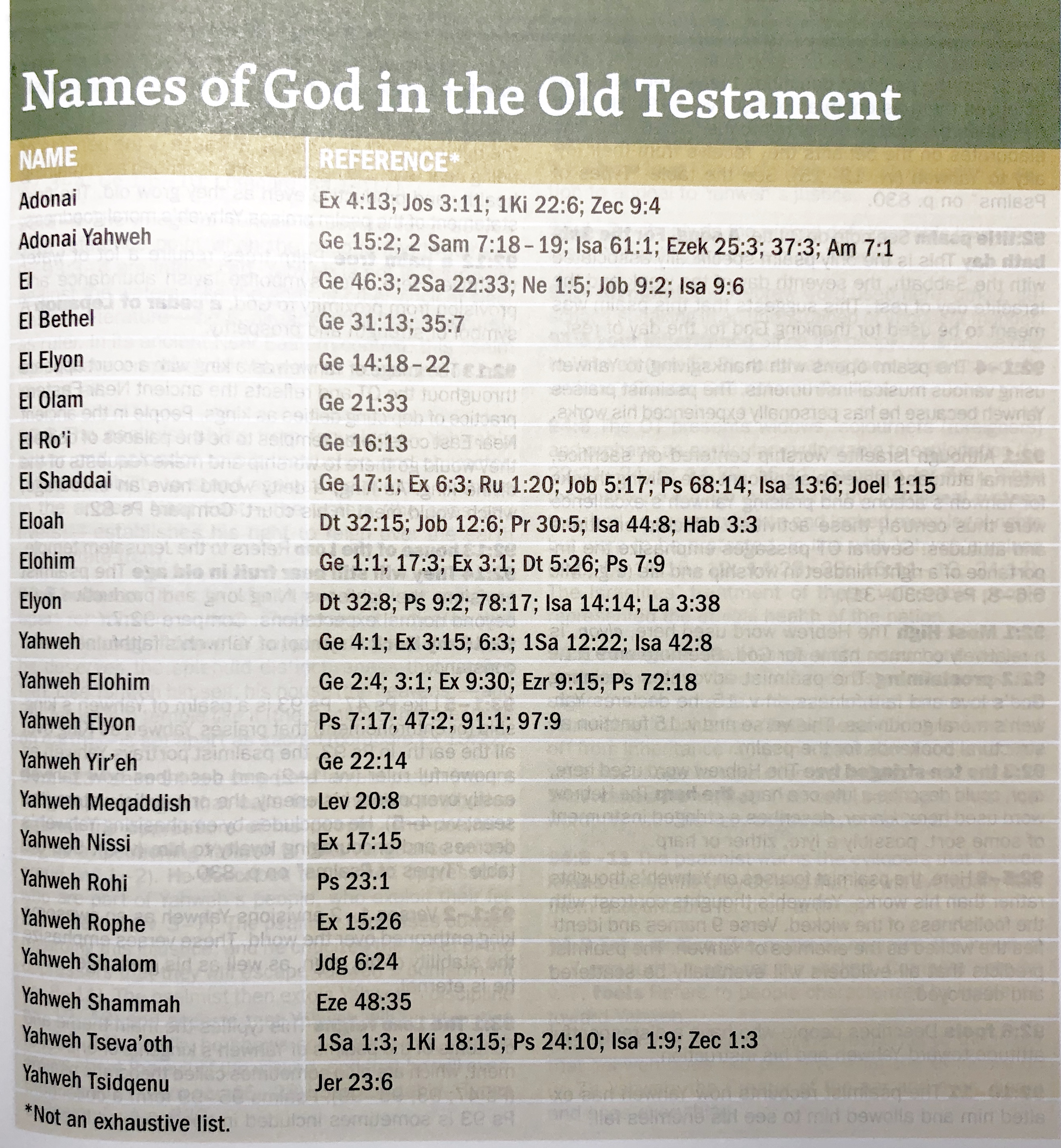
I love my Faithlife Illustrated Study Bible! I found this gem while reading in the Psalms.

יהוה (yhwh)

The name יהוה (yhwh) is known as the Tetragrammaton, and was probably pronounced as Yahweh. In the Old Testament, it is the proper name of God and is the most common term used to refer to Him (e.g., Gen 4:1). Exodus 3:13–15 connects this name with the verb הָיָה (hayah) “to be”; in this passage, God uses two related names for Himself that are not used elsewhere in the Bible: אֶהְיֶה אֲשֶׁר אֶהְיֶה (ehyeh asher ehyeh, “I am who I am”) and the abbreviated אֶהְיֶה (ehyeh, “I am”), and declares that יהוה (yhwh) is His name. By the time that the Septuagint version of the Torah was translated in the third century bc, Jews avoided pronouncing the Tetragrammaton to avoid committing blasphemy; in reading the Scriptures, the name אֲדֹנָי (adonay, “Lord”) was substituted, and the Septuagint translated this with the Greek word κύριος (kyrios, “Lord”). In English translations of the Bible, יהוה (yhwh) is usually represented as “the Lord,” using capital or small-capital letters to distinguish it from “Lord” as a translation for other Hebrew words. The English representation of this name as “Jehovah” is based on a misunderstanding of a scribal convention that combined the consonants of יהוה (yhwh) with the vowels of אֲדֹנָי(adonay) to remind the reader to pronounce Adonai in place of the Tetragrammaton.

For further details, see these articles: YHWH; Tetragrammaton; Tetragrammaton in the New Testament; Jehovah; I Am Who I Am.

Compound names with יהוה (yhwh)

Sometimes the name יהוה (yhwh) was combined with other terms characterizing God to produce a compound name. The most important of these is יְהוָה צְבָאוֹת (yhwh tseva’oth, “YHWH of Hosts”; e.g., 1 Sam 1:11), which expresses God’s position as the leader of the armies of heaven. Some compound names involving יהוה (yhwh) are translated in the King James Version or in other English translations using the erroneous representation “Jehovah.”

For further details, see these articles: Lord of Hosts; Jehovah-Jireh; Jehovah-Tsidkenu; Jehovah-Nissi.

אֱלֹהִים (elohim) and Related Words

Hebrew אֱלֹהִים (elohim) is by far the most common member of a small group of Hebrew and Aramaic words used to refer to God and other deities. This word is plural in form, but is most often used with singular meaning as a name for the one God of Israel; in this meaning, it occurs with singular verbs (e.g., Gen 1:1). It can also be used with plural meaning to refer to deities of polytheistic belief; in this case, any verbs and adjectives that go with it are plural (e.g., Deut 13:13).

The other words in this family also refer either to the one God or to a polytheistic deity. These are Hebrew אֵל (el, “god”; e.g., Num 12:13; Deut 32:12), Hebrew אֱלוֹהַּ (eloha, “god”; e.g., Job 11:7; Dan 11:38), and Aramaic אֱלָהּ (elah, “god”; e.g., Ezra 6:3; Dan 6:7).

For further details, see these articles: Elohim; Eloah.

Compound Names with El

Hebrew El (“God”) sometimes occurs with other terms in compound names for God. These compound names differ from one another in several ways. For example, the name אֵל שַׁדַּי (el shadday) combines El with the word שַׁדַּי (shadday), which also occurs by itself as a name for God—often translated “Almighty.” The compound name El Shaddai is not frequent, but does occur in several passages (e.g., Gen 17:1; Ezek 10:5). By contrast, the name אֵל רֳאִי (el ro’iy) “God of seeing, God who sees me” occurs only in Gen 16:13, and רֳאִי (ro’iy) does not occur independently as a name of God.

For further details, see these articles: El Roi; El Elohe Israel; El Shaddai; El Elyon.

אָדוֹן (adon) and אֲדֹנָי (adonay)

The Hebrew word אָדוֹן (adon, “master, lord”) is not specifically a divine title. It can be used of humans, indicating a person who has authority (e.g., Judg 19:11; Gen 45:8). It is sometimes used to describe God, emphasizing His authority (e.g., Josh 3:13).

The divine title אֲדֹנָי (adonay) is related to אָדוֹן (adon) and is used only of God (e.g., Psa 2:4). Its form is very close to and may be derived from אֲדֹנַי (adonay, “my lords”), which is simply the plural of אָדוֹן(adon) followed by a first-person singular suffix (e.g., Gen 19:2); but it has a short a vowel in the suffix while the divine title אֲדֹנָי (adonay) has a long a vowel. The divine title may have originated as a respectful title used to address God (e.g., Exod 4:10), using a plural form to express extra respect. However, in the Old Testament it is used not merely to address God, but also to talk about Him (e.g., 2 Kgs 7:6).

For further details, see this article: Adonai.

שַׁדַּי (shadday)

The origin of the name שַׁדַּי (shadday) is uncertain, but it is used as a title for God, especially in the book of Job (e.g., Job 13:3). Its original meaning is debated, but it is often translated “Almighty.” It is sometimes combined with אֵל (el, “god”) in the compound name אֵל שַׁדַּי (el shadday) (e.g., Gen 17:1), but more often occurs alone.

For further details, see these articles: Shaddai; El Shaddai.

עֶלְיוֹן (elyon)

The word עֶלְיוֹן (elyon) means “high, highest”; as a title for God, it is commonly translated “Most High.” It most often occurs alone (e.g., Psa 91:1), but also occurs in compounds with other names of God, including El(e.g., Gen 14:18–22), YHWH (e.g., Psa 7:17), and Elohim (e.g., Psa 57:2).

For further details, see this article: El Elyon.

Other Names

A variety of other names and titles are used for God. A few examples include צוּר (tsur, “Rock”; e.g., Isa 17:10), רֹעֵה (ro’eh) (“Shepherd“; e.g., Gen 49:24), and בּוֹרֵא (bore’, “Creator”; e.g., Isa 40:28). In Psalm 68:4, the Masoretic Text refers to him as “Rider through the Desert”; this is sometimes taken to be a modification of an expression “Rider on the Clouds” which was applied to Ba’al in Ugaritic. In Hosea 2:16, God declares that Israel will no longer call Him בַּעֲלִי (ba’aliy) “my master, my Ba’al” but will instead call him אִישִׁי (ishiy, “my husband”); these names are not used elsewhere in the Old Testament.

Please check out my review of the Faithlife Illustrated Study Bible and pick up a copy for yourself.

Truth Is The Source Of Freedom

“The university has traditionally been a unified place (Latin unum) where faculty and students gather in order to discover truth (Latin veritas). A generation ago, college was expected to be a place of freedom, particularly for expression of and engagement with different—even disagreeable—ideas. Sadly, recent events and numerous statistical surveys reveal that such days may be over. Today, many on university campuses expect to be protected or shielded from speech and ideas that could be deemed offensive, even if the free speech rights of others—as well as the pursuit of truth—are sacrificed in the process.

“The current climate, in which people are forcibly prevented from sharing ideas, has arisen because the Culture of Confusion has mistaken autonomy for freedom. In a post-truth culture, where preferences and opinions are elevated over facts and truth, anything that challenges our preferences, even if a challenge is laced with facts, is deemed offensive and oppressive. The Western contemporary concept of freedom is all about the ability to do, feel, and say whatever one wants, as long as it doesn’t hurt someone else. But this isn’t freedom—it’s autonomy (which literally means being a law unto one’s self). Freedom operates at its best within the confines of truth. The pursuit of autonomy is the root of the post-truth mindset that fuels the current Culture of Confusion. If each of our personal preferences is celebrated without truth as our guide, if we are all ‘laws unto ourselves,’ confusion is inevitable in at least three important ways.

“First, the culture seems to have lost its ability to reason—to think and act clearly and wisely. When feelings are vaunted over facts in the quest for autonomy, reason dies in the process. If the facts get in the way of unrestrained autonomy, then the facts will have to be ignored and any opposition will be silenced.

“Second, the Culture of Confusion has lost its moral accountability. If it’s true that ‘man is the measure of all things,’ as Protagoras proclaimed centuries ago, then we make the rules, not God. If there is no God to help us, then we have to help ourselves. There are atheists who claim that the ‘better angels of our nature’ will result in us reaching a rough agreement about moral values. But history has shown us that it’s only a short leap from secular humanism to self-worship and supreme authority. Moral clarity shows us the objective truth beyond our preferences. And we have to mold our desires and preferences to the truth’s boundaries. Because we don’t want to conform, moral clarity has become the vice of the day, and moral confusion the virtue.

“Third, in striving to go from bearing the Imago Dei (with accountability to God) to Deus Homo (with accountability to no one), we have lost what it means to be human and to value other human beings. When we become the measure of all things, then we determine which humans are valuable and which ones are not, meaning our sense of objective human value is lost in the process.

“There is a fundamental difference between limitless individual autonomy and true freedom. The Bible opposes the former and champions the latter (James 1:25; 2:12). The book of Judges demonstrates this well. Each time the people’s thirst for autonomy landed them in trouble, God sent a judge—a person who took his authority from God—to guide the people. But they rejected God’s authority time and again in favor of their personal sovereignty until the resultant chaos became too much. When we jettison truth as our guide, we will end up with autonomy and then chaos, but not freedom. Each one of us, individually in our hearts, needs to search for the source of freedom—truth.” —Abdu Murray, Saving Truth